FANTASICAL AND REALITY WRITING

Facebook – General – and Chandler’s Ford Today

My CFT post this week looks at how “fantastic” and “reality” writing feed off each other. No matter how fantastic the world setting, there still have to be elements about it and the characters that readers can identify with. So there has to be some system of government, some rulers and some ruled, some system of food gathering etc etc to help make the story itself believable.

In a well written fantasy story, these elements are hardly noticeable. They are what I call the necessary background structure to make the whole story work. Not only that, literature would be much the poorer without fantasy stories. It would also be much the poorer without good quality non-fiction. And that’s the way it should be.

This slideshow requires JavaScript.

What slogan would sum up your writing style? I think mine would be something like “quirky, sometimes twisted, and often humorous”. Before anyone says that sums ME up quite well, I know!!

Questions never to ask a writer (unless you want to run the risk of having something thrown at you) include:-

1. How IS the writing going? (We want to give you chapter and verse, literally. You want a quick one line answer. No winners here).

2. But editing is the easy bit, surely? After all, you’ve got the writing done. Tidying it up a bit can’t take long, can it?

3. Have you given up the day job yet? (Is there any way of answering this politely and still remain friends with whoever dared ask this? Answers on a postcard….).

4. You don’t mind if I borrow your book from the library, do you? (Actually, no. We want to support the libraries. However, we would prefer it if you bought the book – bills to pay and all that).

5. It can’t take you long to write flash fiction/short stories/novellas (delete as appropriate) as they’re all much shorter than a novel. That’s where the hard work is, isn’t it?

(Many thanks to all who sent in wonderful comments on my Facebook page and to those pages where I shared this.  Glad to know I’m not alone on this topic!).


Delighted to say I will be a guest speaker at the Hampshire Writers’ Society meeting at the University of Winchester next Tuesday, 9th October. It will be nice to be back at Winchester again as I’m normally there for the Winchester Writers’ Festival and it is a long time until next June when it is on again!

I’ll be speaking about flash fiction (and why I think every writer should try it).

(I know I put up this post last time but can’t resist doing so again!  Am looking forward to next Tuesday’s event.  Am nervous and excited about it all at the same time!).
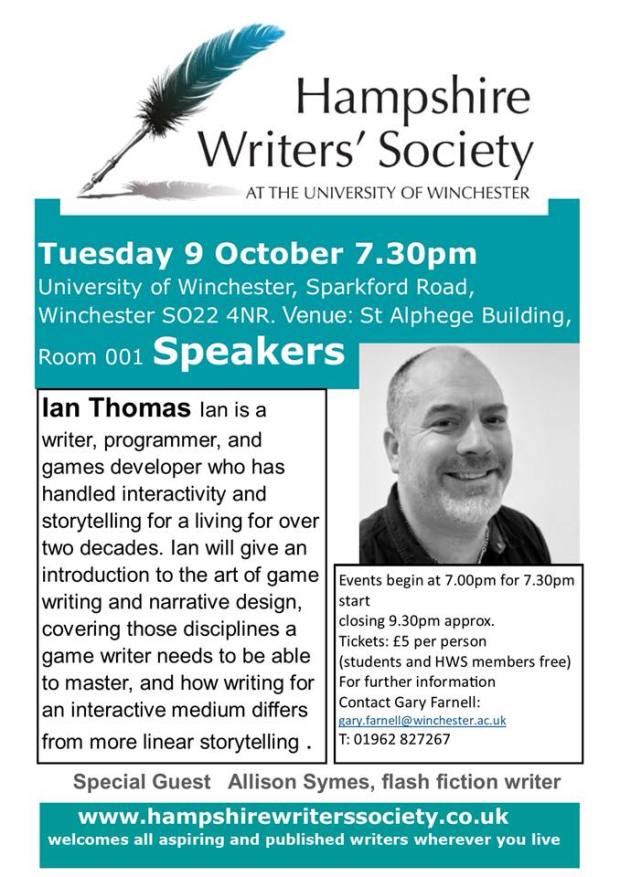
POSTER SHOWING ALLISON AS GUEST SPEAKER AT HWS OCTOBER 2018

Many thanks to Maggie Farran for the poster

Facebook – From Light to Dark and Back Again

Flash fiction writing has taught me so much about editing, but it has also shown me the joy of choosing the right word to make maximum impact. I’ve found that spills over into other writing I do (especially my Chandler’s Ford Today posts), which is no bad thing.

We all know we should put work aside for a bit before coming back to re-read it with fresh eyes but I have found that doing so means you also look at a story and think “I could have expressed that better”. I then go on and do so!

It is true your best ideas and expressions sometimes have to be “teased” out of you. But the great thing is that the more writing you do, the more you’ll be ready for the “well actually this works better than what I had done originally” moment and won’t think twice about changing something.

The latter I think can be a confidence thing sometimes. You do have to have confidence in your own writing ability but also to trust the process – that as you work, better thoughts will come, all of which will help you improve your story and increase its chances of being published.

This slideshow requires JavaScript.

It’s important to mix up the moods in a flash fiction collection. I love volumes of stories to dip into as and when I fancy and what I like to find are tales for all occasions. I will always have a very soft spot for the humorous tale but a well written tragic flash story will move me in a way a funny one can’t (and perhaps shouldn’t).

Also given flash fiction has to be character led, and characters all face different challenges, it is not unreasonable to portray said characters in very different moods, which will also affect how you write their stories.

Even in a book which is meant to be sombre, there can be different shades of sombreness in the tales within it. You don’t want to come across in a monotone style. Nor is levity appropriate but I want to see Character A handling a bad situation in this way, Character B reacting differently etc. I will then be intrigued by what makes A and B tick.

As well as mixing the moods of my stories for a flash fiction collection, I like to vary the word counts I use. The majority will be at about the 100 word mark as it is my favourite and the one I seem to gravitate to, but I like to ensure there are some 250, 500 and 750 word stories in there too. For the book I’m currently writing I am also including one line stories.

I love flash fiction collections (not just mine, honestly!), because of their variety. There are wonderful collections out there based on a specific type of flash fiction (usually the 100 or 140 word stories). There are collections with a mixture of length of stories, like mine, but focussed on one theme.

When you’ve not got as much time for reading as you’d like, these books are perfect to dip into. If you like your books electronically, I think flash fiction is wonderful for that. So very easy to read on a screen. And easy to slip into a stocking for that well known festival coming up in December….! (Get the word in early, that’s what I say!!).

Goodreads Author Programme – Blog – The TBR Pile

Confession time. I have a large TBR pile in paperbacks AND on the Kindle. There really isn’t enough time in the day, though it is nice to know I won’t be running out of good reading material any time soon.

Does that mean I won’t want any books bought for me for Christmas or book tokens/cards? Don’t be silly, of course I will!

Okay, I may need to figure out a way of making sure my TBR pile (paperbacks) doesn’t topple over and crush someone (probably me). Or that my Kindle doesn’t explode with the effort of containing all those ebooks for me. But I’ll manage those!

The lovely thing about being a reader and a writer is you’re never stuck for gift ideas, whether you’re dropping hints to your nearest and dearest, or buying for other readers and writers.

As for my TBR pile, back to reducing it a bit at a time (before I inevitably top it up again!).

This slideshow requires JavaScript.

Fairytales with Bite – A Good Fairytale…

A good fairytale should have:-

1.  Believable characters (no matter how magical they are.  There should be something about them that resonates with a reader, which is why magic is NOT the be all and end all situation to your characters’ problems.  There should be things for them to work out without magic.  There should be things about their character which engage the reader so if the old fairy godmother turns up and does work magic for them, your readers are going to be pleased for them rather than see it as a plot device to get your character out of trouble!).

2.  Emotional impact.  Whether this is where your reader ends up screaming at your character to stop being so stupid or laughs with them or cheers when they get their happy ever after, as long as there is some emotional impact, your story is “getting through”.  People will want to read more.

3.  Justice will out somehow.  This is true most of the time.  Stories where the villains win always make me feel uncomfortable.  It just doesn’t seem right.  This is why I love the cliffhanger ending in The Italian Job with Michael Caine.  Even where the villain does seem to get away with it, I like to see some hint that in the future their success may come back to haunt them or they would have done even better had they acted better.  I suppose one reason why I like to see justice of some sort being done is because in life, it so often isn’t like that.  One appeal of stories overall is that they can reflect life as it should be at times – the underdog does win out, wrongs are put right etc etc.  (The other thought here is that perhaps the villain does have cause so are they so much of a villain after all?  Food for thought here I think).

This World and Others – Things You Need to Know about World Building

This is definitely not a comprehensive guide but I list below some useful pointers for you to consider when building your fictional world.

1.  Identifiable Elements
There has to be something about the world you create your readers will identify with, no matter how fantastical the setting.  Worlds have to be governed.  How is that done?  Every living creature needs to eat so how do the characters in your world do this and what is their food?  How are their societies organised?  (There must be some sort of organisation – could anyone survive sustained anarchy?).  These things are what I like to refer to as necessary background structure.  They may not be the main point of your stories but you need to know this information so you can write with confidence about your setting (it is a character in many ways) and that confidence will come through in your writing to your reader.

2.  How things change
A living world adapts and changes due to new technologies, diseases forcing change on society, wars changing the political landscape and so on.  Again these things may not be the main point of your stories but there should be a sense of your world changing and developing as your characters do within it.  It gives the sense that your world really is a live one and therefore infinitely more believable.

3.  Roles
What are the major roles in your world?  How are genders dealt with (and is there any difference in the roles each play?).  What happens to those who won’t accept the roles they’ve been assigned?  (There is always at least one who does this and some fantastic stories emerge from that).

It would pay to outline your thoughts on these three points before committing to major writing (especially if it’s a novel you’ve got in mind).  Work things out early.  It will save you a lot of time later on.  Good luck!


Word Play

Facebook – General – and Chandler’s Ford Today

One joy of writing is the joy of reading. This is partly because it makes sense to read from (and therefore support) the industry you want to join! Also, you need to read widely to discover the range of writing out there and to find out from that what it is you want to write. There’s also the sheer pleasure of reading well crafted stories that inspire you to work harder on your own!

Playing with Words, as my CFT post this week discusses, is both a fun and invaluable thing for writers to do.  My post this week also pays tribute to Denis Norden and celebrates puns and playing with language.


This slideshow requires JavaScript.

I like to “hit the ground running” when I write flash fiction and do so in a number of ways.

I can take you straight into the lead character’s thoughts, or show you an image of them doing or reacting to something. I also try to show you their general attitude within the first couple of lines. Attitude in itself can tell you so much about what a character is likely to be like (and whether you would like them or not!).

I can also show you a character’s observations such as in my Circle of Life. That opens with “People throw kittens in the river here. I hate that.” Immediately shows a conflict. Immediately shows an attitude at odds with the view held by others around the character. You also know they’re going to do something about it. It is a question of what and will they get away with it?

With all of these different kinds of opening, I am aiming to provoke curiosity in the reader to make them want to find out more.

My CFT post this week looks at Playing With Words. I also pay tribute to the late Denis Norden, who along with Frank Muir, was a wonderful wordsmith. Link up on Friday. I also take a look at puns. (Muir was wonderful on Call My Bluff years ago and Norden – well, I loved his dry wit and manner – and Take It From Here, written by them both, was a forerunner for modern radio comedy).

Two of my favourite ways to end a flash fiction story are a twist in the tale finish or a punchline. Both of course can revolve around puns. I love playing with language but one of the great joys of loving books is coming across others who are masters at this sort of thing. Their work is a joy to read and/or listen to and if you haven’t come across a copy of Muir and Norden’s My Word Ultimate Collection, do yourself a favour and dig out a copy from somewhere. If you like tall tales and puns, as I do, this is a fabulous book.

Facebook – From Light to Dark and Back Again

Flash fiction can be a great vehicle for (a) puns (as part of a punchline to finish with) and (b) short, sharp humorous moments. A good funny flash fiction will not only make you laugh but you should be able to spot other potential for humour had the story been a longer one.

The lovely thing is you can combine humour with other things such as poetic justice to create a great story. Characters being annoyed at the situation they’re in may well make you smile in recognition of their predicament. The situation is rarely funny for the characters themselves. Shouldn’t stop us smiling though!

My late mum always believed in being short and to the point. Think she’d be pleased I take the same approach by writing flash fiction!

You lose any fear of killing adverbs or cutting whatever isn’t necessary for your story when you write flash and, of course, you can carry that over into whatever other writing you do. There’s no chance of getting confused over your characters either given, realistically, you only have the room for 1, maybe 2, main people.

I admit I do miss the fact you can’t have subplots in flash fiction, that really is the privilege of a short story or a novel, but I do love being able to cut to the chase with the very short tale. Definitely a case of you pays your money, you take your choice here.

Time for some autumnal flash fiction one-liners, I think. Hope you enjoy.

1. There were some things brought down by the autumn winds that would have been best left undisturbed.

2. The mouse scoffed the loaf that was meant for the church’s Harvest Festival display, much to the vicar’s chagrin.

(A case of For what we have received, we are truly grateful, I think!).

3. Would the leaves come down deeply enough to cover a body, she wondered?

4. With the nights drawing in, there was more scope for planning and executing the perfect crime.

5. It would be easy enough to do, he thought, given she always has soup at lunchtime on these cold days.

Hmm…. it looks like I’m in a criminal frame of mind this evening!


Is it harder to write longer fiction where you have to keep the readers enchanted enough with your writing to follow the story through to the end or more difficult to write short, sharp stories?

I wouldn’t like to judge on that one as both have their challenges and their joys. Both are vital for ensuring literature has a wide range of styles and lengths of story to suit all tastes.

One problem I face when editing flash fiction is ensuring I keep the important details in as it can be easy to cut far too much out to keep to a set word count and the story is the poorer for it. In those situations, I let the story go what is its natural length whether it’s 50 words or 500 or 1500!

The acid test for me is the editing is done when I cannot add to the story or take away from it. It is a question of not overegging the pudding or cutting back so harshly you have a limited story left. Anything that dilutes the impact of the story on a reader, and that can include harsh editing, is out.

This slideshow requires JavaScript.

Goodreads Author Programme – Blog – Playing with Language

One of the joys of reading across a wide range of genres, including non-fiction, is discovering the different ways authors play with language.

For me the late Denis Norden and Frank Muir were great exponents of this and one of my favourite paperbacks is their My Word The Ultimate Collection. This is full of puns and tall tales galore! Bliss and an addictive read.

I like crisp, punchy styles of writing but every so often you come across a line or two that are just so engrossing, they almost take your breath away. P.G. Wodehouse was a master at creating worlds within what would be considered now very long sentences, but you simply have to read to the end.

I suppose the real test of a good story is does it provoke your curiosity enough so you read it through regardless of the style or genre in which it was written?

Fairytales with Bite – Fairytales A to Z Part 8

Since the alphabet doesn’t divide neatly into three, I will conclude this mini series tonight with the final five letters – V through to Z.  Hmm… going to have fun here I think!

V = Variation
Whatever genre you write in, there should be variation in the types of character you portray.  A story with all heroes is no story at all!  There has to be a villain somewhere (even if the characters concerned don’t think they’re villainous at all).  Also, in a magical setting, there should be variation in how much magical ability characters have.  If they all have unlimited powers, where is the conflict? You’d have a stalemate situation.  The characters know they can’t better each other, at least not with their powers.  So vary things, mix things up, deliberately drop your characters in it, and see what happens!  This is very much the fun side of writing.  You will soon find out who your strong characters are.

W = World
The world you set your stories in can almost be a character in itself.  It needs to be believable, no matter how fantastical its powers or setting.  There must be things about that world we can identify with here.  For example, every world has to be governed somehow so politics has to rear its (at times) very ugly head.

X = Xeno (meaning strange!  Confession time: did have to look it up.  I could have gone for X-rated for this but felt it was too obvious.  I also want to remember this word next time I play Scrabble!).
So word of the week for me is this one then!  Seriously, though, no matter how strange the world you’ve created is, there still has to be something about it that fascinates a reader.  If it is too odd, you risk alienating the reader.  Does that mean your world has to be a sensible one?  Not necessarily.  There has to be a point to what the world does.  If it mines balloons for example, it would make sense to do that if is that world’s chief export to its nearest neighbour.  I did like Monsters Inc for showing why the monsters had to get the children’s screams (they needed it as it was their power source) and I liked it even more when the monster world discovered making the children laugh was a greater source of power.

Y = You
The first fan of your writing should be you.  Your fairytale, whoever it is aimed at, must first convince you.  Is the magic a vital part of the story?  It should be for a fairytale. Do your characters have to get themselves out of trouble without magic?  Even better!  You should enjoy what you write and at the same time be open to where it can be improved.  Not an easy balance to strike which is why it is such a good idea to put work aside for a while and then re-read it.  You will come back to the story with a more open mind, having had the break from it.

Z = Zippy
There will be many in the UK especially who will remember Zippy as a character from children’s TV show, Rainbow!  However for this, I mean zippy in terms of lively.  Your fairytale should be a lively read from start to finish.  Your characters should be lively and engage with your reader.  (This is why if you enjoy your writing, there is every chance others will too.  As for the feeling after reading something you’ve written “this is rubbish”, bear in mind every writer goes through that.  This is another reason for putting work away for a while before coming back to it).

This slideshow requires JavaScript.

This World and Others – Playing with Words

Playing with Words is not just the title of my latest CFT post but the theme for this week for me.  I also take a look at this topic on my latest Goodreads blog.

So how do I like to play with words then?

1.   I like twist endings to a lot of my stories so there is a lot of playing with words to be had there in coming up with a twist that works.

2.    I sometimes end stories with a punchline which often revolves around a pun.  Puns are the very definition of playing with language!

3.     I like to take known phrases and play with them to come up with something that has “echoes” but which is also unique to my story.  For example, we usually talk about punishing the guilty for crime etc but my story in From Light to Dark and Back Again is deliberately called Punish the Innocent.  The idea is to get you wondering (a) why would someone want to punish the innocent, (b) do they do so, (c) were the innocent that guiltless after all?

I sometimes use spider diagrams to help me work out in which directions I could take a story idea and then I pick the one that I like the best.  Playing with words here helps me come up with thoughts deeper than my initial “obvious” ideas and therefore I hope a more original story line.


STORIES, STEREOTYPES, TRICKS AND UNICORNS

Be fair, that is quite a mix, isn’t it?!  I share links to three new stories of mine on Cafelit this week as well and discuss them in my Facebook posts throughout the week too.  Hope you like the stories.  I loved writing them.

Facebook – General – and Chandler’s Ford Today

Busy night tonight. My latest CFT post is live and looks at favourite views, literal and metaphorical. I also discuss how to develop “the writer’s eye”.

This slideshow requires JavaScript.

Facebook – From Light to Dark and Back Again

Delighted to have three new stories due to appear on Cafelit over the next few days. Will share links as and when. But back to the idea of using the same word to start the sentences of a flash piece with. My word for tonight is Restless and I will ‘fess up and admit I have given this one more thought though I did like the environmental theme that came through with Habitat.

RESTLESS
‘Restless, you are, Wilma, that’s what you are – always have been, always will be.
‘Restless, surely not, I just can’t get comfortable, that’s all’.
‘Restless, I said, and restless I meant.’
‘Restless, that’s the last thing I should be in here, George; I always thought I’d have peace HERE.’
‘Restless spirit, restless grave – I did think I’d have a break from your fidgeting when I joined you in here!’

ENDS.

Allison Symes – 18th September 2018

Hope you enjoy.

I do enjoy reading and writing flash stories told from the viewpoint of a minor character looking at the “main action”. Tonight’s story on Cafelit by me, The Balcony Seen, takes this approach. I don’t even name the character in this one. What matters is showing you what they observed and what they felt.

As ever, with flash, it is vital to focus on sharing what the reader needs to know. It is likely you will need to know a lot more before you put pen to paper or write directly to screen but that is what outlines are for. Outlines are fun to write. The difficult bit can be selecting what it is the reader DOES need to know and leaving out all those lovely pieces of information that are good to know but not crucial to the story. What is crucial for you as writer to know isn’t necessarily the same as what the reader needs to know!

This slideshow requires JavaScript.

I love writing throw away lines in a story which tell you something about the character and move the tale on. In my Leaving Home (on Cafelit tonight), there is an example of this. But the crucial thing is it moves the story on. Anything that doesn’t is cut. And that’s the way it should be!


Facebook – Publication News – Cafelit

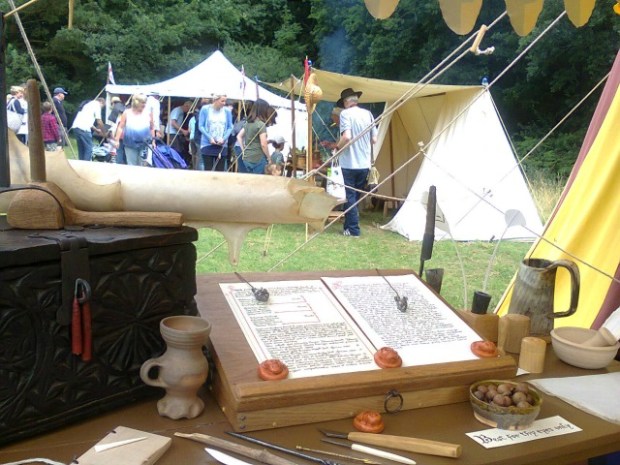
The first of my three stories appearing on Cafelit is The Balcony Seen (I make no apologies for the pun!). This story is based on an exercise set by Simon Hall as part of his A-Z of Novel Writing at this year’s Swanwick Writers’ Summer School. Hope you enjoy. Most of the images below were taken by me at a Hampshire Medieval Fair a year or two ago and shows the scrivener’s wares and his accommodation, which was good by the standards of the time.

Woodland Walk - image via Pixabay

A beautiful woodland walk. Pixabay image

The tools of the medieval writer's trade

The medieval scrivener’s wares. Image by Allison Symes

The Scribe's (Scrivener's) Tent

The Scrivener’s tent. Image by Allison Symes

The scribe had good accommodation

The scrivener had good accommodation compared to most! Image by Allison Symes

As promised, story number two from me on Cafelit this week is now live. Leaving Home shows that the problems of kids pinching parents’ transport is nothing new (or necessarily confined to this world!). Hope you enjoy.

This slideshow requires JavaScript.

As promised, the third of my three Cafelit stories is now on site. Dignity and Injustice looks at the death of Anne Boleyn from a very different perspective. Hope you enjoy.


Another view of the Tower of London - image via Pixabay

The Tower. Pixabay image.

The Tower of London as night falls - image via Pixabay

The Tower at night. Pixabay image.

Fairytales with Bite – Fairytales A to Z Part 7

Marching on towards the end of the alphabet then, this post looks at letters S, T and U.

S = Stereotypes.
It could be argued fairytales have a lot of stereotypes in them.  The Big Bad Wolf represents villainy and indeed the saying has passed into the language.  We say someone is known to be “a big, bad wolf”.  The downtrodden types that have their lives turned around for the better are known as Cinderella types.  I think what any fairytale writer should do is use the tropes wisely but not be confined by them.  What does your Cinderella type do to try to help herself/himself out of the situation that they’re in?  Maybe it is that which attracts the attention of the fairy godmother to help them in the first place.  Stereotypes can also be spoofed or reversed as in the Shrek series.  So use stereotypes, they can be a useful shorthand, but put your own stamp on the characters you are creating so they are clearly “their own people”.

T = Tricks
It is fine to use stereotypes to create shorthands for your characters, who should then still go on to be characters that are uniquely your creation, and other writing techniques to improve what you do, but those should be the only “tricks” played in your stories.  Indeed they shouldn’t even show!  Your stories should read “naturally” with nothing drawn to the reader’s attention any “artificial devices” have been used in the making of that story.  As for tricks played by characters on others, there should be ground rules set out early on in your story as to magical capabilities so readers know that character A could be reasonably expected to play such a trick on character B.

U = Unicorns (and other mythical beasts)
Use sparingly if at all!  For me a story is all about the characters. Unless you are writing a story from the viewpoint of the unicorn or other strange creature, there seems to be little use for these, other than as transport, possibly, or to set the scene for how your world works and looks.

This World and Others – Story Moods

I’m pleased to say I have three new flash stories on Cafelit.  I share the link to my author page here.

The Balcony Seen started life as an exercise at Swanwick Writers’ Summer School this year.  Leaving Home and Dignity and Injustice are new to me in that they share a common character.  But these stories remind me of one of the reasons I really love flash fiction.  They all vary in mood and it is easy to switch from one mood to another and back again.

I also think really short stories can carry the most impact at times.  Yes, there are exceptions (the sadness of Hamlet goes beyond saying) but I generally find the shorter the story the more powerful the reaction.  I suppose part of the reason for that is there is no room to dilute that impact with sub-plots etc.  In a novel, you would need those sub-plots to give a proper ebb and flow to the overall story and avoid having a monotone.  No need to worry about that for flash fiction!

Anyway, hope you enjoy these.

Goodreads Author Programme Blog – Opening Lines

What is it about an opening line that makes you want to read on?

For me, that opening line has to intrigue me, show me something of the fictional world to come, or show me something about the lead character. The very best opening lines combine at least two of these.

I’m thinking especially of Orwell’s 1984 “It was a bright, cold day in April and the clocks were striking thirteen.”. I’m immediately intrigued by the thirteen and I want to know about what kind of world it could be to have clocks capable of doing this. The opening line has definitely fulfilled its role there!

The challenge then for the writer is to make sure that everything which follows lives up to the promise of that opening line and delivers on it! And some people think writing is easy…hmm… I learned a long time ago that when someone makes something look easy, that same someone has almost certainly worked their socks off for years to get to that point.

So what are your favourite lines and why?

I also love the opening to Jane Austen’s Pride and Prejudice and Dickens’s A Tale of Two Cities. Very different in style but they intrigue and set the tone for what is to come.

Happy reading, and writing!


Writing Tips

Facebook – and Chandler’s Ford Today

One of the problems I had in writing this week’s CFT post about Writing Tips was picking the those tips that have not only BEEN useful but mostly still ARE and then whittling those down to what I think are the most useful.

One of the great things about going to conferences etc is picking up all sorts of useful advice on the way. Some tips you’ll use immediately, others you will come back to later and I’ll often find, even in advice for say scriptwriting, there are often general pointers useful in other forms of writing. So I’ve learned then it pays to pay attention!

This slideshow requires JavaScript.

Other than your PC or laptop, what is the most useful thing on your desk?

For me it is the humble notebook and pen (I count these as one item given they’re not that great without each other!).

I don’t always want to stop what I’m working on in Scrivener to open up a new folder to jot down the latest good idea I’ve had (well I hope it will be a good one!).

But a quick note with paper and pen and I can open up a new file and start researching when I’m ready to do so. I’ve long thought pen and paper really should come into the writing process somewhere, it seems right somehow, and that is despite my writing to screen most of the time.

These days odd notes here and there are generally what I use “old technology” for. And neither the notebook or pen need batteries, charging, discharging, or are at the mercies of power cuts etc etc…. Still I’m not sorry I no longer have to literally cut and paste or have to change typewriter ribbons or faff about with carbon paper…

My CFT post this week will be a a round up of writing tips I have found useful over the years (and still do). Hope it will prove useful. Link to go up on Friday.

One great thing about going to conferences like Swanwick Writers’ Summer School and the Winchester Writers’ Festival is you do get to pick up so many useful hints and tips, some of which are not always useful immediately, but you will come back to them later. And they come not just from the courses but when you get together with fellow writers over tea, coffee, dinner etc. So added reason to (a) go to good conferences and (b) get chatting with your fellow writers.

Like we needed an excuse or something…

Facebook – From Light to Dark and Back Again

More six-word stories for you. They should conjure up images and you can see a definite start, middle, and end.

1. The lion ran straight at you.
2. The dentist will see you now.

(Own up, which one scares you the most out of those two? The one that is just about possible or the one where you know you WILLhear those words at some point?!).

3. The fairy godmother trashed her wand.
4. Prince Charming wed an ugly sister.

(Probably as a direct result of story line 3 here!).

5. What was this world, she mused.
6. It really is hell in here.

Hope you enjoy!

Not a new topic I know, but one that is always pertinent: can I put the word out about reviews being really appreciated by authors? The obvious places are Amazon and Goodreads but links to other places so authors can share good reviews on their websites etc are also welcome.

Doesn’t have to be a long review either. I liked or loathed Book X because….. is fine. The crucial point is the review has to be an honest one so if you dislike a book, say why. With my consumer hat on, I do read reviews when I do my online food shop or am buying books myself and I like to see a variety of reviews. I am always suspicious of anything getting ALL 5 or 1 star reviews. I do read the positive and negative reviews and then make my own mind up! But the author is still helped as review numbers make a big difference, especially with Amazon.

Oh and don’t forget reviews are just as welcome for ebooks as they are for paperbacks.

Where do you find your inspiration? I find mine from films, odd sayings I’ve overheard or had said directly to me (so do watch what you tell me incidentally!), proverbs, advertising slogans, the classic fairytales, timeless themes such as love and revenge (and sometimes love and revenge together!), etc etc. The key to being inspired is keeping your mind open to the fact that ideas can be found all around you. It is then up to you to develop that initial spark further.

My Learning the Trade is inspired by the Sorcerer’s Apprentice and naturally my character blames the boss for basically not having an “undo” spell to hand! The Haunting is inspired by the Ladykillers (and if you ever get the chance to see the stage show of this, do. It’s fab in its own right though nothing will top the Ealing comedy with Alec Guinness).

Getting that initial idea is fabulous but what I really love is taking that and seeing what I can do with it. I like to have fun with my words and writing should be fun, most of the time anyway.

Fairytales with Bite – Fairytale A to Z Part 6

On to the next section tonight then and I get to do one of the difficult letters – Q!

P = Princes/Princesses are often the heroes/heroines in fairytales of course but I love the heroines that prove themselves every bit as capable and intelligent as any hero (and are often better!  Think Fiona in the Shrek series basically!). I also like those stories where the characters here have to prove themselves worthy of their calling – i.e.  it doesn’t just all fall into their laps because they are royal.  A character who has to work for something, regardless of their background, is a character that will face conflict, dilemmas, enemies, and will make mistakes and basically give the reader lots of lovely action and drama to follow – and they will.

Q = Questions.  Not such a tricky letter to find an answer for here though as I write this I don’t know yet what I will be coming up with for X!  All characters should ask questions and make your readers question them.  The situations you put your characters in should test them (and make them query whether they are doing the right thing or not – internal conflicts like this add depth to your stories and make your characters seem more real.  We all have internal conflicts to deal with so why shouldn’t fictional characters do too?).  Your readers should be engrossed with what your characters do and their attitudes and perhaps question themselves as to whether they’d act that way or not.  A reader that is asking questions like that is one who is engaged with your characters and stories.  You want lots of those!

R = Reading.  It goes without saying we need to read widely to know what it is we like and what we would like to write as a result.  But what would your characters read and how can you use that to show something of their personality?  What are their world’s myths and legends?

This World and Others – World Building Tips

Whether you write flash fiction or novels (or both!), world building tips should prove useful.  With my flash fiction, when I write in the fantasy genre, I just give enough details to confirm it is a magical setting for my story.  With my novel, I’ve got room to share more but things to consider when creating your world for your characters should include:-

  1. How your characters eat and drink (and what!).  Is the society a hunter-gatherer one? Meat eaters or vegetarians?
  2. How sanitation is dealt with.  If your characters are eating and drinking, they will need to excrete!  Okay this may not be a crucial part of your story, but there should be a general sense of how characters keep clean, and how disease is avoided (or not) due to good sanitation measures (or in the case of not due to the lack of them!).
  3. How their society is organised.  Is it class based?
  4. What their society expects of them especially if it is class based.  What happens to anyone defying expectations?
  5. Is their world a developed or developing one?
  6. If magical, are there limits to what people can do with their powers?  How is anarchy or dictatorship prevented (assuming it is!)?

Food for thought there I hope.

This slideshow requires JavaScript.


The Best and the Worst

Facebook – General – and Chandler’s Ford Today

My CFT post this week looks at some of the best (and worst!) decisions I’ve made in writing! I also share some thoughts on where to get good advice. Hope this proves helpful.

The writing journey is precisely that – and there are bound to be things like potholes, wrong turnings etc along the way. Doesn’t mean your particular journey has to come to a grinding halt though. I’ve found offen things that were not great at the time, I’ve (a) learned from that experience and (b) gone on to do much better.

What is your favourite one liner?

Mine is an Eric Morecambe classic – “He’s not going to sell much ice cream going at that speed, is he?”. Surreal and very, very funny. (Oh and correct too – nobody sells ice cream at speed!)

In fiction, I love Jane Austen’s, “It is a truth universally acknowledged that a single man in possession of a good fortune must be in want of a wife”. Delicious irony here and a great foretaste of what is to come from Pride and Prejudice.

I don’t know how often Eddie Braben wrote and rewrote that line for Eric Morecambe or how often Jane Austen wrote and rewrote her classic opener – but definitely worth the effort in both cases!

On a sadder note, I was sorry to hear of the death of Jacqueline Pearce (Servalan from Blake’s 7 – great acting and a fantastic character to play).

My CFT post this week will be about The Best and The Worst. I take a look at some of the best and worst decisions I’ve made as a writer. (There will be tears before bedtime… mine!). Link will go up on Friday but what I hope will come from this will be a few thoughts on where to go for advice and not being afraid to say no to something that is not good for you or your writing. You’ve got to to see yourself as being in this for the long haul – the VERY long haul!

It was interesting trying to work out what I considered the best and worst decisions I’ve made (to date at least) when it comes to writing/publishing.

You can see my list on my Chandler’s Ford Today post this week (I’ll put up the link tomorrow). It took me a while to figure these out and even then when it comes to the worst decisions, something positive has come out of those. So, overall, that is okay!

As with so much in life, you can only make the best decision you can at the time, but I found out early on it DOES pay to be as informed as possible. This is why bodies like the Society of Authors and Alliance of Independent Authors are vital.

This slideshow requires JavaScript.

Facebook – From Light to Dark and Back Again

Time for some six-word stories then:-

1. While the light lasted, danger abated.

2. “Help me”, he screamed to silence.

3. When the going gets tough, tough!

4. The planet destroyer was wheeled out.

5. So near to the Sun now.

6. I never forget a face, sunshine.

I thought it would be appropriate to have six of those!


What are the most important points any flash fiction writer needs to bear in mind?

1. The story has to be character led – and that character has to grab the reader’s interest from the very first words. (No waffling here!).

2. The story’s ending must be appropriate for the tale and be a satisfactory conclusion. Doesn’t mean it has to be happy though!

3. The opening line, in any form of writing, is crucial to hook interest but in flash fiction, where there is no such thing as spare word count, that line must grab your reader immediately. (Does your opening line make you think YOU would want to read this story if it had been written by someone else?).

4. Use the title to set the scene or mood of the story for you. (This is particularly useful for those competitions where the title is NOT included in the word count permitted. Do make the most of that).

5. Whether you’re writing a character study, a crime story, or writing for laughs, each word must contribute to the tale. There must be no wasted words.

6. Have fun with your stories. I love the fact flash fiction has to be character led. It gives you so much scope.

The cat sat on the mat
(Waiting for the postie)
All ready to surprise
While feeling all toastie.
Why should the household dog
Have all the games and fun
The cat, ready to roar,
And see postie was “done”
Would be Number 1 pet
With a prank, the best yet.
Postie duly obliged
With screams to wake the dead
No-one had told him the “cat”
Was a lion instead.

Allison Symes – 6th September 2018

If my regular postman reads this, I’ve only got a pet dog, okay!

Each flash fiction story is its own little world, of course, but the flash of illumination (in terms of what drives a character to act the way they do) can be taken and developed further for longer stories.

I don’t do this as often as I once thought I might because I’m generally moving on to the next idea, the one after that etc., but I have managed to write flash pieces and then get standard length short stories out of the same idea. Double whammy! Different markets and competitions are available to you too doing this. Something to consider…

What I am doing with the book I’m currently working on is having a few flash pieces with the same characters in, showing different aspects to what is happening with them. Am really enjoying that.


This slideshow requires JavaScript.

Goodreads Author Blog – Favourite Moments

Some of my favourite moments in a book come when a character has to face up to something they would never anticipate and find a way of dealing with it.

For example, my favourite Agatha Christie novel is Murder on the Orient Express, because Poirot has to deal with a situation he would not have guessed at and which in many ways should never have been able to happen. The David Suchet TV adaptation particularly plays on this element. (Not going to say more than that – no spoilers here! But if you’ve not read the book and/or watched the TV adaptation, try and do so. It really is a great story).

This element works especially well with a series character like Poirot when you have already come to know a lot about how they operate and think. To have that all thrown up in the air keeps the character and you, the reader, on your toes. Always a good thing, I think.

It confirms to me that what makes a really good story is the strength of the character, whether they’re a hero or a villain. Plots are fine but you need well rounded characters to carry them out!

Fairytales with Bite – Fairytale A to Z Part 5

M = Myth/Mythology. 
So many of the classic fairytales are based on old legends and myths.  The Brothers Grimm collected German ones. Hans Christen Andersen also collected (and embellished!) and of course went on to write superb tales of his own.  So look into your country’s myths and legends.  Look at the themes emerging from those and write your own fairytales around that.  I do wish people wouldn’t just dismiss something as “just a fairytale”.  There’s no “just” about a fairytale.  There is so much truth in them – and that should be reflected in our own stories too.  Honest writing = characters that grip people because they can identify with them.

N = Numpties
I love this Scottish word for idiot.  And fairytales do need their idiots (especially if they themselves don’t think they’re idiots or realise they are). There is great comic potential here for one thing. The Emperor’s New Clothes is a great example of a numpty in power!  Even the rich and powerful can be taken in by clever conmen.  One of the things I love about Puss in Boots is the miller’s son knows and accepts the cat is cleverer than he is!

O = Origins
This ties in with M above.  Look at the origins of fairytales.  Think about the origins of your characters.  What made you want to write about them?  How do their origins impact on their lives and the stories you are going to write about them?

This World and Others – The Best and the Worst

It is appropriate to come full circle on this tonight!

Following on from my Reflections post last week, I’ve been busily reflecting too this week!  My CFT post looks at The Best and the Worst decisions I’ve made with regard to writing/publishing and I hope this will prove useful.  A faulty step or two does not derail the whole writing journey and I think sometimes that needs to be said out loud.

What would be the best and worst decisions that your characters have made, especially your lead ones?  Do they learn from their mistakes?  How do they handle the fallout?

Often with decisions, it is a question of making the best judgement possible based on available knowledge at the time.  Sometimes the best decisions come as a result of taking time out to take stock and reflect (that word again!), and/or seeking advice from others.  Do your characters do this?  If so, what is the impact on them and your story?


Reflections

Facebook – General – and Chandler’s Ford Today

My latest CFT post is an alliterative one! As Autumn Approaches is a reflective look at the season, I share some thoughts about how the season is for writers.

I also discuss the importance of taking time out to look back, as my church has recently done for its 200th anniversary, but equally how vital it is to move on from periods of reflection, given what stays static dies eventually.

This slideshow requires JavaScript.

My CFT post this week is a reflective one on autumn. I share what I like about it, why it is an interesting season for writers, and also discuss my church’s recent exhibition to celebrate its 200th anniversary where we took stock of our history and recalled friends past, present, and no longer with us. Oral storytelling and local history are so important.

Facebook – General – and Association of Christian Writers’ More than Writers – The Highs and the Lows

Many thanks to all who commented on my More Than Writers blog earlier. You really can’t underestimate how much persistence, determination, and ability to work hard you will need as a writer. The great comfort is ups and downs are a normal part of the writing life so you’re definitely not alone here.

The Highs and the Lows – Allison Symes

What would you say were the writing highs? 

Your first piece of writing (aka “the I did it” moment!)?

Your first publication credit (the “family start to take you seriously” moment!)?

Your first book acceptance (the “some of the rest of the world start to take you seriously” moment!)?  Sadly, it always is some of the rest of the world…

What would you say were your writing lows? 

That first rejection?
Having your novel come back for the umpteenth time?
Countless short stories turned down?

The great irony, of course, is, with the right spirit and attitude, a writer can use those rejections and set backs to (a) fill them with determination to keep going, (b) to improve on what they do so the turn downs don’t arrive so often as they once did, and (c) recognise all writers go through this.

There are no shortcuts to publication.  Also, even when published, the learning curve goes on and you have to be open to it.  The writer that doesn’t learn is the one who remains static.  What is static dies, eventually.

So then it is a question of relishing the highs and getting through the lows, which is where the support of understanding writing friends is crucial.  One of the things I love about social media is the fact it makes it easier to stay in contact with said writing friends, especially when you can only meet up face to face once or twice a year.Writing forums such as the one we have on the ACW website are also useful for this kind of contact (and for sharing helpful advice and tips too).  Going to a good writing conference is invaluable too given that for most of the year we are at our desks, working alone.

Peter, of course, literally had his mountain top experience but his low was clearly his denial of Christ.  (What I love about Peter’s story is his redemption – it offers hope for us all).  So this pattern of highs and lows then is a reflection of life as it is lived and not just the writing life.

Our characters must have their highs and lows.  Without them, there is no conflict yet alone a story.  The highs and lows are not just the story events but what is in those characters.  No villain should be all evil (there must be a decent reason for them acting the way they are, decent to them at least).  No hero should be a goody two shoes.  Much as I loved Little Women by Louisa May Alcott, I found it easier to identify with Amy or Jo rather than the saintly Beth.  Identifying with your characters is the goal.  The moment a reader does that, the more likely it is they will read on and find out what happens.

Show the flaws.  Show the vulnerabilities.  Show the things the character does well.  Enjoy the process.  And good luck.

Facebook – From Light to Dark and Back Again

Don’t forget if you subscribe to Writing Magazine, you can put your book on their Subscribers’ Showcase. It’s free for a while but after that you pay a small amount per month to have it on there. My own plans later, once hopefully I have more books out, is to switch which ones I put up there to keep things fresh.

n a novel, you would have the space for different moods. Moods in the story itself. Moods of the characters. In flash fiction, you have to focus on one mood (and often on one character). But the advantage of putting a collection together is over the space of the entire book, you can have a range of moods and therefore of stories.

This was one aspect of putting From Light to Dark and Back Again together that I really enjoyed. Themes and moods became apparent and it was so easy to group these together.

Time for some more one-line stories, though one I admit is also useful wildlife advice!

1. The dragon, determined not to be fobbed off with false gold coinage, destroyed the Royal Mint with two blasts of flame.

2. Glass slippers, how the hell did that happen, thought the fairy godmother as she hung up her wand in disgust.

3. The quick brown fox jumped over the lazy dog only to find the canine could bite in places no male animal would ever wish bitten.

4. When the red, red robin comes bob bob bobbing along, it’s looking for food in the winter months, not the chance to be the star of a song.

5. The girl in the red hooded coat took one look at the Big Bad Wolf in her granny’s bed and said, “That gingham really doesn’t suit you, try silk next time.”

Any story, no matter what its length, should create an impact on a reader, whether it is to make them laugh or cry. I concede though No. 3 will probably make a few of you wince!

Goodreads Author Programme – Blog Where Do You Turn First?

So you have limited time to read (it is ever so!) and you can choose between reading one hardback, one paperback, or pick one option from your Kindle? Which would you automatically plump for over the others?

I’d go for the paperback every time (partly because while I have some hardbacks, my paperback collection is far greater). There is still the element of the “go for the real book” here, much as I love the Kindle.

Where the Kindle does come into its own is when I’m away anywhere and the last thing I want to do is lug a lot of books along with me (unless they’re by me and I’m trying to sell them of course!).

The other reason I’d go for the paperback first is I’d want the experience of the “whole book”. You can’t smell a Kindle’s “pages” but you can do it with a paper book – and I have and will continue to do so.

I do like the smell of a book. I like the look of a well designed cover. I like the feel of a paperback in my hands. So there is the whole tactile experience going on here.

I do know I’m not the only reader/writer to feel that way so if I’m weird, I know I’ve got company. Very well read company, I should add!

So what would you pick then and why? Comments welcome.

Fairytales with Bite Fairytales A to Z Part 4

J = Jealousy.  Such a powerful emotion and an excellent trait to exploit in your characters given it is understandable as a motivation for action. People do strange things, motivated by this, in real life.  Your characters can do so too in fiction.  You don’t have to like jealousy as a trait or the character to be able to identify with where the character is coming from here.  It can also act as a kind of shorthand.  If you say someone is the jealous type, it conjures up an immediate image of what that person is likely to be like, doesn’t it?

K = Killer Instinct.  Do your characters have this?  Do you?!  Firstly your characters, particularly your villains, need this (and often in the literal sense), but even the “goodies” need this to keep them going in the face of opposition etc.  They need to know when to “go” for a course of action and it will be their instinct here that will ignite the spark which drives them on.  As for you as a writer, do you have the killer instinct when it comes to editing your work?  Will you take out anything that is really not working (and be open to the idea it isn’t)?  You need to learn to be ruthless about taking out anything that is not pushing your story on.  The “kill your darlings” expression has a lot of truth behind it.

L = Learning and Laughter.  Do your characters learn from their mistakes?  A good story and great characters will have that as a major factor.  Some of my favourite series novels have shown the lead character developing over time and I love that.  It makes the character far more real to me.  As for laughter, even in darker stories, there can be room for this.  In the classic fairytales, for me, the Emperor’s New Clothes is a great example of laughing at those who supposedly are superior but are taken in by conmen (and you do have to hand it to those tailors for sheer nerve).  So where can laughter fit into your stories?

This World and Others Reflections

Reflection is a major theme of my latest Chandler’s Ford Today post called As Autumn Approaches.  (Well, this is true for the UK and Europe anyway!).

What would make your characters reflect on their actions to date/their attitudes to life?  Being made to confront the consequences of what you are doing would be one major reason to take time out to reflect, especially if there was time to reverse matters or limit any damage done.  Love, as they say, changes everything and can be a major influence in making people change their behaviour (usually for the better, but this isn’t always the case).

Sometimes a character will take time out to reflect before heading out on their adventure/quest etc.  What is interesting here is how that period of reflection influences what the character then does.  If your characters do this, how do they reflect?  On their own or do they have a mentor?  Do they look up books (especially history) to find out how others in their world’s past handled certain situations?  If the characters themselves will be setting a precedent, are there general guidelines to give them pointers as to what they should be doing?

Last but not least, are the characters themselves willing to learn from the reflections of others?


UNWINDING YOUR CHARACTERS AND GOOD WRITING CONFERENCES

Facebook – and Chandler’s Ford Today

I always enjoy writing my CFT posts but tonight’s one, The Benefits of a Good Writing Conference, was particularly nice to do.

There are several pictures from the recent #Swanwick70 in there and many thanks to #GeoffParkes for kind permission to use some of the many fantastic pics he took. My favourite from the ones I’ve used is that of me reading from From Light to Dark and Back Again at the Prose Open Mic but I admit freely I am not exactly unbiased here!

Looking forward to #Swanwick71 already.

This slideshow requires JavaScript.

Facebook – From Light to Dark and Back Again

Another fantastic element to writing flash fiction is that you can literally write stories set in a fanastic setting and then come right back down to earth again with a setting in the every day.

You can have alien characters (and I do!) and poignant character studies. One of my favourites from the latter category is They Don’t Understand which shows in a couple of hundred words or so the lives of two elderly people as one reflects on what they both went through during the war years and beyond.

What I’m looking to do here is have the right character for the impact I want to make on the reader and that will dictate both the mood of the story and often its setting as well.

Image Credit: Many thanks to #GeoffParkes for kind permission to use the image of me reading from From Light to Dark and Back Again at the Swanwick Writers’ Summer School Prose Open Mic night. Also all credit to him for the fantastic group photos celebrating #Swanwick70.

Also thanks to #CherylHolland for using my phone to take the wonderful group pic of friends and I having a laugh on the lawn at Swanwick. (It wasn’t the only laugh that week, far from it!!). Am I missing being at Swanwick? You bet..

Fairytales With Bite – Fairytale A to Z Part 3

On to part 3:-

G = Greatness.  Whether your character is a godmother (of the fairy variety), a villain, or a hero/heroine, there should be some greatness about them to make them memorable characters.  Greatness can be in the form of intelligence (the villain perhaps), moral integrity, actions undertaken etc.  There should be something about your characters that resonates with the readers (even if it is just understanding of where the villain is coming from in terms of attitude and behaviour while at the same time not agreeing with it).  There is greatness behind whatever resonates here.

H = Humour.  Humour is wonderful in a story.  It can provide moments of light relief.  It can show up attributes of a character that would not come out necessarily in any other way.  (Perhaps a character’s wit here could show a good grasp of irony that they might use in a different way later in the story to bamboozle their opponents?  Quick thinking and humour often go hand in hand and the former is usually vital for a character wanting to get out of a tight spot).

I = Imagination.  How imaginative are your characters in dealing with others, making their plots succeed, using others to achieve their ends etc?  Do they need to plan things out thoroughly or can they be intuitive?  How do they handle matters when things go wrong?  Can they use their imaginative skills to correct the situation?

This World and Others – Unwinding Your Characters

I find being in the company of writers from all genres, as I was when I was at the Swanwick Writers’ Summer School recently, to be a great way to unwind.  I talk about other benefits of good writing conferences in my latest CFT post – The Benefits of a Good Writing Conference

But this led me to wonder about how characters unwind.  When your characters are in the thick of the action, what favourite memories of special places and people help motivate them to keep going and get through it all?  I always loved the Rivendell sequences in The Lord of the Rings.  (This for me is where the films were particularly fantastic, being able to visualise Rivendell like that). Just ahead of the quest, Frodo particularly needed that time there.  So what do your characters need to prepare them for whatever hell you are going to put them through (all in the name of entertaining fiction of course!)?

Knowing what really makes your characters tick will enable you, as the writer, to know what will spur them on, what will discourage them, what is the right way to motivate them etc.  A really well written villain in your stories will do exactly the same and tweak the strings of your lead like an evil puppetmaster.  Result?  A villain worthy of your hero/heroine.  Drama.  Conflict.  Story, story, story!  What’s not to like about that?


COMING BACK TO EARTH

Just returned from the Swanwick Writers’ Summer School, after a fabulous week of excellent courses and getting to catch up with writer friends, with whom, for the rest of the year, I stay in contact with via social media.  Lovely as that is, you can’t beat getting together face to face!

So tonight’s post is all on the theme of coming back to earth and I also look at Books That Should Have Been Written as a lighthearted CFT post.  There is nothing anywhere that says you HAVE to come back to earth with a bump or several!

Facebook – General – and Chandler’s Ford Today

My CFT post this week is called Books That Should Have Been Written and, if you like puns, this is definitely for you!  I also take a peek at irony.

Back from a wonderful week at #Swanwick70. The highlight of my writing year is the week at the Swanwick Writers’ Summer School. Why?

I meet up with writer friends that for the rest of the year, I keep in contact with by social media. I make new friends. I learn loads from the courses, which is never a bad thing. Oh and I sold a few books in the Book Room too!

Back down to earth then but with perhaps a more gentle bump! My CFT post this week is a lighthearted one called Books That Should Have Been Written. Contributions welcome in the CFT comments box!

This slideshow requires JavaScript.

Facebook – From Light to Dark and Back Again

Had a lovely time at #Swanwick70. Really enjoyed reading three of my 100-word stories from From Light to Dark and Back Again at the Prose Open Mic hosted by #JenniferCWilson. Flash fiction works really well at these things (as indeed does poetry – I missed the Poetry Open MIc night as it clashed with the Literary Quiz and I do love a good quiz but I hope all who took part in the Open Mic slots had a fab time).

Images of Swanwick were taken by me at last year’s event. Such a lovely place to be!

Fairytales with Bite – A toZ of Fairytales Part 2

So on to the second part of this series…

D = Determination.  The best fairytale characters I know have this trait in buckets (other suitably large utensils are available, as they say…!).  They can vary from determination not to be ground down (Cinderella) to determination to survive (Hansel and Gretel).  Determination can keep a character going when the world and its dog/unicorn/dragon seem to be out to “get them”.  Determination separates the wolf (big, bad or otherwise) from the sheep.

E = Energy. Can be topped up by determination but your characters are going to need plenty of energy to get them through whatever frightful horrors you’re putting them through.  Not only are there the obvious physical needs to think about, but bring in how your characters top up their mental strength.  They will need plenty of that too.

F = Fairies/Fantastic Creatures.  The great irony with fairytales is you can have them without fairies in (Little Red Riding Hood), but when you do use them in your stories, give them plenty to do and ensure not everything is solved with a wave of the magic wand.  Your fairy character still has to work for/struggle to get success, even if that is only implied in your story.  A wave of the wand may be what they do to remedy a situation or modify it (Sleeping Beauty) but there should still be issues for the characters in your story to overcome.    Otherwise there is no conflict and without that, the story vanishes.  Fantastic creatures can vary from animals to other magical beings (including your own invented ones) but we still need to have some sense of what they are like and where they fit in to the world you’ve created.

More next time…

This slideshow requires JavaScript.

This World and Others – Coming Back to Earth

Coming Back to Earthis the title of my latest Goodreads blog (where I do suggest a cure!).  I wrote a lighthearted post for CFT this week, Books That Should Have Been Written,partly as a “gentle” way of coming back to earth after my return from the Swanwick Writers’ Summer School.

But how do your characters come back to earth?  They’ve experienced perhaps great adventures, now there’s a lull in the action as they come to terms with what they’ve just gone through.  How do they handle that?  I love The Lord of the Rings  for many reasons but the portrayal of Frodo becoming more and more tired as the stress of what he has to do becomes more and more of a burden is realistically shown.  On the assumption your characters are not super heroes who never get tired or out of sorts, how do your characters handle setbacks, tiredness, illness etc?

How do they pick themselves up from “earth” to get back to their “mission”?  Who helps them and how?  Plenty to think about there!

Goodreads Blog – Coming Back to Earth

Have just got back from my annual highlight – the Swanwick Writers’ Summer School.

Had a wonderful time discussing and learning about all things connected to the worlds of books and stories. What’s not to like about that?

But, as ever with these things, you come back home again and you feel shattered and a bit flat. (You take in far more than you know you are when you are there and then I think the physical/mental tiredness of that hits you later).

So what can help you perk up again?

Why, nothing but a good book of course!

And the lovely thing about being a writer? You need to read widely, in and out of genre, to help feed your own imagination in any case, but you also get to write the books and with a lot of hard work, and some luck, get them out there.

So happy reading and writing!


Getting Away From It All and the Fairytale A to Z (Part 1!)

Facebook – General – and Chandler’s Ford Today

My latest CFT post is Getting Away From It All. Appropriate as I am about to swan off to Swanwick! I share some thoughts on the importance of relaxing and how just writing something for the sheer fun of it can be a marvellous way to unwind for writers.

The great thing too is you can always work the piece up “properly” later on and submit it but to just write something for fun is wonderful. Possibly something we don’t do enough of? I’ve found doing this useful (a) to take a break from my main writing work and (b) to remind myself during tough patches just what it is I really love about writing – the creativity of it. I think you can lose sight of that at times.

This slideshow requires JavaScript.

Facebook – From Light to Dark and Back Again

More on the ABC of Flash Fiction…

D = Drive. Not only do you need that as the writer, but your characters do as well. Something has to happen in your narrative for it to be a story at all so your characters must be ready to “act” and for that to wrap up quickly. They must be ready to “hit the ground running”. They do something, there is a reaction, there is a conclusion (and of course it doesn’t necessarily have to be a happy one).

E = Entertainment. Whatever your genre, your flash fiction should entertain (even if that entertainment is simply to make your reader think about the theme of your story and whether they would do the same as your character has). Every word has to make your reader want to read on, every line has to move the story on, and at the end you want your reader to feel as if they have had a good read, even if it is only in 500 words, 100 words, 75 words or what have you.

F = Fairytales. I’ve found flash fiction to be a good vehicle for fairytales (albeit of the short and sharp variety. Not necessarily sweet as well though. Many of my fairy characters do have a penchant for justice, the rough kind where they feel it is necessary at that!).


Association of Christian Writers – More than Writers – On Criticism

Confession time:  Am certain I didn’t put this up when I was supposed to so will share now.  It IS better late than never and I hope my post for July on On Criticism will prove helpful.

What good judging should be and that includes for reviews etc

What every review should be. Pixabay image,

Fairytales With Bite – the Fairytale A to Z Part 1

I love a list – whether it’s a numerical one or an A to Z format.  So for fairytales and the magical world, what would my A to Z be?  Part 1 then would be:-

A = Anthropomorphism 

Not my favourite word to spell, I must admit!  However, for me, a classic tale will have this as one of its elements.  Think Puss in Boots, Shrek, The Chronicles of Narnia etc etc.  What matters is the traits shown or speech given to an animal character to have/speak must make sense for the way that character has been portrayed.  We see Puss in Boots is a character who would be smarter than his master so the speech given to Puss must reflect that.

B = Beauty
One thing I love about fairytales is that beauty is in the eye of the beholder and is not always the classical definition either.  I love the stories of The Ugly Duckling and Beauty and the Beast. Is it just me but I didn’t think the Beast was that ugly incidentally (especially as Disney portrayed him?  Huge, yes, but that’s not the same thing!  That aside, there is a strong emphasis that it is a beautiful heart/character that matters most, which I fervently believe.  I can’t say what single thing makes me love fairytales but this is a very high contender for being the top one.

C = Characters
There isn’t one dull character in fairytales, is there, when you come to think about it.  There shouldn’t be in your stories either.  (And even when a character is meant to be “dull”, there still has to be something about them that will make your reader want to find out if they stay that way or change or if there is a point to the dullness.  Maybe the lead character needs a duller one’s sensible comments to point them in the right direction?).

More next time….

This World and Others – Getting Away From It All

Getting Away from it All is my title for this week’s Chandler’s Ford Today post and my latest Goodreads blog.

What do your characters do to unwind?  Where would they go to get away from it all?  If your fictional world has a hierarchy (and frankly most will have something), are there places where the “commoners” can’t go?  How is that enforced?

I am about to head off to the Swanwick Writers’ Summer School for a wonderful week of courses, catching up with writer friends, and making new ones.  A marvellous time is had by all.  For your longer stories, where would your characters go to catch up with friends and family they can’t see often (and how did that situation happen)?

In my Goodreads blog, I talk about my holiday reading.  What would your characters read?  Does your fictional world have a good literacy rate?  If not, is anything being done about it?  I’ve mentioned in previous posts that a totalitarian world will seek to restrict/ban books (as sadly is seen too often in this world!) but is there an underground system that bypasses/overcomes those restrictions?

Plenty of story ideas there!

This slideshow requires JavaScript.


A BUNCH OF AMATEURS, THE MAGIC OF THEATRE, AND NON-FICTION

Facebook – General – and Chandler’s Ford Today

It’s a joy to review the plays performed by The Chameleon Theatre Group as there is always a good mix of shows put on during the course of a year. I’ve watched pantos, tragedies, and comedies. Each review I do for CFT on these means having a look at the background of the play and/or the writers of it and I always learn something.

It’s a great way of taking in stories that are new to you: go and see them acted on stage!

A Bunch of Amateurs is written by Ian Hislop and Nick Newman.  The plot hinges on a local theatre company, the Stratford Players, desperately trying to save their theatre so bringing in a fading American star, Jefferson Steel, to get sponsorship and bring in the punters seems such a good idea….   You know the phrase “famous last words”?  Well, that applies here!

Image Credit:  All images below are kindly supplied by Lionel Elliott and the Chameleon Theatre Group and used with permission.  Many thanks to them.


This slideshow requires JavaScript.

Facebook – From Light to Dark and Back Again

I was watching a Dr Who episode tonight (Peter Capaldi) and a phrase “stories are where memories go” caught my attention. Mind, it many ways it should do!

What memories of a character could you turn into a flash fiction piece (or longer)? Can you write a story where a character is led astray by mistaken or deliberately falsified memories (and why would someone do that)? Have you got another character who uses memories as weapons against others and how do they do this? What do they gain? How are they stopped, assuming that they are?

There are some good stories to be written out of memories, that’s for sure! (And the great thing is you can create the memories to write about in first place. The lovely thing about fiction is it should be rooted in truth to ring true to your readers, but it doesn’t actually have to be true, otherwise we’d have little in the way of sci-fi or fantasy!).

This slideshow requires JavaScript.

Fairytales with Bite – The Magic of the Theatre

My latest CFT post is a review of A Bunch of Amateurs (written by Ian Hislop and Nick Newman), which was recently performed by the Chameleon Theatre Group.  It was a great play, brilliantly performed.  But it led me to thinking:-

1.  Going to the theatre is a great way of taking in stories!

2.  In your fictional world(s), how do your characters take in stories?  Do they read?  Do they have theatres/cinemas etc?  What would they watch/read?

3.  When you go to a performance like this, you go in knowing you are seeing a “pretence” but being willing to suspend disbelief.  You focus on wanting to see how the story ends and enjoy the performances taking you to that point.  The challenge for writers is hooking our readers quickly enough at the start of the story to achieve the same effect for the length of the tale, whether it is a flash piece or a trilogy of novels!  So face the challenge!  The key is in creating characters readers will want to follow through anything.

Happy writing!

This World and Others – Why Non-Fiction Matters to Fiction Writers

I’ve written about this in a post for Chandler’s Ford Today (Fiction -v- Non-Fiction? No Contest!) a while ago, but it is a topic close to my pen so thought I’d bring it up again here.  Why does reading non-fiction matter to fiction writers then?

1.  If you are writing material which means you need to world build, finding out how this world works/has worked/has made blunderingly colossial historical mistakes/created some fascinating engineering etc can directly inspire you for how your fictional world carries out these things.  (Sometimes it can be the direct opposite of how we’ve done it but you need to know how we did it first to be able to do that!).

2.  Ideas spark off other ideas and non-fiction is full of them.  What did make an inventor come up with their revolutionary new designs?  What made them come up with a new system for, say, transport when nobody else had realised a need for it?  There are ideas for characters here too…

3.  When anyone comes up with something new, there will be opposition.  Sometimes it’s justified, sometimes not.  How does your hero/heroine overcome that?  Or if they are the ones behind the opposition, do they achieve their objective?

Plenty of story triggers there!

This slideshow requires JavaScript.