Christmas Stories

Facebook – General – and Chandler’s Ford Today

My last CFT post before Christmas is all about Christmas stories. I look at the Nativity, Hogfather, and A Christmas Carol amongst others. I also discuss the role of books and stories. I hope you find many a book related present under your Christmas tree this year!

Also in the post are links to some of my Christmas related Cafelit stories. Hope you enjoy.

And however you celebrate the festivities, I do hope you have a lovely Christmas.

This slideshow requires JavaScript.

My last CFT post before Christmas looks at Christmas stories appropriately enough. I look at some of my favourites, share a few of my Cafelit pieces with a Christmas theme, and look at why we need stories. Link up tomorrow.

Hope there are plenty of books on your Christmas wish list and that you get them!

Very pleased to say my first non-fiction piece was published in Christian Writer today. It is a 500-word piece about the telling details which help bring stories to life (though there is no reason why this can’t apply to articles as well).

What is lovely about writing is the joy of being published never diminishes. Yes, the first time you hear someone else loves your work enough to print it or put it online is very special but so are the others that follow! It also encourages you to keep going.

Am working away on my novel plus what I plan to be my third flash fiction collection in due course. Would like to write more non-fiction too. Now if only there was a way to stretch time… Still there is no chance whatsoever of boredeom setting in and that has to be a good thing.

Facebook – From Light to Dark and Back Again

Flash fiction is the ideal vehicle for capturing those story thoughts that are illuminating in themselves but would not stretch to a standard length short story. I find this makes the focus sharper and sometimes for a tale that’s what you need. Short, sharp focus and then that’s it.

Flash fiction is also a great vehicle for showing the thoughts and actions of a character in detail. You are focusing on this one character alone. What drives them? What are they hoping to achieve? What do their thoughts and actions reveal about them? (The great thing here is the character does NOT have to be aware that they are showing themselves up as, say, greedy, when they think they’re not).

This slideshow requires JavaScript.

What is the important thing about any story? Figuring out what makes it work as a story and that is usually down to outstanding characterisation.

So how can you make characters count especially when you’ve got a limited word count as you have with flash fiction?

1. Show the character’s attitude. This can be done in thoughts, actions, or direct speech. Attitude reveals a lot about a character. A character that is sarcastic will show that in what they say without you needing to spell it out. In the case of actions, if we see a character setting something out “just so”, you can imply this character is fussy (and I’d want to know the reasons behind that). A character that moves a doily half a centimetre to the left is going to be far more fussy than someone who slaps said doily down on the arm of a chair!

2. Show how others react to the character. This can be very revealing. Do they all react in the same way or is there an awkward one who treats the lead character differently to everyone else? What are the reasons behind that? Is the awkward one justified in their stance?

3. Focus on the MOST important aspect of your character as that will determine how your story will go. If your character is stubborn, show how that plays out and the consequences (there will be some!).

Names are important of course and the more often they are used in a story, the more important the character is (even if they never appear in the tale itself).

My They Don’t Understand has my narrator refer to his wife, Joan, throughout. That will give some indication in itself of how important she is to him as well as what he actually tells you as the tale goes on. He only names his carer the once!

So how can you make names work for you in a story? Well, the name itself can give a good indication of the age of the person. How many people are called Gertrude these days? If the name can be abbreviated, IS it or does your character insist on the name being used in full? Equally are they known by one name in one situation and by something else in another? (Good potential for double life stories there).

Fairytales With Bite – Stories, Lovely Stories!

My Chandler’s Ford Today post talks about Christmas Stories (and I share some links to some of mine on this too).    One of the great things about this time of year, when the nights draw in so early, is that it is a fantastic time for reading more!

One of my highlights at Christmas is at the end of Christmas Day itself when I’ve put my feet up on the sofa and I’m curled up with a book given to me as a present.  It is very easy to please the writer in your life by the way – just ask them what books they’d like and Christmas present shopping problems are resolved!

So what stories do you hope to enjoy over the Christmas period?  I like a mix of fiction and non-fiction books plus, of course, there is the chance to enjoy stories as films.  (Watched The Muppet Christmas Carol earlier tonight, which is one of my favourites).

As for writing stories, I tend to take a short break over Christmas and then resume but I come back eager to write again and find the respite incredibly useful for recharging the imaginative batteries.

However you spend Christmas, do have a lovely time, and I hope you get to enjoy stories old and new!

This World and Others – What Defines a Good Story

What defines a good story for you?  What I look for in a good story includes:-

1.  Strong, memorable characters.
2.  An intriguing plot.
3.  The story makes me laugh, or think, or react in some way.  (That’s how you know a story has had impact).
4.  An ending that delivers on the promise of the opening lines.
5.  Where there is a twist ending, for this to genuinely take me by surprise.  I like to look back at a story and then spot the clues I missed first time around! (The great thing about doing that is you can learn so much from doing this and, of course, apply it to your own writing).
6.  It is a story you are keen to read again and again and again. A Christmas Carol is a classic example of this for me.
7.  It is a story you remember well.  This doesn’t stop you wanting to read it again because you will not recall all the details but you DO recall the pleasure this tale gave you and THAT is what you want to experience again.
8.  You can easily envisage the story being a film.  (This is a great test of how memorable the characters are and how strong the plot is).
9.  It is a story that adds something to the language.  Shakespeare takes top honours here.
10.  It is a story that defines its genre or expands it.  I’m thinking of Hans Christen Andersen here who added so many wonderful fairytales to that genre.

This slideshow requires JavaScript.

Christmas

I hope you have a wonderful Christmas and New Year.  My next post would usually be due on Tuesday but, surprise, surprise, not next week!  I will resume here on Friday, 28th December.  See you then!


Celebrations, Reading Work Out, and Framing Stories

A nice mixed bag tonight I think!

Facebook – General – and Chandler’s Ford Today

My CFT post this week is the review of the recent Bridge House event, Celebrations, Crackers, Chapeltown, and Cafelit, though I’m quite pleased I managed to come up with an alliterative title! I also look at how reading work out is useful to writers, as is listening to others reading their work out. For one thing, you literally hear a story’s rhythm and can apply that to your own stories.

Many thanks to Dawn Kentish Knox for kind permission to use some of the images in this piece. I’ve yet to find a way of reading work out and taking my own pictures of me doing this at the same time! (Oh and before you ask, I am really not keen on selfies!).

This slideshow requires JavaScript.

My CFT post this week will be a look back at the Bridge House celebration event held on 1st December. I’ll also share some thoughts on the benefits of reading work out loud and on being read to, both of which are lovely!

One of the nicest things about this time of year is that it is very much a time for stories, which is a theme I will be looking at for CFT before too long. Naturally, I love the Christian Nativity story but I also love those wonderful tales associated with it. For example, how did the robin get his red breast? By burning himself on a fire he was fanning to keep a fire going to keep the Holy Family warm.

I also like to have a general review of the year (and also a specific writing review. How did things go? Did I achieve all the goals I set myself? What goals would I like to set for 2019 etc?). So that’s my CFT posts sorted until the year end! Just have to finish writing them now…

One of the great joys of stories (both writing and reading them) is their escapism value, especially if the news is particularly grim. That shouldn’t be underrated.

Whether you read or write humour, horror, sci-fi, or what have you, a story, of whatever length, should transport you into its world. You should be happy to stay there for the duration too! That, ultimately, I think is the biggest challenge to a writer. But it’s a great challenge to have a crack at!

Facebook – From Light to Dark and Back Again

I like to choose themes which can be open ended. Love, for example, can obviously provide happy stories. It can also provide tragedies, something Shakespeare took good advantage of in Romeo and Juliet.

I’ve found that picking the theme I would like to use and then deciding on the mood of the story is so helpful in giving me a “frame” for my story. Then the title comes into play and again I try to choose one which is open, unless I specifically want to put a twist into the tale right at the beginning (my Punish the Innocent is a good example of that).

I find it useful to have my “frame” and then write. It helps me focus.

When drafting a story, what is the first thing you are keen to get right?

For me, it’s ensuring I know my character well enough to know how they would react/act regardless of what situation I drop them right in! (Dropping your characters right in it can be a great way of finding out just what they’re made of). I also like to know what would shake my character out of their sang-froid and what their general beliefs are. Naturally, there should then be something to challenge all of that!

I like to use things that inspire me as a source of story ideas. The great thing with this method is what inspires me and how I combine these to create a new tale will help my writer’s voice to come through. Nobody’s tastes and inspirations are exactly the same. The way these are combined will also differ from writer to writer. So list what your inspirations are. Think about how you can use these. At the very least, you should find some great themes emerging. Good luck!

Fairytales With Bite – Why Fairytales with Bite?

It occurs to me I should have written this post long ago but never mind!

I use the phrase “fairytales with bite” as a lot of my flash fiction work, in particular, is set in a fantasy world and I use a lot of irony. There really is a bite to a lot of what I write. I like quirky writing – my own and that of others! I also use twist endings a lot and there can be a great deal of bite behind those. I am, after all, looking to make an impact with my stories.

My catchphrase is also a reaction against those who think fairytales are twee. I know I’ve touched on this topic before, here and on other blogs I’m involved in, but fairytales can show up human nature for what it is and are anything but twee as a result. Think of all the tales where kindness is rewarded and/or greed is punished. What happens to the villains in lot of fairytales is anything but twee!

Of course, with the Big Bad Wolf, you could argue the fairytale with bite is literal here!

This slideshow requires JavaScript.

This World and Others – Reading Work Out Loud

This theme ties in with some thoughts I share on this as part of my Chandler’s Ford Today post this week called Celebrations, Crackers, Chapeltown, and Cafelit.  The latter is a look back at my publisher’s annual celebration event but one part of this is where some of the writers, including me, read some of our stories out to our audience.  Good fun whether you’re taking part or not, but for a writer it’s incredibly useful and here are some reasons why.

1.  You quickly realise if you stumble over words, so will your readers, so out comes the editing pen again.  Always better though that this happens before you submit the story anywhere.  By reading the work out to yourself before submission, this acts as another editing layer and can save your blushes!

2.  You literally hear the rhythm of the story.  There should be a natural ebb and flow to it.

3.  Especially if you write in a genre where you’re inventing names/place names etc, you can literally hear if what you’ve come up with is pronounceable!!  So no more Xxxrbtrzog (try saying that sober yet alone if you have had alcohol!) but something like Xerstone is “do-able” and still conveys to a reader they are in a setting NOT of this world.

4.  As you listen to someone else’s work, take note of what makes a real impact on you.  Is it the power of the dialogue?  Is the sentence structure hitting home well?  I usually find short, simple, and to the point works best.

5.  As you listen, watch out for where you are anticipating what comes next.  What MAKES you wonder what comes next?  Can you apply those thoughts to your own writing?

6.  We all love a story, it’s why we’re writers, and the oral tradition of storytelling is fantastic.  Without it we would have no stories at all so it is a joy to take part in and kind of “support it” ourselves.

Love your reading!


Crucial Characterisation and a Charity Cookbook

Facebook – General – and Chandler’s Ford Today

My latest CFT post shares news of a very special cookbook written by Barbara Large MBE. Barbara was the founder of the Winchester Writers’ Festival (as it is now known) and her book is raising funds for the Nick Jonas Ward at the Royal County Hospital, Winchester.

Barbara shares her thoughts on the joys and challenges of writing this book, as does Anne Wan, who through imprint North Oak Press, published the book. There is also a delicious recipe to try!


This slideshow requires JavaScript.

Shooting Star - Barbara and Anne 1

Barbara Large and Anne Wan at the launch of Anne’s book.  Image kindly supplied by Anne Wan

Anne Wan and Allison Symes at Bay Leaves Larder

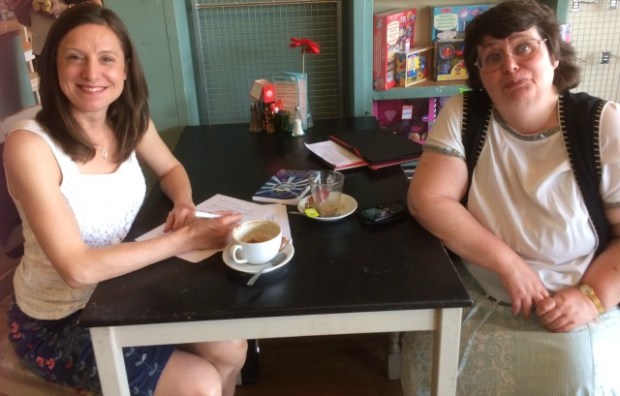
Anne Wan and I enjoying a cup of tea as I interview her for Chandler’s Ford Today a while ago.  Image taken on Anne’s phone by the cafe staff!

When Writing Magazine comes in, I flick through and see if I know anyone who has written in to the letters page or the Members’ News section. I’m glad to say there usually is someone I know in either section in most editions!

Going to writing courses, conferences etc., is the best way I know of for networking with other writers and connections build up over time. Though a week at Swanwick Writers’ Summer School speeds that process up a LOT!

Talking of connections, how do your characters build up their relationships with other characters? What kind of networking exists in the world you’ve created? Often it is a case of showing Character A has this relationship (of whatever nature) with Character B but can you hint at how it all kicked off? Is there a solid basis to how your characters interact with each other? There should be…!

This slideshow requires JavaScript.

My CFT post this week will share news of a charity cookbook called Scrumptious Recipes Shared with a Pampered Patient, written by Barbara Large, MBE, who founded the Winchester Writers’ Festival (formerly the Winchester Writing Conference). More details and the link on Friday.

I look forward to sharing thoughts on the recent Bridge House/Chapeltown/Cafelit celebrations the week after. As ever, can hardly believe how the year has raced by. Many thanks to Dawn Kentish Knox for the pic of me reading some of my more recent stories from Cafelit and also from From Light to Dark and Back Again.

Facebook – From Light to Dark and Back Again

Have fun mixing up the settings you use for your stories too. Some of mine are set in a magical or fantasy world but others are very much here on Earth.

My Time for Tea is set with the opening showing an old man arranging the tea things as he is expecting his adult children to visit. But this is no ordinary tea party.

And I guess that is the point of this post. The setting may be ordinary but it is what you do with it that will turn your story into something special.

A random word generator can be fun to play around with sometimes. Having a look at one tonight, and having set the first and last letters I wanted, my haul was “bloody”, “biography”, “biology”, and “beneficiary”. Hmm… definite possibilities there.

DANGEROUS WORDS
The biography of my long dead great-aunt whom I cared for, well it was well over a decade in the end, was a revelation, a bloody one at that. No wonder she didn’t want this coming out during her lifetime and I’m heartily wishing I hadn’t been sent this book. Someone wanted me to have it but who and why? And why send it now?

Frankly, I’m not sure what I want to do with this. The logical thing would be to burn the wretched book but how many copies were produced? How could I find out without revealing what I know? And whoever sent this to me is expecting some sort of reaction I guess. There’s nothing to stop them sending me other copies either is there? Have they gone to the police? Well let them… I’ve done nothing wrong except be a beneficiary to a sick old lady whose family abandoned her. Except I now know why they dumped her. Has one of them finally decided I ought to know? Or are they going to try to take my inheritance from me?

What did I find out? That my aunt knew quite a bit about biology as it turns out and where exactly to stick the knife. She wasn’t always crippled with arthritis! Said knife ended up right in the backs of anyone to whom she was a beneficiary. Collected quite a sum in the end – well over £500 K. People have been killed for less than that. What I can’t figure is how she got away with it. All I know is I’m keeping that money and I am getting out of here NOW.

Ends.

Allison Symes – 6th December 2018

See a random word generator as another way to conjure up ideas for you to play with. You don’t have to use all the words that come up – a lot will depend on how much of a challenge you feel up to tackling! But have fun with this and hopefully you’ll get some stories down as a result.


Ideas for flash fiction stories can come from many sources (and I’ve used advertising slogans, scenes from films, well known phrases, and sometimes puns – e.g. my Raising the Stakes. Yes it IS a vampire story but told from the viewpoint of…. well no spoilers here!).

Mix up your sources of ideas from time to time. Never use just one source. You want to have a nice wide “net” to scour for story ideas. Don’t forget pictures either. They can be a great starting point for a story. What could you do with the images below for instance?

Above all have fun with your writing. It does show through!

Fairytales With Bite – Editing Your Story

Some of the ways I edit a story are:-

1.  To put it aside for a while.  Sounds odd I know but you need to put some distance between you as the writer of the piece before you can become you, the editor of that piece.  You are too close to the work to be objective about it just after you’ve written it.  You’re either going to think it is the best or worst thing ever written (there seems to be no happy medium here!) so remind yourself, you will look at the piece when it will seem like new to you again.  Then and only then can you judge it properly.  Assuming you have done that:-

2.  Read work out loud.  This is great for literally hearing whether your dialogue works as well as you think it does.  If you stumble over words or phrases, so will your reader.  I’ve sometimes recorded a story (using Audacity) and played it back.  You get to listen to it as a listener would then.

3.  Do a basic edit first.  I start by getting rid of my known wasted words, repetitions, and go through for spelling and grammatical errors.  You will need to do this again at least once more once you’ve got a final draft but I have found it useful to use this to get me into “editor mode” and to get started on the whole business!

4.  Look at whether the structure makes sense.  Are there gaps the reader can’t follow?  Where you have hinted at something happening in the story, did you follow through on it later?

5.  Do all of your characters have a vital role in the story?  If not, can you get rid of some or amalgamate them into one person?

6.  Do all of the plot lines tie up and make sense?  Have you shown a point of change in the characters?  Have you ensured the story reaches a logical conclusion (which doesn’t need to be a happy one)?

Good luck!

This slideshow requires JavaScript.

This World and Others – Crucial Characterisation

Characterisation is always crucial, of course, but pointers I have found really useful include:-

1.  Ensure there is something about your characters that your readers can identify with.  They don’t necessarily have to agree with your characters but should be able to see why your characters are acting as they are.  Part of the challenge of a story is to get your readers to wonder whether they would have done the same as your characters and, if not, why not and what would they have done!

2.  The goal should be an understandable one.  From the character’s viewpoint, naturally, it has to be a life or death matter.  It should be something they are prepared to risk all for.  It should be something they can’t refuse to do.

3.  Characters should be memorable.  Doesn’t matter if they’re heroes or villains, the crucial point is your characters should stay in the minds of your readers long after they’ve finished your story.


Stories!

Facebook – General – and Chandler’s Ford Today

My latest CFT post is a review of one of my favourite stories, A Christmas Carol, as performed by the MDG Players at the Dovetail Centre recently. Well done to all!

And this is the only production where the audience got to join in! If you want to know how, read the post! Oh and yes I joined in too.

I forgot to mention I’ve had a couple of stories on Cafelit recently. Anne Boleyn fans will like my story, Consistency, published by Cafelit on 24th November.  It’s been a good week on Cafelit given my Moving On was published by them on 27th November.  Hope you enjoy them both.

My Doubting the Obvious was published by Paragraph Planet on 22nd November.  I need more weeks like this!  The link should take you to their archive for November, which is why I’ve listed the date in case you need to scroll through to find this.  Having said that, have a look good at the other stories here (and indeed on Cafelit too).  There is some wonderful writing here – all very entertaining tales!

This slideshow requires JavaScript.

Facebook – General – and Association of Christian Writers’ More than Writers blog spot

I discuss writing goals in my monthly spot on the Association of Christian Writers’ More than Writers blog.

Do you set any? Have you achieved what you hoped to do? Did you take part in NaNo? I didn’t because I know I’d exceed the word count on some days, be under on others, and while it might balance out in the end, I just don’t need the guilt of “not achieving”! And I would feel guilty…

See what I DO do about setting goals in this post.


This slideshow requires JavaScript.

Facebook – General

My CFT post this week will be a review of A Christmas Carol as staged by the MDG Players.

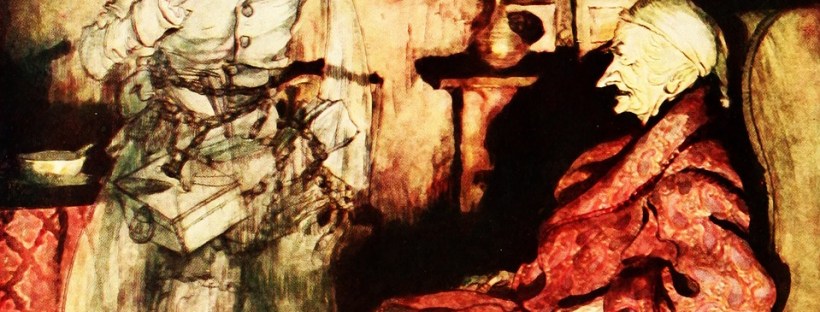
A Christmas Carol is my favourite Dickens story and one of my favourite tales overall. It has everything – a villain (at least to begin with), ghosts who reveal why Scrooge has become the way he has and what it will mean for him if he doesn’t change, and redemption. The story is its own little world and just works so well.

Still love the Muppet version with Michael Caine. Is on my must watch list again this year. It is just really well done. Looking forward to sharing my post on Friday.

Facebook – From Light to Dark and Back Again

Sometimes I write flash fiction with a historical flavour to it. Here’s one for Anne Boleyn fans. Consistency was published by Cafelit on 24th November. Hope you enjoy.  Link given above.

I’ve been talking about achieving goals as my monthly Association of Christian Writers’ blog has been about that. See below. I don’t set a particular number of flash fiction stories to write or submit in a year. What I DO try to do is seek to produce a regular number of stories and then submit them to outlets as often and consistently as I can.
 

Where is the point where a story really comes alive for you?

For me, it is when I realise I have GOT to find out what happens to the character, whether I love them or loathe them. I generally want to see villains get their comeuppance so read on to see if they do! Equally I want the “good guys” to win through so again read on.

So when creating my own characters, I am always trying to ask myself will this one grip a reader? Is the character strong enough? What is there to love and/or loathe about them?

Fairytales With Bite – When Is a Story Ready to be “out there?”

There is no hard and fast answer to the above question, of course, but what I have found to be true is that a story is ready for submitting when:-

1.  You really cannot edit another word of it without spoiling it in some way.

2.  The story haunts you – and you wrote it!  (Good chance readers will be haunted by it too).

3.  Having deadlines to submit (for reputable competitions say) can be really useful as it makes you work to a date and encourages you to let a story “go”.  It can be easy to keep editing and polishing.  At some point you need to pluck up courage and test the market with your stories.

4.  When you can genuinely envisage your piece as suiting Publication X, say, because you have read several of their editions, have a feel for their style and your story or article fits in beautifully.  If you are right go on and send it in but be sure to follow their submission guidelines.

5.  You come across other published stories which you have cause to feel are not as good as yours.  Only one way to find out if you’re right or not:  send your one in!

This slideshow requires JavaScript.

This World and Others – Story Moods

What’s your favourite mood for a story or does it depend on what mood you are in at the time of reading?

I love humorous and poignant stories and am glad to say Cafelit have published one of mine in each of these categories in the last few days.  Consistency is a historical piece and Moving Onis a changing job story, both very different in mood.  I should add the mood varies for my Chandler’s Ford Today pieces too.  My post this week is a review of A Christmas Carol as staged by the MDG Players recently.  In articles like this, as well as the actual review, I like to give some background to either the material or the writer of the material which is being performed so I generally go for an informative. chatty style.  For my scam alert pieces, I obviously adopt a more serious tone.

The key, of course, is having the right “mood” for the right story or article.  Yes, you can have funny crime and I’ve read and listened to some wonderful stories in that genre, but generally, unless it is flagged up, you would expect crime stories to have a fairly sombre tone to them.  This is where the blurb on books is so important.  A reader will pick up on the mood of the book and decide if it suits them thanks to that so it is vital to get this right.

With my From Light to Dark and Back Again the title is the big clue that there is a variety of moods here (as is my strapline – “a story to suit every mood”).

Yes, I think you should play to your strengths when writing so if that is serious writing, go for it, but I would also say don’t be afraid to experiment and play with words.  If you find you can write in more than one mood or tone of story, so much the better.  It will open up more competitions and markets for you to try.  Good luck!

Goodreads Author Programme Blog – Impact of Writing

The impact of writing on the world in general cannot be underestimated.

As well as the Bible, Shakespeare, Dickens etc., all of which have contributed so much to our language and whose stories have been the inspiration for so many others, there are things like the Domesday Book and Magna Carta.

Historical documents which colour so much else in life and law. Nobody could have foreseen at the time of writing just how much impact these would have (though there would have been many hopes about the Magna Carta. Not least that King John was hoping to get rid of it again as soon as he possibly could! An early recognition of dangerous writing perhaps?).

What makes us love our favourite books and stories the way we do? It is also down to impact. The impact of them stays with us. We want to be like the heroic lead characters perhaps. We feel fear for the characters we love as they face dangers. We feel relief, joy etc when our favourites survive.

So do writers’ play with their readers’ emotions then? Yes but it is always best done subtly. The reader has to be willing to go along with the writer here. The writer has to deliver on the promise of his/her opening lines. We have got to be able to identify with those in the story to want to find out whether they make it through to the end or not.

So the impact of writing is everything then. As readers then we need to decide what impact we want to experience.


Light and Dark

Facebook – and Chandler’s Ford Today

My latest CFT post is called The Light Fantastic and looks at light and dark in terms of fiction, mood, and vision (including photography). I look at how fantastic light is but why we also need darkness – and this is true for fiction writing too. Hope you enjoy.

This slideshow requires JavaScript.

Had a lovely evening at the Dovetail Centre watching A Christmas Carol performed by the MDG Players. Review to follow on CFT on Friday week.

A Christmas Carol is one of my favourite stories and Dickens is one of the few authors to add something to the Christmas tradition. (The others include Christina Rossetti with In the Bleak Midwinter, Mrs Cecil Frances Alexander with Once in Royal David’s City etc, Charles Wesley with Hark the Herald Angels Sing etc and Clement Clark Moore with The Night before Christmas). Favourite version of Dickens’ classic for me is The Muppet one though!

Talking of stories, I am thrilled my Doubting the Obvious is on Paragraph Planet. 75 words including the title is a good challenge! Work to come in next few days on Cafelit too.

DOUBTING THE OBVIOUS Jemma knew monsters existed, the monsters knew they existed, so why did everyone else scoff at the idea and end up eaten by the things? They weren’t getting her that way. Jemma was prepared. She had her dart gun. She had a fire roaring in the forest clearing. Everyone knew monsters were attracted to the warmth. It meant food. An hour later one monster discovered that was true. Jemma was barbecuing him.

Allison Symes – Published on Paragraph Planet 22nd November 2018


This slideshow requires JavaScript.

Really loved seeing the moon rising through the trees tonight, both at home, and on a late walk with better half and Lady. Lady has to have a clip on light to her collar, otherwise you really wouldn’t see her, so she goes around lighting up the world like a little Christmas tree. She’s not impressed by this – but I am! And it means I can see my dog!

I was impressed with the amount of light the moon was giving on the walk tonight. Absolutely beautiful. My theme for CFT this week funnily enough is light and dark in terms of mood, fiction, and vision (in every sense). It’s too easy to take too much for granted and the way the brain processes light is one of them.

As for light writing, I have a 75 word piece coming up online tomorrow. More details then but I will say my heroine isn’t afraid of the monsters in the dark! Mind you, most of my heroes/heroines aren’t but then that’s how I like my characters!

This slideshow requires JavaScript.

Facebook – From Light to Dark and Back Again

Light and dark is the theme for my Chandler’s Ford Today post this week. Very appropriate given my book’s title! Do you enjoy writing and/or reading the lighter stories in a collection for do your prefer your tales on the dark side?

I love both of course. Much depends on my mood as to which I prefer at any one time. What I do know is the 100-word story is ideal for where I want to make an impact and also the simpler the theme the better. More likely to “deliver” on the promise of the theme set.

Contrasts are often used in fiction as they are a great way to generate conflict between characters or between a character and their situation. I’m reminded of magnets here – contrasts can either attract or repel!

Contrasts can also be internal within a character especially on things they would like to do and things they are actually able to achieve. (There can be some great comedy out of that scenario too! Think of all the comedy characters who’ve clearly thought more of themselves than they should have done and how they always fall flat on their face – in the famous Del Boy falling through the bar scene in Only Fools and Horses, that was quite literally too!).

There can be be the obvious contrast between light and dark between two characters or within one character. Dr Jekyll and Mr Hyde resonates as a story precisely because we can all identify with a character’s struggles to be “good”.

Looking forward to sharing latest flash fiction story to be published online tomorrow. I will say it is a 75-word one so that will give fellow flash fiction writers a big clue as to where it is appearing! More tomorrow.

I must admit one of my favourite writing sessions is when I have got “the bit between the teeth” and I draft lots ot flash fiction stories of differing word counts. I edit later and eventually submit them to different places. All good fun.

Another thing I love about flash is when I know I won’t have a lot of time for writing, there is always enough to draft a story or two here, even if they are just of the one line variety. Sometimes I expand those stories out when I DO have more time. Sometimes I leave them as they are (and I must try and submit some of these to the 25-word competitions, they’d be ideal for that).

Fairytales with Bite – Light and Dark

The Light Fantastic is my latest Chandler’s Ford Today post and looks at light and dark from the perspectives of vision (including photography), mood and fiction.  Light and dark are crucial to fiction.  If there is no dark in a story, there is no conflict, there is no drama, nothing happens for better or worse, and any potential tale here collapses.

Fairytales are full of the contrasts between light and dark in the way they portray their characters.  Fairytales are often grim and perhaps the antidote here has been what has become the “happy ever after” ending.  Light and dark have to be in the right proportions.  All darkness is just oppressive.  All light would be blinding.

Look at the light and dark qualities of your characters.  Are they in balance?  What weakness in your character really lets them down?  What virtue really makes them?  How did they develop these things?  Do they actively try to fight the weakness?

It isn’t always appropriate for a story to end happily of course but the finish must be appropriate.  I like to see stories end on a note of hope even if the finish is a sadder one.

This World and Others – Pointers for World Building

Some useful pointers for world building include:-

1.  Ensure there is some sense of how your world is run.  We may not need to know how it is done, we need to know it IS done, and your fictional world isn’t in a state of anarchy.

2.  Ensure your characters know what they need to know at a local level.  For example, if there are rules in the region of XYZ citizens can’t go out after a certain time at night, your characters need to know this.  Breaking such a rule could, of course, be a major part of your plot here.  If so, ensure your characters know the consequences of breaking the rules and what they are facing in doing so.  It all helps increase the tension!

3.  Your characters will, presumably, need to eat, sleep, find shelter etc so again there should be some sense of how your characters do this as they have their adventures.  Things don’t “just happen”!

4.  I like to see a general picture of how the different species interact with each other, including whether there could be any Romeo and Juliet situations where two “people” from rival backgrounds fall for each other.

5.  What is expected OF your characters by the world in which you’ve placed them?

This slideshow requires JavaScript.


Memories and Motivations

Facebook – General – and Chandler’s Ford Today

My latest CFT post, The Importance of Memories, is timely of course as we enter Remembrance Sunday/Armistice Day, but I also look at the topic from the angle of how and why memories are vital to us all as individuals and as countries. I look at the impact of dementia and how singing helps with memory. I also discuss how fiction writers can use memories.

This slideshow requires JavaScript.

One tip I’ve found useful when planning out my stories is making sure my characters’ motivations ARE strong enough.

It doesn’t necessarily have to be a “do or die” approach either (though the dramatic qualities of that are obvious), but if, for example, Character A wants to buy a special present for Character B, then you must show why Character B means the world to A. Motivations have got to be something any reader is going to be able to identify with (but not necessarily agree about!).

What is your favourite form of writing and/or reading – fiction or non-fiction?

I love (and write) both. Non-fiction can and has inspired ideas for my fiction. It also means having different projects to work on, I never get bored, and I am exercising more “writing muscles” than if I did just write one thing. (I just wish I had more time but then don’t we all?).

I also think where you have a fictional world but which has solid basis in fact (i.e. you have thought about how gravity works in your fantasy setting, what form of government there is etc, based on what we know here), your story has got to be more convincing and stronger as a result.

Facebook – From Light to Dark and Back Again

The best flash fiction is where the writer has stuck to ONE simple idea/theme and followed it through. There really isn’t the room to do anything else and the impact of the story is greater for keeping it simple.

This is not the same thing as simplistic though. The best flash fiction will hit you emotionally, can make you think, can frighten you, make you laugh etc, all in a few words.

Simple writing is where the editing has been done (and often several times) and, to quote the late great Eric Morecambe, albeit in different circumstances, “you really can’t see the join”!

Favourite themes of mine for flash fiction include rough justice, alien life being as intelligent as ours (and usually more so!), and crime (often showing the criminal’s justification, if only to themselves, as to their course of action). It is perhaps ironic that the really big themes – love, justice etc – can be summed up in one word but the amount of variety of stories you can get from these is vast.

I believe the simpler the theme, the better. It comes across well too. You don’t need your readers scratching their heads trying to work out what the theme is.

Looking forward to the Bridge House celebration event in early December. Less than a month to go!

One of the nice things about writing is getting to meet other writers. It is lovely knowing you are not the only one who wants to get their imaginary world down on paper and send it out there in book form.

I suppose one of the biggest things I’ve learned is never to underestimate how long it takes to get a book together! It always will take far longer than you think, as will the editing process, but it will be worth it in the long run.

Memory is my theme on Chandler’s Ford Today this week but it plays a vital role in fiction too. For characters to seem real and therefore believable, they must have a past. That past doesn’t need to BE the story you’re telling but it should impact on it in some way (if only because it has made the character turn out to be the way that they are).

Also the setting in which your characters live, that world should have values and rules, which will be formed by its history. There are likely to be ceremonies and special days which your characters will observe or note in the course of your story.

With flash fiction of course this has to be condensed right down. In my Helping Out, my opening line has a witch helping a fairy and acknowledging she is not supposed to do so. Those last few words immediately imply a whole history of feuding between the two magical groups and the witch is remembering it and, in this case, ignoring it! The story goes on to explain why but her memory of usual behaviours impacts on her actions here. Memories = realities = more convincing fiction.

This slideshow requires JavaScript.

Fairytales with Bite Character Memories

I write about The Importance of Memories in my Chandler’s Ford Today post this week.  I touch on the subject of memories and fiction writing here too but below are some specific reasons why memories should come into your stories (even if they are just implied.  They often are just implied in flash fiction due to the limited word count but to my mind that makes the impact more hard hitting).

1.  Characters need to seem real to be believable.  Real people have memories.  So do real characters.

2.  Our behaviour is affected by memory – memory of what we did wrong, memory of what we did right and the difference between the two!  Our characters should reflect this too.  They’re not going to get it right all the time (good thing too – no story there!) but do need to show they’ve learned from their mistakes.  That is where memory comes in of course.

3.  Your world setting will have rules and values it expects its citizens to live by.  Your characters will know what these are, will know what special days and ceremonies there are, and will live their lives i obedience to all of that or be rebelling against it, but again your characters need to know and remember what these are!

4.  We are shaped by our memories in terms of who we are and why we are the way we are.  Our characters should be too.

5.  We can be haunted by memories, especially of those we’ve loved and lost.  Our characters should be too.

This World and Others – Character Traits

What are the most useful character traits for a writer to use?  My thoughts would be:-

1.  Whichever trait you choose, it has to be “open” enough to go in several directions.  For example, if your character has a “brave” trait, does this mean they are brave all the time?  Are there some fears they really cannot face but because they are brave in other areas that hides this?  Are they brave when out and about with friends but cowardly at home?  Lots of directions you could go in there.

2.  Whichever trait you choose, it should be something most people can identify with/aspire to.  Most of us want to be decent, kind, brave etc.  I love reading characters who have those traits and who overcome against all the odds.  Instant reader sympathy.

3.  Whichever good trait you choose for a character, they should also have a fault that goes against it, something they have to manage and control.  (A good example of that is The Incredible Hulk!  Mild mannered most of the time but boy when he becomes angry the sparks fly!).  You have internal conflict here and also what happens when another character has seen the good side and suddenly comes to see the bad side for the first time?  What are the reactions there?


Reviews and Remembering

Facebook – General – and Chandler’s Ford Today

It was a delightful and very moving experience to watch the Chameleons’ production of Blackadder Goes Forth last week. My review for CFT this week shares some wonderful pictures from the set (and many thanks to Stuart Wineberg and the Chameleons for kind permission to use these). The production was a sell out run and I am not at all surprised.

The way the very famous final scene was carried out on stage worked so well too. For more, see the post.

This slideshow requires JavaScript.

Looking forward to sharing my review of the Chameleons’s most recent production, Blackadder Goes Forth, later in the week. Found a particularly nice Youtube clip to go with it which fits in beautifully. It is always nice to uncover gems to go with posts like that.

Remembering is a fundamental part of being human (which is why Alzheimer’s is the tragedy it is). It should feature in your fiction too. What makes your character the way they are? What do they remember that they fight against or go with? Do they join in with their society’s collective memories or would they be what we would know as a revisionist?

What ceremonies are special on the world you’ve set up and what memories have led to these ceremonies taking place at all? Is everyone expected to join in or is it only for the privileged few?

Funny day today. Saw my sister go off to NZ (holiday and catching up with family). Not been to Heathrow for years. Last time was when our parents went over there. Mum and Dad went over at exactly the right time. It wasn’t long after their return that Alzheimer’s became “openly apparent” in Mum. Had they delayed at all, they would not have been able to go. The decisions we make…

What decisions do your characters make that turn out to be pivotal? They don’t necessarily need to be “obvious”. Something as simple as deciding to take a journey at a particular time as opposed to a later or earlier time could make all the difference to your story outcome but you will need to show why and how. Plenty of possibilities for drama and conflict there (especially if your lead is arguing with others as to the best way and time to go about their “mission”).

Facebook – From Light to Dark and Back Again

I’ve been thinking a lot about journeys today (my sister is off to NZ as I type this), but of course every story is a journey in and of itself, regardless of its length. You have a character, something happens (the moment of crucial change) and then there’s the outcome (not necessarily a happy or good one).

The main difference with flash fiction of course it that this tends to be a short, sharp journey and there’s no hanging around for the outcome!

I sometimes write pieces where a character reflects on their life. My They Don’t Understand is a good example of this. Not an action story as such but one where, hopefully, the characterisation grips you and you have to find out how the character did in the end.

Naturally there has to be something special about the character to get you to keep on reading. Often it is their voice that is compelling. Know how your character would think, act, and therefore speak. It will make a huge difference to how you write them.

I sometimes write pieces where a character reflects on their life. My They Don’t Understand is a good example of this. Not an action story as such but one where, hopefully, the characterisation grips you and you have to find out how the character did in the end.

Naturally there has to be something special about the character to get you to keep on reading. Often it is their voice that is compelling. Know how your character would think, act, and therefore speak. It will make a huge difference to how you write them.


Thoughts for starting to write flash fiction:-

1. Pick out or invent a title and see what story ideas can come from that. Ideally try not to go with your first idea, as usually that is a way in to finding deeper, better ones to work with!

2. Know who your lead character is going to be and what their chief characteristic is. Very useful way to get started!

3. Don’t worry about the word count limitations at this stage. Write the story. Edit it. Read it out loud. Edit it again. Then see what its word count length should be. Some stories really do work better at 100 words, others at 500. The great thing is there are markets for both!

4. Keep the idea simple. Don’t try to be too clever. You want the reader to identify with your characters and for the idea to be a plausible one (no matter how fantastic the setting of the story). Being too clever will just tie the story (and you!) up in knots and won’t do anything for a potential reader.

Fairytales with Bite – Character Dialogue

Character dialogue has to sound natural when a reader comes to it, whether they read it aloud or not and whether they read a print or ebook or listen to the story on audio first. Often character dialogue is a “tidied up” version of what we say in life with few hesitations (best used sparingly in writing. It looks gimmicky and is “tiring” to read.).

I’ve found reading work out loud (sometimes recording it and playing it back) is a great way of checking to see if my dialogue is up to scratch. If I stumble over my words, a reader will too as out with the old editing pen again! It is wise to use accented speech sparingly. You want to give a sense of what a character’s accent is. You don’t need to use an accent for each and every word they say. Again, that is tiring to read, especially in a longer work.

You need your characters to speak in different styles so readers can easily tell them apart during “conversational pieces”. Sometimes this can be done by the choice of words a character uses. Sometimes it can be that Character A always speaks in short, sharp sentences, while Character B takes their time in getting to the point!

I love getting my characters to “chat” even if sometimes it is to themselves via their own internal thoughts. This is where you and, later, a reader can find out so much about them.

This World and Others – Packing a Punch With Your Writing

This topic has come about as a direct result of my Chandler’s Ford Today post this week, which was a review of the Chameleon Theatre Company’s recent production of Blackadder Goes Forth.  This last series in the Blackadder canon is by far the best of them and with humour and irony conveyed the horror of life in the trenches in World War One.  Blackadder would have been mad NOT to have tried any means possible to get out of there.  The writing is excellent and the tragedy of what happens is beautifully portrayed.  How?

A lot of the writing is understated.  Blackadder’s final “good luck, everyone” is said calmly and without emotion as the men are about to go over the top.  There is a wealth of emotion behind those three words.  Anyone watching knows those men are about to go to their deaths and that they know it too.  So you don’t need lots of words to make a powerful impact on your reader.  There is a lot to be said about quiet courage (as shown by Blackadder funnily enough).  Think about then what impact you want your readers to experience, then look at the best way of achieving that.

Humour can achieve a great deal here as can quiet acceptance of what is about to happen.  Raging against the unfairness of it all can engender some sympathy but I’ve found a better approach is for characters to fight the odds as much as they can and if they lose, it is clear from the story it is NOT because of anything they’ve said or done.  It is for your reader to conclude that it is unfair on the character, rather than have the character do it (as you run the risk that the character may come across as being whinging).


Music and Stories

Facebook – General – and Chandler’s Ford Today

One of the joys of writing my Chandler’s Ford Today posts is when I have a topic where I can go to town on finding music clips! The topic of books is one of them.

Many thanks to my wonderful panel – #JenniferCWilson, #ValPenny, #AnneWan, #WendyHJones, and #RichardHardie – for taking part in my mini-series The Joys and Challenges of Writing Series Novels. Hope you enjoy their fantastic insights AND the music I’ve used to go with these!

This slideshow requires JavaScript.

Had a great night out watching the Chameleon Theatre Group perform three episodes from Blackadder Goes Forth, including Goodbyeee. Review to follow on Chandler’s Ford Today in due course but I will say now it was superbly done and the set, made by the company themselves, was brilliant. Looking forward to sharing more on that.

Adaptations I’m generally happy with if they are faithful to the book/series etc. This is why I loved the Miss Marple series with Joan Hickson – they were faithful to the Christie canon – but the Marple series. No. Didn’t watch it. Just couldn’t bring myself to do so when it emerged they were altering the stories and bringing in characters that didn’t belong in the originals. Really don’t like that.

My CFT post this week will be the final part of my series on the joys and challenges of writing the series novel. As ever, my thanks to to #JenniferCWilson, #ValPenny, #AnneWan, #WendyHJones, and #RichardHardie. Nice range of genres between them too – from children’s to crime (and Wendy writes both!) to fantasy to historical crossed with ghost stories. Link up on Friday.

Glad to report I’ll be having more work on Cafelit later this week and again in November. Will share links as and when.

From what I’ve seen of the set the Chameleons have produced for the stage version of Blackadder Goes Forth, I anticipate a packed house and a wonderful and thoughtful evening of entertainment. Will review for CFT in due course. Do check their FB page out.

No automatic alt text available.

Image may contain: outdoor

thank you text on black and brown board

Pexels image.  There are times when words are inadequate.

Facebook – From Light to Dark and Back Again

So more on my alphabetical list then.

J = Juicy Storylines! Not just for soap operas, honestly, but something every character wants. Now “juicy” can be taken literally of course, but I see it as the storyline being appropriate for the character and taking them and stretching them to see what they are really made of. There’s nothing like a crisis for bringing out the best or worst in someone and that applies just as well to fiction!

K = Kicker. Must admit I needed to look this one up. (It’ll be interesting to find out what I can research for Q!). In journalism it apparently means a sudden unexpected change of events. In fiction we’d usually refer to it as a twist in the tale. I like kicker though. Has bite. And your stories must too, whether they have a twist/kicker in them or not.

L = Lines. Who is getting the best lines in your story? Your hero or your villain? A great story will have this split between the two to prevent either becoming a stereotype or, worse still, boring! Also a villain capable of humour etc means while your reader will not want them to win (possibly SHOULD not!), they will sympathise and identify with the villain to a certain extent. There should be something about each character a reader can identify with. (My inspiration here is Alan Rickman’s masterly portrayal of the Sheriff of Nottingham in Robin Hood: Prince of Thieves!).

About halfway through the alphabetical listing now. So then:-

M = Muse. The best way to feed said muse is to read widely and often (and do include non-fiction and poetry in this too. Different sources of writing are good for you and inspire your own thoughts and ideas in various ways). I’ve also found writing regularly feeds it too. Never worry about what you come out with at first being awful and needing work. That would’ve happened to Shakespeare too! It can and will be put right in the edits!

N = Narrative. Whose story is it? Whose viewpoint is going to dominate? What can that character see and know that the others cannot? Why have you chosen that character to lead the narrative? Answer those questions and your story will be off to a good start!

O = Originality. Reading widely feeds your originality. Partly this is due to what you read, but sometimes it can be because you read something you really don’t like or feel you can do better and that can be the trigger point for your own writing. Also, your voice is unique to you and will come through in your writing, especially if you write often. Regular writing (even if it is short bouts at a time) really does encourage your imaginative “muscle” to start working.

Pressing on with my alphabet topic then, we reach P, Q and R. (Great letters if you can get them out in Scrabble incidentally!).

P = Performance. Do your characters perform well in your stories? Do they live up to what you outlined them to be or have they gone beyond that? Read your stories out loud. Perhaps record them and play them back. Hear how your characters perform. Are they having the impact on you that you want them to have on your reader?

Q = Quizzing. I’ve found quizzing my characters to be a very useful part of my outlining. I don’t need to know the minute details. Nor do I put everything I outline in a story. However, I take my character’s basic traits and quiz them from there. If I decide a character is going to be brave, I will quiz them to find out if there are limits to that courage. I try to find out where that courage comes from. Does their “tribe” prize bravery? Or is it noticeably absent and your character is rebelling against that? What are the outcomes? (There WILL be some and that’s where the drama and your stories are to be found!).

R = Right Word Count for your Flash Fiction. I sometimes write a piece deliberately to a word count and that’s it. Sometimes I think a story will come to 100 words but discover it can be done in 75 or needs to run to 250, say. Be flexible on this. The story is the right length when the lead character has done and said all they have to do/say for the situation you’ve put them in. The great thing with flash fiction is there are so many different categories, that even if your treasured 100 word piece comes in at 500 words, there will be markets and competitions for that out there.

This slideshow requires JavaScript.

Goodreads Author Programme – Blog –

After the End, What’s Next?

If you’ve enjoyed a really good book, what do you do when you finish it? Go on to read more books by the same author, or read more in the same genre, or do you go for something that is completely different in mood and style?

I have done all three of these (though obviously not at the same time!) and it very much depends on my mood at the end of the story. If I’ve loved a gory crime thriller, I may well want something humorous to show the lighter side of life, albeit a fictional one!

With short stories especially, I tend to read a few by the same author before moving on. With novels, if the book has really gripped me, I’ve got to check out what else the author has done, even if I decide I’ll come back to those later.

The important thing though is that whatever you read, you enjoy it so much, you keep on reading, no matter what author, genre, style etc you choose next. Happy reading!

Image Credit:  many thanks to the Hampshire Writers’ Society for taking the photo of me reading as guest speaker and for kind permission to use the photo.  Both much appreciated!

Fairytales with Bite – Signs of a Fairytale World

What are the signs of a fairytale world?  How can you know quite quickly you ARE in one (via fiction I’m presuming for the purposes of this post!  If you do find a portal to another world, however, be sure to report back with plenty of details, pictures if at all possible.  We will all want to know!!).

1.  Magic.  The biggest giveaway of course is the use of magic.  The interesting thing to work out when planning your stories though is whether everyone can use magic or just a select few.  If everyone can use it, what are the rules so anarchy doesn’t break out?  Boundaries increase the drama in your story.  If everyone can zap everyone else, that doesn’t make for much of a story.  If only a few can do that but the price they pay is their own lives are forfeit, now there’s a potential story.

2.  Inanimate Objects – The Use Of.  We all know from Disney (see Beauty and the Beast) a teapot, to name one example, is rarely just a teapot!  Sometimes they’re an enchanted victim.  Sometimes these things are portals (also see Harry Potter).  So what uses are the inanimate objects put to in your setting?  Does a particular object convey a particular meaning or power and, if so, what and why?  What are the limits to the use of objects?

3.  Creatures.  Ranging from domestic animals that can talk (hello, Puss in Boots!  Loved Puss in Shrek.  Thought they had the portrayal spot on) to odd creatures that are the stuff of legends to monsters of course.   Basically what you wouldn’t see here!  And there’s nothing to stop you inventing your own.  This is where some knowledge of natural history is invaluable.  Knowing what animals need to survive and how their bodies are designed to handle that should inspire some ideas for how the creatures in your stories will do this kind of thing.

Happy writing!

This World and Others – Music and Stories

In my latest CFT post, the final part of my mini-series on The Joys and Challenges of Writing Series Novels, I get to have some fun choosing music tracks to go with my fantastic panel’s insights.  Many thanks again to Jennifer C Wilson, Val Penny, Anne Wan, Wendy H Jones, and Richard Hardie for taking part in this three part series.  Hope you enjoy the insights and the music!

Music and stories have long been intertwined of course.  So many wonderful songs are stories set to music effectively.  Music can and does play a part in stories.  It can be used to show character.  Movies, of course, rely on music to help set mood.  Think of the Jaws theme by John Williams.  Every note of that puts pictures and therefore stories in your head (and possibly might put you off swimming in the open sea but that’s another matter!  There are advantages to just swimming in the local public baths!!).

I write with classical music playing.  (I often listen to Classic FM).  Unlike other styles of music, it hasn’t affected my mood (and therefore what I write!).  It does help me relax and I write more (and I hope better) when relaxed.  I’ve also found it helpful to think of the kind of music my characters would be fans of when I’m creating them.  It almost certainly won’t come into the story I write but it fills out my knowledge of the character I’m about to place before a reader.  That has to be a good thing.

And I must admit I loved choosing the music for my book trailer for From Light to Dark and Back Again.   The track used is an adaptation of Camille Saint Saens Danse Macabre (used as the theme tune for the BBC detective series Jonathan Creek).

https://www.facebook.com/plugins/video.php?href=https%3A%2F%2Fwww.facebook.com%2FAllison.Symes.FairytaleLady%2Fvideos%2F954726234630356%2F&show_text=0&width=560

Stand Alones, Flash Fiction and Fairytales

Facebook – General – and Chandler’s Ford Today

Many thanks again to Jennifer C Wilson, Val Penny, #AnneWan, Wendy Jones, and Richard Hardie for their further insights into the joys and challenges of writing series fiction. Amongst tonight’s topics is how to ensure each book in a series works as a stand-alone, given our series writers can never know which book a reader will actually start with. It isn’t necessarily book 1!

This slideshow requires JavaScript.

What five things do I like to see in a character? Ideally they have all of the traits I list below but as long as a character has the majority of them, I’m likely to enjoy spending time in the company of that character as I read their story.

1. Courage.
2. Sense of Humour.
3. Loyalty.
4. They, at the very least, respect books; at best they have their own library!
5. Kindness.

Does that rule out the villains? No! Even villains can be kind to their pet cat, have a decent library etc.

Looking at that list, it’s what I like to see in myself and, before you ask, I’m working on the personal library bit! (It’s nowhere near as grand as the one in the pictures below though!).

This slideshow requires JavaScript.

One of the things I love about going to writing conferences is that I always learn something pertinent to what I write. And it is not always an obvious link.

I’m off to the Association of Christian Writers’ Day on Saturday, the topic is Writing for Children and Young Adults, which is not directly what I do, but I just know I will pick up useful tips that I can apply directly.

And you never know – looking at what other writers do can help you re-examine whether you are working in the best way you can. It may also inspire a new direction of writing too! What I do know is it will be fun finding out if it does or not and what useful tips I’ll bring home with me.

The great thing with writing is you never stop learning how to improve what you do and that is so good for your brain!

(And networking is always fun!).

Facebook – From Light to Dark and Back Again

A = Alliteration. Can be useful for titles in flash fiction (though I don’t use it much) but as with any story, it can grab the attention and help set the mood. Best not overused I think. You want each title to set the tone for what it is to come and a variety of methods for doing that is best. Keeps it fresh for you as the writer too.

B = Backstory. Not a lot of room for that in flash fiction! Best to hint at it through one or two vital details the reader has to know and leave it at that.

C = Character. The kingpin of fiction I think. Get the character right and the plot will come from them. Know your character inside and out – I find it useful to know their chief trait (and I piece together a mental picture of what they are like from there). Find the appropriate starting point for you but it is worth taking the time to know your character well before you start. Your writing will flow better because you write with that knowledge. It does come through in what you write.

As ever, am planning to write flash fiction on the train journey to and from London on Saturday as I head off to a writing day run by the Association of Christian Writers. It’s amazing what you can get done on a smartphone with no interruptions! (Daren’t do this on the Tube though. Always worried I’ll miss my stop! I do think the Tube is a wonderful invention and you never get cold down there either…).

I also sometimes draft non-fiction articles and future blog posts when out and about. I just need a long enough train journey to draft a novel now. 😉😁Hmm….


When planning your story (you do, yes?), I find it useful to work out what the obvious ideas might be from a title I’ve thought of, and then work out what could come from those. I don’t plump for the first ideas that come to me. I try to make myself dig that bit deeper to come up with something that fits the theme, makes sense, but is also different precisely because I haven’t gone for the obvious ideas!

Spider diagrams or flowcharts can be useful here. I find I must have a title to kick start the process with, even if I do end up changing it for something better later. It is always a tad annoying that a better title idea crops up when you are writing the story and NOT before you get started, but that is one of those quirks of writing!

Picture of me reading was taken by the lovely #DawnKentishKnox at last year’s Bridge House event. Am very much looking forward to this year’s one too!


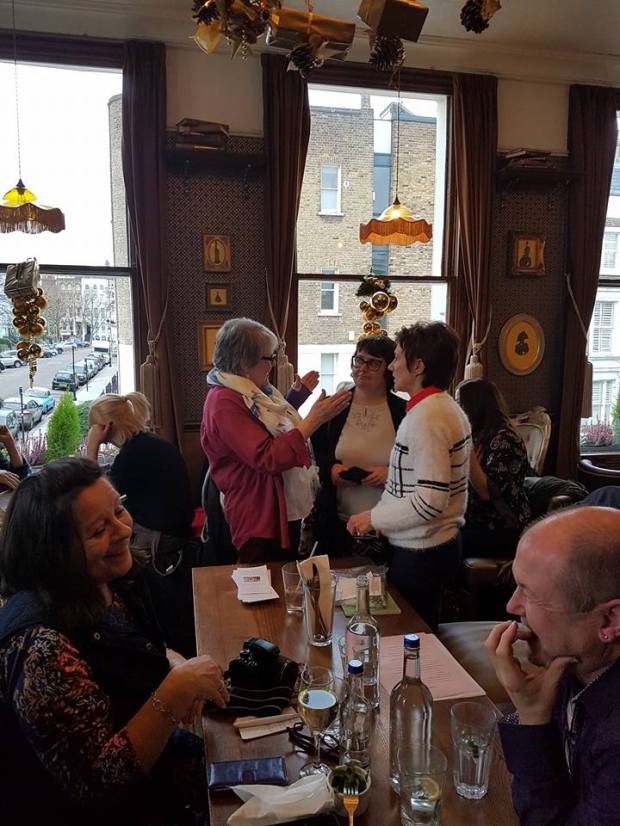
Gill talks with Dawn and I at the BH event, image taken by Paula Readman

Gill James talks with Dawn Knox and I at a networking event held by Bridge House Publishing last December. Am glad to report Dawn will also be in the Waterloo Festival Anthology. Image from Paula Readman and thanks to her for permission to use it.

Paula Readman, Dawn Kentish Knox and Allison Symes and books - with kind permission from Paula Readman - Copy

Paula Readman, Dawn Knox and I at the recent Bridge House celebration event. Many thanks to Paula for the image. Also Paula is another winning entry for the Waterloo Festival.

20171202_160214

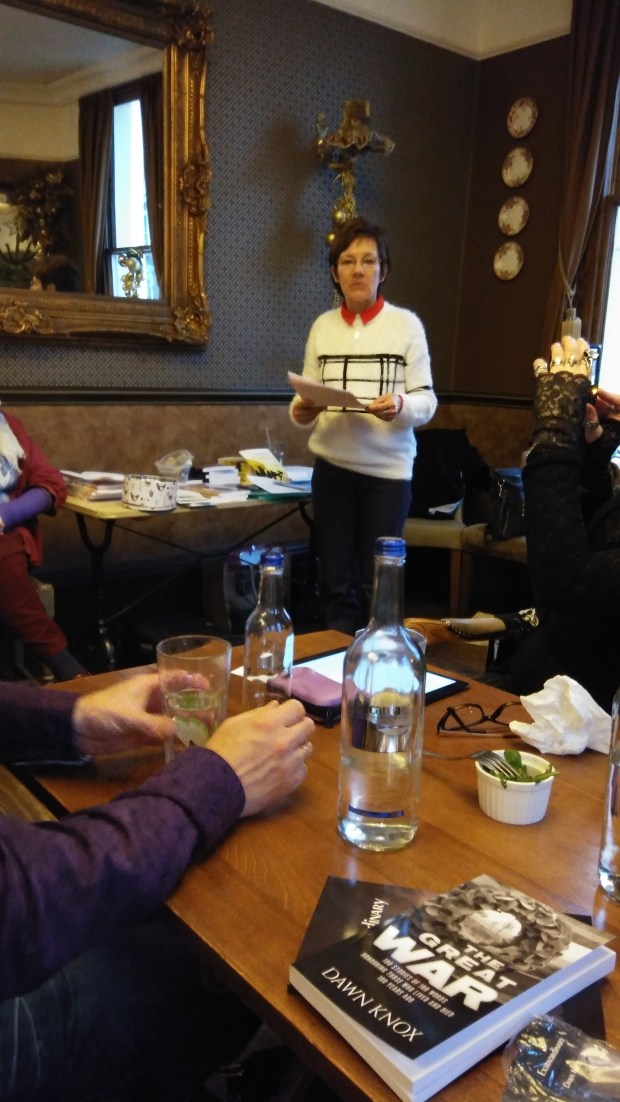
Dawn Kentish Knox, fellow flash fiction writer, reads some work from her excellent book, The Great War. Image by Allison Symes

Lovely having an appreciative audience, pic taken by Dawn Kentish Knox

I read three stories from From Light to Dark and Back Again. Many thanks to Dawn Kentish Knox for the picture!

Book Buying News!

From Light to Dark and Back Again is available from The Book DepositoryDelivery time on the paperback is 1 to 3 business days.  As ever, reviews are always welcome in the usual places.  The great thing is reviews do not need to be long but they all help the writer, even the indifferent ones!

Fairytales with Bite – Flash Fiction and Fairytales

Flash fiction is an ideal vehicle for fairytales.  Why?  Because the best fairytales set up their world quickly, have a definite conclusion, and often pack a powerful punch.  Flash fiction does this too so to my mind flash and fairytales are a match made in writing heaven.

Flash fiction has to be character led due to its limited word count but you can set that character wherever and whenever you wish.  A few telling details can set up a magical world quickly.  For example from my George Changes His Mind (in From Light to Dark and Back Again), I set up a magical world with the opening line “He refused to kill the dragon.”  The telling detail there is in one word – dragon! The story goes on to show what happens and that is the important bit of the story after all.  I don’t need to use thousands of words setting up the magical world in which this is set.  This is not crucial to this story.  What matters is it IS in a magical world and what George goes on to do or not do.

A lot of my stories are either reflections of a fairytale world or set in it and they are great fun to write but I always focus on what the lead character is like.  That is the crucial point of any story I think but in flash where every word must work hard to earn its place to stay there, it is even more so.

This World and Others – Stand Alone

Part 2 of my CFT mini series on The Joys and Challenges of Writing Series Novels looks at, amongst other topics, how to ensure a book stands alone given no series novelist can know at which point a reader will discover their writing.  It is highly unlikely to be book 1.  Indeed I’ve discovered series at the mid point! Many thanks again to my marvellous panellists – Jennifer C Wilson, Val Penny, Anne Wan, Wendy H Jones, and Richard Hardie – for some great insights.  Very happy to recommend their books to you too.  Great reads one and all albeit for different audiences!

It is true that every writer stands alone, even those that collaborate as they have to go off to write “their bits” before coming back and swapping notes with the other one(s) in the project.  We have to judge whether our work is strong enough to submit and, if there is a choice of places to submit to, which is the best one.  We have to judge whether we have edited a piece enough or if it still needs work.  The call is with us and we are going to get it wrong.  The joy, of course, is when we get it right and a piece is published.

This is where meeting other writers, whether at conferences, online, at courses etc., is invaluable.  There is nobody like another writer to know exactly how it feels when you’re struggling to get the words out or who knows the joy of the words pouring out and work going well.  You do have to share this sometimes for the sake of your own sanity!

I learned a long time ago no writer is a competitor to me.  I write as I write.  I cannot write as you would.  We all bring our unique perspectives to what we write – and that is the great thing about it!

This slideshow requires JavaScript.


Joys and Challenges

Many thanks to the Hampshire Writers’ Society for making me so welcome on Tuesday night.  Also thanks to those who have liked or given other positive feedback via my Facebook pages on my talk.  Much appreciated.

thank you text on black and brown board

Thank you, HWS! Image via Pexels

HIGHS POST - An inspiring thought

Indeed! Pixabay image.

HAMPSHIRE WRITERS PICTURE OF ALLISON

Many thanks to the Hampshire Writers’ Society for their kind permission to use this photo.

Facebook – General – and Chandler’s Ford Today

My CFT post this week is part 1 (of 3) looking at the joys and challenges of writing series novels. My panel joining me for this are #JenniferCWilson, #ValPenny, #AnneWan, #WendyHJones and #RichardHardie. Between them they cover crime fiction, children’s fiction/YA, historical, ghost and timeslip! Some great insights here with more to come over the next couple of weeks.

This slideshow requires JavaScript.

Many thanks to all who sent in likes, encouraging comments etc following Tuesday night’s talk at the Hampshire Writers’ Society. All very much appreciated.

I know that some would like the links for some of the competitions/markets I mentioned. I list only a few below. I hope you can see these as a useful starting point.

http://www.flash500.com/index_files/flashfiction.htm
You do have to pay to enter this one but the competitions are quarterly and on an open theme so if you miss one date, put a story in for the next one!

http://writersfestival.co.uk/competitions
This is for Winchester Writers’ Festival and lists all their competitions. Great to now see flash fiction listed here.

http://www.paragraphplanet.com/submission.php
Free to enter. Always looking for submissions. Want to get around to trying this one myself!

Cafelit – give website details and submission details
http://cafelit.co.uk/index.php/submission-guidelines-2
I started writing flash fiction thanks to their 100-word challenge but do visit the site for a wealth of stories and styles.

Writing Magazine
For their 750 words and 1000 word competitions but very much fits into flash fiction territory. Keep an eye on their website and, of course, the magazine itself.

Earlyworks Press details
http://www.earlyworkspress.co.uk/Competitions.htm

And don’t forget The Bridport Prize, the Bath Flash Fiction Award etc etc. Definitely worth scanning the net every so often to see what is out there.

Trust this helps – and just to finish, something I didn’t have time to share on Tuesday. Two one line stories which, in different ways, conjure up a whole world of fear! You tell me which is the most frightening…

1. The lion ran straight at you.
2. The dentist will see you now.

Well?

Many thanks to the Hampshire Writers’ Society for making me so welcome as guest speaker at last night’s event. Much appreciated.

I discussed what flash fiction is, what I love about it, why I think all writers should try it, and a few hints as to possible markets and competitions – in about 15 minutes! Mind you, isn’t it appropriate that a flash fiction writer keeps her speech short!!😁

The main speaker was Ian Thomas, games writer, (founder of Talespinners – stories for video games etc) and his talk was illuminating as to what is needed in this field of work. What was interesting was two skills needed in flash fiction writing – the ability to edit ruthlessly and the need to leave gaps for readers to use their imaginations and fill in – are both vital for games writing too.

Facebook – From Light to Dark and Back Again

As part of my talk at HWS yesterday, I discussed what I love most about flash fiction. One aspect is that it is proof you can make a huge impact on your readers but don’t need thousands of words to do so. I’ve read many a thoughtful flash fiction piece which would have LOST impact had it been a longer work.

I find I am always thinking about what impact I want my stories to have on readers (or those I’m reading my work to, come to that!). So even as I am writing the story, I am trying to engage with a potential audience. I think it is a good mind set to be in. It helps make it easier for me to cut out the inevitable waffle that does creep in to any draft writing I do. I have a tendency to overwrite, which is okay. That can be cut after all. But I always DO have to cut and that is just one of those things.

It’s a good thing to look at what your writing weaknesses are (in my case, overwriting) and then work out strategies to deal with them. I accept I overwrite, I get the draft down and then I ruthlessly prune back. Problem solved. The great joy of the first draft is only I get to see it!

If you’re having a brainstorming session for story ideas, how about trying a random word generator?

Weave, say, the first three words you come up with into a story. Having a quick look on the net, I found one of these that lets you choose how many words and the first and last letters of the words. You could even select the number of syllables or word length! I chose the first letter of a and the last letter to be t, and a word length of six letters. The words that came up were:-

appointment
accountant
appoint

So what can be done here? How about:-

A QUESTIONABLE CHOICE

It was a grim day in the magical realm when the Dark Lord decided to appoint an accountant. This was not the way things were done here. The Dark Lord was supposed to rob and plunder and then spend his ill gotten gains in a frenzy. The appointment even made the headline news. People dared to question what the Dark Lord was doing and ask what would happen next.

Allison Symes – 11th October 2018

Naturally you can expand this out to trying the first five words you come up or vary the syllable and/or word length, but there is a lot of fun to be had here playing with words and ideas. When is that ever a bad thing?!

Many thanks to #HampshireWritersSociety for taking this picture of me (see top of tonight’s post!) speaking at their meeting last Tuesday (and for permission to use it). I usually take my own pictures of my book stall etc at events and so on but it’s a bit tricky doing it when you’re the one who’s speaking!

One thing I love when talking about flash fiction is getting to read some of it as part of this. It is by far the best way of showing people exactly what it is and, of course, does not take too long. It also mixes up your talk with some storytelling (and I know I love listening to this sort of thing when I’m at other writers’ talks etc).

Says it all really. Image via Pixabay.

Says it all really. Image via Pixabay. And am glad to say my poorly border collie, Mabel, has very much been showing this spirit.

Never give up, work hard, be disciplined... all valuable traits for success, whether you're a tennis player, a writer or a character in a story! Image via Pixabay.

Never give up, work hard, be disciplined… all valuable traits for success, whether you’re a tennis player, a writer or a character in a story! Image via Pixabay.

Fairytales With Bite – Story Loves

What do you love most in a story?  I look for the following:-

  1. Gripping characters – I’ve got to really root for them to succeed or get their just desserts for me to stay with them during the story.
  2. Good pacing – What pacing is required obviously depends on the type of story but generally I’m looking for a pace that keeps the tension up until the end.
  3. Unforgettable settings – This doesn’t have to be an invented world (though it often is).  Here I’m looking for the setting being appropriate to the story and characters and be a place I’d love to visit or equally be glad I’m nowhere near.  The latter depends on the type of story but whichever way it goes, the setting has to provoke a reaction in me.
  4. Entertaining dialogue – Sure sometimes this will be funny dialogue (when appropriate) but even when not I want to feel as if I’m eavesdropping on a conversation that I have absolutely got to finish listening to!
  5. Strong Resolution – The story definitely has to end.  Not on a cliffhanger – that should be for the chapters leading up to the end in a novel or in the middle section of shorter works before the issue is resolved.

This World and Others – Joys and Challenges

My CFT post this week is the start of a three-parter looking at The Joys and Challenges of Writing Series NovelsMany thanks to my panel of Jennifer C Wilson, Val Penny, Anne Wan, Wendy H Jones, and Richard Hardie for their great contributions.  Am looking forward to sharing the rest of the series over the next couple of weeks.  Between them, these fine writers cover children’s/YA, crime, historical, ghost, and timeslip!  (Some of them cover more than one of these!).

The title of this piece led me to think about the joys and challenges our characters face. How do they handle these?  Which do they cope with better?  (Not everyone handles happiness that well – they literally don’t know how to cope with it or live in such dread that the happiness is going to end any moment, any enjoyment of it is lost!).

Are others pleased for your characters in their joyful times or is there resentment there (openly or hidden)?  In the challenges your characters face, do they have friends and family to support and encourage?  When your characters overcome a challenge, do they go on to learn from the experience or does their success change them (and not necessarily for the better)?

This is where the core central values and attitudes your characters have really matter.  Someone who is generally a decent character is not going to upset others by showing off about their successes.  They will have friends who are genuinely pleased for them.  Someone who aggravates others will only find said other characters will be rooting for their downfall!

This slideshow requires JavaScript.