(E)xcellence in Fiction

Image Credits:-
All images from Pixabay/Pexels unless otherwise stated (though most are then put through Book Brush). Book cover images from Chapeltown Books and Bridge House Publishing. Screenshots taken by me, Allison Symes.
Has been very hot here in my part of the UK with more to come. Lady staying cool. And I found a suitable topic for X in my In Fiction series for Chandler’s Ford Today. It has been a good week! Hope yours has been too.
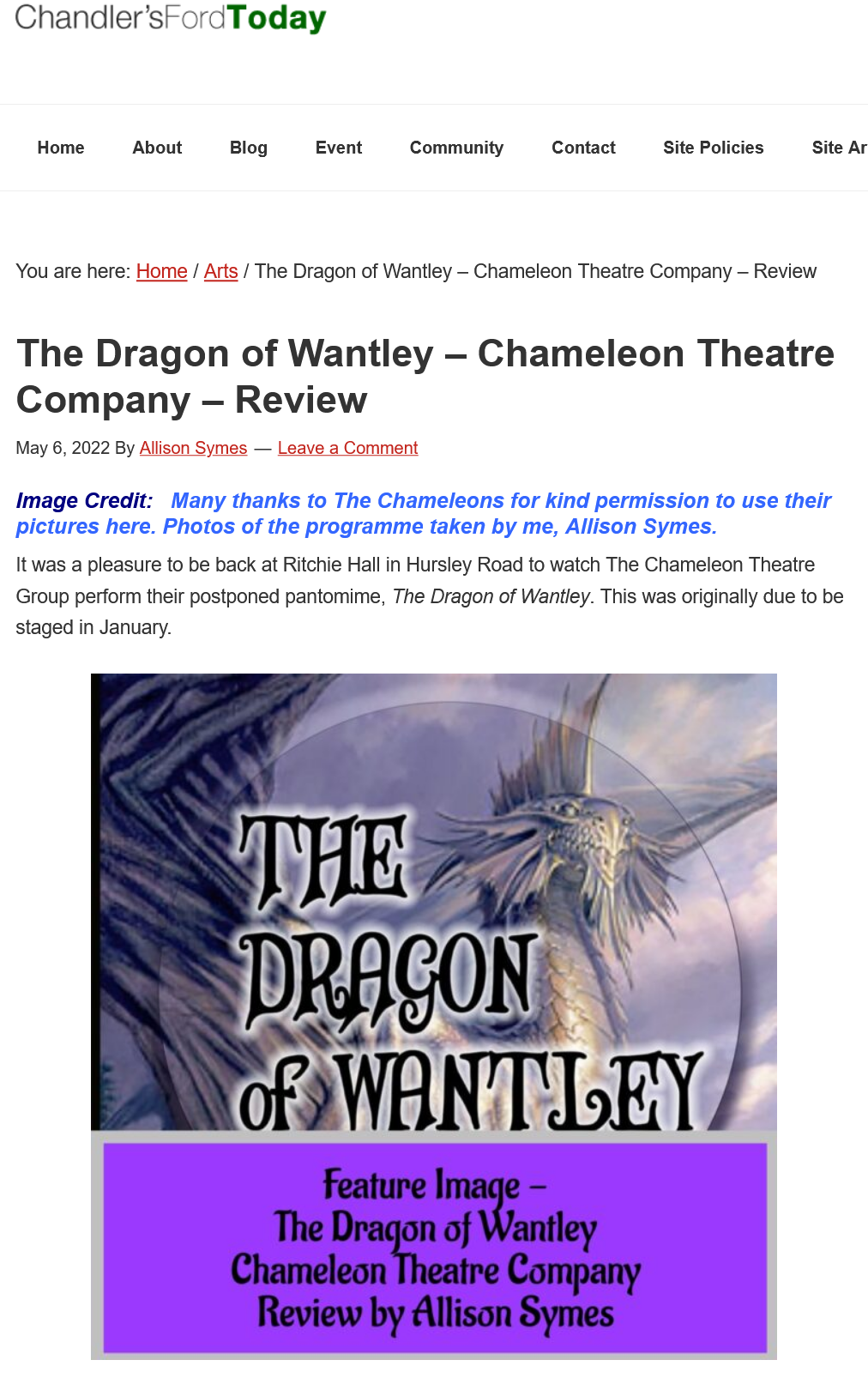
Screenshot 2022-07-15 at 16-45-33 (E)xcellence in Fiction - Chandler's Ford Today

Facebook – General – and Chandler’s Ford Today

I’m pleased to share (E)xcellence in Fiction, my latest Chandler’s Ford Today post. Comments about what you think makes for excellence in fiction would be most welcome over on the post. As well as sharing my thoughts on the topic, I look at what writers can do to make their work as good as possible in the hope readers will find their work excellent. A good goal to strive for!

The writing journey is full of ups and downs but it should be a moving one. Sometimes it will be a case of changing direction. I did so with the switch to flash fiction and short form writing and then blogging. Also over time I want to get better at what I do. I should move on from where I started out as a flash fiction writer, say. Very much a case of continuing professional development then and I hope it leads to excellence in what I write.

I want to get each story I write as good as I possibly can and to always be open to the thought that, while no story is perfect, as it is written by fallible human beings, I should be able to see progress. Hopefully if I do, a reader will too. It is all about the reader, what they get from your work.

(E)xcellence in Fiction

This slideshow requires JavaScript.


Looking forward to sharing (E)xcellence In Fiction for Chandler’s Ford Today tomorrow. Relieved to find a reasonable topic for X in this series! I’ll be looking at what I think makes for excellent fiction (and it’s not genre dependent either) and what a writer can do to help things along here. See above.

Are you finding it easy or hard to write in this hot weather (for those parts of the UK with the high temperatures)? I’m writing as usual but find I am “flaking out” earlier than normally do come the evening. Am getting around that by trying to start my writing sessions earlier! It is nice writing with the French windows open though. Nice breeze this evening is refreshing. Won’t be doing this come November! Having said that, and to prove there can be a positive side to a lot of things, I won’t be peeling myself off my chair come November either – it’s an ill wind and all that!

Am looking forward to going to see The Chameleon Theatre Group‘s latest production, Hoovering the Edge, later this month. It will be lovely getting together with my great CFT editor, Janet Williams, for this too.

BookBrushImage-2022-7-14-20-1053
How can I judge when I’ve got the flash fiction word count right for my story? It depends on whether I’m submitting a piece of work to a fixed word count competition or market. Obviously if I am, I stick to the rules. If it’s an “open”word count (but still up to 1000 maximum), I go by what I need the character to do to bring the story to a satisfactory conclusion. Sometimes that is at 300 words, sometimes I need the whole 1000.

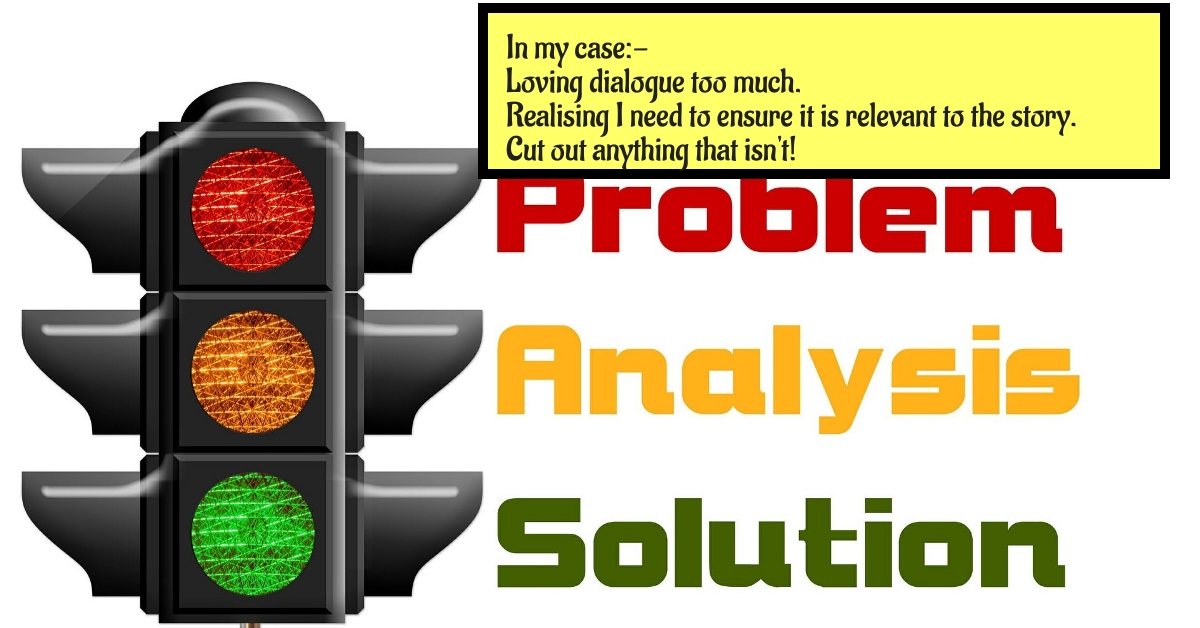
What I love with Scrivener is I can set the word count I want to write to and watch the bar at the bottom of the screen go from red to amber to green as I type. I do love a simple visual! Over time I’ve learned to judge what roughly looks like 500 words, say. When I then do a “proper” word count to check where I am, I find I’m usually within about 50 words of my initial estimate. You do get better at judging these things over time and the more you write.

I don’t always set my word count bar deliberately. I always do use it for a fixed word count market. Where it is more open, I just write and then worry about the word count later on. I find this works for me.


Facebook – From Light to Dark and Back Again

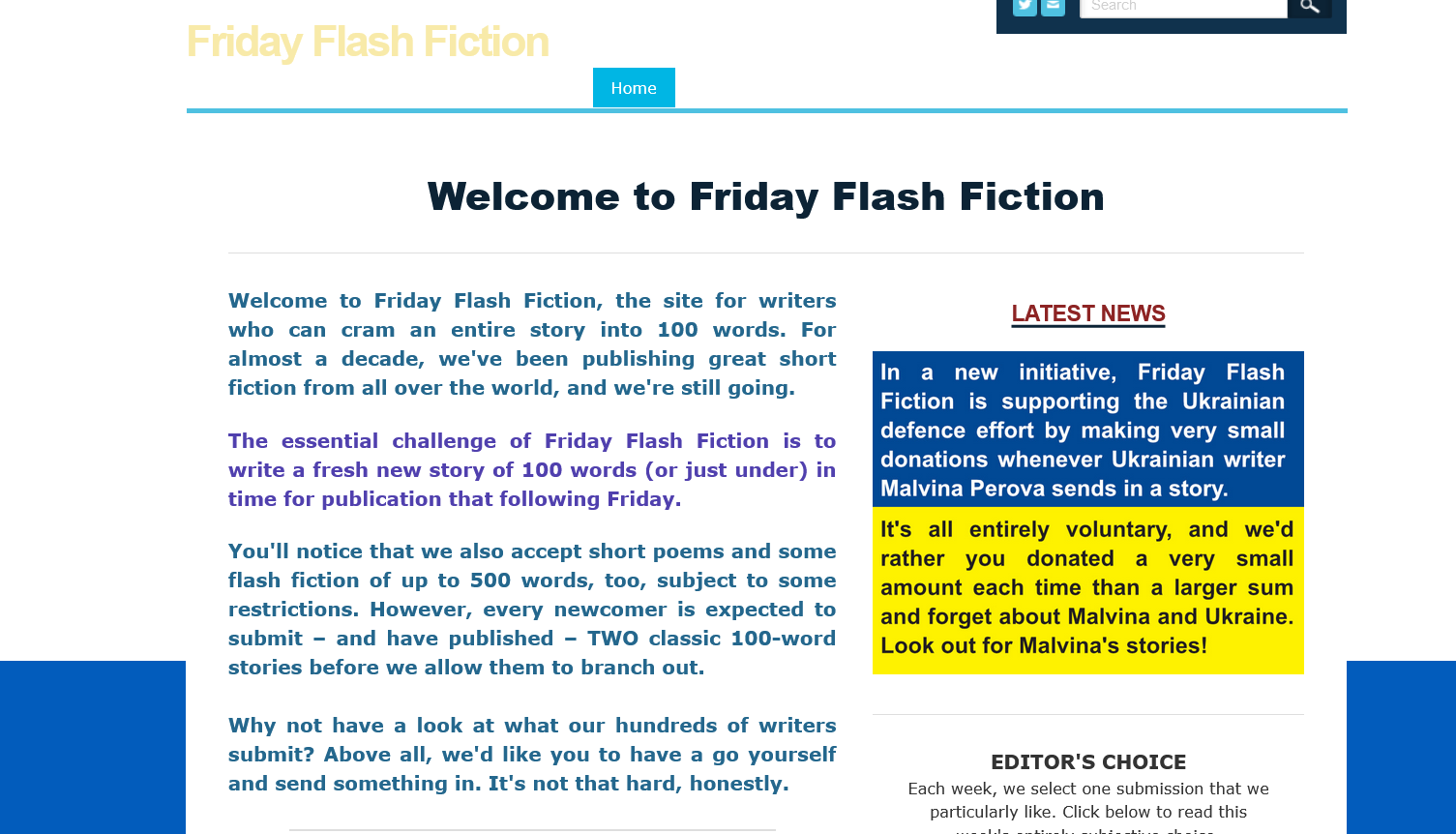
Pleased to share my latest Friday Flash Fiction tale. This one is called Cookie Surprise and I used a random noun generator to trigger a story idea. The words cookie and road came up and this tale is a result of putting those together. Hope you enjoy it.
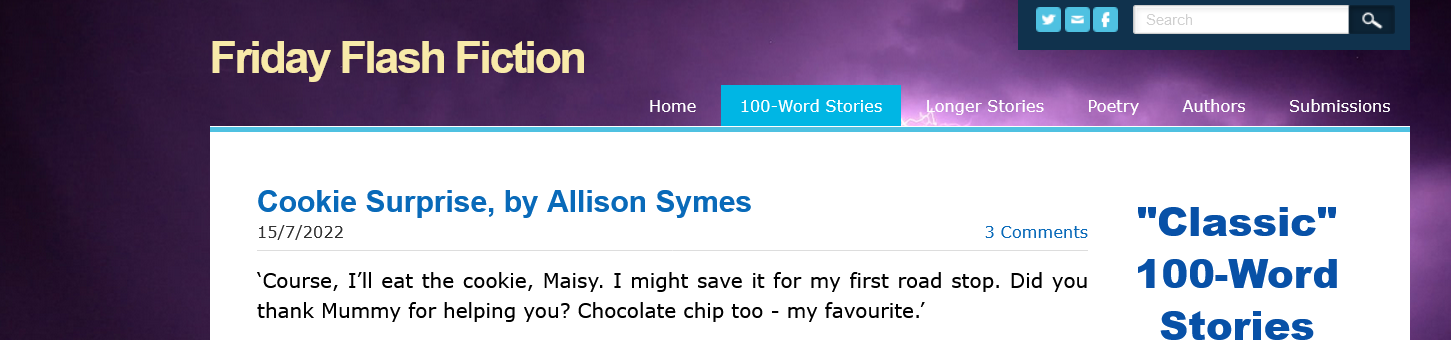
Screenshot 2022-07-15 at 16-53-16 Cookie Surprise by Allison Symes

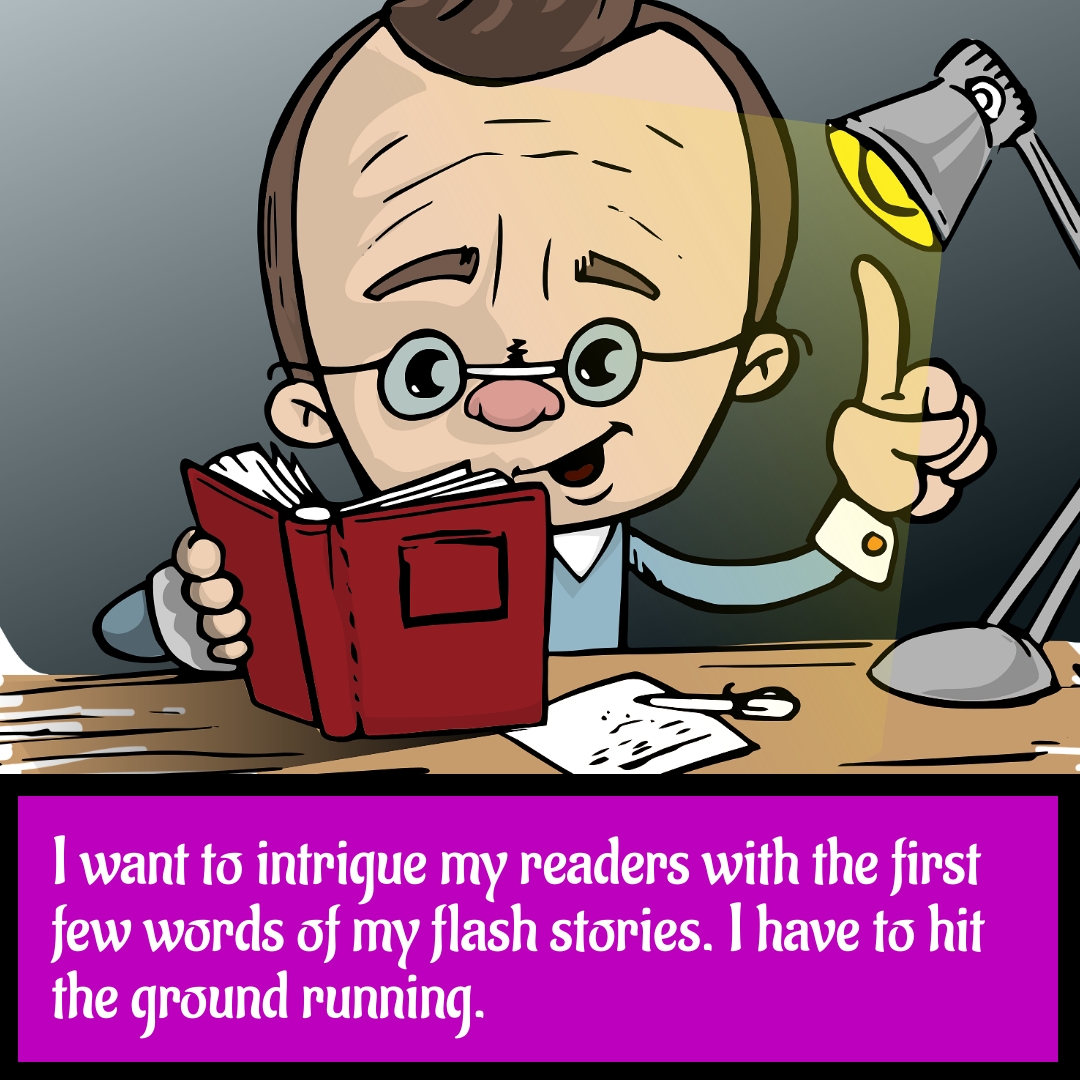
Intriguing a reader to want to read on is vital for all forms of storytelling. With flash you do have to hit the ground running given you have less room and time in which to do that intriguing. This is why I find knowing my character and their voice from the start helps a lot.

I know my character has got something worthwhile to share so I’ll let them “get on with it”. I don’t want my author voice getting in the way because that is all it will do. It is the character’s story. I love powerful opening lines which make me want to find out what happens next as I figure a lot of readers will react the same way.
BookBrushImage-2022-7-14-20-212

I love writing about characters who turn the tables on people (naturally said people deserve to have said tables turned on them!). What I need here is a character with a good reason to want to do this. There has to be something in their personality which flags up they are capable of turning those tables if they are pushed far enough. The fairytales show this kind of character time and time again – and I love them all.

What I don’t like are characters who are pushy, dominant, careless of the needs of others (precisely because they couldn’t care less) etc. If I write a character like that, you can be sure I will get another one to turn the tables on them. And that I will have written this with considerable relish!

Writing is so much fun. I once told my other half I had had an excellent day because I’d just finished bumping off a character and I’d got away with it! Fortunately by this time I’d been writing long enough for him to consider this as a normal day in my office… make of that what you will!

BookBrushImage-2022-7-13-20-1319

Fairytales with Bite – Using the Tropes of Fairytales

Every genre has its tropes. I see them as useful shortcuts that readers will expect to see in the kinds of stories I write. For example, if I mention a magic wand, I’m not going into details about what it looks like because most people will have their own ideas. Disney and Pixar will also have helped people form those ideas I suspect.

Also people will expect for these things to turn up in fantasy tales/fairy stories. Neither do I spell out what my fairy godmother characters look like though I usually give some indication of likely age range. The story she is in will have some indicator showing her level of experience in fighting evil etc and that will flag up a likely idea of age.

The other trope is that justice is expected to be done in some way so I deliver on that. I’m not reinventing the wheel here. What I will do though is turn things on their head. My sweet little old lady of a character turns out to be fearsome when confronting the latest monster in her world and so on.

I can keep you in suspense here too as you wonder whether she will deliver on expectations or not. The way she tackles it will be unique to her too. But you just know that somehow this lady is going to deliver because you expect unassuming characters to be more powerful than they look in fairytales – another trope here.

Think about what you’re going to use in your stories and why you want to use them. I won’t bring in a magic wand or fairy godmother character unless I have got a definite role for them to play. Everything in your story has to earn its place in it. The shorter the form you write in the more important this is, as readers will query why something being in the story if there’s not a role for it and they will remember.
Tropes are there to be used but with care I think.

BookBrushImage-2022-7-15-20-1829

This World and Others – Trips Out

In your fictional settings do your characters get to have days out for the sake of it? Or is travel restricted to only the high and mighty. What would happen if there was a public clamour for transportation to be opened up to everyone? Can people freely go from one village to another and have nobody think anything of it or does the approach of a stranger send everyone into mild panic and they get the government to intervene? Not everyone welcomes strangers after all.

If day trips and holidays are a thing in your setting, where would your characters go and why? What is the hospitality sector like? What would considered as a tourist trap in your setting? Do the locals welcome it or nor? And could one of your characters find out something important on a day trip that leads on to further things?

Also sometimes a stranger can see what a local does not precisely because the latter is too close to the situation in question. Would locals welcome having their eyes opened or not? Could that trip out for the stranger have unfortunate consequences?

Food (possibly takeaway!) for thought there!

BookBrushImage-2022-7-15-20-2437

Twitter Corner

https://platform.twitter.com/widgets.js https://platform.twitter.com/widgets.js

Processing…
Success! You're on the list.

Writing Techniques in Fiction

Image Credits:-  All images from Pixabay/Pexels unless otherwise stated. Book cover images from Chapeltown Books and Bridge House Publishing. Screenshots and photo of Lady taken by me, Allison Symes. Had a lovely day out (Friday 8th July) with better half and Lady – I think the photo proves she had a great time. (And yes we always carry plenty of water for her, wherever and whenever we take her out, even locally. The breeze down by the coast was lovely and Lady and I got to do some paddling. Now that’s the kind of Friday I like!).

20220708_122648

Facebook – General – and Chandler’s Ford Today

Pleased to share Writing Techniques in Fiction, my new post for Chandler’s Ford Today. I look at show don’t tell, speech tags, and share thoughts about reading your work out loud, researching the market, mixing up your reading and learning not to expect to write a perfect first draft. I also look at the importance of giving yourself enough editing time. You often do need more time than you think.

I’ve found all of these things have helped me improve my own writing techniques, especially learning to give myself plenty of time to edit.

This is why for competitions I tend to take about 10 to 14 days off a deadline and make that new date my deadline instead. It will be at this point I go through my story for the final time and, guess what, that is when I spot the typos etc I missed on my previous edits. It happens, folks! Anyway, I hope you find the post useful.

Writing Techniques in Fiction

This slideshow requires JavaScript.

Hope you have had a good day. I can think of one person in the UK today who definitely hasn’t. Moving swiftly on (unlike… you can fill in the gap here!).

Will be sharing my next Chandler’s Ford Today post tomorrow. I’m looking at Writing Techniques in Fiction where I’ll share thoughts on show don’t tell and speech tags amongst other things. It can only be an overview but it took me a long time to work out what show don’t tell is so I hope this post will prove useful. See above.

I worked out a long time ago that my best writing time is in the evening with no distractions, but where I can I fit in more writing during the late afternoon, I do. I see it as bonus writing. I often use those times to draft extra flash pieces and blog posts as I can do those fairly quickly and I know I’ll find a use for that flash tale or blog post at some point. Little is wasted in writing. Even when I can’t use a flash tale or blog post directly I can usually take something from them to use elsewhere.

BookBrushImage-2022-7-7-20-2156

Lady has had a fabulous week so far. Today she played with her favourite girlfriends, the Ridgeback, the Labradoodle, and the Hungarian Vizler. All four dogs went home happy and tired. Job done.

Amazon have an offer on both of my paperbacks – From Light to Dark and Back Again and Tripping the Flash Fantastic. See screenshot. You can find my Amazon Author Central Page at http://author.to/AllisonSymesAuthorCent – all the anthologies where I’ve had work in are included here too. (Looking forward to being able to add The Best of CafeLit 11 and Evergreen, the Bridge House Publishing annual anthology, later on this year).

I like to catch up with my writing magazine over lunch most days and I will sometimes note promising markets and/or competitions from that. I believe this is where I found out about Friday Flash Fiction if memory serves me correctly.

It is worth taking time out to review things like these and see if there are possibilities for you out there. I would be very surprised if there weren’t any. The wide range of online publications helps a writer to build up publication credits too. And don’t forget the indie press markets for collections etc. There are opportunities out there.

Being aware of them and knowing where to look are the two biggest things to know (which is why I always suggest reading writing magazines regularly as it helps you build up your own industry knowledge as well as being entertaining and informative).

I think it is a fab way to do my market research – reading over lunch!

Screenshot 2022-07-06 at 17-18-36 Amazon.co.uk Allison Symes

Facebook – From Light to Dark and Back Again

Many thanks for the wonderful comments in already on Respect, my latest tale for Friday Flash Fiction. This story is linked to the YouTube one I shared earlier in the week called Deterrent. Also see below.

I used a random clock generator for both so the times appear in both – but so does the lead character and you are left in no doubt about what she thinks about her cat. Hope you enjoy.

Screenshot 2022-07-08 at 17-15-37 Respect by Allison Symes

Earlier in the week I shared my YouTube story which involved my using a clock time generator. I wrote another piece using the same generated times which I hope will appear on Friday Flash Fiction tomorrow. Hope to share the link then, if it is on there. It did appear – see above!

Another way to use times is to have one which has a meaning to your character. Maybe a certain time on a certain day is a significant anniversary. You get to decide what that is of course. It may mean something to your character so that triggers a course of action in them with consequences for others. Just what could those be and what does those consequences do to/for the character who triggered it all off in the first place?

Deadlines can involve time as well as dates. Could there be a misunderstanding about a meeting time say? After all there are, for example, two eight o’clocks in one day? Could someone getting the meeting time wrong have hilarious or other consequences? Your call but there are good opportunities to use time effectively in your flash fiction.

BookBrushImage-2022-7-7-20-3050

Do you write seasonal stories including flash pieces at all? I must admit I do write festive flash but for most of my stories, the time of year doesn’t matter much. However, if I take an opposite view on that, I find it leads to a writing prompt idea.

The biggest difference between winter and summer, for example, is the amount of natural daylight available (and that will vary even more depending on your character’s location). You could use that difference in light availability to make a huge difference to the success or otherwise of your character’s “mission” (especially if it is a criminal one).

My late maternal grandmother never used to liked autumn. She saw it as the season of dying. Ironically, she did indeed die in the autumn herself.

But you could use people’s views on the seasons, and indeed your own, to help round out your characters and encourage empathy for them in your readers. A character may dislike autumn because they’re frightened of spiders and you always see loads in the autumn (well, I do. They keep trying to come into my house!). A story could emerge from them having to overcome their fear because they’re trying to help someone they don’t want to let down and they have to find a way of coping with spiders. Just a thought. Good luck!

BookBrushImage-2022-7-6-20-119

Fairytales With Bite – A Magical Shopping List

This is what I think could be on a fairy godmother’s magical shopping list.

  • One magic wand which does as I ask it to when I want it to do it. I don’t want “connection” issues causing havocs with my spells.
  • Anything BUT pumpkins. Have had enough pumpkin pie, pumpkin soup etc to last me several lifetimes. Wand went crazy on producing these, hence my first item on this list. I can’t stand the sight of them now.
  • A clearly legible spell book. I must have misread something or have been drunk to come up with glass slippers. I know I wasn’t drunk when I did that. I wanted to be when I saw what poor Cinders had to put on her feet. Oh those things can’t have been comfortable (though I did get a good deal from the chiropodists on corn plasters etc. Cinders knows where to come when she needs them. She will do). It must have been some dodgy calligraphy that got me here. Well, that’s my excuse and I’m sticking to it.
  • Static objects to convert into transport etc. I still feel guilty about those rats. I still don’t understand why a chair couldn’t have done for that spell. After all you need something to sit on in a coach. It would’ve saved Cinders and I chasing around after those rats for another thing. Trust me, that was not a dignified look for one of my gravitas.
  • I want something I could legitimately use to take all calories out of chocolate though the big boss says it’s cheating. Says it is interfering with natural processes. And turning a rat into something else wasn’t? I can’t believe the hypocrisy of my world at times. But if I could find something natural to remove the calories she couldn’t stop me then, could she? It is worth a good look around the shops for that. Might even be able to share it with humans. There would be a lot of happy people then though possibly not the Tooth Fairy and dentists. Still one can’t have everything, can one?

BookBrushImage-2022-7-8-20-2248

This World and Others – Who Owns What?

In your created world, have you got a system for who owns what? Is your world based on a free capitalist like economy or is everything controlled by the government? If the latter, how good a job do they make of this? Is there any room for private enterprise at all? If so, how are things regulated? What would happen to anyone defying those regulations?

What range of facilities, shops etc do your characters have to choose from? Are they happy with what they can buy and where they get it from? Do shops and so on find it easy to keep a good supply range?
There is an old saying about he who pays the piper calls the tune. How does that work out in your stories?

Are the owners of businesses etc in political power themselves or in league with those who are? What happens when things go wrong here? Relationships can break down of course so there would no reason why that couldn’t happen here.

Also could someone from a lowly background go on to do well so they start owning property etc? Do they face resentment or prejudice because of that lowly background and what do they do about it?

Plenty of food for story thoughts there!

BookBrushImage-2022-7-8-20-3033

Twitter icon

https://platform.twitter.com/widgets.js https://platform.twitter.com/widgets.js

Processing…
Success! You're on the list.

Verbs and Verbosity in Fiction

Image Credits:-
All images from Pixabay/Pexels unless otherwise stated. Book cover images from Chapeltown Books and Bridge House Publishing. Screenshots taken by me, Allison Symes.
Hope you have had a good week. I think I may have found my favourite title for a Chandler’s Ford Today post (see above and below!). Strange weather week here – had sun, gales, heavy rain and that was just by Wednesday. Welcome to the British summer!

BookBrushImage-2022-7-1-19-2217

Facebook – General – and Chandler’s Ford Today

Pleased to share Verbs and Verbosity In Fiction, my latest post for Chandler’s Ford Today. Hope you find it useful.

I look at the crucial role verbs play in any fiction and look at whether verbosity could be useful. Natural instincts would say otherwise. Surely you want to keep to the point, especially if you’re writing to a right word count as is required by flash fiction?

Generally, yes, but there is a place for well thought out verbosity funnily enough. See the post for more. I also share how I specifically use verbs to trigger story ideas.

Verbs and Verbosity in Fiction

This slideshow requires JavaScript.

Had a lovely time at the Association of Christian Writers Flash Fiction group last night. Good to see everyone.

Writing wise this week, my Chandler’s Ford Today post will be about Verbs and Verbosity in Fiction. (Love it when I get some alliteration into a title!). Link above. Can verbosity be useful in fiction? Yes. Will share more about that in the post. Link up tomorrow. Also out tomorrow will be my author newsletter.

Writing Tip: I blog for various places as you know so I plan out what I’m blogging where and when. It’s a good idea to have a diary – great way to ensure I stay on track as well as helping me with that planning. I also aim to get a blog post up a few days before it is due out (earlier where and when possible) so I have time to go back in and do a final check on it.

For example, I will be carrying out a final check on my CFT post for this week shortly after I post this! Occasionally I pick up an odd error but at least I then have the time to amend it before the blog goes live. Did I pick up anything when doing this? Oh yes. And doing this gives me a final chance to check links etc are working properly.

29th June – More than Writers
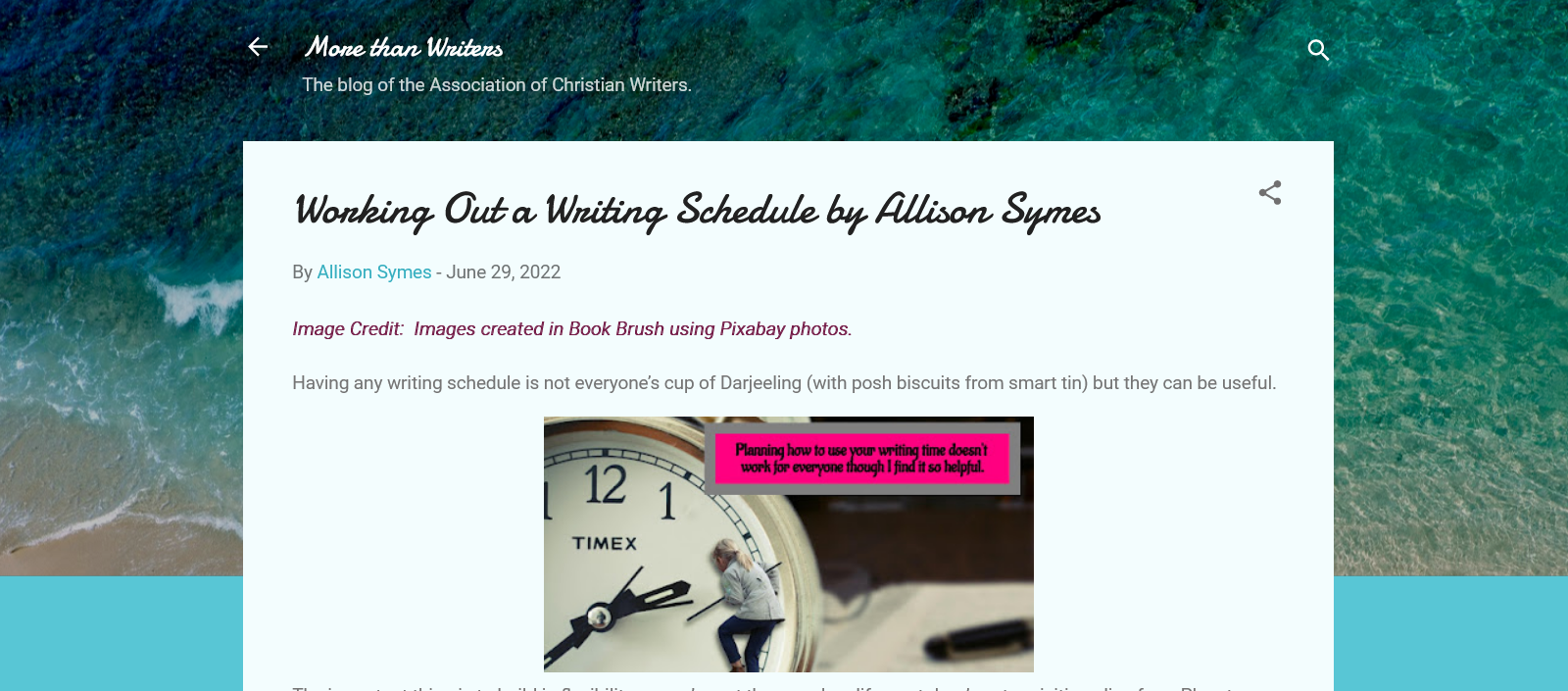
It’s my turn once again on More than Writers, the blog spot for the Association of Christian Writers. This time I talk about Working Out a Writing Schedule. I look at why I find these useful and why it is so important to build in flexibility.

Life does get in the way at times after all but I’ve found knowing what I’m going to be writing on any one day means I am more productive. I can get straight to my desk and get on with things and I like that.

Screenshot 2022-07-01 at 09-24-51 Working Out a Writing Schedule by Allison Symes

Facebook – From Light to Dark and Back Again

My latest story on Friday Flash Fiction is an upbeat one. Hope you enjoy The Big Day. I have every sympathy for my character, Janine, here. See what you think!

Screenshot 2022-07-01 at 09-21-26 The Big Day by Allison Symes

30th June
How is it the end of June already?! Time marches on (which makes a great theme for a piece of flash fiction!).

Don’t forget you can use time as a structure for your story (as well as a theme). How? Well, I’ve written the odd diary style story. (That one took me up to the 1000 words limit but that was fine. The story was great fun to do and you can find it in Tripping the Flash Fantastic – Losing Myself).

But you could also set a story which has to happen over a few hours and you put in time progression as the story goes on.

You could also show what happens to a character over a longer time period, which could work well as a series of linked flash stories. I’ve sometimes used Time as a character too.

BookBrushImage-2022-6-30-19-5631

Am posting earlier than usual today as I’ll be leading the Association of Christian Writers’ Flash Fiction group on Zoom later on. Always good fun and much learned and shared. Always a joy to talk about flash fiction too!

My more reflective pieces (such as They Don’t Understand from From Light to Dark and Back Again or The Pink Rose from Tripping the Flash Fantastic) are hard stories to do. Why? Because I still have to ensure there is a story in there.

I have to ensure my character voice is strong enough to “carry” the tale so you want to read what they have to say. This is where planning out my character helps enormously because it means I’ve got to know them well enough to know where they are coming from and why they have got a story to tell. That in turn makes it easier to write said story.

BookBrushImage-2022-6-29-16-1740

Fairytales with Bite – Where Fairytales DO Bite

It has always annoyed me fairytales are considered in some circles as twee little tales for the kiddies. It does tell me one thing immediately though – the person saying that has not read fairytales in ages. They certainly haven’t read the originals which are often violent. Disney has had to water them down for family viewing!

Fairytales are unflinching in showing cruelty up for what it is too and that justice is often on the rough side. Think of The Red Shoes. The wicked stepmother in that has to dance in those shoes until she drops down dead. The Big Bad Wolf is boiled alive in The Three Little Pigs.

Twee – definitely not then.

I do love their robust honesty about what human nature can be like though. Fairytales don’t pull their punches. And that is how it should be.

BookBrushImage-2022-7-1-19-4524

This World and Others – Society Norms

Following on from Fairytales with Bite, I think fairytale reflected society norms (and can still do so). People were used to the idea of short lives and for their society to be often violent and unjust. Fairytales were a way of showing that justice could be done, even that too was rough at times.

Though, thankfully , we have moved on (at least in general terms – the UK no longer has the death penalty for example) there is still a deep down wish evil should not prevail. Injustice rightly angers us.

So when it comes to your own created world, what are the society norms there? Are people so used to the violence around them they just accept it? How do your characters seek to improve things (and I’m taking it as a given they are seeking to improve things – there’s a great story structure right there)?

What do they have to overcome? Who helps them? Is magic involved? What are the end results? How are society norms changed by what they do? And there should be change.

Story is all about change, conflict and resolution after all, regardless of genre.

This slideshow requires JavaScript.

Twitter Corner (2)

https://platform.twitter.com/widgets.js https://platform.twitter.com/widgets.js https://platform.twitter.com/widgets.js

Processing…
Success! You're on the list.

Underlining In Fiction


Image Credits:-
All images from Pixabay/Pexels unless otherwise stated. Book cover images from Chapeltown Books and Bridge House Publishing. Screenshots and one photo were taken by me, Allison Symes.
Hope you have had a good week. Mixed bag weather wise (hot, cold, windy etc). Will be having another story on CafeLit next week and am looking forward to sharing that. Working away on further workshop material too.

BookBrushImage-2022-6-24-19-428

Screenshot 2022-06-24 at 09-19-44 Underlining in Fiction - Chandler's Ford Today

Facebook – General – and Chandler’s Ford Today

Pleased to share my latest Chandler’s Ford Today post on Underlining in Fiction. I look at how writers can stress points without seeming to repeat themselves. Also I look at where repetition, carefully used, can be effective too in underlining an important point. I give an example of underlining that I use when running workshops. (It’s also a good example of show and not tell).

I discuss how characters themselves can do the underlining, whether they are conscious of that or not, and why it matters to pick the right thing to underline.

For example, I want my readers to pick up on my themes from what I show them through what my characters say, do and think. I don’t want to have to spell everything out (for one thing I think that’s boring – I love working things out for myself when I read other writers’ books. I just need the right clues).

The best underlining is subtle. You want your readers to absorb things and work things out and to have fun doing that!

Underlining in Fiction

This slideshow requires JavaScript.

Cooler today though Lady, and her lovely gentleman friend, a wonderful Aussie Shepherd, were clearly happy about that as they ran around. It was a joy to watch them.

My Chandler’s Ford Today post (Underlining in Fiction) goes up tomorrow – I don’t know where the time has gone as I rapidly head towards the end of this series. Link up above.

I use a variety of ways to find ideas for my blog posts, as well as my fiction. Often the random generators (especially the theme and question ones) can be used to trigger ideas for a CFT post say.

For example this came up on the random question generator I often use – If you lost all of your possessions but one, what would you want it to be?

  1. I could invent a character here and get them to answer the question (and that would be the story. Nice thing about that is I’ve got a basic structure in place immediately too. Questions always need answering!).
  2. I could answer the question directly and frame a CFT post around it.

You get the idea so why not give the random generators a go if you are looking for non-fiction inspiration.

This slideshow requires JavaScript.


Another hot day here though Lady was pleased to see her best buddies, the Rhodesian Ridgeback and a lovely Hungarian Vizler, today. Am looking forward to another swim tomorrow.

I’ll be talking about Underlining In Fiction for Chandler’s Ford Today – post up on Friday. See above. Am busy getting my author newsletter ready for July. Do sign up for tips, stories, prompts etc at https://allisonsymescollectedworks.com.

Do you find it harder or easier to write much in the hot weather? I must admit I flag a bit but this is where writing short pieces is a bonus as I still feel like I’ve got something useful done and that is enough for me.

This slideshow requires JavaScript.

Facebook – From Light to Dark and Back Again

It’s Friday. It’s storytime. It’s time for Friday Flash Fiction. Hope you enjoy my latest – A Picture Paints a Hundred Words. Written in exactly one hundred words of course, barring the title.

Screenshot 2022-06-24 at 11-42-40 A Picture Paints A Hundred Words by Allison Symes

Getting into the head of your characters is vital in any fiction but for flash, with the short word count, it is essential to do that from the get-go. This is why I outline what I need to know about a character before I start writing their story up. I need to know what their reactions to any situation would be at once – I can then decide which situation I’m going to throw them in! It is great fun dropping your characters right in it.

I read a wonderful short story ages ago in The Oxford Book of Humorous Prose (compiled and edited by the much missed Frank Muir) where the characters come to life and berate their author. Very funny – and a teensy weensy bit scary for any writer I think!

Knowing your character’s basic attitudes (and why they have them) is a good way in here. Fleshing your character out means you are more likely to write their stories up with conviction because you know your character is definitely capable of this. You’ve already seen how and why they would be like this.

I’m convinced a writer’s belief in their character does come through in the story. Certainly I can sense when a writer has fun with their character precisely because I do the same thing myself with mine.

This slideshow requires JavaScript.


I have fun sometimes having titles which are capable of more than one interpretation. For example in my story Serving Up a Treat from From Light to Dark and Back Again, I can take that in a lighthearted way or not, as I see fit. (Not saying which way I did though – do check out the book! Yes, I know I’m bound to say that!).

I also see this as giving my imagination more room in which to work. Proverbs and well known sayings come in handy here. And guess what I just found? Yes that’s right – a random proverb generator! Will take up less room than the old book of proverbs I suppose but this will prove to be another useful tool to use to trigger story ideas. Hope you have fun with it too.

20220624_195637(1)

Fairytales with Bite – Character Development

I am partial to character development in any story, regardless of what genre it is or its word count length. Indeed I don’t think you can have a story without it given something has to change and often it is the character that does the changing. Sometimes it is forced on them if they are going to survive. Sometimes they are happy to change. Maybe they have been waiting for the chance to do so and escape something.

In fairytales, I think this is even more important. I don’t think a wave of the magic wand should be the cure to all ills. Where’s the drama in that? Even when the fairy godmother turns up to help out, I still want the main character to have done something to merit that help and to still have problems to sort out after the wand waving!

To avoid the old problem of character cardboard cut-outs, your character does need to have some sort of back story which has a bearing on their story now but which they overcome. That is the kind of development I love to read and write.

So think about how your characters will develop over the course of your story. Where is the moment when they have to change and go on to better things? How do they make themselves face up to what has to change? Great conflict can come from a character’s internal struggle as well as external circumstances.

BookBrushImage-2022-6-24-20-530

This World and Others – Formative Experiences

One of my earliest formative experiences is that of my late mum teaching me to read before I went to school. Back in the day, she got told off for that. (These days they’d probably give her a medal). Apparently Mum taught me in the wrong way. Have I felt the lack? Not a bit of it. Am I grateful to Mum for giving me my life-long love of books and stories (and from there the wish to write my own)? Oh yes!

What kind of formative experiences have shaped your characters? What impact are they having on your characters’ lives now for the purpose of your story? I don’t always put such things into my stories but I need to know enough about my characters to be able to envisage what they would do and how they would react in any given situation. Knowing what drives them including formative experiences is so useful here.

Also bear in mind a society’s formative experiences as well. A society which has had to face continual threat of invasion is likely to have a reasonably strong military to try to counter that and/or seek alliances with other threatened worlds. So their attitudes towards diplomatic relations will be different from a strong, isolated kingdom which feels it has no need of anyone else. Their people’s views and attitudes will be coloured by things like that.

BookBrushImage-2022-6-24-20-1226

Twitter icon

https://platform.twitter.com/widgets.js https://platform.twitter.com/widgets.js

Processing…
Success! You're on the list.

Travelling Workshops

Image Credits:-
All images from Pixabay/Pexels unless otherwise stated. Book cover images from Chapeltown Books and Bridge House Publishing. Photos for Chandler’s Ford Today post taken by me, Allison Symes, as were the screenshots.
Hope you have had a great week. I had a wonderful time at the Association of Christian Writers Golden Jubilee weekend. Many thanks to those who came to my flash fiction workshop. It was so lovely catching up with old friends and making new ones. It’s great to be out and about again too.

BookBrushImage-2022-6-10-19-4427

Facebook – General – and Chandler’s Ford Today

Am pleased to share my Chandler’s Ford Today post this week about Travelling Workshops. I look back at the Scottish Association of Writers conference, and the more recent workshops I ran for the London Jesuit Centre and the Association of Christian Writers Golden Jubilee weekend.

Screenshot 2022-06-10 at 09-27-05 Travelling Workshops - Chandler's Ford Today

I look at the point of workshops, I discuss the value of writing exercises (whether I set them or do them!), and share my thoughts on why workshops should be interactive. Hope you find the post useful preparation for your next workshop!

Travelling Workshops

This slideshow requires JavaScript.

Hope you have had a good day. My Chandler’s Ford Today post about Travelling Workshops will be up tomorrow. See above. I then plan to resume my In Fiction series after that. Will be at the letter T for next time (17th June) so I am getting there!

It’s been a busy week since coming home from the ACW Golden Jubilee weekend but it is always a better week when you happily get a publishing contract sent off to someone you’ve worked with before on many happy occasions. Also spurs me on to try and get another one!

A big thank you for the response to my rather long post yesterday. Just sometimes you really feel the need to say something, right? And I wanted to share that my writing journey has had (and will continue to have) setbacks. The writing life is up and down and I think over time you get used to that. I’ve found it has helped me appreciate the up times far more (and to not take them for granted).

One of the joys of writing for me, whether it is published or not, is having an outlet for creativity. For many years I sought to just write for myself. I wanted to prove to myself I could write and keep on writing. It was only when, with my confidence up a bit knowing that I could write, I stared approaching publishers etc. That was a huge learning curve in itself!

This is a good indication of why I say writers always learn. You have to learn from your mistakes so you can do better (and sometimes just being alerted to what the mistake is can be a great help. I found that when someone told me about vanity publishing).

BookBrushImage-2022-6-10-20-534


Shortly, I’ll be having the joy of returning a contract to my publisher for a short story to appear in an anthology due out later this year. It’s always a lovely thing to do but for many years, I despaired of ever being published. All I ever seemed to receive were rejections or, even more frequently, I just wouldn’t hear back. So what changed?

Firstly, I didn’t give up. Secondly, when I could get feedback on my short stories (some competitions offer this), I took it. Thirdly, I read plenty of writing advice (reputable writing magazines and websites etc) and tried to apply it. Fourthly, I gave myself much more editing time before submitting a story anywhere. All of those things put together made a huge difference.

The best tip is the last one though – write regularly and read regularly. It is the regularity that matters. You do kind of build up your writing “muscles” here. From reading, you can work out what it is about stories you love or dislike and apply those principles to your own stories. I dislike insipid heroines so am not writing any!

Yes, you do need some luck. But putting in all the work you can matters too. It is a bit like an apprenticeship here and every writer I know has had their fair share of set backs.

The positive thing about the rejections? They made me look at my stories again and sometimes I could find a way to improve them. So I did. I then resubmitted that work somewhere else and I have been published doing that. Sometimes it was a case of accepting I could do no more with this particular tale – time to write more.

And I found having a story “out there”, another one being written and rested ready for editing, and another one being drafted helped a lot. It still does. It means I always have something on the go. It pays not to pin your hopes on one story on the chance it will be rejected and that then crushes you.

BookBrushImage-2022-6-10-20-1043

Facebook – From Light to Dark and Back Again

It’s the end of a long week (well it will seem like an even longer one than usual after the Platinum Jubilee weekend!) and it is time for another story. My new tale on Friday Flash Fiction is Midnight Bells. See what Maggie thinks about bells and firemen here!

Screenshot 2022-06-10 at 09-27-17 Midnight Bells by Allison Symes

If you’d like to check out my latest column on flash fiction for Mom’s Favorite Reads, you can do here. It is great fun writing for the magazine (and a challenge too but writers need a challenge to keep their creativity firing on all cylinders, so to speak).

As with my blogs, I prepare material in advance and this does pay off. It means I’m not going to worry about deadlines as I know I’ve got the piece prepared. And I draft future blogs too. I inevitably use these on those occasions where I really don’t have time to write anything new. That pays too.

Screenshot 2022-06-06 at 20-40-38 Mom’s Favorite Reads eMagazine June 2022Screenshot 2022-06-06 at 20-40-13 Mom’s Favorite Reads eMagazine June 2022

Great to see such wonderful comments coming in for On The Doorstep, my most recent story on Friday Flash Fiction Thanks everyone. I love inventing characters but sometimes one particularly “gets” to you. For me Mabel does that here. See what you make of her.

Screenshot 2022-06-10 at 20-22-49 On The Doorstep by Allison Symes

Fairytales with Bite – Celebrations

I loved watching the Queen’s Platinum Jubilee events recently (and I especially loved the Paddington Bear sketch – marmalade sandwich, anyone? Do look this up if you haven’t seen it – it’s good fun and quite sweet too). So all of that turned my thoughts towards celebrations.

In your fictional world, what would these celebrations be for? What food and drink would they have? What music? Can anyone take part or are only certain types allowed to celebrate? I loved the fireworks Gandalf produced in The Lord of The Rings but how would your magical world have a spectacular display like this? Would magic be used to produce it or would things be hand-made?

Is the whole of your society expected to celebrate when told to do so and what would the consequences be for those who do not take part? How do your characters celebrate when, due to their own circumstances in your stories they really don’t feel like doing so? How well can they cover up and pretend all is well?

Who would feel relief when the celebrations were over? That could range from the organisers to the security people who can now step down. So that relief can be for positive reasons rather than the obvious negative ones.

BookBrushImage-2022-6-7-20-5030

BookBrushImage-2022-6-10-20-3028

This World and Others – Commemorative Events

Commemorative events tend to be more sombre than celebrations, of course. So how does your fictional world remember important historical events? Do they actively remember to try to prevent future wars etc? Does your world have schools and how are younger members of your society educated about commemorative events, if so?

I remember being told many years ago by family what the meaning of the Remembrance Sunday/Armistice Day events was and there was no question of not watching or going to these. (My grandfathers both served in the war – one in the forces and later as an ARP Warden in London’s East End and the other in armaments in the Woolwich Arsenal – the latter was forever being bombed out).

Commemorative events are full of meaning and symbolism so how does this work in your fictional world? Can anyone pick up on the meaning of the symbols used? If anyone is excluded from taking part, who are they and why are they shut out? Do different societies in your world commemorate the same event but in vastly different ways and does this cause conflict? People don’t always like different after all.

How did the commemorative events come in to being and who was the driving force behind them? How did they persuade those in authority to stage these things?

Food for thought there I think!

BookBrushImage-2022-6-10-20-4112


Twitter Corner

https://platform.twitter.com/widgets.js https://platform.twitter.com/widgets.js

Processing…
Success! You're on the list.

Settings and Simplicity in Fiction


Image Credits:-
All images from Pixabay/Pexels unless otherwise stated. Book cover images from Chapeltown Books and Bridge House Publishing. Screenshots taken by me, Allison Symes. Hope you have had a good week. Have enjoyed what I’ve seen of the Platinum Jubilee events (and plan to catch up on the rest next week. Why then? Because I’m off to a Golden Jubilee weekend for the Association of Christian Writers, where I’ll be running a flash fiction workshop. No Jubilees for ages and then two at once!).

BookBrushImage-2022-5-31-20-5845

Facebook – General – and Chandler’s Ford Today

Am pleased to share Settings and Simplicity in Fiction for Chandler’s Ford Today. I look at how settings can act like characters. I also wonder whether some authors came up with their settings first and then knew what characters had to be in them or if they came up with the characters first and then had to find the most appropriate setting for them.

I also look at how simple writing takes work and crafting but it is a joy to read and the reader has nothing clunky getting in their way. It makes a huge difference to the reading experience for them. I often wonder when I come across over-complicated prose, as I do sometimes, just what the writer was trying to hide or show off here. For me the joy of writing is about communicating with a reader and I want to be as direct as possible on that. I don’t see the point of doing anything else.

Settings and Simplicity in Fiction

This slideshow requires JavaScript.

2nd June – Queen’s Coronation Day Anniversary

Loved watching Trooping the Colour and the flypast today. Fabulous weather. Great crowds too. I plan to catch up with the other events once I am back from the ACW Golden Jubilee weekend. Am off on my travels for that tomorrow.

My Chandler’s Ford Today post tomorrow is all about Settings and Simplicity In Fiction. I look at how settings can act like characters and why simple writing isn’t as easy as it (a) looks and (b) sounds. One benefit from flash fiction writing is it has taught me how to spot my wasted words, what doesn’t add anything to my story, so I know to ruthlessly cut all of that on my edit.

And I have publication news too – I am pleased to say my story has been accepted for the Bridge House Publishing anthology due out later this year. More news as and when – am delighted to be included again. Congratulations to everyone else who received this lovely news too!

BookBrushImage-2022-6-2-20-1227

Two days to go to the ACW Golden Jubilee weekend. So looking forward to seeing everyone.

Next trip after that will be to the Swanwick Writers’ Summer School in August. Looking forward to that too! Am getting good use out of my railcard this year. This is nice because I was the woman who bought a railcard two weeks before the first lockdown started in 2020 when nobody was going anywhere. Oops! Making up for lost time now though.

I will be putting my posts up as normal over the weekend but they will be at different times. Will be pretty busy during the day and evening so expect the posts to go up late. I do hope to write up about the weekend (and my time with the lovely people at the London Jesuit Centre recently) for a CFT post before long as well.

Chandler's Ford Today post reminder picture(1)

Facebook – From Light to Dark and Back Again

So pleased to share my latest story on Friday Flash Fiction. Hope you enjoy On The Doorstep. This was a joy to write and I was rooting for my character, Mabel, all the way through. This is good. The first person to care about a character should be their creator!

https://www.fridayflashfiction.com/100-word-stories/on-the-doorstep-by-allison-symes

Screenshot 2022-06-02 at 20-42-56 Friday Flash Fiction

One reason I outline before writing a story is to avoid the old saggy middle problem. Yes, it can happen in flash fiction too. I’ve found knowing my start and end points is a good way of avoiding that issue. I know where I’m heading so off I go!

How much to outline is up to each writer. I don’t fill in each and every detail as I want to give my imagination manoeuvre room, as I’ve mentioned before, but I do need the “pillars” of the story in place so I know from the start the structure is going to be okay. (Maybe without a good structure in place, that encourages the saggy middle to happen – just a thought).

I think it is a question of working out what you need to know before writing a story and that will differ from writer to writer as well.

BookBrushImage-2022-6-2-20-1818

Looking forward to sharing the joys of flash fiction at the ACW Golden Jubilee at the weekend. Talking about talking…! One good thing about flash is when you do use dialogue, you’ve got to keep it focused. I must admit I do enjoy getting characters chatting but conversational ping-pong is not the idea!

What I look for dialogue to do (including internal dialogue) is for it to move the story on in some way. If it does, fab; it stays in. If not, out comes the old editing pen. It has helped to be aware though that I do like conversational ping-pong. I love to hear my characters speak because to me that proves they are “real”.

But the overriding concern has to be does it help the story develop? That is my guiding light as to whether something stays in a tale or not, regardless ot the story length.

BookBrushImage-2022-6-1-20-2620

Fairytales with Bite – Clothes in a Magical World

When the thought for this topic came to me. I thought of two stories immediately. The obvious one was Cinderella – the rags being turned into that wonderful dress.

I also thought of the fairytale The Elves and the Shoemaker – I do count shoes as clothes (well, if you’re going out somewhere, you need something on your feet!, but also because of how this story ends with the shoemaker’s wife sewing clothes for the elves in return for their kindness to her husband and herself. I also like this story because you get to see the elves being cobblers (and not just using magic to make the shoes etc) and you also see the wife sewing.

I could have thought of The Emperor’s New Clothes too but that is really a story about a pair of successful con artists when all is said and done!

So in your created world, what do your characters wear? What are the differences between species and/or classes here? How are the items made? Is there a manufacturing industry as such or does everyone make their own? Or are skills bartered? What equipment is used? I’ll take spinning wheels as a given!

In your stories, you almost certainly won’t need to go into a lot of detail here but the odd line here or there about who wears what, where they get clothes etc from will help your world seem more real to a reader. Having a character go to a shop (or your world’s equivalent) would be enough to show a reader how this works. I love little details in stories. They help me picture things and I won’t be the only reader who thinks that.

This World and Others – Material Matters

Tying in with Fairytales with Bite , where does your fictional world get its materials from, whether for clothing, shoe making or anything else? Can it produce its own or does it have to import some or all of what it needs? Where would it import from and have there ever been trade wars etc or have two societies been able to trade successfully?

When it comes to producing its own, what can it produce? Are crops (such as cotton) grown? What kind of people in your society would do things like that? Are they looked down on for doing manual work or held in high esteem? Attitudes to others have repercussions!

What does your fictional world value? We obviously value things like gold and silver but do they? In a world where that is common place, it might be treated with contempt. You don’t tend to notice the “every day” stuff.

This slideshow requires JavaScript.


Twitter Corner

<blockquote class=”twitter-tweet”><p lang=”en” dir=”ltr”>Pleased to share latest CFT post. I look at settings acting like characters and why simple writing isn’t easy writing. It is vital for good prose though!<a href=”https://t.co/llXyQpHphi“>https://t.co/llXyQpHphi</a></p>&mdash; Allison Symes (@AllisonSymes1) <a href=”https://twitter.com/AllisonSymes1/status/1532659454084251648?ref_src=twsrc%5Etfw“>June 3, 2022</a></blockquote> http://a%20href=

<blockquote class=”twitter-tweet”><p lang=”en” dir=”ltr”>Hope you enjoy my latest drabble on Friday Flash Fiction. I was rooting for my character, Mabel. Hope you do too.<a href=”https://t.co/Q7WjxPCo5T“>https://t.co/Q7WjxPCo5T</a></p>&mdash; Allison Symes (@AllisonSymes1) <a href=”https://twitter.com/AllisonSymes1/status/1532659994797154304?ref_src=twsrc%5Etfw“>June 3, 2022</a></blockquote> http://a%20href=

Processing…
Success! You're on the list.

Reading, Rhythms, and Resolutions In Fiction


Image Credits:-
All images from Pixabay/Pexels unless otherwise stated. Book cover images from Chapeltown Books and Bridge House Publishing. Screenshots taken by me, Allison Symes.
Hope you have had a good week. Am looking forward to the Association of Christian Writers Golden Jubilee weekend at the end of next week. I’ll be running my flash fiction workshop at that. Good to have some gloriously sunny weather in my part of the UK. The dog and I have been making the most of it!

WOWIG advert

Facebook – General – and Chandler’s Ford Today

I’m pleased to share Reading, Rhythms and Resolutions in Fiction for Chandler’s Ford Today this week. Must admit I’m enjoying writing the In Fiction series. Only one more tricky letter to think about – X! Wish me luck!

In this week’s post I look at the reasons why writers should read widely. It’s something writers are often told to do but here I look at specific reasons why it is such a good idea. I also look at why making writer friends also helps with your reading “diet” – doing so myself has done wonders for mine!

I go on to look at rhythms in stories. Now these can vary depending on genre. Crime ones for example tend to have a fast rhythm to them, a reflective piece has a slower one, but all have to follow an internal rhythm we as readers subconsciously pick up on.

Occasionally I have read a story which hasn’t felt right to me and on looking back at it, this is because the rhythm of the story is wrong for the type of story that it is. Something feels out of kilter and it is nearly always the rhythm.

As for the resolution side of things, again a story has to have a resolution which works for it. Sounds obvious, doesn’t it? But it doesn’t always work out in practice. A resolution shouldn’t be based on chance. It should also be apt to the character and type of story. My post looks at this aspect of things too. Hope you enjoy the post.

Reading, Rhythms, and Resolutions in Fiction

This slideshow requires JavaScript.

Reading, Rhythms, and Resolutions In Fiction is my Chandler’s Ford Today post for this week – link up tomorrow. See above.

I’ll be looking at why reading is so important for a writer, how stories should have a natural rhythm to them (though the rhythm can vary on genre – crime fiction will always be faster paced than reflective tales, say), and why resolutions should tie in with and make sense for your character and setting.

Just over a week to go to the Association of Christian Writers Golden Jubilee weekend. Am so looking forward to going and catching up with people. I’ll be running my flash fiction workshop and I hope people will leave it either with a draft story completed and read out later in the day or with something for them to take home and work on further (and then submit somewhere. I would love to hear of publishing success as a result of this). Looking forward to the Swanwick Writers’ Summer School later on in the year too.

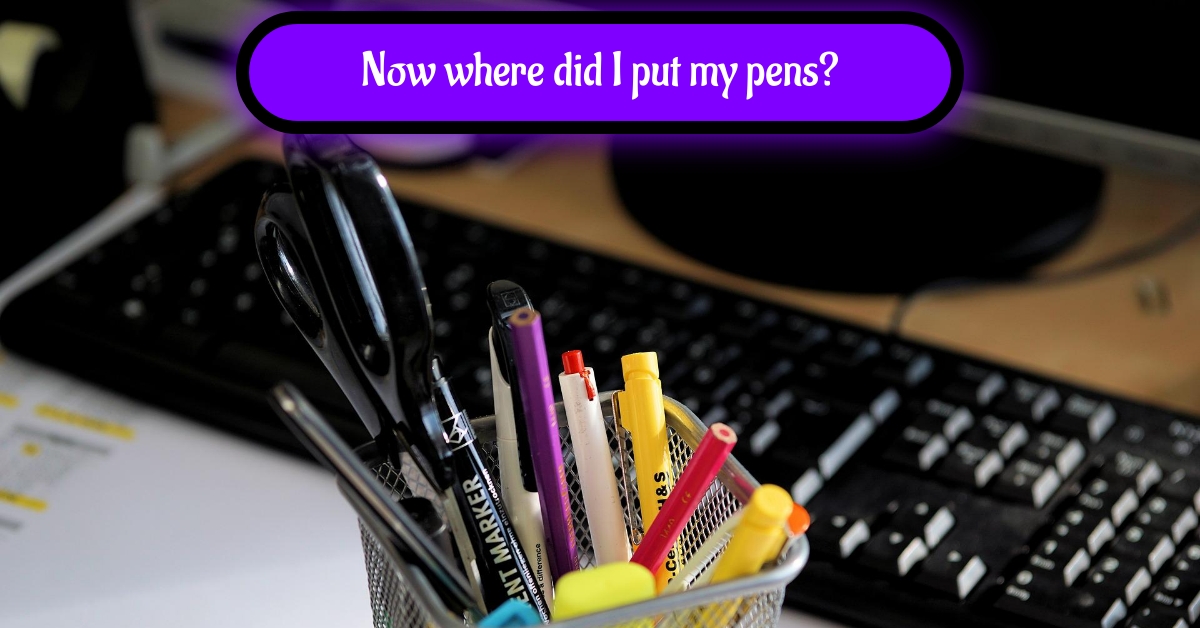
Writing Niggle Number 1890 – why is it I can never find a pen when I want one? I know I’ve got them. I’ve got loads in fact. But are they ever to hand when I need to jot something down quickly? Of course they’re not! For almost any other profession, this would be one of those things but for a writer? We’re supposed to have pens on us!

BookBrushImage-2022-5-26-19-594

Blustery day today, more like autumn out there. Not impressed! Am grateful writing is generally done indoors.

Do you have any writing niggles? If you’ve got loads, which ones particularly bug you? Mine are:-

1. Phone going just as I am completing an edit and I lose my train of thought. Okay, I can ignore the phone, but that train of thought has been derailed and nothing is bringing that back quickly. It is as if I have to step right back to just before that wretched phone rang…

2. Manage to do that and am settling down to editing the next bit when guess what… the phone goes again. Worse, it’s one of those fake Amazon/Inland Revenue calls designed to part you from your money. I’m usually thinking unpleasant thoughts at this point. May ask one of my crime writer pals (you know who you are) to arrange something to deal with these people in their next novel so the scammers never bother anyone again. How about it, girls? You would be doing the world a service here, honestly.

3. Getting off to a slow start with my writing session, then the spark really gets going and I can’t type fast enough. Okay it’s great the spark gets going but I prefer an even pace throughout and would like that spark to turn up sooner! I’m good to go, it’s just that my brain isn’t! Have learned to accept you do just get days like this. What matters is I am writing something which can be improved at a later date but it is frustrating at the time.

BookBrushImage-2022-5-25-16-5910

Facebook – From Light to Dark and Back Again

Am pleased to share my latest story on Friday Flash Fiction. This one is called The Heights of Equals and is based on a random generator which came up with “pet peeves” as a theme.

I chose one pet peeve for one character and created the story from that. It is also one where I have immense sympathy with my heroine here given I am also under five feet tall. Is it a coincidence I gave my heroine the same name as myself given this information? Err.. No! Hope you enjoy it.

Screenshot 2022-05-27 at 09-24-38 The Heights of Equals by Allison Symes

Really enjoyed the Association of Christian Writers’ Flash Group meeting on Zoom last night. I set everyone a challenge too which I will also have a go at. Groups like this are great for encouraging you to write (a) more – if I do the challenge, I will have an extra story to my credit and (b) encourage people to write something short.

The nice thing with flash is you have a market now for small pieces. If time is tight as it so often is for most of us, five minutes is enough to draft something towards a complete flash story. You’ve then got something to carry on with the next time you’ve got five minutes spare. You can build up a story like that.

BookBrushImage-2022-5-26-20-512

I was chatting about writing niggles over on my Facebook author page and one that bugs me from time to time over flash fiction writing is when I’ve got an idea for a 100-word story and a competition/market to sent it to, but try as I might, the tale will end up at 150 words or so. I know now to leave it as it is and write something else for the 100 word market but it can be frustrating at times!

Having said that, this happens and it means I end up writing two stories so you could argue it increases my productivity.

Screenshot 2022-05-27 at 17-15-34 Allison Symes Facebook

Fairytales with Bite – Using Minor Characters

I’ve used minor fairytale characters in stories. Indeed my first published story in print was about the youngest stepsister to Cinderella and appeared in Bridge House Publishing’s Alternative Renditions anthology back in 2009. It is great fun to write fairytales from the viewpoint of other characters.

Minor characters should have a vital role to play in your story, even though they’re not on the “stage” for long. This could be anything from providing key information to unwittingly getting in the way and having to be “removed” in some way so the lead character can get on with the job they’re meant to do. It should be clear to the reader why they’re in the story. The story should feel as if something was missing if they weren’t in it.

A good way of flagging up whether a character is important to a story is to name them. Unnamed characters are generally seen as “walk-ons”.

In longer works, minor characters can have sub-plots of their own which should add something to the overall plot. Think about The Lord of the Rings. The lead story there is Frodo’s quest to destroy the Ring of Power but there are many sub-plots including the role of Pippin and Merry. They’re not major in their own right (not compared with Frodo and Sam anyway) but their story adds something vital to the overall depth of that book.

Could your minor characters do the same for your story?

Always ask yourself what their role is to ensure there really is a place for them in the tale.

BookBrushImage-2022-5-27-17-2110

This World and Others – Layers

What layers does your fictional world have? I think of layers as dimensions to the fictional world created. For example. Do you focus on the political side of things with layers of government etc. Or do you focus on the creative side of your world with the layers being the various arts and industries supported by those arts?

What is the most important thing about your fictional world and how does that impact on your characters?

What layers are there to your characters themselves? What hidden depths do they have (or are they strictly shallow)?

I focus on characters for my stories so I want to know what drives those people. I need to know what their major trait is as that will give me a rough picture of what they are like.

Minor traits tend to back up the major one. For example, if a character is brave, are they also honest, direct in their speech and actions etc? Answering those questions helps me build up a composite picture of my characters and then I get on with the draft.

Working out what you need to know, what layers your world/characters needs to have for you to write convincingly about them, pays off. It can can save you a lot of grief in the editing.

BookBrushImage-2022-5-27-17-277

Twitter Corner

https://platform.twitter.com/widgets.js https://platform.twitter.com/widgets.js

Processing…
Success! You're on the list.

Questions in Fiction

Image Credits:-
All images from Pixabay/Pexels unless otherwise stated. Book cover images from Chapeltown Books and Bridge House Publishing. Screenshots taken by me, Allison Symes.
Hope you have had a good few days. I ‘fess up to one of the downsides of scheduling this week! Let’s just say I think most schedulers get caught out this way at some point and this week it was my turn!

BookBrushImage-2022-5-20-18-5937

Facebook – General – and Chandler’s Ford Today

Now I’ve talked before about the virtues of scheduling blog posts etc. It is a useful thing to do but one slight downside is it can mean you get ahead of yourself a bit and I’ve realised I’ve just done that for Chandler’s Ford Today.

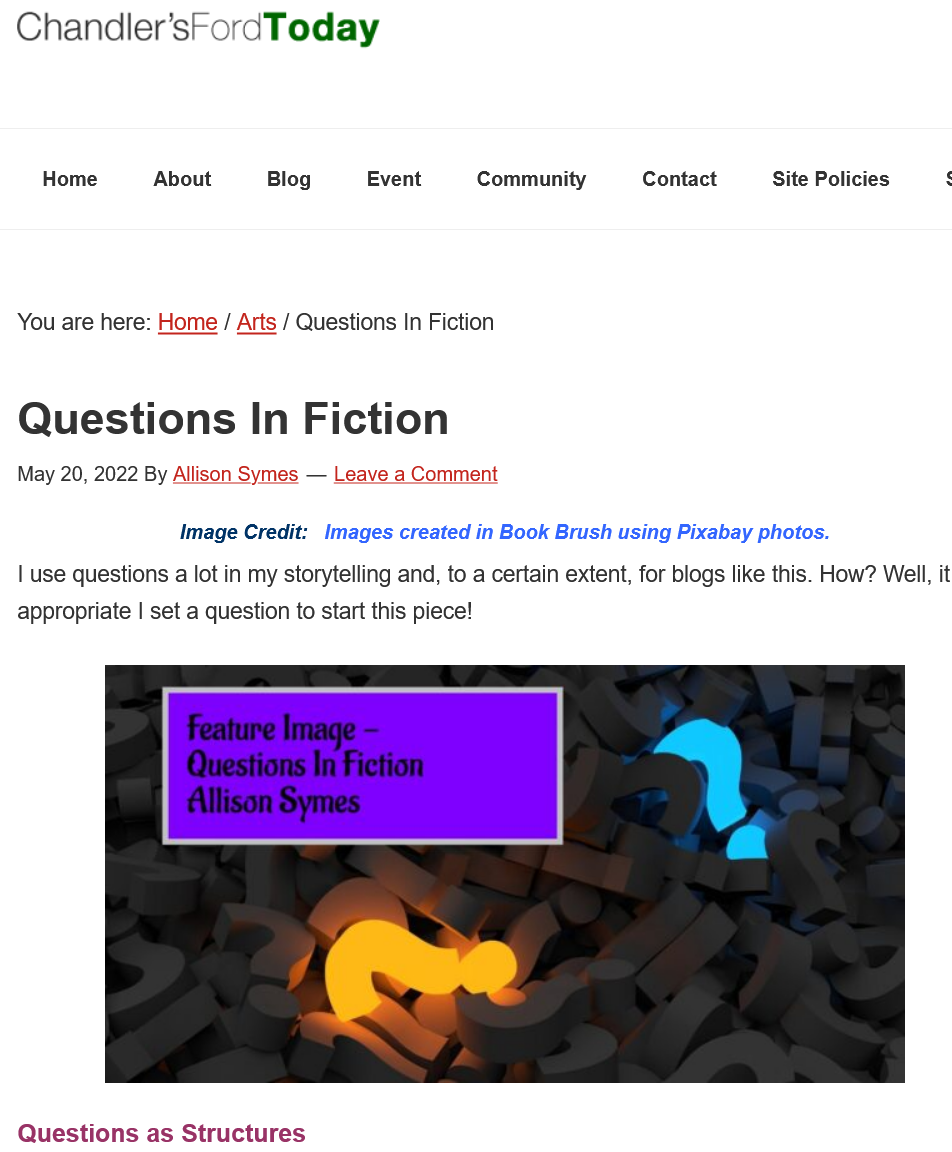
My post this week is actually called Questions in Fiction where I talk about using questions as a structure, as inspiration for themes and titles, and I look at questions for characters too.

Screenshot 2022-05-20 at 09-54-18 Questions In Fiction - Chandler's Ford Today

My Reading, Rhythms, and Resolutions post will be on CFT next Friday, 27th May and will I hope to prove to be equally useful as I discuss why reading matters so much to writers. I will also look at rhythms in stories and how resolutions have to be suitable, even if not happy ones.

Apologies for the mix up but as ever comments on all of my CFT posts are welcome over on the website. (It has been a long week! That’s my excuse and I’m sticking to it!).

Questions In Fiction

This slideshow requires JavaScript.

Hope you have had a good day. Nice to see some decent weather. Other half and I enjoyed our evening meal al fresco which was lovely and not something we get to do that often.

My Chandler’s Ford Today post tomorrow covers Reading, Rhythms, and Resolutions in Fiction. Err… no! See above! As ever comments are welcome in the CFT box. This is always true though!

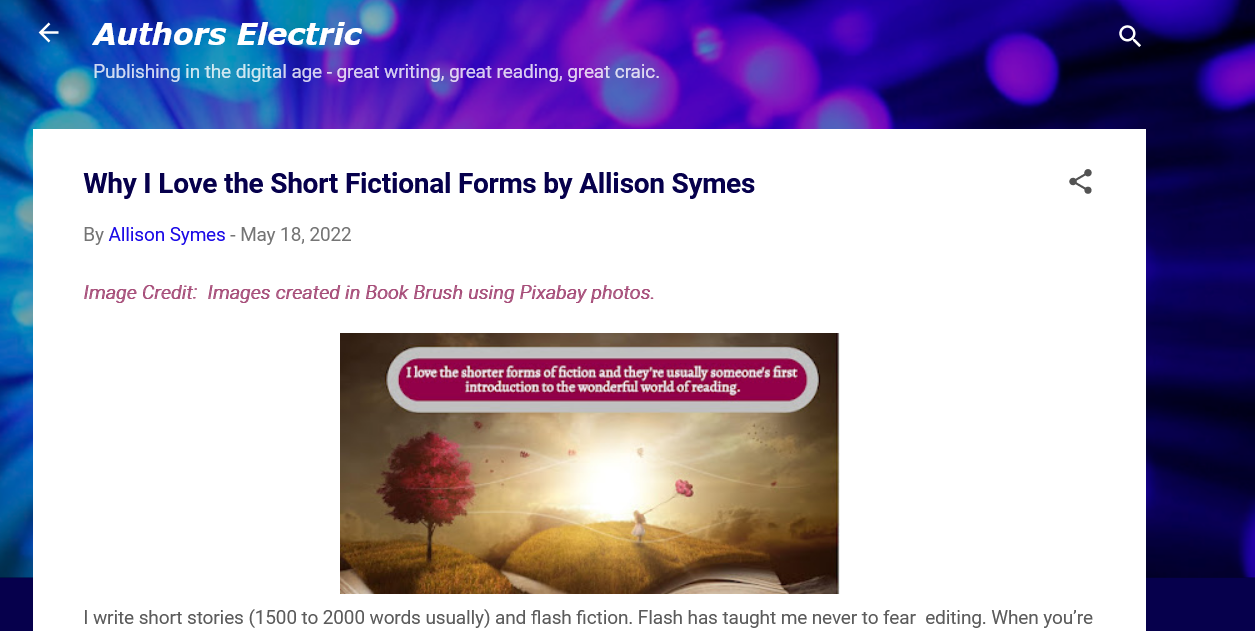
Talking of comments, many thanks for the comments in on my Authors Electric post yesterday. See below. I was talking about Why I Love the Short Fictional Forms. I love novels, novellas, short story anthologies, and flash fiction collections though I must admit I would like the latter two to have as much “status” as novels.

What every short form writer will hear at some point includes the following:-

1. When are you going to write a proper book?

2. Can you only do short stories then?

3. You must be belting out short stories all the time then because they can’t take you long!

4. Are short stories only for children?

5. Is there really a market for short stories?

Answers (possibly given to stop the writer from gnashing their teeth at the questioner):-

1. A short story or flash collection is a proper book. It still takes time to compile, edit, and proof-read.

2. No but I love short stories so that’s what I write.

3. I do write a fair few but each story needs editing and crafting and that takes longer than you might think.

4. No! Best example here is the original story of The Birds by Daphne du Maurier, which Alfred Hitchcock then turned into a film. Definitely not for kids!

5. Yes. It’s a question of knowing where to look. There are the magazines, including the online ones. There are the competitions. And then there is the indie press who are open to collections.

I feel better for getting that off my mind!

BookBrushImage-2022-5-19-18-5539

18th May – Authors Electric
It’s always a joy to blog for Authors Electric, especially when it’s on a topic close to my heart. This month I talk about Why I Love The Shorter Fictional Forms. I celebrate the wonders of the short story and flash fiction formats here.

One great aspect to them is you get the “payback” from a twist in the tale story, to name one example. that much more quickly. And I love going on from story to story in a collection too. In one book I can read a variety of moods and genres. Why should mixed assortments only be for chocolates?!

Screenshot 2022-05-18 at 08-51-06 Why I Love the Short Fictional Forms by Allison Symes

Facebook – From Light to Dark and Back Again

20th May 2002 – Bonus Post – Mom’s Favorite Reads
Pleased to share a bonus post tonight. Here is an example of a column I write on flash fiction for Mom’s Favorite Reads. The magazine is FREE to download and, as well as the column, I set a writing challenge each month. Why not take a look, have a good read, and give the challenge a go?

Screenshot 2022-05-20 at 12-20-06 Flash Fiction

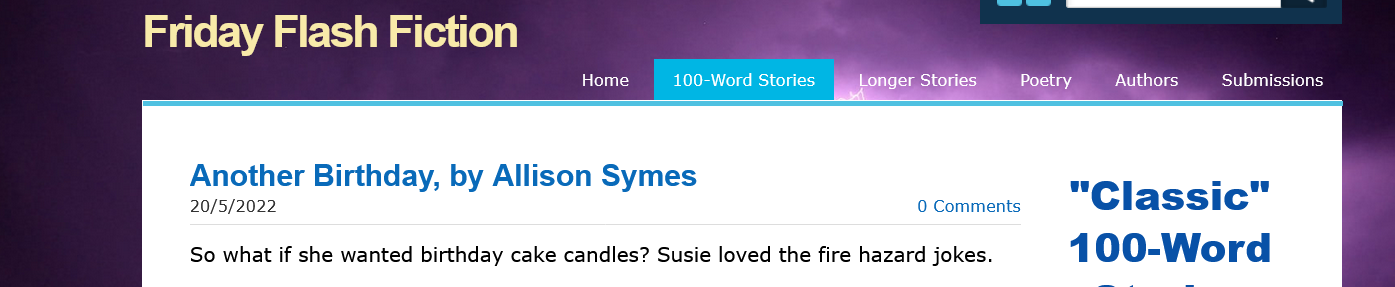
I like to start the working week with a story (YouTube) and I like to end it with one (Friday Flash Fiction). Seems like a good arrangement to me! Hope you enjoy my latest tale on FFF called Another Birthday.
Screenshot 2022-05-20 at 09-54-32 Another Birthday by Allison Symes

Titles can carry a lot of “weight” for flash fiction but I’ve found they work best when kept short. I like to use my titles to either indicate the mood of the story to come or to be open to interpretation so someone has to read the story to find out which direction I have taken it in. I sometimes subvert well known phrases (my Punish the Innocent is an example of that).

I also like using one word titles such as Expecting – the idea there is to raise questions in the reader’s mind. Who is expecting what? Are they going to be disappointed or thrilled?

So I do give some thought as to what I want my title to be/to do. For flash this is useful as in many cases, the title does not count as part of your overall word count so a writer can use that to good effect.

However, a ten word title to indicate mood etc isn’t going to work. As with the story itself, you want to have an impact on the reader and that works best when kept short. A long title will dilute the effect (and be harder for readers to remember).

BookBrushImage-2022-5-19-19-123

I love slipping in humorous one-liners into my flash stories sometimes. For example in my story, Rewards, from From Light to Dark and Back Again, I have the line “The mocking face of blue-eyed brunette, Gemma Alderson, who was endowed with a bosom that could knock someone out if deployed as a weapon”.

It was great fun writing that but I needed it to have a purpose too – I wanted to send out a specific image (and I so do there!). I could’ve just said that Gemma was big-busted and saved a fair number of words in doing that but it wouldn’t have been so much fun to read or to write.

So yes there is a time when you need more words rather than less in flash fiction but there should always be a specific purpose behind it. Here it was to raise a smile! Good enough reason for me!

Fairytales With Bite – Making the Most of Tropes

For my flash fiction, I can make the most of tropes to help me get the most out of my word count.

If I’ve got a fairy godmother character, I needn’t go into details about the magical equipment she uses, say. You will expect there to be a magic wand, probably a spell book, maybe some pre-prepared potions and so on. You will bring to the story what you know from other fairytales you have read. You will know what to expect. What you don’t want is for something to spill over into cliche.

Yet a fairy godmother character who turns up without a magic wand would seem odd to a reader. So you can use the conventions to your advantage here. You can work out what you don’t need to explain and what you can leave to your readers as they fill in the gaps.

And, yes, things like magic wands can act as a kind of a shorthand. Saves a lot of explaining on your part. Pick your “things readers could reasonably expect” carefully.

If you want to bring in a twist on your trope, such as my fairy godmother character hitting someone with her wand rather than aiming it at them, do explain why. Better still, get your characters to do it. There must be a good reason for the trope being used in a strange way.

BookBrushImage-2022-5-17-20-3640

This World and Others – World Building Acrostic

W = Work out whether you’re going to show the whole of your world in a story or just part of it.

O = Originality – what makes your world stand out? How is it different from ours?

R = Realistic characters are always vital. Just bear in mind in a strange setting, those characters can still be realistic even if, say, they are e a great big dragon! Their behaviour and attitudes should be reasonable for the world you’re in.

L = Limits are a good idea, funnily enough. Limit what your powerful characters can do and make them think of alternative solutions to problems.

D = Dreams – what do your characters want and what stops them getting it? Are their dreams/ambitions etc constrained by the type of world they’re living in?


B = Build in contrasts. Comparisons with things on earth bring home this is a alien type story.

U = Under your world – what lies there? All sorts of things are being discovered in our seas so what could be beneath current knowledge in your world? Could that have a major impact on them later.

I = Imagination. Have plenty of it! Use the right telling details to help us conjure up what you’ve created.

L= Lunches and leisure – how does your creative world affect them? Does everyone have to stop at a certain time? If so, what would happen on the odd occasion they couldn’t turn up?

D = Dig deep into your characters’ lives but also in to why this setting rather than one other.

I = Intensify the conflicts between certain people groups on your home planet.Look at how these developed. Then ideally come across people from both who will try to put things right. great drama there!

N = New scene, new paragraph. Keep things nice and tight. Drip feed information in throughout the story. Don’t go for big blocks of explaining. Those will be what readers skip.

G = Go for it! Have fun. Think about what you need to know to be able to write the world and characters up.

This slideshow requires JavaScript.

Twitter Corner

https://platform.twitter.com/widgets.js https://platform.twitter.com/widgets.js https://platform.twitter.com/widgets.js https://platform.twitter.com/widgets.js https://platform.twitter.com/widgets.js https://platform.twitter.com/widgets.js https://platform.twitter.com/widgets.js https://platform.twitter.com/widgets.js

Processing…
Success! You're on the list.

Paragraphs and Punctuation In Fiction

Image Credits:-
All images from Pixabay/Pexels unless otherwise stated. Book cover images from Chapeltown Books and Bridge House Publishing. Screenshots taken by me, Allison Symes.
Hope you have had a good week. Off to run a workshop in London tomorrow. Submitted a story for a competition I always enter. Finished judging a flash fiction competition and sent results back to the organisers. Has been a reasonably productive week!

BookBrushImage-2022-5-13-19-371

Facebook – General – and Chandler’s Ford Today

It’s that time of the week again. I’m pleased to share Paragraphs and Punctuation In Fiction, my latest post for Chandler’s Ford Today.

I discuss how both are invaluable aids to clarity in writing which in turn is going to increase your chances of acceptance by a publisher or getting a placing in a competition.

What you don’t want to do here is give them a reason to turn your work down and writing which is clunky thanks to bulky paragraphs and/or unclear punctuation (which can change the meaning of what you want to say) is a sure fire way to ensure your work is turned down.

My post looks at the Oxford comma, why size matters for paragraphs, and why keeping it simple for punctuation does pay off. I also recommend checking out house styles for publishers (and for competitions the guidelines the organizers are asking you to adhere to) and share my thoughts on why I treat writing and editing as two separate creative tasks.

Albeit editing is creative in a different way to writing that first draft but it is still creative. Honest. I find it immensely satisfying seeing how a work improves over various drafts before I finally send my piece out into the big, bad world.

Hope you find the post useful and, as ever, do add your comments in the box – it is always good to hear from people.

Paragraphs and Punctuation in Fiction

This slideshow requires JavaScript.

What got you into reading for pleasure? Well, in my case, it was my late mother who read stories out to me and encouraged me to learn to read at a very early age. You do copy by example.

What got me into writing my own stories? Suddenly waking up to the idea after I hit a significant birthday and a life change (the birth of my son) and realizing if I wanted to be a writer, something that had been in the back of my mind for ages, I should get on and do something about it.

I wrote just to prove to myself I could do it but it was some time later before I went on to try and be published. I suspect lack of confidence was an issue there, but by then the writing bug had got me well and truly hooked and I wasn’t going to let rejections etc stand in the way, which helped against the lack of confidence dilemma!

For me, stories are all about the characters. I have to find out what happens to them. I have to care about the outcome. And that remains an enjoyable challenge for me as I write my stories, as well as giving me immense delight when I read stories by other writers where I am rooting for their “people” all the way through. I use the word “people” loosely there. After all, I was cheering on rabbits in Watership Down!

280503986_10160367595712053_5670134207705471563_n-1

Changeable day weather wise. Lady and her pals were not that impressed by it. Their owners were even less impressed. At least the dogs were running around! (Before you ask, there’s no chance of me doing that. Walk yes; run out of the question!).

Will be sharing my Paragraphs and Punctuation In Fiction on Chandler’s Ford Today on Friday. See above. I’ll be looking at this from the viewpoint of a writer but also from the viewpoint of a competition judge – me! I judge flash fiction and short story competitions every so often and am currently judging for Nottingham Writers’ Club. I also judged the Margaret McConnell Woman’s Short Story competition for the Scottish Association of Writers earlier this year. So I hope you will find the tips in my CFT post handy as both of these things can help make or break a story for being placed. Will explain more on that in my post.

Image on the right is one I took at the SAW conference earlier this year. They have a very impressive range of trophies for their competitions!

Facebook – From Light to Dark and Back Again

It’s Friday. Hope you have had a good week. I’m glad to say my story, Creation, is now on Friday Flash Fiction and I think any creative type will identify with my lead character in this one. Hope you enjoy the story.

Screenshot 2022-05-13 at 09-12-04 Creation by Allison Symes


Am currently judging a flash competition for the Nottingham Writers’ Club, which is a great pleasure to do. Does judging other people’s work make me think about what I do with my stories and why? Oh yes and that’s a very good thing.

It means I can take a more detached view of my own work for a start but I can also think about why a story works for me and apply that to what I’m writing. What will my readers make of this? Will my readers pick up on what I want them to pick up and so on?

The best tip I’ve ever had was (and continues to be) to put my work aside for a while before evaluating it. It does need that distance of time to help you to read the piece as a reader (or editor or judge) would do. That in turn opens your eyes to potential faults but you then have time to correct those.


Out in my garden at the moment is a laburnum in flower. Looks stunning. So what, you may think?

Well, this tree is an old one, it has lost major branches over the years, and every time there is a storm, we expect it to come crashing down. But it carries on and is a visual lesson in resilience and not giving up, I think. Now there’s an obvious parallel to the writing life in that but why not also think about this from a character viewpoint?

What kind of character could you create that battles on regardless and “blooms” again despite everyone around them having good reason to think they can’t? I think there could be some interesting story ideas from that.

BookBrushImage-2022-5-11-19-5717

Fairytales with Bite – Magical Equipment

What springs to mind when you think of magical equipment? Wands? Crystal balls? Potions (and the ingredients for them)? Fair enough. These are the classic tools which spring up in countless fairytales. But I was wondering whether the magical world had its equivalent of Microsoft and they were always bringing out magical upgrades and so on. Perhaps someone’s wand wasn’t “healthy enough” to take Wand 11 Version 8.9 and so on.

What would your characters make of having to upgrade regularly? Would they be suspicious of the manufacturers doing this trying to make even greater profits? Would they make do with their old equipment for as long as possible? (I resisted switching to Windows 8 when that came out as I heard nothing but bad things about it from various sources. I basically wore my PC out still using Windows 7 and switched PCs only when Windows 10 was out).

Also how many magical equipment manufacturers exist in your created world? Is there a monopoly? Can old equipment be recycled or can people still find a use for it? Does said equipment ever let your characters down at awkward moments and, if so, are the consequences tragic or even humorous? Some story ideas there I think!

BookBrushImage-2022-5-13-20-534

This World and Others – Engagement

How does your created world engage with (a) other worlds near it or (b) with different species within its own confines? Is engagement a positive thing or are your people suspicious of it?

How would national characteristics come into play? If one part of your world was aggressive, how would that impact on the rest of your created world and what would their reaction be? How would they engage with the aggressor to try and persuade them to stop?

Now there are obvious parallels with the war in Ukraine (and indeed with many wars throughout our history) but this is where knowing how we engage with others can make you think about how you would do this for your fictional people and worlds. Are they better than us? Are they worse?

Comparisons with what we know here to what could be in what you are drafting are useful. They give you a place to start as you world build. They can also be useful “echoes” for readers who recognize certain traits are what we do or are based on what we do/have done.

Even the most fantastical world has to have something readers can identify with – they need to engage with what you have come up with – so basing your concept on what we know here helps with that.

BookBrushImage-2022-5-13-20-2054

twitter-corner-2


https://platform.twitter.com/widgets.js https://platform.twitter.com/widgets.js

Processing…
Success! You're on the list.

The Dragon of Wantley, Live Events, and the Writing Life

Image Credits:- 
All images from Pixabay/Pexels unless otherwise stated. Book cover images from Chapeltown Books and Bridge House Publishing. Screenshots taken by me, Allison Symes. A huge thank you to The Chameleon Theatre Company for supplying most of the images for my review of their recently staged The Dragon of Wantley for Chandler’s Ford Today.
Hope you have had a good week. Weather improving here. Hints of summer in the air too.

Screenshot 2022-05-06 at 17-04-28 The Dragon of Wantley - Chameleon Theatre Company - Review - Chandler's Ford TodayScreenshot 2022-05-06 at 17-04-48 One of Those Days by Allison Symes

Facebook – General – and Chandler’s Ford Today

It is with great pleasure I share my latest Chandler’s Ford Today post, my review of The Dragon of Wantley. This wonderful pantomime (loosely based on a true story) was recently staged by the fantastic Chameleon Theatre Company.

My lovely editor at CFT, Janet Williams, and I had a fabulous time and spent most of the evening laughing (a sure sign of a successful pantomime well performed). For more details and a good flavour of what went on, do check out the review. It is so nice getting out to live events again and being able to review them once more too.

(And if you’re in a position to support your local amateur dramatic company, do so. I’ve watched many gems performed by The Chameleons and discovered plays new to me and I look forward to that continuing. Watching a live performance is a fabulous way of taking in a story when all is said and done).

A huge thank you to The Chameleons for the great pictures for this post too.

The Dragon of Wantley – Chameleon Theatre Company – Review

This slideshow requires JavaScript.


Looking forward to sharing my review of The Dragon of Wantley, the recent production staged by the Chameleon Theatre Company, for Chandler’s Ford Today.  See above. It has been lovely getting out to live events and reviewing them once again. I’ll resume my In Fiction series on 13th May.

Why did I start to write? Well, I’ve always been a reader. I loved what was known as composition lessons in English in school where I could invent stories. It just took me a while to realise I could carry on doing that as an adult!

What do I want from my writing? I want to improve on what I do, to continue having fun creating stories, and to be published as often as possible. I don’t expect to make my fortune (which is just as well!) but the moment writing stops being fun is the moment I will consider hanging up up my PC/pen. Writing has to be fun.

And creating something which is unique should be a joy (though it is also hard work and there are bound to be moments when any writer will wonder if the slog is worth it. I often find when I feel like that it is because I am tired. That is when I back off a bit and start being kinder to myself. Then the joy of writing comes back. I don’t think that’s a coincidence).

I know now as well in a way I could not know when I was starting that the writing life is a roller coaster. It helps to know to expect the peaks and troughs and this is all normal, It isn’t just me!

BookBrushImage-2022-5-6-19-4347

4th May!

Hope you have had a good day (Star Wars related or otherwise!). Am busy getting workshop material ready and looking forward to presenting both in due course. I love going to workshops too and always learn a great deal from them.

This is where my trusty notebook and pen gets a good workout too! The act of writing something down helps embed what you are writing down into your memory so there’s another reason to do it! Is there a writer out there who doesn’t have the dilemma of which notebook and pen combo to use? Oh well. It’s a nice dilemma to have.

I do sometimes read out a flash piece or two of mine when giving a workshop as I select stories which will back up the points I’m making. The nice thing with flash of course is that this doesn’t take too long. I think it’s easier to take the points made on board too.

So practicing reading out loud is a good idea too. The biggest thing I’ve had to learn to do here is slow myself down when reading. That also makes it easier for me not to trip over my own words.

BookBrushImage-2022-4-26-20-3335

Facebook – From Light to Dark and Back Again

I’m pleased to share my latest tale on Friday Flash Fiction. My One of Those Days is based on ideas triggered by a random noun generator this time. I generated two items – a waitress and a tiara. See how I used them here! Hope you enjoy the story.

Screenshot 2022-05-06 at 17-04-48 One of Those Days by Allison Symes

One of my own favourite openings comes from Helping Out in From Light to Dark and Back Again. This reads as:-

It’s not everyday you untangle Hanacrill, a fairy who, Merlin knows how, got caught in a Leylandii hedge but being a witch means being able to handle anything though I’m not meant to rescue fairies.

Why do I like this one?

Firstly, you hear the character voice clearly. You can sense the attitude!

Secondly, you’ve got a fantastical setting spelled out in only a few words (fairy, witch, Merlin etc).

Thirdly, you’ve got a situation which I hope makes the reader curious. Just why would a witch come to the rescue of a fairy? How did that fairy end up getting tangled up like that?

Fourthly, you have a named character who has to be important to the story somehow – and so does the unnamed narrator. They’re telling the story after all so they have to be “in on it” in some way.

Fifthly, you can sense the mood. There is humour here if only in the idea of a fairy getting caught up in a hedge.

If I was writing this again now, I would split the sentence after the word hedge. This is a long one by my standards and I usually prefer short and punchy lines. But this one does work and I do love lines which show a lot of information like this. No need for lots of description. You an imagine what a fairy might look like and do the same for the unnamed witch.

BookBrushImage-2022-5-6-19-5532
4th May – Star Wars Day!

When I’m reading a flash collection by someone else I’m looking for a nice mixture of story moods. I do like a good selection! It helps with the tempo of the book too. I like a nice mix of upbeat and lower beat stories.

Life is like that so I like my story collections to reflect this. It also means there will be a good mixture of characters in the collection. Some will serve humorous pieces better than others, for example. And I like to “meet” a nice range of characters in any anthology.

When I’m putting a collection together, I like a nice balance of characters and stories knowing it is what I would like to read (and other readers will feel the same way. Again I have my Ideal Reader in mind here.). I also like to vary the flash word count used too. I’ve mentioned before I think of my books as mixed assortments of stories so it makes sense to me to vary the word count element too.

BookBrushImage-2022-4-29-20-717 - Copy

Fairytales With Bite – A Wand’s Tale

Woe to the one misusing me.
Who thinks that by casting a spell
He can get out of and be free
From fetching water from the well.

Who using objects for his work
Means he can take things so easy
Magic is not meant to let you shirk
Life isn’t so easy-peasy.

So guess who then called the big boss
When things went so horribly wrong?
His Nibs won’t let anyone “doss”
He’ll make them sing a different song.

That young smart alec apprentice?
You should’ve seen him go bright red
It was all rather momentous
Hearing what the big boss then said.

He came up with a naughty word
Oh I blushed as the big boss swore.
The apprentice didn’t – he’d “heard”
It from the owner of the store.

Where our lad “worked” briefly last time.
Boss there sacked him with a rude mime!

Allison Symes – 4th May 2022

And before you ask, I do love the music and story of The Sorcerer’s Apprentice!

BookBrushImage-2022-5-6-20-56

This World and Others – When Things Go Wrong

Hope you enjoyed the above. It was fun to write. Now things did go wrong for that lazy apprentice and he was taught a lesson.

When things go wrong for your characters in your settings, how do they learn their lessons? Was it something they did need to learn of were they a little bit unlucky? What kind of machinery etc exists in your created world and what are the consequences when that goes wrong?

For the rulers of your setting, what things could go wrong for them and what do they do to try and prevent this? Would this explain why they rule by dictatorship, for example?

Understanding where your characters come from is important. It will help you picture them better and write them up more convincingly because you will believe in them precisely because you do know where they are coming from. Readers will pick up on that too.

Of course things could go wrong in a humorous way too. How do your characters react to that? Do they find it funny? What would happen when one character did find something amusing and another one finds it to be anything but hilarious? How would that change the nature of the relationship between the two? What impact would that have on the rest of the story and would it lead to other things going wrong, which are not so funny?

BookBrushImage-2022-5-6-20-1318

twitter-corner-2

https://platform.twitter.com/widgets.js https://platform.twitter.com/widgets.js

Processing…
Success! You're on the list.