

Image Credits:-
All images from Pixabay/Pexels unless otherwise stated. Book cover images from Chapeltown Books and Bridge House Publishing. Screenshots taken by me, Allison Symes.
Hope you’ve had a good few days. Weather changeable here. Hope it brightens up for Her Majesty’s Platinum Jubilee (mind you, we are used to changeable weather here so prepare for it). I plan to raise a glass or two while I’m away at the Association of Christian Writers’ Golden Jubilee this weekend. I know – no jubilees for ages and then two at once!

Facebook – General
Hope you’ve had a good day. You know I said Lady and I received a bit of a soaking yesterday? Well, today we “copped the lot” in a cloudburst that drenched us in minutes. It was a relief to get home and change. Lady is pretty good at being towelled down – she sees it as a chance for a cuddle.
Don’t forget I send out my author newsletter on the first of the month. I share tips, prompts news etc here and if you would like to sign up, just head over to my landing page at https://allisonsymescollectedworks.com
Looking forward to my trip to Derbyshire at the weekend. So nice being able to do in person events again. Mind you, I’ve taken to Zoom well too. It has been lovely to be able to make the most of both worlds here. Long may that continue!
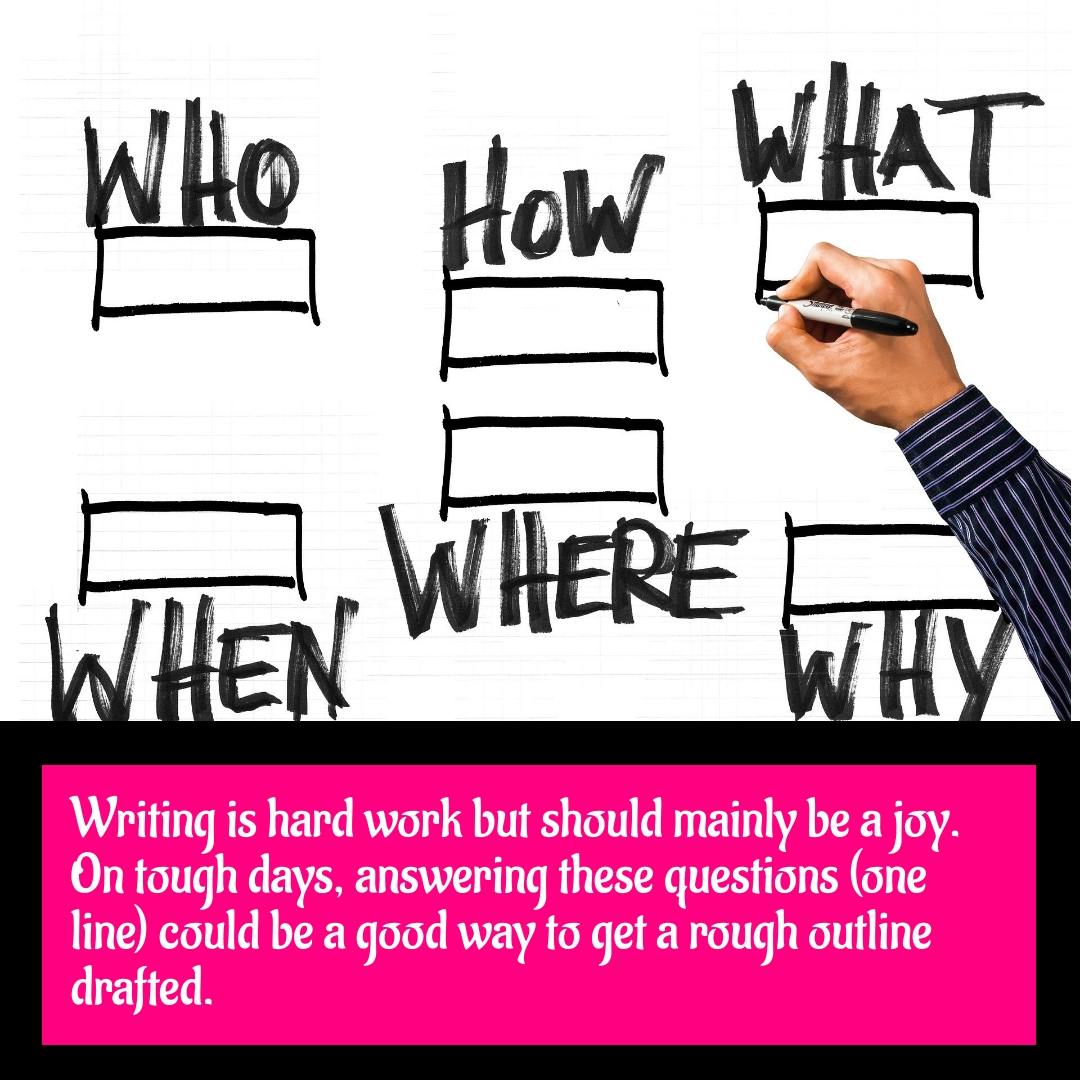
Is there a particular day of the week when writing just seems tougher to do than usual? I hope it is some comfort to know every writer has those days. On those days, I focus on writing short things or accept I will write something towards a longer piece (say one of my blog posts). Writing is writing, whether you manage 50 words in a day or 5000. It accumulates.
And on those tough days, you will still have got something written. I find that cheers me up knowing I’ve got something to develop later. On those days when I can’t write at all, I try to ensure I “up” my reading as that helps with my writing too.
Writing is hard work but most of the time it should be a joy too.
Changeable weather here in Hampshire – Lady and I did get a bit of a soaking. (Have known worse, mind you).
Many thanks to everyone for the lovely comments in on my Getting the Most from a Writing Workshop post for More Than Writers yesterday. Link further down.
I’ll be looking at Settings and Simplicity In Fiction for Chandler’s Ford Today on Friday, just ahead of my heading off to the ACW Golden Jubilee weekend in lovely Derbyshire. I hope to write about that event and my recent workshop for the London Jesuit Centre in a CFT post after that. And I’ll be setting another flash challenge for Mom’s Favorite Reads soon too – so it’s all go in a good way.

Writing Tip 10008 or thereabouts: Be kind to yourself.
What has that got to do with writing, I hear you ask. A lot! I find I write more (and enjoy what I do more) when I am relaxed. So having classical music on in the background helps me a lot there but so do things like ensuring I get enough sleep, make time for reading, etc.
I’ve learned over time to realize on those days when the writing is slow or I am especially tired to just write what I can and have done. (Mondays for me is often a day like that). I’ve found being kind to myself, especially in not beating myself up over what I haven’t got done, helps me on those days when I do have more time to write. Away I go again and it’s fine.
I also look at my writing over the course of a week so I never judge my progress (or lack of it) by what I managed to do (or couldn’t do) as a result of one good or bad day. I’ve found that helps a lot. I think my productivity has increased due to this too – it certainly feels like I get more done now than I used to do.
It’s my turn on the More Than Writers blog (Association of Christian Writers blog spot). I’m talking this time about Getting The Most from a Writing Workshop. I share some thoughts and tips which I have found useful over the years when going to these. Hope you find it helpful).
Looking forward to running my flash fiction workshop at the ACW Golden Jubilee weekend from 3rd to 5th June too.
Oh and the most important tip (well it is to me, anyway)?
Go – and have fun!

Many thanks for the great comments coming in on my The Heights of Equals, my latest story on Friday Flash Fiction. All much appreciated.
I’m back on the ACW blog tomorrow with my post about Getting the Most Out of a Writing Workshop. Timely since I’ve recently run one and am about to do so so again. Link up tomorrow on that. See above.
Don’t forget I send out my author newsletter on the first of the month. I share tips, news, prompts, writing advice etc and if this sounds of interest please do sign up at https://allisonsymescollectedworks.com
Am enjoying using the various random generators to trigger ideas for stories and hope to resume more work on those tomorrow. I’m finding I am producing more stories as a result so I like that aspect too.

Facebook – From Light to Dark and Back Again
I do a dry run of my workshop material and record myself on Zoom. As well as listening to see how it sounds (and therefore how the material is likely to come across to someone else), I can get a sense of the timing of my workshop and adjust things as I need to.
I do love that facility within Zoom to automatically convert your files to mp4 for you. So useful.
I like to leave enough time for questions too. Knowing the timing means it is easy to do that. At workshops I’ve attended, I love the question section. Interesting topics come up and I inevitably learn something useful from that.
I often read a story or two of mine and break down how I wrote them. (I’ve found this useful when other writers do it). So I get to practice that too.
It helps (I find just knowing I have had a read through helps with nerves. I can remind myself I have read the stories, it was fine etc., now all I need to do is do it again – and that’s fine). With flash, the huge advantage is the readings don’t take long (leaving plenty of time for question time later!)

How come it is almost the end of May already? I don’t know the answer to that one but I do know it’s Monday and time for a story. Hope you like my latest YouTube story, Surprise.
I’m running my flash fiction workshop as part of the Association of Christian Writers Golden Jubilee weekend (3rd to 5th June – yes, we’ll raise a glass or two to the Queen while there !). Very much looking forward to it as it is always a pleasure to spread the word about the joys of writing flash fiction.
I look at how it can benefit all forms of writing and share a couple of stories and break down how I wrote them amongst many other tips and advice and yes I set writing exercises too. All good fun. Did I imagine I would ever do something like this when I started out as a writer? Absolutely not! It’s another reason to be grateful for the flash fiction though!


I often read my stories aloud, as you know, sometimes for things like Open Prose Mic Nights. I also do this as I prepare workshop material so I can hear that my chosen tales do fit in as well as I thought. I also do this when I get a collection together. I see that as part of my editing.
Reading work out loud does confirm if the story flows as well as you think or not. If you stumble over reading the story, a reader will do but you can adjust that before the story sees the light of day. I’ve done this several times. It can be strange sometimes when you see dialogue written down, say, it looks fine. Reading it out loud shows otherwise!
Goodreads Author Blog – Other Worlds in Books
All books take us to other worlds. Yes, even non-fiction, given that can enlighten us to aspects of life in this world and increase our knowledge, making us see this world in new lights.
But for fantasy and sci-fi especially, what is it about their settings which convinces you to “suspend disbelief” while reading the story? For The Lord of the Rings (though this applies to many other stories too) it was the portrayal of the characters which made me believe in the settings.
Hobbits are small so it makes sense for them to live in something like hobbit holes. I was also convinced by the peaceful tranquil setting of The Shire especially when contrasted with the dark world of Mordor. To have both of these elements in the book made sense to me. One represents good, the other evil. No world is perfect, even in fiction. Contrasts work for me.
And we can all understand the wish to defend one’s home, even more so with world events right now. So again I get the setting and the wish to defend that. I don’t need to know every little thing about the setting but I do need to know enough to understand why the characters love it.

https://platform.twitter.com/widgets.jsliked Allison Symes's blog post: Other Worlds in Books https://t.co/OQqm5SenFR via @goodreads I discuss other worlds and what brings them to life for me in this week's Goodreads post. pic.twitter.com/kfWalz4IZu
— Allison Symes (@AllisonSymes1) May 28, 2022
https://platform.twitter.com/widgets.jsIf you are attending the WOW weekend, @AllisonSymes1 has written a blog post with you in mind! https://t.co/NEQAxnPBor #writingworkshop #hints
— ACW (@ACW1971) May 29, 2022
https://platform.twitter.com/widgets.jsMore than Writers: Getting the Most from a Writing Workshop by Alliso… https://t.co/f4SqwDh7NU For my turn on the ACW blog, I share thoughts and tips about making the most of writing workshops which I've found useful over the years. The most important tip? Have fun! pic.twitter.com/iCvWf4Qyc0
— Allison Symes (@AllisonSymes1) May 29, 2022
https://platform.twitter.com/widgets.jsHow come it is almost the end of May already? I don’t know the answer to that one but I do know it’s Monday and time for a story. Hope you like my latest YouTube story, Surprise.https://t.co/TuY9n66CFz
— Allison Symes (@AllisonSymes1) May 30, 2022




 Allison Symes: Collected Works