History – Fact and Fiction/The Joy of Author Interviews

This slideshow requires JavaScript.

Image Credits:-
All images from Pixabay/Pexels unless otherwise stated with many created in Book Brush. Book cover images from Chapeltown Books and Bridge House Publishing. Screenshots taken by me, Allison Symes.
Hope you have had a good week. Glad to be talking about history, something I adore, for Chandler’s Ford Today this week. Lady has been out and about with her closest girlfriends and we’ve had more sunshine. (You make the most of that while you have it. Lady shares that view!).

BookBrushImage-2024-4-19-18-5046

Facebook – General and Chandler’s Ford Today

Delighted to share History – Fact and Fiction for Chandler’s Ford Today this week. I’ve loved history from an early age in fiction and non-fiction forms.

I recently gave a PowerPoint talk on two women united by one king (Richard III – the women in question are Josephine Tey and Philippa Langley) and fiction as well as non-fiction can do so much to bring the past to life. My post looks at the advantages of both forms of writing when it comes to history and I also share how music can help enhance historical portrayals too.

I’m currently reading Double Cross by Ben Macintyre and loving that. If you have any suggestions for good historical reads, fictional or otherwise, do pop across to the CFT page (link below) and share in the comments box. Would be good to get a reading list going!

Hope you enjoy the post.

History – Fact and Fiction

This slideshow requires JavaScript.

Pleased to be back on Authors Electric. This time I’m talking about The Joys of Author Interviews. I look at conducting them (I do this often for Chandler’s Ford Today) but also what I find fascinating about interviews I listen to/read which are conducted by others. Hope you enjoy the post.

This slideshow requires JavaScript.


Sunshine again today! Lady and I made the most of that.

Looking forward to sharing History – Fact and Fiction on Chandler’s Ford Today on Friday. See above. I love history. Historical fiction can bring out truths which cannot be proved in the traditional sense but which could be said to be reasonable supposition based on what is known.

I use reasonable supposition for my historical flash pieces such as in My Girl (Tripping the Flash Fantastic) where the viewpoint is from Queen Anne Boleyn on the eve of her execution.

For fictional characters, having worked out their main trait, their attitudes and behaviours will be based on that. I like to think of that as “following through”. If a character’s main trait is slyness, then they will act in that way and their attitude reflect it.

Characters have to seem true to a reader to convince them to follow the character’s story.

438095568_10161835901577053_4542912687878235968_n

Facebook – From Light to Dark and Back Again

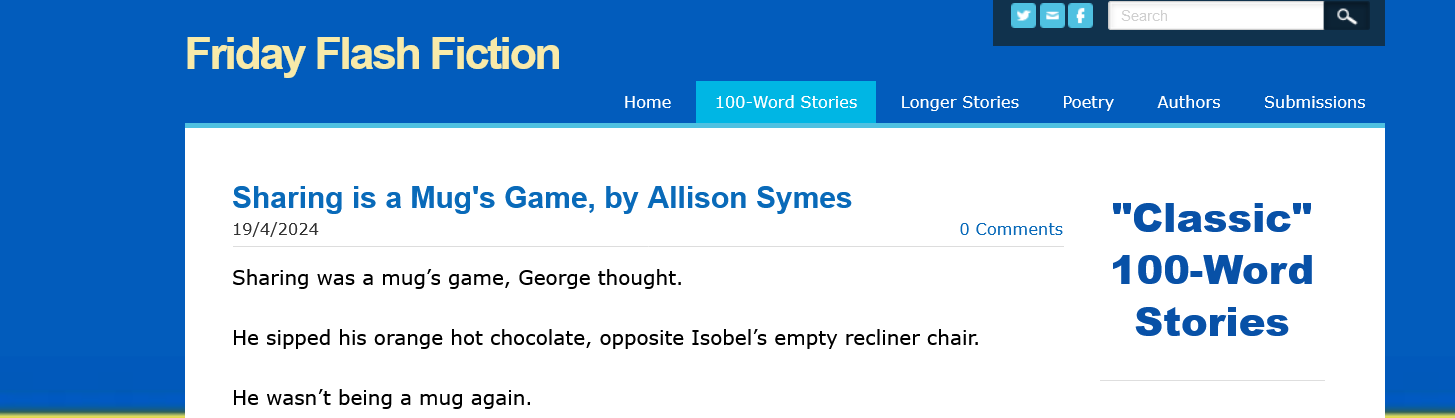
End of the working week means it’s time for another story. Hope you enjoy my latest on Friday Flash Fiction. This one is called Sharing Is A Mug’s Game. Find out why my character George comes to this thought – is he right?
Screenshot 2024-04-19 at 10-13-07 Sharing is a Mug's Game by Allison Symes

Flash fiction is ideal for Open Prose Mic Nights. Doesn’t take too long to read. You can mix up the mood of the stories you pick for this too. But I do practice what I read beforehand. Find it helps with the nerves (and there should be some good nerves here – some adrenaline is useful for a performance. I find it gives me a kick start!).

I like to mix up the mood for the stories I put in collections but you can pick a big enough topic to write about only. Dawn Kentish Knox did this with her excellent The Great War, which contains 100 tales of 100 words each. It also has to be a topic that is of huge interest to you. You need the commitment to that topic to be able to produce that number of stories.

For assortments of stories, which so far has been my route, it is a question of getting the balance of stories right – literally from light to dark and back again.

From Light to Dark and Back Again - by night

I’m a huge fan of outlining but I focus on ensuring I know my character(s) well enough. I work from their major traits and what attitudes/actions these would be likely to lead them to and that in turn helps ensure their motivation is understandable.

If a reader understands why a character is acting the way they are, the character will come across as more believable, regardless of how fantastic the setting might be. I see doing all of this as my bedrock for a story.

Once I know my character I can then see what kind of situations they are likely to end up in. A forthright character, for example, is likely to cause upset simply by being tactless. What is then fun is working out what that leads to – one of my stories with a character like that ending up cutting up someone in a car park who later on was revealed to be the judge for a story competition they’d entered. Oops!

Following through to ensure everything about your character makes sense pays dividends. You’re less likely to have plot holes for one thing because you have already figured out what Character A would be likely to do/feel in the situation you’ve set up.

438095659_10161835905742053_5888578408640552465_n

Fairytales with Bite – Breaking the Magical Rules

For your magical setting, it pays to let readers have some sense of the rules early on. For example, can all of your characters use magic? If there are limits, why have these been imposed and are they imposed fairly?

What are your characters allowed to do with their powers? What are they expressly forbidden to do and how are these rules enforced? What would happen to anyone who broke the rules accidentally? What would happen to someone who did this deliberately? I would hope there would be a difference here!

Give some thought as to who in your creation set the rules for magic. If these were imposed on your setting by a superior power, why was this done and by whom? Why are they not involved with your setting now? Are they likely to come back?

Most of us understand and accept most laws but there will always be some which niggle, which seem petty or bureaucratic. What would the equivalent of these be in your setting? Does someone breaking rules like that get away with it? Could it lead to petty laws being repealed? What would your character be seeking to change here and are they doing it for the greater good of their society?

Sometimes there could be a point to breaking the magical rules, especially if these were being misused. So who would challenge the status quo here and what has led them to do so?

Story ideas there!

BookBrushImage-2024-4-19-19-1324

This World and Others – What is Normal Anyway? (Settings)

I think this is a good question to answer regardless of what your setting is! For your world, what would be considered normal behaviour? Would it equate with what we consider normal behaviour? What would your world make of humanity and the ways we organise our countries etc?

In an alien setting, where there are special powers/magic/greater scientific discoveries etc, what would be considered normal there? Would someone we consider to be a genius be seen in a different light in your setting because intellectual capacity is so much greater?

What would be the normal use of magic, special powers etc? What would be considered excessive?

Within your communities in your world, what is the range of expectations? If you have a magical community, what would be considered normal for elves to be able to do, dwarves to be able to do and so on? Do the different groups co-operate to make things better for all? (And yes we could do with more that here!).

BookBrushImage-2024-4-19-19-2041

WRITERS NARRATIVE SUBSCRIBER LINK

This slideshow requires JavaScript.

AMAZON AUTHOR CENTRAL – ALLISON SYMES

This slideshow requires JavaScript.

Twitter - phone and blue bird image

https://platform.twitter.com/widgets.js https://platform.twitter.com/widgets.js https://platform.twitter.com/widgets.js

Processing…
Success! You're on the list.

Interviews and Characters

Image Credit:  As ever, unless otherwise stated, all images are from Pixabay.

Facebook – General – and Chandler’s Ford Today

For my CFT post this week, I look at why writer interviews are so useful. I also share news of an interview I’ve taken part in, more details on that next week, and share memories of an interview that went wrong and another that involved an Emu! Anyone growing up in 1970s Britain will remember the latter!

I look at what I think makes for a good interview too and share my thoughts on interview etiquette. I also share a little of how I go about interviewing authors for Chandler’s Ford Today (and I hope there will be many more of those later this year).

I discuss the art of interviews as part of my Interviews post on Chandler’s Ford Today this week. Good preparation for an interview is important for both parties to it, of course. But it is just as important for writers, as well as interviewers and interviewees, to think of good questions. (In the latter’s case, anticipating questions that are likely to come up gives you time to prepare your answers).

For fiction writers, you may well want to interview your characters to find out more about them and what makes them tick before you write their stories. (I do this as part of my outlining process. I have to ask what the character thinks makes them tick. They don’t have to be right! Other characters may have completely different ideas as to how Character A really ticks!).

For non-fiction writers, it’s a question of working out what research you need to do for your project and there you ask yourself what you think you need to know. As you start working on your project, other questions will inevitably crop up but, having already decided where and how you will research and found answers to those initial questions, you will know where to look to deal with the other ones as they come up!

I often find this to be the case for my CFT posts. I know a thread I need to look into initially to help me write on my topic. Inevitably there will be threads from those initial ones I need to check out to see if they are relevant to what I want to write about. Sometimes they are. Not always. It is important not to be sidetracked but this is where asking yourself what you really need to know first can help. It helps to keep you focussed.

This slideshow requires JavaScript.

How well do you know your characters before you start writing your stories?

Particularly for flash fiction, I outline what I need to know about my character before I work out what their story is.

A character who is a loud mouth is going to need a tale that will show this trait in action and the resultant consequences. This could easily be a funny story or a tragic one.

A quiet mouse of a character is going to need a tale that will either show when that trait saves the day or they get so fed up of being treated as a doormat, they rebel. Then you can go into the consequences…

I’m a great believer in getting the character right. Then it is a question of deciding what kind of story they WOULD naturally be at home in and whether that shows them at their best or their worst. Either can be a great deal of fun!

This slideshow requires JavaScript.

My CFT post this week will be about interviews and what I think constitutes a good one. It’s a timely post for me as you’ll see when I put the link up on Friday! (I also hope to be sharing more interviews later in the year on CFT too).

Moving on, let’s think of a wish list for writers. My top three wishes would be:-

1. Time expands so you can do all the writing you want and the boring things of life (e.g. housework) somehow magically go away. I do see that as one wish, so there!

2. There are never any tech issues. Computer batteries won’t go too flat. You’ll never get a power cut at any awkward moment (if only!). You’ll always be able to connect to the net. I’m sure you can think of loads to add to that one!

3. Never running out of ideas and enthuasism for writing (again I see that as one wish on the grounds the first bit is no good whatsoever without the second part as well).

This slideshow requires JavaScript.

Facebook – From Light to Dark and Back Again

I see a novel as akin to seeing a beautiful tapestry on a wall. You step back and literally see the whole thing. You are rightly taken in by its scale and how much it covers. There are so many wonderful threads to follow and your breath is taken away wondering at the mastery in putting such a thing together. You are immersed in the whole world portrayed.

A novella is like seeing one half of the tapestry, complete in and of itself, with plenty of stunning details to take in but simply not as much as the full novel, which is fair enough. But there is more than enough to capture your interest, plenty of threads to follow, again just not so many as the novel, but exactly the right amount for what you want to take in and enjoy. (I’m very pleased to see the form is back. Why? Well, people have all kinds of tastes in reading, not just in genre, but in length of story that they want too. There is plenty of scope for the novella).

A short story is like seeing one quarter of the tapestry. There is still plenty of detail. There are interesting threads to follow but obviously not so many as for a novella or a novel. You are taking in a world in minature and that’s fine. Maybe you want to enjoy some of these before taking in the whole of the tapestry again. (I often read flash fiction and/or short story collections in between reading novels).

Flash fiction is like focusing on one section of that quarter of the tapestry. You can’t see the whole picture. You are literally too close to it. Everything else around that section is blocked from your view. What you DO do is find those wonderful moments of sheer detail that those looking for the bigger picture will overlook as they have so much to take in and follow. They are standing too far back to spot what you are looking at. You are focusing on the ONE most important thing and can tease out every vital detail from that. You will pick up on things missed by the longer forms of creative writing.

And I love them all! (Whatever your preference is here enjoy! Writing and reading are two of the most wonderful things in life).

This slideshow requires JavaScript.

Story time again. Hope you enjoy.

Putting My Face On

If I can fake this, I’ve got it made.

I’ve only got to go and meet John at 3. I don’t want to go but it will be the acid test. If I can keep my act together when I meet him, I can keep it together for anyone. Anyone, I tell you.

So if a bit of lippy and rouge are what I need to cover how I feel, so be it.

Well, I say I’ll meet him. It’s really a question of seeing him.

John’s in the Chapel of Rest at the local undertakers.

I put him there.

ENDS

Allison Symes – 6th February 2020

Now this is one of those tales where I knew my lead wasn’t looking forward to meeting John but I then had to work out why. So I did! Could’ve taken this in all sorts of directions but that is the joy of flash. It is open to genre and I fancied this one being a crime tale.

The irony is I can change the mood of the story completely by adding a few words to the ending.

If I added “I put him there – and so wished I hadn’t” – the mood of the story completely changes. Yes, there could still be a crime element but tragedy becomes the lead genre here instead.

So have fun with your flash fiction. Think about what impact you want your character and story to have on a reader.


This slideshow requires JavaScript.

The story I shared yesterday, Putting My Face On, was something I came up with while out on a walk with my dog, Lady. I mentioned yesterday I could’ve changed the mood of the story by adding a few words. That is one of the arts of flash fiction if you like. You can change mood with a judiciously placed word here and there. The fun bit for you as the writer is working out what mood it is you want to go with!

The story on the book trailer for FLTDBA is one of my favourites. Part of the reason for that is the whole mood of the story turns on the very last word of Calling The Doctor. Do check the trailer out and you’ll see what I mean.

One thing I make sure of is that whenever the twist of moods comes in the story, it IS something that could reasonably be expected from the rest of the tale based on the information given.

Calling The Doctor does this because the conversational style of my narrator here is (a) consistent and (b) ties in with the mental image you will form of the character especially their age and such a conversational style would be appropriate for them and their age. The story leads up to … but that would be telling now, wouldn’t it! But the denouement is appropriate given the facts already stated by my narrator.

And very conveniently here is the book trailer with Calling the Doctor for you to check out!

Fairytales with Bite – Favourite Character Types

We all have our favourite kinds of characters, the ones we instantly gel with when we come across them on the page/on audio/on video etc. Some of mine include:-

  1.  The underdog. I always look out for the character who is bullied, despised, overlooked etc. I am never surprised when this character beats all the odds and has transformed their life by the end of the story. I adore stories like that.
  2. The fairy godmother. I love these. They are the agents through which cruelty and neglect will be put right. (Think Cinderella especially). Sadly we only know cruelty and neglect are so often not put right and even as a kid I remember being aware of that. Fairytales are comforting in that in those you know things will be rectified. I think we all need that comfort sometimes.
  3. The one who sees the error of their ways. Firstly, they too can be used to transform the story. Secondly, I like anyone who can see the error of their ways in life as well as in fiction! I am also very fond of redemption stories. I like to see characters being redeemed (it gives hope for us all!) but it has to be done in a way that makes sense. This is why I think gradual realisation of said errors is far more realistic.

Whatever your favourite kinds of characters, happy reading!

This World and Others – 

What I Like to See in Created Worlds

  1. I like to get a picture of the overall world. This is partly because I’m nosey (!) and partly because I like to be convinced the writer really has thought it through.
  2. I like to see a system of government, even if it is a basic one. A world does have to have someone leading it after all. (Best one here: Terry Pratchett’s wonderful Lord Vetinari from the Discworld series).
  3. I like to know how people live. I love the Middle Earth/Shire scenes in The Lord of the Rings. Okay, I could probably make myself very cosy and comfortable living in a hobbit hole as I’m not tall (that’s my example of understatement for this week!). More importantly, again it convinces me the author has thought this through and recognised different species will have different kinds of home and so on.
  4. A sense of how the different species get on, assuming they do. Where there are conflicts, and I would expect some, I want to see how these originated. Both sides in the conflict should have good reasons for holding the views they do, even if they are only good to them and their people. It should be something a reader can understand.