
Image Credits:-
All images from Pixabay/Pexels unless otherwise stated with many created in Book Brush. Book cover images from Chapeltown Books and Bridge House Publishing. Many thanks to Geoff Parkes for taking the shot of me reading at a previous Writers’ Summer School, Swanwick. Screenshots taken by me, Allison Symes.
Hope you have had a good week. Weather slowly improving. Making good progress on various writing projects and there will be some wonderful author interviews coming up on Chandler’s Ford Today in the next couple of months I really can’t wait to share.
I often read/listen to author interviews (including a recent one with Gill James from Bridge House Publishing on Hannah Kate’s show on North Manchester FM). Always learn something interesting. If you’re starting out as a writer, do take note of the questions asked. What would you say about your work if you were asked about it? It’s never too early to start thinking about that.
Facebook – General and Chandler’s Ford Today
Delighted to share The Task of the Opening Lines for Chandler’s Ford Today this week. Hope you find it useful regardless of whether you write fiction or non-fiction or both.
I share thoughts as to what opening lines need to do and tips on what I’ve found helpful. I use various ways of creating opening lines which are likely to make the reader want to read more.
I also discuss why practicing writing potential opening lines is an excellent writing exercise to try when you have five or ten minutes spare. You can come back to these ideas later and then see what you can do with them. I also look at testing your opening lines to see if they are as strong as you think.
Happy drafting of opening lines!
The Task of the Opening Lines
Happy World Book Day! I haven’t done anything special for it but I think it is a fantastic idea. Am also thrilled to bits to see the return of the BBC 500 Words competition for children and understand the winners will be announced at Buckingham Palace by the Queen.
If ever there was a fantastic way to encourage children to write (and in flash fiction format too!), this is it. Congratulations to all of the finalists and I hope everyone who took part enjoyed doing so.
I can’t think of any author I know for whom a day passes without a book being involved, whether we’re reading or writing them or doing both. But to have a special day to celebrate all books is a wonderful thing, I think. I know the focus will be on fiction but there are fabulous non-fiction works out there and I am so glad to have added non-fiction to my own literary diet.
Am also pleased to be writing fiction and non-fiction. It is lovely to have both in my writing life and I’ve learned so much (and continue to do so) from them. With writing you are always learning, striving to improve what you do. Good for the old brain that!
Talking of writing, I will be looking at The Task of the Opening Lines for Chandler’s Ford Today tomorrow. Relevant to all writers that one! See above.
Weather much better today and Lady got to play with her two best girlfriends so we’re all taking that as a win!
Glad to say my copy of Writing Magazine arrived today. First thing I do is flick through it and see how many names I recognize from Swanwick, ACW, etc. If the number is ever less than three, I consider it a bad month! Well over that this time.
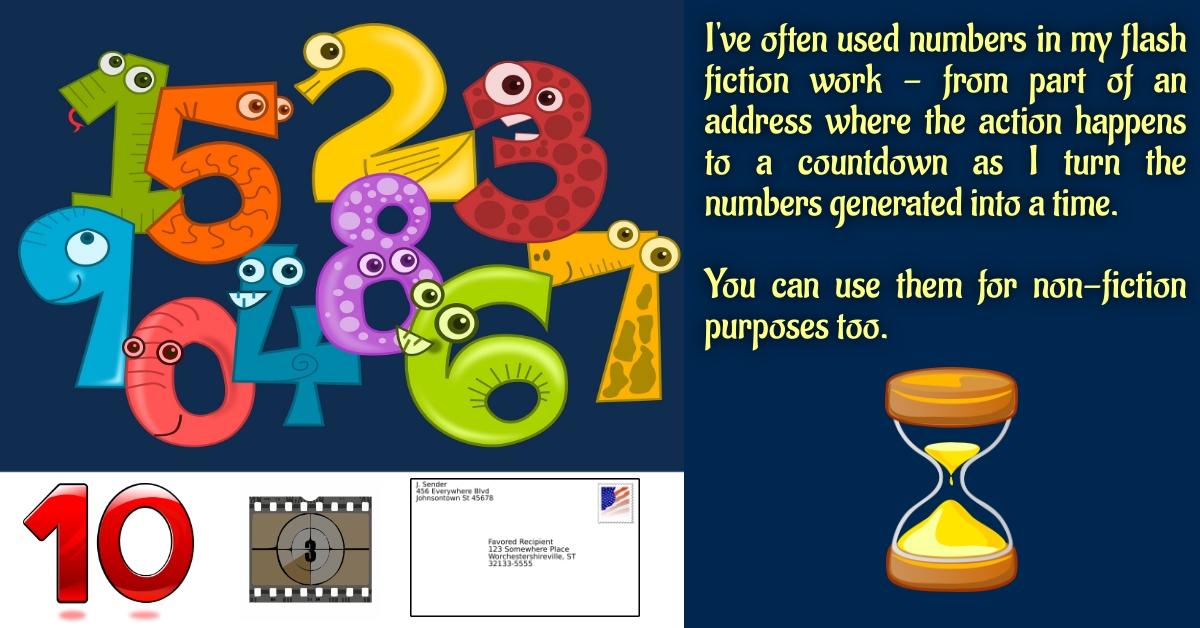
Writing Tip: Numbers can be useful in writing, odd as that may sound. I’ve used numbers as part of an address where the action of the story takes place. I’ve also used numbers as a time and then turned that into a countdown.
For flash fiction in particular you could use a randomly generated number as your word count for your story, just as long as your number is 1000 or less.
For non-fiction, you could look at why certain numbers are associated with luck (bad or good), the history of numbers (we haven’t always had the zero for example), and the joy (or otherwise) of numeracy.
Facebook – From Light to Dark and Back Again
Sometimes you just know early on a story is going to be great fun to write up and, for my latest on Friday Flash Fiction this week, it was the second line which confirmed this to me. See what you think. I hope you enjoy Point of No Return.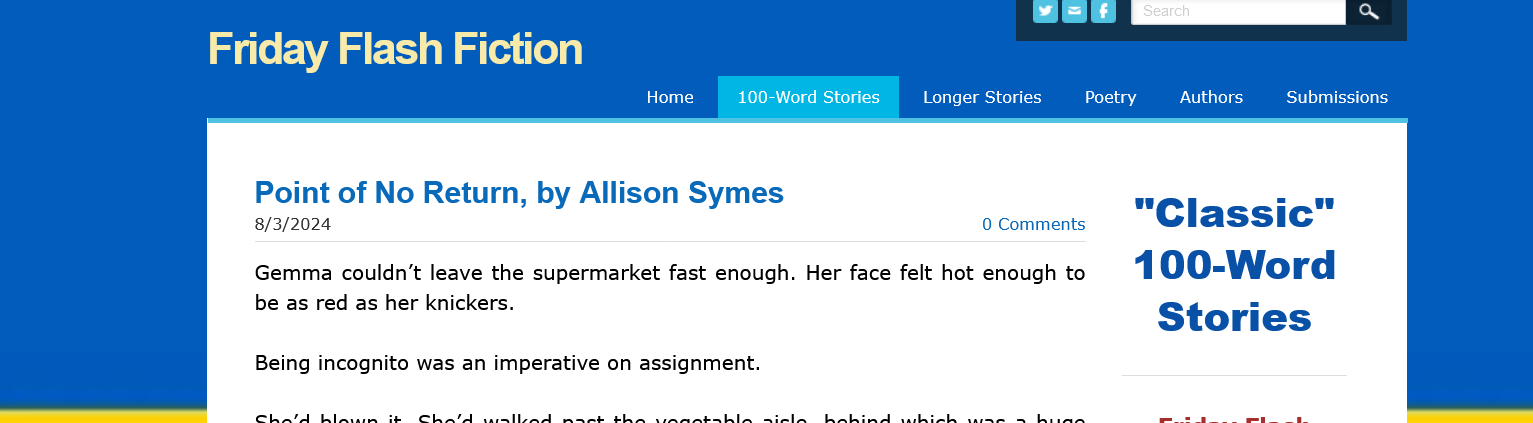 The BBC 500 Words competition for children is coming to its conclusion this evening at Buckingham Palace. As I mentioned on my author page, I hope everyone who took part enjoyed it. I understand about 44000 entries were received and were whittled down to a total of 50.
It’s a good idea when writing flash fiction to practice writing to different word counts. There are plenty of competitions out there which specify word counts of 100, 250, 300, and 500 words in particular so it pays to work on stories at these levels.
Writing Magazine has a 750 words competition and often when publishers are putting calls out for submissions of flash they will specify the maximum word count you can write to. Some do ask for specific word counts.
But it pays to be able to turn your hand to a wide range. It is also great fun to do. Try it and see! (All of these also make for great warm up writing exercises even if flash isn’t your main writing form but why not try and get your flash pieces published too?).
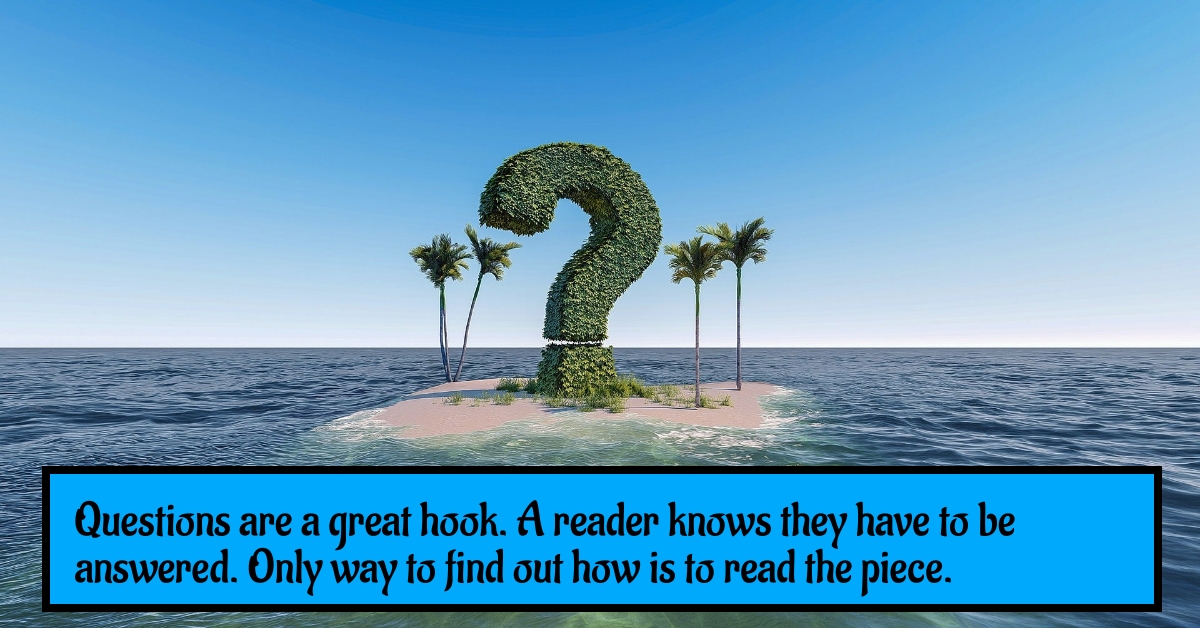
 I sometimes start a flash fiction piece (or a short story) with a question. It makes a great hook because I would hope a reader would want to find out what the answer to the question was and the only way to do that is to read on.
Also I can use that question to show something of the character who is asking the question. I can also use the question to show something of the setting too or the character’s likely attitude. You can tell much by how someone asks the question – it shows attitude for one thing.
Fairytales With Bite – Magical Power
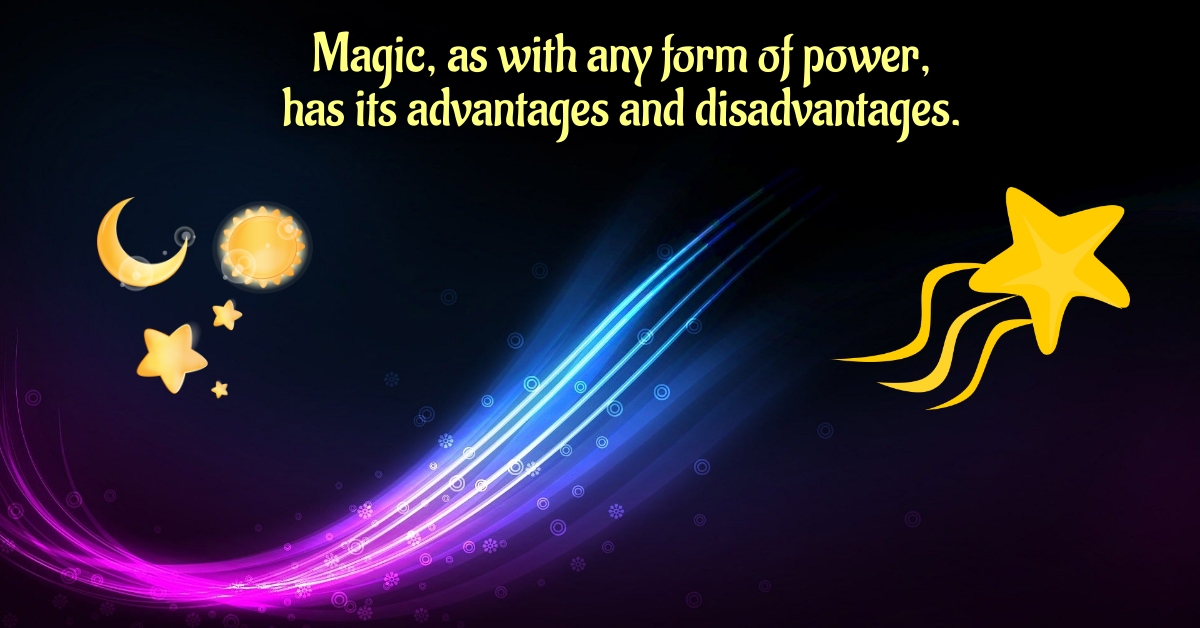
M = Magic, as with any form of power, has its advantages and disadvantages.
A = Advantages include speeding up processes and/or coming to the aid of someone where “ordinary” methods are not possible.
G = Granting wishes or using magic should come at a cost to your characters.
I = Imagine a character who could use magic with no consequences – there would be no story.
C = Conflict and resolution is the life blood of any story so limitless power means no conflict, one character would just dominate.
A = Allowing them to trample anything and anyone in their way – I would find that so depressing to read.
L = Limitations mean characters have to find other ways of doing things and means those without magical powers have a chance to survive.
P = Power comes with responsibility then and there should be consequences for those misusing it (doesn’t just apply to magical powers!).
O = “Ordinary” characters with no or fewer magical powers should be able to have ways in which they can prove themselves, otherwise they are just there to be a kind of fictional cannon fodder. Again no story in that.
W = Wizards, witches, fairy godmothers etc should (in my view) be accountable and it be possible to challenge them.
E = Ensuring magic is used responsibly and those abusing it are stopped.
R = Resulting in satisfactory stories for characters (magical or now) and, more importantly, for the readers. I like to see the “little” people/characters win through against the odds, even magical odds.
This World and Others – The Natural World
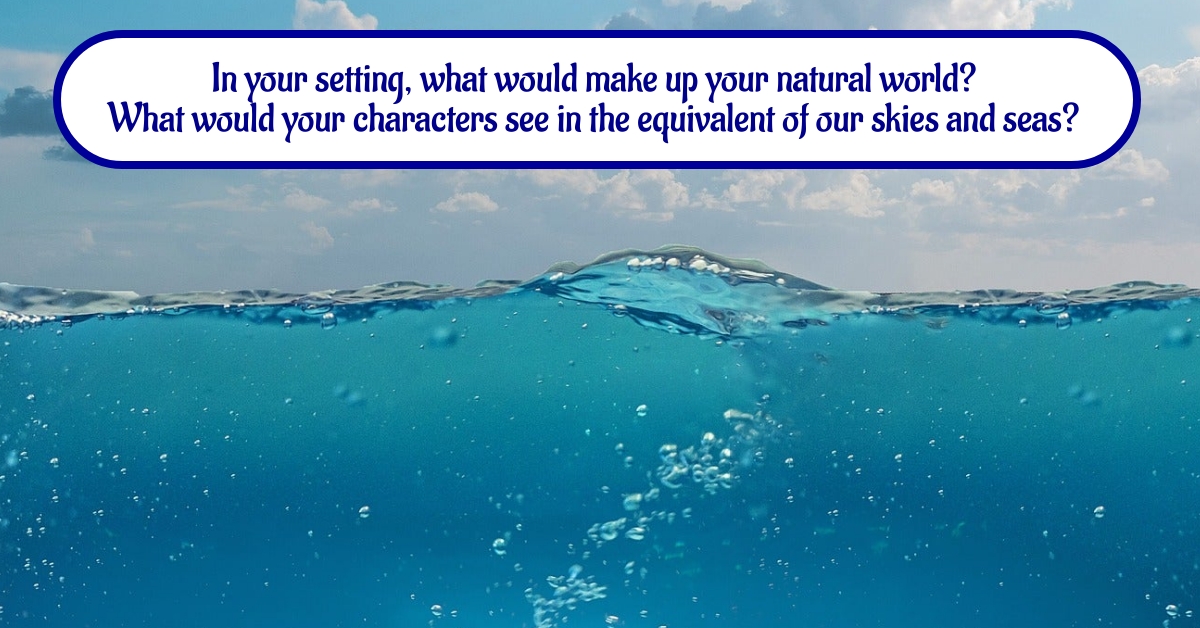
In your setting, what would make up your natural world? What would be its landscapes, flora and fauna, atmosphere(s), ways of producing food (on the assumption your setting does grow its own and doesn’t rely on imports? What would be the dangers of your natural world to your characters? How would your characters be helped by the natural world around them?
What would your characters see in the equivalent of our skies and seas? What would they hear? What aspects of the natural world do they like or loathe? How does your government(s) make use of the world and is this done in a responsible, sustainable way?
There is a big development in cli-fi (climate change fiction) which, naturally, does have the natural world at the core of its stories. On your setting, would there be those concerned about their climate? What actions would they take to put things right? Are they themselves right?
What would live where in your natural world setting? Would it be similar to what we have here or alien? Could it be a mixture? Your setting has blue skies but pink seas for example?
Does anyone in your setting look after the natural world? Would that be something which was expected from everyone or do your characters ignore the natural world until it starts causing problems?
So there are story ideas here. Also where you are using the natural world as a backdrop to the main story, share enough details to help readers picture it but drip feed this information into the story. Readers will pick up on a detail here, a detail there as they read on and you won’t slow down your story pace.
WRITERS NARRATIVE SUBSCRIBER LINK
AMAZON AUTHOR CENTRAL – ALLISON SYMES

https://platform.twitter.com/widgets.jsOur More than Writers' blogpost for Leap Year Day came from @AllisonSymes1 https://t.co/CHDjx7gsNE
— ACW (@ACW1971) March 7, 2024
https://platform.twitter.com/widgets.jsPoint of No Return, by Allison Symes – Friday Flash Fiction https://t.co/P6sAxjmiIu Sometimes you just know early on a story will be great fun to write up. For my latest on FFF this week, it was the second line which confirmed this to me. Hope you enjoy Point of No Return. pic.twitter.com/2pclFbbv1k
— Allison Symes (@AllisonSymes1) March 8, 2024
https://platform.twitter.com/widgets.jsThe Task of the Opening Lines https://t.co/DfK7nRZmlw Delighted to share The Task of the Opening Lines for CFT. Hope you find it useful regardless of whether you write fiction or non-fiction or both. I discuss what opening lines need to do and share tips on what I find helpful.
— Allison Symes (@AllisonSymes1) March 8, 2024
 Allison Symes: Collected Works