


Image Credits:-
All images from Pixabay/Pexels unless otherwise stated with many created in Book Brush. Book cover images from Chapeltown Books and Bridge House Publishing. Screenshots taken by me, Allison Symes.
Hope you have had a good week. Strong winds and heavy rain where I am, snow elsewhere in the UK. Keep safe, everyone. Great week overall with news that three of my stories will be published in The Best of CafeLit 13 later this summer. This is a personal best. It is also huge encouragement to keep writing and to submit my stories to CafeLit!
Am working on other stories where I know they will need other homes but I love creating characters and discovering how they get out of the situations I put them in – great fun. May you never lose the joy of creative writing!

Facebook – General and Chandler’s Ford Today
I’m pleased to share my latest Chandler’s Ford Today post on Planning Out Your Writing. I discuss why I find planning useful, even when life throws spanners in the works, as it so often does. I also discuss whether planning kills creativity (and why I take the attitude it doesn’t).
I also look at the risks of using planning as a procrastination technique and what I do to ensure this never happens to me. Hope you find the post helpful. Oh and great news – you don’t have to plan out everything. You figure out what you need to know. More in the post.
Planning Out Your Writing
My Planning Out Your Writing is on Chandler’s Ford Today tomorrow. Hope you will find it useful. Link up on Friday. See above.
When do you think you know your characters well enough? I would say when you know what they are likely to do and how they would react to any given situation. Answering this is a great example of how a little forward planning makes your task as a writer easier too (note I didn’t say easy!).
If I know my character likes biscuits and is a petty thief, I am likely to combine those two things in their story and then it will be a case of working out who catches them out and what happens then. But knowing those two things immediately gets me off to a good start when writing their story.
I can also then decide if this is likely to be a lighthearted tale or a more serious one. Does my character prove to be sorry and stop doing it or, conversely, do they go on to steal more important things and have to be stopped at a later date with more serious consequences resulting from their actions? But just having that starting point gives me those options.

Hope you have had a good day. Lady got to play with her best pals, the Hungarian Vizler and Rhodesian Ridgeback, today. Fabulous running by Lady and her Ridgeback friend. The Vizler as “pack leader” watches indulgently but is so pleased to be with her two pals. It’s sweet to see.
Writing Tip: It pays to read your stories out loud so you hear them as a reader takes them in. If you need to focus on one thing, read the dialogue out. What looks good written down doesn’t always read out well. If you stumble, a reader will and you don’t want anything switching them off. I’ve found this has paid off for me.
Facebook – From Light to Dark and Back Again
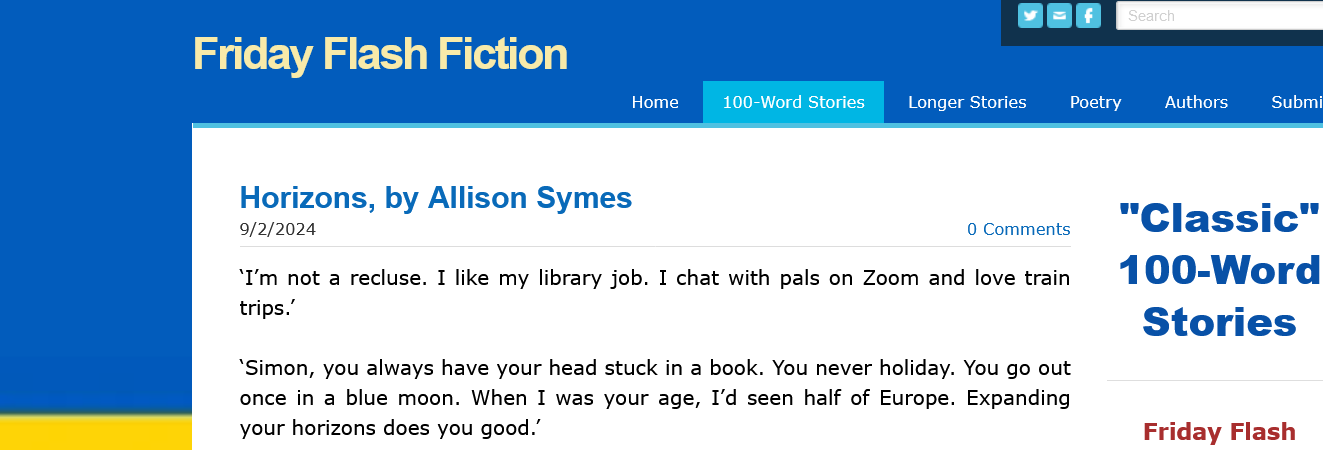
Delighted to be back on Friday Flash Fiction with my latest tale, Horizons. Is Simon’s mother right in wanting him to broaden his horizons? Will he ever do so? Find out here.
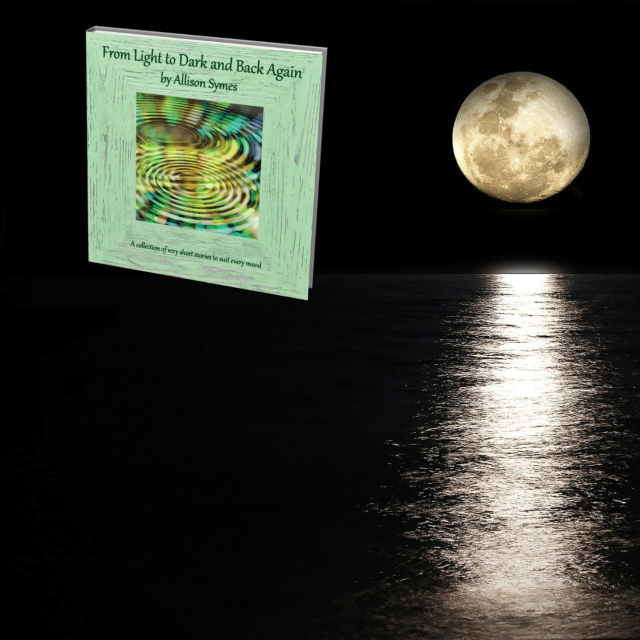
Little details in a story can add so much depth to your characterisation. From my Pen Portrait in From Light to Dark and Back Again, my character Mary is described as someone who brushes her hair once a day whether she needed it or not. Now that gives me an instant picture of Mary in my head.
For one thing she’s not vain. There are more important things in her life than her personal appearance. I’m visualising Mary as being on the scruffy side when it comes to her hair and, by extension, her clothes just on the strength of this line. The story goes on to show why Mary does this and I’m not giving the game away here.
But that one phrase conjures up a whole image for my character. Flash is fantastic for this and it helps you make much more of your word count. Flash teaches you to simplify description here. It can also lure your readers in so they will want to find out whether their expectations of the character are correct or not (and if the latter, why not as well. My story does give a very good reason for Mary being the way she is).
 Something to consider is that many of the writing festivals have competitions to go with them. Some of these, as well as offering short story competitions, have flash fiction ones too. So do bear these in mind.
A good rule of thumb for any competition is you should be able to check the background out of the competition easily. Also any entry fees should be proportionate to the prizes on offer.
Flash fiction competitions come up often but are not always labelled as such. Writing Magazine offer a 750 word story competition and a 500 words all dialogue one. They’re not labelled as flash fiction competitions but they are of course.
Entering (reputable) competitions is good practice in writing to deadlines and if you get shortlisted or better, it is something to put on your website, author newsletter, writing CV, query letters etc. Also if a story doesn’t do well in a competition, have another look at it. Polish it up and send it elsewhere (which would be suitable for your type of story).
Fairytales With Bite – Tooth Fairy Rules
Every profession needs its guidelines. Here are some which would be useful for a trainee Tooth Fairy to know.
- You only collect from those customers who are on your daily client list.
- You do not, repeat not, need to make up numbers. See 1 above.
- Pliers are not regulation equipment. See 1 and 2 above.
- Do not expect gratitude from your clients. They should be asleep for a start. If they see you, something has gone horribly wrong. Report back to HQ immediately.
- When leaving the correct money, also leave toothbrush, toothpaste and the fun comic we issue showing the benefits of looking after your teeth, even the baby ones, for as long as possible. Never leave sweets. You are not to speed up the natural process for when the next tooth is due to come out.
- If you suspect the client has sped up their own natural processes for losing baby teeth, report to HQ and don’t leave any money. The boss may well send superiors in to investigate further. Don’t get in their way. They will be the ones the kid will be allowed to see. They will tell the kid off. Kid can’t report to parents. Who’s going to believe them when they say they’ve seen the Tooth Fairy and they’re not nice? What matters here is the cheat doesn’t get the money. They won’t do it again.
- Look after your own teeth. You are meant to set a good example. Don’t eat sweets when on duty in case someone sees you. It is not a good look for the Tooth Fairy.
- Stay away from dentists’ kids. You shouldn’t get these allocated to you but if you suspect you have been report to HQ. Dentists’ kids won’t believe in you. They’ll have had all the “facts” from their parents here. So why visit? Save your time and effort for those who do have some belief, even if it is based on the wish to gain money from having lost a tooth. We gain their teeth, we have their belief, they get some payment. Those are the rules. No belief. No payment.
- Report back to HQ when you finish your nightly rota. Most of the time this will be a simply check in and check out. Did you get all the teeth expected? Yes. Were there any problems? No. You’ll then be issued with your rota for the following night.
- When out on your rounds, ensure you are not followed by vampires. They too look to extract from humans but they’re nowhere near as nice as we are. Be wary of politely spoken gents wearing big capes and who seem reluctant to smile. Any sign of fangs from anything, get the hell out of there, but this is good advice for all species to be honest.

This World and Others – Health Matters
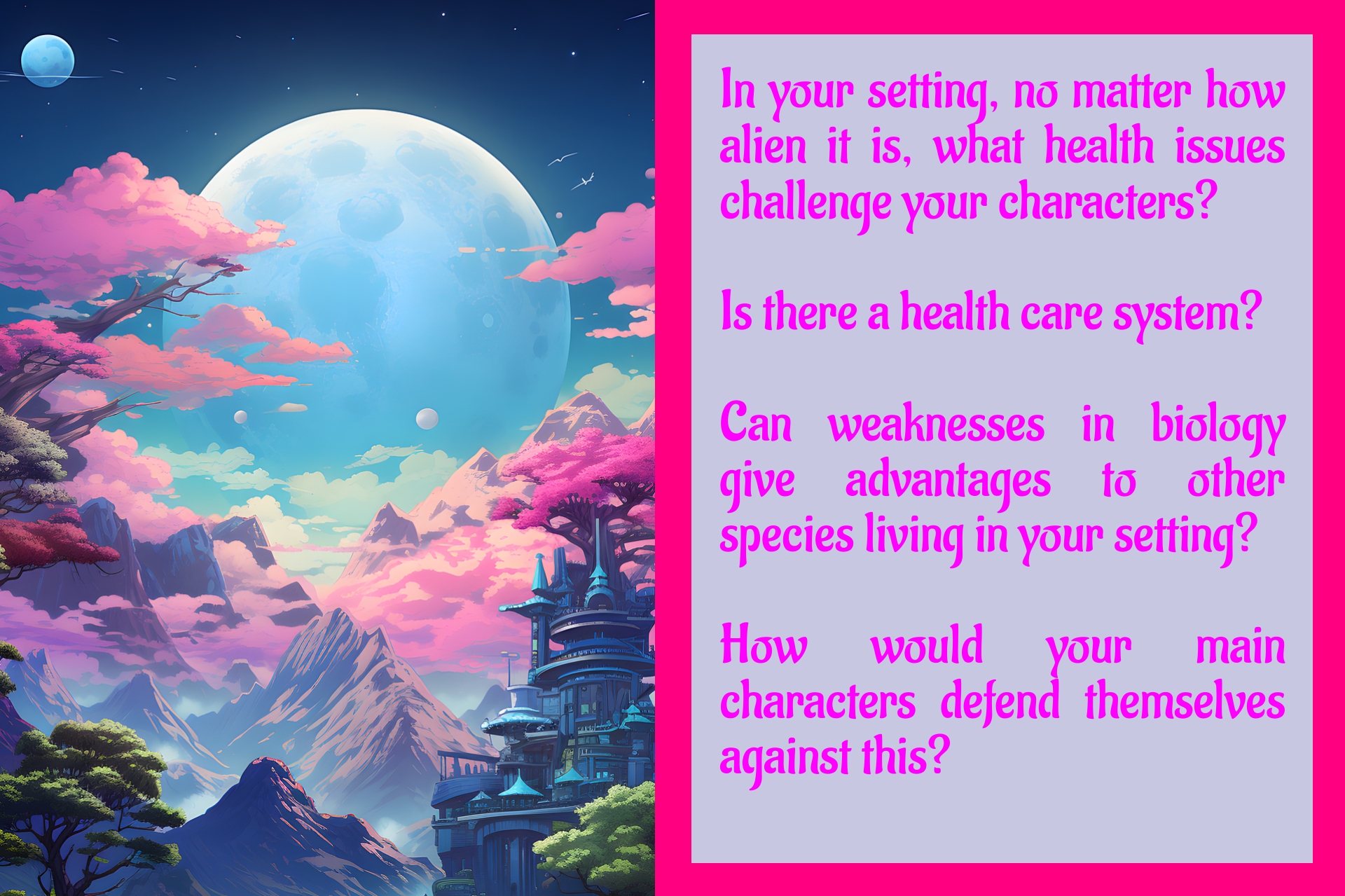
In your setting, and assuming you have more than one kind of creature living in it, health matters will vary. So think about how your creations are made, biologically speaking, and then work out what health issues would concern them.
If you have winged creatures for example, do they have to keep wings and the muscles supporting them in good working order and how would they do that? Would they suffer from wing rot if they don’t look after themselves, for example?
If you have characters who are known for their speed, are their feet especially developed here and how would they differ from human feet? Again, how would your creations look after themselves here?
Does your setting have doctors etc to take care of health issues that do crop up? No creature is going to be totally invincible. Even immortals can suffer from problems (if they’re dependent on a kind of climate to be immortal, if there are changes there that will have a knock-on effect).
Can other characters take advantage of known health weaknesses here and how that would change the outcome of your story?
WRITERS NARRATIVE SUBSCRIBER LINK
AMAZON AUTHOR CENTRAL – ALLISON SYMES

https://platform.twitter.com/widgets.jsHorizons, by Allison Symes – Friday Flash Fiction https://t.co/j2y55JoEFN
— Allison Symes (@AllisonSymes1) February 9, 2024
Delighted to be back on Friday Flash Fiction with my latest tale, Horizons. Is Simon’s mother right in wanting him to broaden his horizons? Will he ever do so? Find out here. pic.twitter.com/WrkofP14kW
https://platform.twitter.com/widgets.jsPlanning Out Your Writing https://t.co/I8fMVqRZ1o
— Allison Symes (@AllisonSymes1) February 9, 2024
For CFT this week, I discuss why I find planning my writing useful, even when life throws spanners in the works. I discuss whether planning kills creativity and look at the risks of planning being a procrastination technique.
 Allison Symes: Collected Works