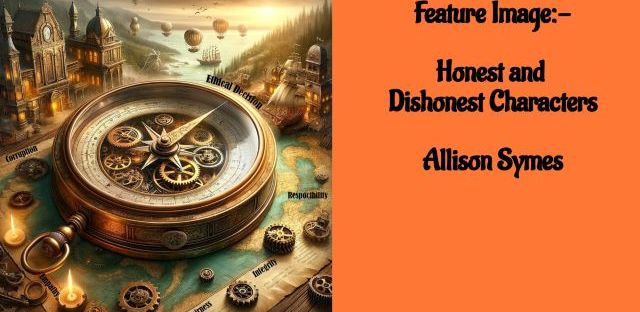
Honest and Dishonest Characters


This slideshow requires JavaScript.

Image Credits:-
All images from Pixabay/Pexels unless otherwise stated with many created in Book Brush. Book cover images from Chapeltown Books and Bridge House Publishing. Screenshots taken by me, Allison Symes.
Hope you have had a good week. Lady has had a fabulous time with her closest friends. I’ve had a lovely trip to the local theatre and good writing news which I hope to share before too long.

Facebook – General and Chandler’s Ford Today

Delighted to share Honest and Dishonest Characters for Chandler’s Ford Today this week. Fun piece to write especially given literature is full of excellent examples of both types of creation. I look at some of the aspects you need to consider when creating these and share thoughts and tips. Hope you find it useful.

This slideshow requires JavaScript.

24th April
Am off to see The Chameleon Theatre Group perform Sudden Death at Thornbury Manor later this evening. Will review it for Chandler’s Ford Today in due course. The audience get to interrogate the cast as part of the performance which should be good fun. Have not been to an “interactive” murder mystery play before. Looking forward to reporting back later.

I see going to plays like this as another way of taking in stories. It’s not a bad idea to try to visualise your own stories as if someone was acting them out.

It can be a good aid to ensuring your dialogue sounds right, helps you cut down description (for a play you would see this as a visual set – can your readers picture your scenes easily enough?), and will show you whether all of your characters are playing a vital role in the story or not. If one or more doesn’t seem to have “much to do”, do you really need them in the tale?

Hope you have had a good Wednesday. Lady had a fabulous time in the park with her Hungarian Vizler and Rhodesian Ridgeback pals. Came home tired but happy.

Don’t forget my next Chandler’s Ford Today post is upon Friday when I’ll be looking at Honest and Dishonest Characters. Fun piece to write which I hope you will find useful and thoughtful. See above.

Marketing Tip: Consistency matters. I find it useful to focus on those social media outlets and marketing tasks I know I can keep going. So select what you would enjoy most and stick with that.

I like preparing an author newsletter and my YouTube videos, for example, so I have no problems being consistent with producing these. As much as possible, your marketing as well as your writing should be fun for you too. (Or as much fun as possible most of the time anyway!).

Facebook – From Light to Dark and Back Again

Pleased to be back on Friday Flash Fiction with my latest tale, Same Old Thing.

Hope you enjoy it. Good to finish the working week with an enjoyable tale I think. Do check out the rest of what is on FFF – you will have plenty of good reading here.

24th April
Hope today has gone well. Am off to see my excellent local theatre company perform an interactive murder mystery. Should be fun. Led me to think though all of our stories should be interactive in that they should engage your readers so they are gripped by the situation and world you are showing them. No pressure then!

I do believe we are our own first readers though and if I’m not gripped by my characters, I can’t honestly expect anyone else to be.

Have come across another flash competition I may have a go at which specifies a character count rather than a word one (and yes it is linked to X or Twitter as I still prefer to think of it as).

Today, 23rd April, is both the birthday and anniversary of death day for William Shakespeare. Not sure what he would have thought of flash fiction given the length of his plays! But in the wonderful writing world, there is room for all word counts and styles (which is yet another reason to love being part of the overall writing community).

Writing Thought: Why not take one of Shakespeare’s famous quotes and use it as a theme for one of your own stories, flash or otherwise? What could you make of “a rose by any other name would smell as sweet” as a theme, for example? Shakespeare was right on that one but could you come up with a tale which proved otherwise?


Fairytales with Bite – Crime in the Magical World

I love the Vimes novels within the late Sir Terry Pratchett’s magnificent Discworld series. The entire canon is superb but the Vimes books stand out for me and books like Men at Arms are excellent detective stories in their own right (and the fantasy setting makes them stand out more).

So thinking about your own magical/fantasy setting, which crimes could happen with in it? Are the crimes solved by magic or with good old fashioned police work (the Pratchett approach, which for me makes the books more real).

If you use magic to solve the crimes, bear in mind the criminals would almost certainly have used crime to commit their nefarious deeds so how can more magic overcome that?

You will need to give thought as to what magic can do and not do in your setting. There should be advantages and disadvantages to using it/not using it (as this will give more issues for your characters to think about as they work out what to do and will help increase tensions in your story).

Also think about the crimes which could only be committed in a magical world, what would these be? What is done to try to prevent them? Is there any kind of magical crime prevention agency and/or a detective one? Who could police the use of magic and what powers would they have to enforce this? How did the rules for the use of magic come into being in the first place?
This World and Others – Social Issues in the Magical or Sci-Fi World

Where magic or where science beyond what we know here exists in your setting, which social issues arise from them? Do these things create a have and have not society? If so, how is that handled? Are there any attempts to make things better for the have nots? Are there classes of citizens who are gifted with this kind of magic and/or science and do they share it or hoard it?

Has your magical/scientific setting over time benefited from the developments discovered or created? If so, how? Do these benefits help all? Those with the skills – are they revered or hated? Would others in your setting have good cause to fear them?

If your setting can survey other worlds, such as Earth, are there ideas we have they do not? Would they be prepared to steal them? If so, how would they go about this without drawing attention to the fact there was was an alien invasion going on (might cause panic!) or do they not worry about that? Have they raided other worlds before?

Scientific developments especially can cause two reasons – welcome and rejection. People can fear what they don’t understand so how would your setting’s people overcome this so new developments weren’t misunderstood or misrepresented?

The trouble with misunderstanding or misrepresenting something is the panic and resulting actions from that panic which in turn could cause social issues( rioting, maybe?).

Food for story thought there I hope.
MailerLite – Allison Symes Author Newsletter – Sign Up Link

WRITERS NARRATIVE SUBSCRIBER LINK

AMAZON AUTHOR CENTRAL – ALLISON SYMES

This slideshow requires JavaScript.


https://platform.twitter.com/widgets.js https://platform.twitter.com/widgets.js

Writing Fitness

This slideshow requires JavaScript.

Image Credits:- All images from Pixabay/Pexels unless otherwise stated with many created in Book Brush. Book cover images from Chapeltown Books and Bridge House Publishing. Screenshots taken by me, Allison Symes.
Hope you have had a good week. Getting nearer to that wonderful week of The Writers’ Summer School, Swanwick. Mixed bag weatherwise. Hope it improves for Swanwick week. Hope it just improves! Lady made a new friend earlier this week so she’s had a good few days and doesn’t care if she gets wet! It’s okay for her. She dries off quicker than I do.

BookBrushImage-2024-7-12-19-323

Facebook – General and Chandler’s Ford Today

Pleased to share Writing Fitness for Chandler’s Ford Today this week. I look at the value of screen breaks, being prepared for the ups and downs of the writing life, accepting you are in for the long haul with your writing, and how taking that approach can make it easier to take rejections as well as it is ever possible to take these things. Hope you find the post useful.

Writing Fitness

This slideshow requires JavaScript.


Lady and I appreciated the sun this morning after what has been a wet week so far. It is apt I’m listening to O Sole Mio on Classic FM (O My Sunshine) as I write this post too.

Do look out for my Writing Fitness post on Chandler’s Ford Today tomorrow. See above. Also my next author newsletter will be out on 1st August. Yes, I know, how can it nearly be August already? You can sign up to said newsletter for news, tips, and stories at https://allisonsymescollectedworks.com

Writing Thought: When you put down the old pen, or shut up the old laptop, and resume reading for pleasure, do have a look at how the authors are presenting their dialogue, moving their story on and so forth.

One of the joys of creative writing is I think writers have two joys here. We have the joy of inventing our own tales but we also all love reading. And the second joy is we can learn from what other authors have done and have a fabulous time reading while learning, I definitely see that as a win-win.


Well, the sun did put in an appearance today, for which Lady and her chums, the Rhodesian Ridgeback and Hungarian Vizler, were all grateful. First day this week Lady and I haven’t got wet.

I’ll be looking at aspects of Writing Fitness for Chandler’s Ford Today on Friday, including looking at the value of screen breaks and preparing yourself for the long haul in writing. See above.

My favourite aspect to creating stories is in inventing characters who come to life as I outline them and find out more about what they would do and say (and what they would never do or say. That can be remarkably enlightening in itself).

When it comes to creating blogs and posts like this, my favourite moment is in having an idea to write about and then seeing its use to writers. I always find that a good moment because I then write away happily. I focus on tidying things up later.

But I have to see a use for writers here because I want these posts to be useful to me too. I also see this as a way of giving back because I’ve learned a lot over the years from useful posts myself so like the idea of giving back in some way.

But whatever I write, it is the getting started which is the key moment for me because once I have started, away I go.

450545956_10162014998377053_3178739373101990085_n

Facebook – From Light to Dark and Back Again

I find it useful to be able to visualise what 100 word stories look like on screen (where most of mine usually find a home so it pays me to know this!) and one great way of doing that is to check out the 100 word stories page on Friday Flash Fiction. See link. Do take the chance to have a great read. Flash encompasses all moods and genres. It is a major reason why I love writing it and reading it. Enjoy!


I like to mix up how I present my flash tales every so often. I’m not reinventing the wheel here but it is nice to sometimes share a story in the form of an acrostic, a poem, a letter, an all dialogue piece, as well as in the “usual” prose layout. Keeps it fun and interesting for me and I hope it does for readers too.

I love reading as well as writing pieces for collections and anthologies. Those stories which stand out because they are using a different format always grab my attention. Partly I want to find out if the different format works. It nearly always does because the writer has rightly focused on ensuring it is apt for their character and situation.

In my Punish the Innocent (From Light to Dark and Back Again), I use a letter format because my main character has to leave information for another one in this way as it is the most appropriate medium. Without giving too much away, my second character here has to receive the information after a certain event has happened involving the main star here. The latter doesn’t want to be stopped from what they are intending so a letter, timed to only arrive after the event concerned, is the way to go with this one.

So if you use a different format, ask why you need it. Ask why it has to be this format. Ask why it has to be the appropriate one for your character. If you can answer all those in the affirmative, go for it and good luck!

From Light to Dark and Back Again - by night

Ending a flash fiction piece has its own joys and challenges. I do love ending a story on a punchline or a twist. They’re fun to write and a great place to leave the story. The tale has revealed all it needs to – the end, that’s it.

The challenges come from ensuring the punchline or twist (and sometimes you can have a punchline which is also a twist) arises naturally from the characters and situation I’ve put them in. Nothing must seem contrived or forced. A reader has to be able to feel the ending was the appropriate one for this situation.

This is one reason why I find a simple outline so useful. I have Character A, they’re in this situation, how would that be resolved? I can then jot down ideas for the ending and I go with the one which makes the strongest impact on me. A story and character has to be able to make me react to it, no matter how short or long the tale might be. I have to care about the outcome. If I care about that, readers should do too.

450542819_10162015003582053_5662813459618974_n

Fairytales with Bite – Magic Wands Plus

M = Margo so begrudged having a second hand wand.
A = All of her fairy colleagues had brand new tools.
G = Granted, Margo’s mother was always fond
I = In Margo’s view of making her the butt at fairy school.
C= Considered it vital for making her develop backbone.

W = Wishing on a star was a complete waste of time.
A = And spell books could always be misread.
N = Never mind, Margo’s mother said, your wand is sublime.
D = Doubting this, Margo put it to the test and found it led
S = Straight to Margo outperforming everyone in her year.

P = Performance does not depend on having the latest gadget.
L = Learn, Margo’s mother said, updates are not all they’re cracked up to be.
U = Understanding now, Margo buried the hatchet.
S = Success came to her by studying hard and the hidden strengths of her old wand.

Ends
Allison Symes – 10th July 2024

Hope you enjoyed that. My sympathy here is with Margo’s mum given updates are indeed not always what they’re cracked up to be. They never come in at good times either but that may just be me.

BookBrushImage-2024-7-12-19-5028

This World and Others – Inventors

Which three inventions would you say were the best? There are so many to choose from but my nominees are:-

  1. The invention of literacy going on to include the development of print.
  2. The invention of medicine.
  3. The invention of photography because I love seeing all those wonderful images coming from space and that all started with being able to capture things on film in the first place.

In your setting, which are the inventions your world could not do without? Which inventions do they wish hadn’t come about? (There is always something there. We didn’t need the “invention” of pollution to name but one).

How does your setting treat its inventors? Are they honoured or treated with suspicion? Not everyone welcomes the clever. Often people can be fearful of new inventions and those behind them.
Is your setting keen to develop further or does it want inventions to be within set limits? (Makes it easier to control, doesn’t it?).

BookBrushImage-2024-7-12-19-556

WRITERS NARRATIVE SUBSCRIBER LINK

This time I’m sharing the December 2023 edition of the magazine with its focus on Finishing Strong. That is always a timely topic.

AMAZON AUTHOR CENTRAL – ALLISON SYMES

This slideshow requires JavaScript.

Twitter Corner with hashtag, Scrabble tiles, and the blue bird

https://platform.twitter.com/widgets.js https://platform.twitter.com/widgets.js https://platform.twitter.com/widgets.js https://platform.twitter.com/widgets.js https://platform.twitter.com/widgets.js

Processing…
Success! You're on the list.

Learning from Author Interviews

This slideshow requires JavaScript.

Image Credits:-
All images from Pixabay/Pexels unless otherwise stated with many created in Book Brush. Book cover images from Chapeltown Books and Bridge House Publishing. Screenshots taken by me, Allison Symes.
Hope you have had a good weekend. It was a Bank Holiday one here in the UK. Mixed bag weather wise but that’s normal. Lady saw her best chum, the Rhodesian Ridgeback, unexpectedly on one of our afternoon walks. Both dogs relished that.
I’m catching up with my writing again after an unwelcome break (as in break in!) and being so glad to be back doing normal things again. Well, as normal as things get for a writer anyway. Have not yet thought of a flash story where a burglar gets their comeuppance but give me time…!

BookBrushImage-2024-5-27-21-320

Facebook – General

I love conducting author interviews for Chandler’s Ford Today and also enjoy reading those in writing magazines etc. I’ve picked up many useful tips along the way from these. I also find it endlessly fascinating how each writer comes up with ideas, how they approach getting the writing and editing done and so on.

I got into the habit of reading author interviews long before I had anything published. I was interested then chiefly in how writers got their breakthroughs and quickly discovered no two writing journeys are exactly the same.

But I also realised if I was the one being interviewed and asked these questions, I ought to work out just what I would say in response. So I jotted down several questions and worked out what I might say in the event I had stories published (and then later a book) and had these posers put to me.

I’ve found that so useful. It also helped me filter out what I do need to get across when talking about my writing and to leave out those interesting side bits which aren’t relevant to the questions being asked. I also found doing all of this helped with self confidence.

Practicing talking about what you do (and using interview questions you’ve come across as a guide) is a good thing to do. I found it ensured I was able to summarize my books in a line or two. That’s useful too.

Look up author interviews and get a feel for the kind of questions that are asked

Hope you have had a good Monday. Bank holiday here in the UK. My usual hectic day but with the family at home. Usually feels like a strange cross between a Sunday and a Monday.

Writing wise, I’m interviewing Jenny Sanders on Chandler’s Ford Today about her new devotional book, Polished Arrows. This will be a two-part interview and we will be taking a good look at this kind of writing, which is a specialised form of literature. More to come on Friday.

Looking forward to the Association of Christian Writers Flash Fiction Group on Wednesday evening where the topic will be questions and answers.

And don’t forget the June issue of Writers’ Narrative will be out very soon.

Weather back to being all over the place again. Oh well. Glad to see some love-in-a-mist coming up in one of our borders. Lovely name for a pretty plant. First time we’ve planted it. Something cheery to see after a bad week.

I had a quick look at a random theme generator and the topic which came up was redemption.

Interesting one. Fiction wise, you can invent a character in need of redemption and work out whether they obtain that or not (or deliberately refuse to be redeemed. There would be consequences from that. How would that play out?).

Also bear in mind the character themselves may well feel they don’t need redeeming at all but those around them do! Who would be right? The need for redemption is in the eye of the beholder perhaps.

For non-fiction, there could be some interesting pieces about redemption as a theme in art and the artists who created those pieces, just to name one example.

That is just one topic.

Bear in mind you could also combine themes which come up on the generators. Another one which came up on my look through was spaceship. Okay, you could look at who needs redeeming on board said craft! I’m sure there’d be some interesting possibilities there.

What I always look for when I use random generators, story cubes, books of prompts etc is a starting point, a way into creating interesting characters I then want to write up (and dump right in it and then see how “they” get out of that situation).

442511886_10161909686842053_2864289053011399985_n

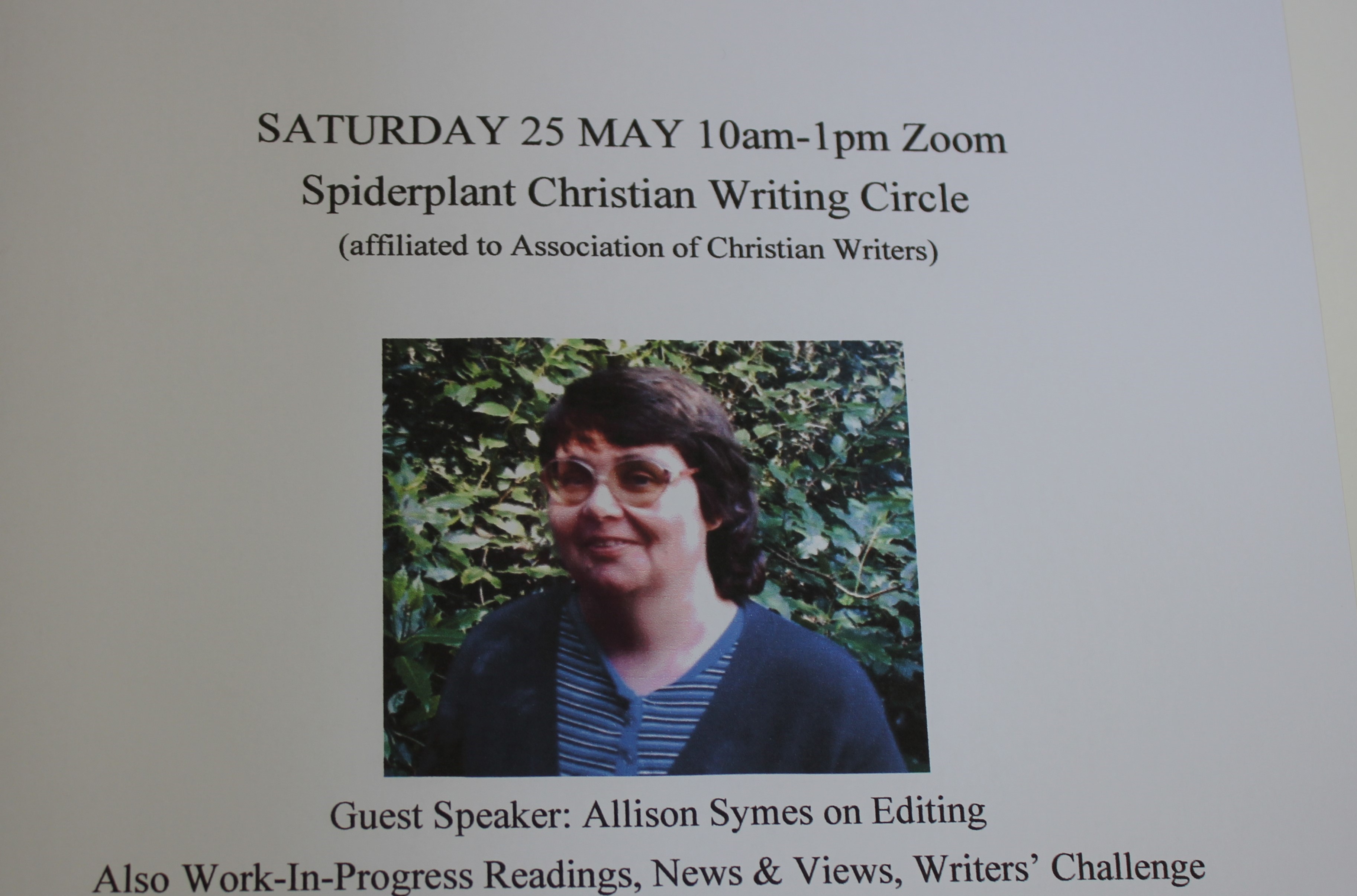
It was a pleasure to share on Zoom a one hour talk on editing with the Spiderplant writing group (who are affiliated to the Association of Christian Writers). Many thanks for making me feel so welcome and I hope you found the advice useful. (Many thanks to Rosalie Weller for kind permission to use the photo).

As well as being an author, I’m an editor and judge competitions too. This can be enlightening because it helps me improve my own writing. This is because I can see where mistakes are made (especially on competition entries) and then try to ensure I don’t make the same ones myself.

In other writing news, I will be talking to Jenny Sanders on her new book, Polished Arrows, in an in-depth two part interview which starts next Friday on Chandler’s Ford Today. Looking forward to sharing Part 1 then.

Spiderplant advert for editing talk by Allison Symes on 25th May 2024

Facebook – From Light to Dark and Back Again

Occasionally, I do have scene breaks in my flash stories. These tend to be for the tales which are 750 to 1000 words in length such as my She Did It Her Way, Kind Of (From Light to Dark and Back Again). Most of the time the action of my stories is dealt with in a few paragraphs but this story did need the full flash word count range to show what I needed it to show.

This tale had four characters in it (one was a dog) and another was referred to by the two female, human characters. (The last character was a pushy salesman who fell foul of the dog). I especially enjoyed writing the ending for this story where everything is wrapped up.

A story has to be the appropriate word count length to tell it properly. Sometimes I find a story I thought would come in at 100 words does need more space and can end up as being a 500 words tale instead. That’s fine. I just find another market for it than the one I originally intended.

For me, a story is only complete when everything is wrapped up and I feel not another word could be added without diluting the impact in some way.

Framed Flash CollectionsIt’s Monday. It’s a Bank Holiday but nothing disguises the fact it’s Monday. Garfield, the cartoon cat, famously loathes Mondays. But then he wasn’t about to enjoy a new story from me on YouTube! Hope you like my latest here – First Class. Is Griselda right to be suspicious of posh looking mail coming by first class post and is she in trouble? Find out here.
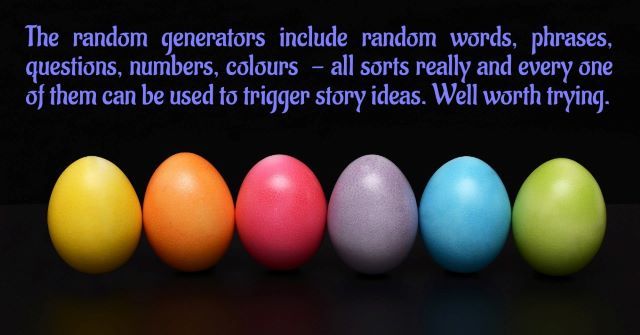
I talked about random theme generators over on my Facebook author page but wanted to add here there is a huge amount of these things out there. I find it pays to mix up the ones I use as this makes for an interesting challenge. Can I write to what has been generated? It is useful practice for writing to story competition themes as well, I think, because you’re getting into the habit of responding to a prompt which has been set by someone else.

The opening line kind is my favourite because I can use that to kick start a new piece of flash fiction or a short story. Occasionally, if the line is right, it can inspire an idea fora blog post. One I generated for this post reads I am optimistic that…

Now you can write an article or a blog post from that but you could use it for fiction too as a story told in the first person by your character. What are they optimistic about? Are they right?

The important thing is, whatever type of prompt you use, to have fun with them. I’ve created (and had published) many stories and flash pieces which started life this way.

444788868_10161909688187053_2028057979148157027_n

All stories need a proper beginning, middle, and end, regardless of their word count. I find for flash fiction it helps to visualise my word count. This is where studying sites like Friday Flash Fiction helps a lot. You can literally see what 100 words looks like on screen.

Having got the visualisation sorted, I can then work out when I need to have the character and set up by, leaving myself enough words to show the problem and worsen it for my poor characters, while still leaving myself enough word count room again so I can give a proper finish.

For a 500 word story, for example, that is roughly one page of A4 so I can visualise splitting that A4 into thirds to deal with the three crucial elements of any tale.

442493362_10161906744262053_4319445498384693671_n

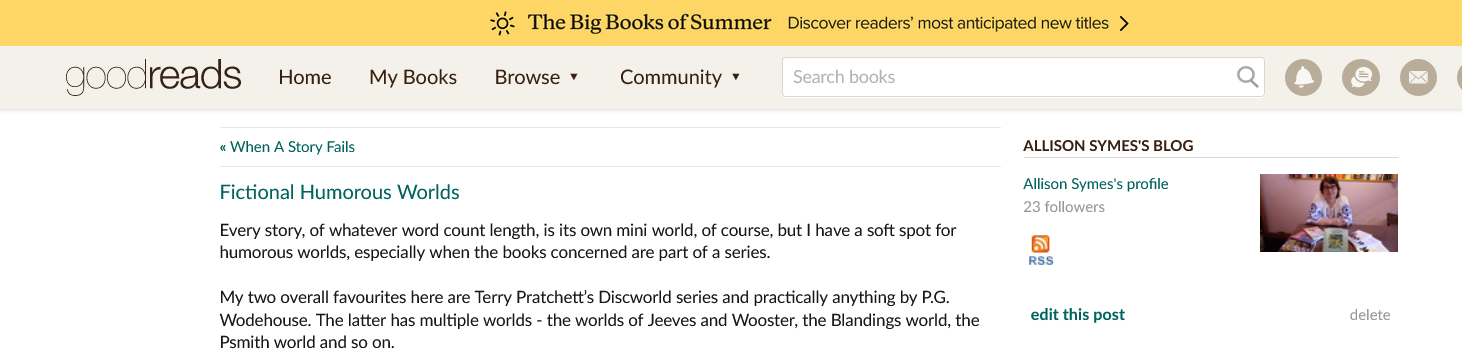
Goodreads Author Blog – Fictional Humorous Worlds

Every story, of whatever word count length, is its own mini world, of course, but I have a soft spot for humorous worlds, especially when the books concerned are part of a series.

My two overall favourites here are Terry Pratchett’s Discworld series and practically anything by P.G. Wodehouse. The latter has multiple worlds – the worlds of Jeeves and Wooster, the Blandings world, the Psmith world and so on.

I love humorous writing. It is wonderful escapism. There is always a time and need for that but perhaps never more so than now when the news is so grim. What I love about the book series though is watching how characters develop over them. This is especially true for Pratchett’s Sam Vimes. That character arc is a fascinating one. Compare who he is in Guards! Guards! with how he is in the final book he is in, Raising Steam. It is a fascinating character study all authors can learn from. Feet of Clay and Men at Arms also work as great detective stories too so do check them out.

You could argue Jeeves and Wooster don’t change that much but that is part of their charm. What does change is the chaos around them they have to sort out, especially Jeeves.

But what is consistent about all of these is the laughs! In a troubled world, I so welcome these. I do wish humorous writing wasn’t looked down on though. I learned a long time ago what looks like easy writing took an awful long time for the writer to craft. It’s even harder for humorous writers given humour can be subjective.

Screenshot 2024-05-25 at 18-08-02 Fictional Humorous Worlds

WRITERS NARRATIVE SUBSCRIBER LINK

AMAZON AUTHOR CENTRAL – ALLISON SYMES

This slideshow requires JavaScript.

Twitter - phone and blue bird image

https://platform.twitter.com/widgets.js https://platform.twitter.com/widgets.js

Processing…
Success! You're on the list.