
Image Credits:-
All images from Pixabay/Pexels unless otherwise stated with many created in Book Brush. Book cover images from Chapeltown Books and Bridge House Publishing. Many thanks to Lynn Clement and Gill James for two images in my Chandlers Ford Today post this week. Screenshots taken by me, Allison Symes.
Hope the week has gone well. Lady has had a lovely time with friends. Have had some sunshine which was welcome but more rain which wasn’t! Writing going well. Am drafting various things at the moment.
Facebook – General and Chandler’s Ford Today
Lady had a lovely time with her Hungarian Vizler pal today and has had a fabulous week in that she has “partied” with pals all week! You’ve got to admire the stamina…
Writing wise, I’m pleased to share Writing Events as my Chandler’s Ford Today post this week. I look at the benefits for writers of going to events and how I evaluate which ones are the best for me. I also discuss day events and Zoom/online ones. (Am going to one of these later this evening in support of a friend’s book launch so the timing of this is nice).
Hope you enjoy the post and find it useful.
Writing Events
Hope the day has gone well. Lady had a fantastic puppy party with her Rhodesian Ridgeback pal and Coco, the lovely Labradoodle. Cold and drizzly out there but nowhere near as bad as yesterday.
Writing wise, I’ll be discussing Writing Events for Chandler’s Ford Today this week. I share what I look for when deciding which events to go to and look at day events and Zoom ones too. Hope you’ll find the post useful. The link goes up tomorrow.
Writing Tip: When I started writing seriously, the thought of networking terrified me. When I realised going to events would mean talking about something I love, writing, with others who love writing too, those fears went. And it got me used to talking about what I do writing wise. What I did do before going to my first ever event was jot a few thoughts on what I could say about what I write. That helped give me more confidence because I knew I had something I could say and then, of course, as you get chatting to other writers, the conversation continues naturally which is wonderful.
18th February – Authors Electric
Despite cold and wet weather, Lady managed to have a great time at the park with her Hungarian Vizler and Rhodesian Ridgeback chums, and Charlie, the lovely Toller. I can’t speak for the others but I do know Lady and I weren’t sorry to be indoors again.
Writing wise, it’s my turn on the Authors Electric blog and this time I look at The Shortest Time, an apt title for a flash fiction writer. I look at this from the viewpoint of meeting deadlines for competitions, using smaller pockets of writing time well so I can make better use of longer sessions, and, of course, I give my characters the shortest time possible in the format to resolve their issues. No dithering about what to do here!
Hope you enjoy the post.
Facebook – From Light to Dark and Back Again
Am happily drafting a flash piece I hope to submit in the next week or so. Have got the basics okay but it is a question of now fine tuning the piece and I know I need a few days away from the work to be able to see what needs to be done and where. I’ve mentioned before it pays all writers to draft a piece, rest it for a while, and then come back to it so you can see it with fresh eyes.
The advantage for flash fiction writers here is we don’t need such a long break as, say, a novella writer would. But it still pays to put the time aside here. I always find something I could’ve phrased better etc on coming back to the work again. The distance from that initial creative spark is crucial, I think, to pick things up and make the work even better.

I like to use my characters to show their location. Often it is by showing you what kind of character they are. For example, if I have a dragon or fairy godmother, it’s a reasonably safe assumption to believe they’re in some sort of magical world. If they’re not, I will show them “on location”, almost inevitably confronting/being confronted by another character (and it will be clear enough where they must be based).
Flash teaches you, I think, to work out what the characters can show the readers. You haven’t got the word count room to spell everything out in any case. I must admit I love it when authors leave me to work things out. All I need is the right clues to be able to do that. The challenge to me as a writer is to plant the right clues so readers can do that with my stories without giving it all away.
I don’t use the weather much in fiction because, for me, it always a background thing. Where the weather has a direct impact on what my characters can do and how, then fine I’d write it in. But I don’t want the weather dominating the story (and when such scenes are badly written, they can be ripe for mockery. Love a laugh etc. Don’t want it to be aimed at my writing though!).
Where it can be useful is in showing more about your character. If I want a character to be struggling against the elements, I will probably show something of the clothing they’re wearing (that is often indicative of prevailing conditions). I may get them to moan about the weather to another character. That is something we an call identify with. I don’t generally need to show you the rain my character is struggling through. I will mention the lightning and rumble of thunder though which makes them start.
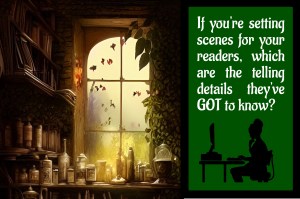
As with anything in fiction, it is the telling details which will make something stand out. So think about your reader, as well as your character. What would they expect to see? What would they expect to hear? Do use as many of the senses as you can.
Having a character doing the following makes something more gripping to me.
Mary knew she had to get away from the trees. The thunder was happening more often now and yes, there it was, she saw the first flash of lightning. She pressed on towards the cottage. Once there, everything else could wait including her vital message.
Allison Symes – 18th February 2026.
Hmm… now that does sound much more promising than saying something like It was pouring down!
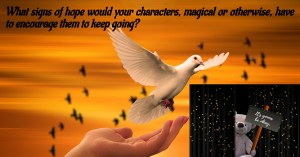
Fairytales With Bite – Signs of Hope
February 2026 has been just as much of a wash out weather wise as January was but there are more signs of hope in February. The natural world is waking up to the thought of spring being not too far away and I’ve loved being out with the dog, despite the rain, spotting things like snowdrops, early crocuses and much more. Also the evenings, when it isn’t raining, are becoming lighter for longer.
What signs of hope would there be in your magical setting? What role does the natural world have against your main magical background? What signs of spring (or the equivalent season) would your characters like to see? Do they even appreciate these things? Do your magical characters appreciate other flora and fauna which are not used for potions etc?
Signs of hope aren’t just confined to the natural world. For example, if your setting has a dictatorial system of government or a wicked magical character in charge, but your characters are moving against all of that, what signs of hope would they have to encourage them to keep going? How would those signs of hope make a difference to the eventual and hoped for victory?
Hope can spur people on in difficult times. How would that play out in your setting?
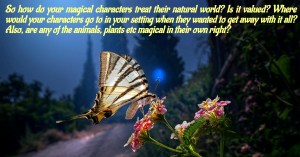
This World and Others – The Natural World in a Magical Setting
As with Fairytales with Bite above, the role of the natural world in a magical setting is an interesting one. Yes, it will be the source of ingredients for spells and potions but it can be more than that.
I’m thinking of The Ents in The Lord of the Rings here, where they, representing the natural world as the Shepherds of the Trees, rose up against Saruman to try to overcome his wanton destruction of trees etc. The natural world can rebel against ill treatment (and I would say climate change is a warning from our own planet here. I don’t see how anyone can deny it. There have been major changes and it still befits us to take as good a care of our planet as we can – and that’s as radical as I get though to me it is plain common sense).
So how do your characters treat their natural world? Is it valued? Would your magical characters appreciate their natural world for its beauty, health benefits to walking in it etc? Where would your characters go to in your setting when they wanted to get away with it all?
Also, are any of the animals, plants etc magical in their own right? What advantages are there to this for your setting or characters? What would be the disadvantages? What are the dangers? How would the natural magical world clash or co-operate with the magical characters?
MailerLite – Allison Symes – Newsletter Sign Up

WRITERS’ NARRATIVE SUBSCRIBER LINK
ALLISON SYMES ON SUBSTACK

AMAZON AUTHOR CENTRAL – ALLISON SYMES

https://platform.twitter.com/widgets.jsAuthors Electric: The Shortest Time by Allison Symes https://t.co/HJknnhe5Qw
— Allison Symes (@AllisonSymes1) February 18, 2026
I discuss meeting deadlines, using small pockets of writing time, and, of course, as a flash fiction writer, I give my characters the shortest time possible to resolve their issues. No dithering here! pic.twitter.com/Xine2gygUw
https://platform.twitter.com/widgets.jsWriting Events https://t.co/ZgumIX1IGe
— Allison Symes (@AllisonSymes1) February 20, 2026
Glad to share Writing Events as my Chandler’s Ford Today post this week. I look at the benefits of writing events and how I evaluate which are the best for me. I also discuss day events and Zoom/online ones. Hope you find the post useful.

 Allison Symes: Collected Works