FAIRYTALES, TRUTH, AND NETWORKING

Now there’s a combination!

Facebook – General – and Chandler’s Ford Today

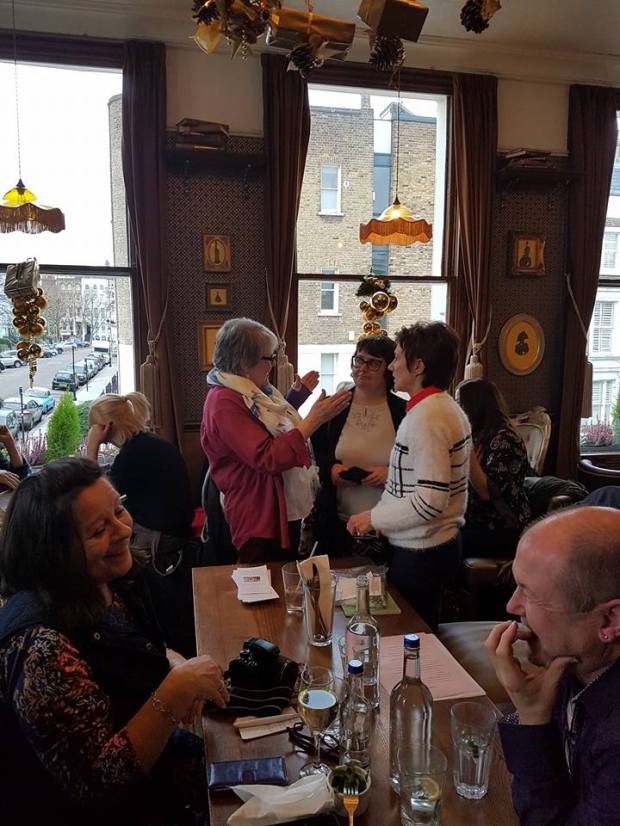
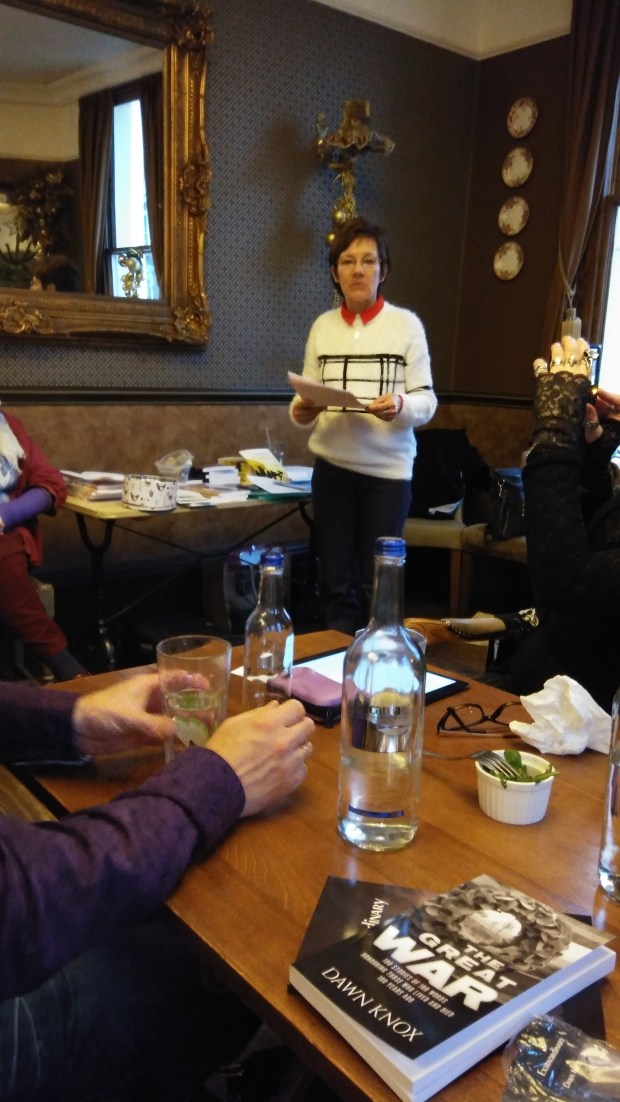
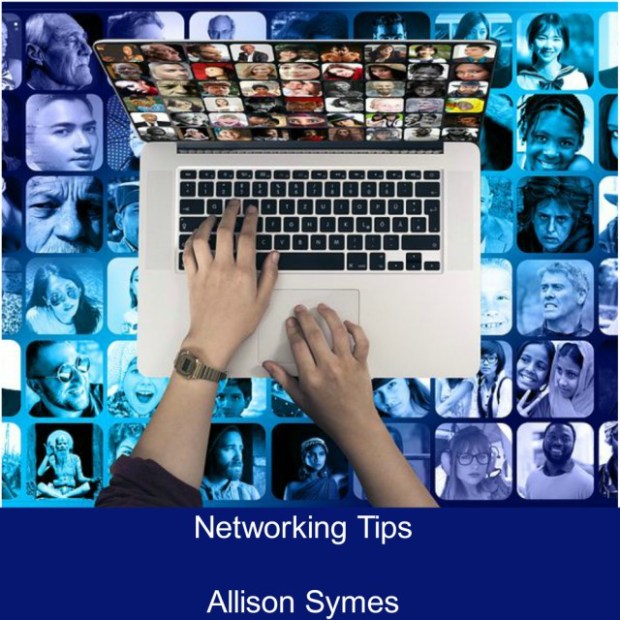
My latest Chandler’s Ford Today post is called Networking Tips. Fellow Chapeltown Books author, Mandy Huggins, and I both share our thoughts on networking here and we hope you find the post useful. Many thanks to her for her pictures. Also a big thank you to Paula Readman for kind permission to use the picture of Dawn Knox, Paula and I which was taken at the Bridge House celebration event last December.

I remember being so scared of the thought of having to network when I was first starting out as a writer. It was really only when I realised networking meant talking about something I love – books, stories etc (generally, as well as my own) – that I relaxed. Can I talk about these things? Yes! The problem can be stopping me! (But that is how it should be. I don’t see how you can commit to writing as a long term love unless you are enthuasiastic about stories. Given the ups and downs of a writer’s life, writing has to be thought of as a series of hopefully achievable goals over a reasonable period of time. There are no shortcuts).

This slideshow requires JavaScript.

Facebook – General

Questions I like to ask of my characters from time to time include:-

What would you say was your best trait?
What would you say was your worst one?
What drives you and why?

I inevitably don’t use all of what I come up with here in the stories themselves but have found having a good working knowledge of what my characters are really like makes it so much easier to write convincingly about/for them.

It is worth taking the time out to flesh out your thoughts here before you write your story. (Scrivener is great here with its character and setting outlines in its short story “mode” but you can create your own template of things you should know about your “people” before you write their stories down).

Facebook – General

What are your writing “likes”? Some of mine include:-

Decent one-liners that make me laugh.

A story that shows me motivations or stresses characters are under that I might not have considered before. For example murders are committed for serious reasons and to what appears to others to be trivial ones. Yet a good story will take you into the mind of that murderer and show why the trivial reason isn’t trivial to them.

Good, sharp pace with quiet bits in between giving me good background on the setting and characters, knowing said quiet bits are gearing the reader up for the next big scene.

A satisfactory ending, which is not the same as a happy one necessarily. The ending has to be right for the story and the main character. It won’t feel right if the match isn’t there.

Characters I can rally behind (or metaphorically boo for) but either reaction has to be genuine. I don’t want to see the author’s hand making their characters act in a certain way. The characters’ acting has to be realistic for those characters.

I love getting to the end of a story or novel and in a sense wishing neither had ended. Always a sign of a well told tale! Going back over a story/novel and picking up the bits I missed first go around. This is particularly true for a detective novel. I always miss some of the clues on the first read!

I like a happy ending where the hero/heroine has “earned” it. I also like to see villains get their comeuppance but again in a realistic manner. Villains generally are not going to fall apart. They can be caught out.

Every word to count… Funnily enough that doesn’t necessarily mean everything has to be short but that each word is appropriate for the story being told. In P.G. Wodehouse’s stories so often he uses very long sentences (he’d never get away with it now!) but not a word is out of place and indeed especially when Wooster’s narrating the long-windedness is part of (a) the character’s charm and (b) the character’s characteristics!

Positive developments in characters, especially a character that goes on to make something good out of themselves.

I like pinpointing moments of change in a story and watching the drama unfold.

Feeling a slight sense of envy I didn’t write the story/novel I’ve enjoyed is a good sign – and nothing but a compliment to the actual author!

Facebook – From Light to Dark and Back Again

It is only in looking back at stories that make up a collection, you really get to see what influences came out. FLTDBA has a nice mixture of influences – fairytales, nods to films, Frankenstein, poetic justice, and Pride and Prejudice to name just some.

I guess this shows why you should read widely (in whatever format and including non-fiction) because you are feeding your imagination. What drives you to write the stories you do? Your own influences/thoughts. Why have you got those influences and thoughts? Almost certainly thanks to things you have read that rang true for something deep inside your creative self.

Facebook – From Light to Dark and Back Again

The right ending for a story is the one that is most appropriate for it. It doesn’t need to be happy necessarily. Indeed, quite a few of mine in From Light to Dark and Back Again are definitely not of the traditional happy ever after variety!

I remember being stunned when I first read Hans Christen Andersen’s The Little Mermaid. You expect everything to work out okay (after all, isn’t that how fairytales are supposed to turn out?) and then it doesn’t! And I won’t say more than that. No spoilers here. It does pay to read the fairytales. They’re often darker than people think and have more layers. The Little Mermaid is a tale of sacrifice when all is said and done.

Facebook – From Light to Dark and Back Again

What do I most like about writing? Well, here’s a few thoughts.

Coming up with characters who spring to life and develop in front of your “eyes”.

Coming up with world(s) that fascinate you.

Coming up with villain(s) that fascinate you!

Coming up with hero(ines) that also fascinate but show why they are the good guys. They’ve got to have a good cause, literally.

Being able to write short length stories from flash to standard length (up to 2000 words) to novels to plays… the only limit is your imagination.

You can explore ideas.

You can discover ideas from the characters you develop, not just in terms of new story ideas, but you get to learn how your “people” think and why. Could it change how you feel about issues? Can be fun finding out!

Receiving feedback which helps you improve your work (this is not necessarily complimentary, though nice responses are obviously nice, but so you can see how well you “got through” to your reader).

Winning or being shortlisted for competitions is a huge morale boost.

Getting to talk about your work at writing festivals and enjoying hearing about others’ work. I love both aspects here. I think it’s like a kind of celebration of the work of the imagination.

Fairytales with Bite – Fairytales and Truth

I’m sure you must have come across at some point someone saying something like “it’s just a fairytale”.  That phrase has always annoyed me.  There is nothing “just” about a fairytale.

When examined closely, the vast majority of fairytales contain at least one element of truth in them (and often much more).  Yes, fairytales do tend to follow character type but there is a lot of truth in those.  What does the wicked witch represent?  Those who are prepared to use the power they’ve got to control others or who are prepared to do anything to gain power.  Who does the good fairy represent?  Those who use their powers for the good of others.  And that’s just to name two examples. We can all think of real life people who can fit into those categories so fairytales do reflect humanity as we know it.

Hans Christen Andersen showed that fairytales do not always have happy ever after endings.  (While it surprised me the first time I read his The Little Mermaid here, I have a greater appreciation now of the truthfulness of his characterisation and the way the story does end).  Fairytales can sometimes get across a certain amount of social commentary (again see Hans Christen Andersen’s The Little Match Girl here).

So I do wish some people would stop being dismissive of fairytales.  There is a lot more to them than may at first be apparent.

This slideshow requires JavaScript.

This World and Others – Networking In Your Stories

My Chandler’s Ford Today post this week is all about networking.  Fellow Chapeltown Books author, Mandy Huggins, and I share our thoughts on this and I hope you find it useful. But it led me to wonder what kind of networking goes on inside the world of our stories.

How do our characters meet each other?  Have they known each other for years?  What are the social networks in the worlds you’ve created?  What happens to those who defy convention here?

Our stories won’t necessarily spell out all of that but readers should know why the characters are interacting the way they do.  If they hate each other, that is bound to be a major factor in how your story develops and the reason for the hate should be shown.  (I don’t think you can ignore the fact they hate each other, it must be what is driving your story.  I can’t see how it would be otherwise).

Is there such a thing as an old boys’ network in your world?  Who benefits or suffers because of it?  Is there a class system and can people/beings cross the divides?  If your world just has one major species, there should be some sort of hierarchy within it.  How does this work?

Feature Image - Networking Tips

My latest CFT post. Mandy Huggins and I discuss networking. Image via Pixabay

FromLightToDark_medium-2

My flash fiction collection from Chapeltown Books!

perf6.500x6.500.indd

Mandy’s flash fiction collection from Chapeltown Books. Image kindly supplied by her.

Amanda Huggins reading from the Ink Tears showcase anthology Death of a Superhero at the launch party in London December 2017

Mandy Huggins – reading is a great way to network with your readers. Image kindly supplied by Mandy Huggins.

It is always good to meet readers and even better when they read you - image via JW

Networking with readers at the Chandler’s Ford Book Fair in 2017. Image from Janet Williams, CFT’s amazing editor.

Setting the mood classically perhaps - image via Pixabay

Setting the mood with music. Image via Pixabay

pexels-photo-680940.jpeg

Humans are immensely creative - image via Pixabay

Let those ideas flow! Image via Pixabay,

A familiar desk scene for writers - image via Pixabay

The familiar sight of the writing desk, regardless of genre! Image via Pixabay.

The best advice for any writer - image via Pixabay

Sound advice. Image via Pixabay

From diving board to keyboard via Pixabay

The keyboard beckons…


TALKING CRIME, RESEARCH IN FICTION AND NETWORKING

A good mix tonight, I think!

Facebook – General – and Chandler’s Ford Today

I talk crime and research, amongst other things, in Part 2 of a fab interview with crime writer, the lovely Val Penny.  Val is the author of Hunter’s Chase, which is the first book in her Edinburgh Crime series. We also talk about writing conferences and I know both of us are looking forward to networking in person later in the year at the Swanwick Writers’ Summer School!

This slideshow requires JavaScript.

Also a big thanks to Gail Aldwin for sharing details about other Chapeltown books including Badlands by Alyson Faye and my own From Light to Dark and Back Again. Much appreciated.

Facebook – General

How do you feel when you reach the end of writing a story or, even more, a book?

A little bereft perhaps but at the same time eager to get on with the next one. That’s my position at the moment.

Have got a few competitions I’d like to have a go at so those will be my next goal. I deliberately want to get work off to these before I start outlining my thoughts for my next book (and I’ve ideas I want to explore there). I think a break between books is a good idea. By the time you come back to writing a book again, you’ll be keen to get on with it!

Facebook – From Light to Dark and Back Again

Where do I get ideas for my stories? From all over the place! When I was starting out as a writer, that kind of answer used to annoy me. My thoughts tended to be along the lines of “well, it’s all right for them to say that but I’m struggling, thank you”. Well, words to that effect anyway.

What I have learned over the years (lots of years too!) is you do learn to develop more of an open mind as to what could make a good story idea. What is useful is having a starting point to trigger ideas that can be developed further. Some of my starting points include:-

1. Proverbs/famous sayings to use as a theme.
2. Picture prompts (not necessarily taken by me). For example, landscapes can offer ideas as to where your setting is or if you are writing fantasy or sci-fi, is your world the complete opposite to the picture? Sometimes that can be useful in getting started.
3. Competition themes can be great as you can then enter the competition too!
4. Snippets of conversation can get you thinking about how a character of yours might get to say something similar.
5. I sometimes have a brainstorming session and write down what could be an opening line to a story. I don’t plan these sessions and try to just write freely for a set time. The lines can be as bizarre or as ordinary as I want but the ones I like the most of later are the ones I write up.

I think the most important thing is to have fun with your writing. If you don’t enjoy it, nobody else will!


Honest feedback is the only kind worth having - image via Pixabay

Honest feedback is the only kind worth having. Image via Pixabay.

Good historical fiction will make it seem as if you had stepped back in time - image via Pixabay

Could this picture inspire stories? Good fiction will take you out of the world for a while. Image via Pixabay.

The best advice for any writer - image via Pixabay

Sound advice.

Feature Image - Flash Fiction - Books are Gateway - image via Pixabay

Says it all really and applies to non-fiction equally as fiction. Image via Pixabay.

writing in many forms via Pixabay

Planning your work. Image via Pixabay.

Facebook – From Light to Dark and Back Again

Looking forward to starting work on a third flash fiction collection after a pause to enter some competitions etc. I find a break between books useful.

Indeed, when I write batches of short stories, I like to have a break and switch to writing flash for a while and vice versa. In between all of this I’m writing posts for Chandler’s Ford Today and More Than Writers (the ACW blog though the lovely thing with writing on the 29th of the month is I have most Februarys off!!).

There are other things I’d like to do at some point (including seeing if I could write a radio play) but those will be projects that I might refer to as my “bits on the side”. I do think it is vital writers have fun with whatever it is they write and also to set themselves fresh challenges now and again.


Fairytales with Bite – Do You Need Research to Write Fiction?

One of the topics I discuss with crime writer, Val Penny, in Part 2 of my interview with her for Chandler’s Ford Today this week is research. We talk about the resources that are available for crime writers and I go on to mention that even for writing fantasy as I do, some research is useful.

Strictly speaking, for any fiction, of course you don’t have to carry out research.  You make it all up!  However, I’ve found that to root my characters so readers can identify with them, I need to know how we react as people and why (so a basic knowledge of how humans “work” is useful).  Also when it comes to world building, knowing how we work is a building block for making up your own  universe.  After all if you decide your world is going to be nothing like this one, you’ve got to work out in exactly which ways it will differ.  So you do have to bring some knowledge to the writing desk to be able to write effectively.

I’ve also found that researching (whether I do so via the internet, a book or what have you) helps me extend my knowledge (obviously!) but the knock-on benefit of that for my fiction writing is it also expands what I can write about.  Write about what you know is good advice so expand what you know and you can expand what you can write.

This World and Others – Networking

I discuss the value of networking in my Chandler’s Ford Today post this week, which is Part 2 of a great interview with crime writer, Val Penny.   Amongst other topics, we share our thoughts on two conferences we’ve been to – Winchester Writers’ Festival and the Swanwick Writers’ Summer School (and indeed are looking forward to networking in person again then!).

How does networking happen on the world you’ve created for your fiction though?  What is it used for?  Can only certain people/beings/robots/strange creatures etc do this?  Is corruption an issue and does anyone try to fight it, if so?  Which of the creative arts is known on your world and are there conferences/classes for them?  How is successful networking “rewarded”?

Have any of your characters formed friendships, which later they depend on in life threatening situations?  How does networking earlier in their life benefit them now?  (Or does it endanger them because the friends they thought they’d made turn out not to be friends at all?!).

This slideshow requires JavaScript.


One of the best ways to escape is with a good book. Image via Pixabay.

THE MAGIC OF WRITING

FAIRYTALES WITH BITE

The Magic of Writing shares what I love about writing and writing get-togethers such as the Bridge House Publishing/Cafelit joint book launch I went to last weekend.  It was huge fun meeting up again with some I met from last year and others who were new to me.

And we all got the chance to practice our networking skills with the speed dating exercise.  You get to chat to a writer or reader for three minutes and ask them for marketing tips (if speaking to a writer) or discuss books in general (if speaking to a reader).  Once the three minutes are up, you then talk to someone else.

The only thing I dislike about this is you inevitably stop half way through an excellent conversation and there isn’t always time to get back to it at the bar again later. However, it does get you mixing and talking and you inevitably learn something really useful.

(Baubles – the Bridge House anthology for this year – and The Best of Cafelit 5 are available in print and on Kindle and via Amazon, as well as from the publishers directly.  I have a short story, Helping Out, in Baubles and a flash fiction piece, Telling the Time, in Cafelit 5).

https://youtu.be/WgxXa9GB7to

THIS WORLD AND OTHERS

Writing Books shares some non-fiction how-to-write books I wouldn’t be without.  I deliberately kept this to a short list. Can you add to my list?  I wouldn’t dare list the fiction books I’d hate to part with as I’d be writing that list till Doomsday!

FACEBOOK PAGE

I discuss the joys of swimming tonight.  I always thought I would end up working out stories as I swam but it hasn’t worked out like that.  I’m more likely to do that when doing the ironing!

https://www.facebook.com/plugins/post.php?href=https%3A%2F%2Fwww.facebook.com%2FAllison.Symes.FairytaleLady%2Fposts%2F847454668690847&width=500

One of my favourite book images. They really are magical. Transportation into other worlds and around this one in a few hundred pages. Brilliant! Image via Pixabay.

One of my favourite book images. They really are magical. Transportation into other worlds and around this one in a few hundred pages. Brilliant! Image via Pixabay.