Music and Stories

Facebook – General – and Chandler’s Ford Today

One of the joys of writing my Chandler’s Ford Today posts is when I have a topic where I can go to town on finding music clips! The topic of books is one of them.

Many thanks to my wonderful panel – #JenniferCWilson, #ValPenny, #AnneWan, #WendyHJones, and #RichardHardie – for taking part in my mini-series The Joys and Challenges of Writing Series Novels. Hope you enjoy their fantastic insights AND the music I’ve used to go with these!

This slideshow requires JavaScript.

Had a great night out watching the Chameleon Theatre Group perform three episodes from Blackadder Goes Forth, including Goodbyeee. Review to follow on Chandler’s Ford Today in due course but I will say now it was superbly done and the set, made by the company themselves, was brilliant. Looking forward to sharing more on that.

Adaptations I’m generally happy with if they are faithful to the book/series etc. This is why I loved the Miss Marple series with Joan Hickson – they were faithful to the Christie canon – but the Marple series. No. Didn’t watch it. Just couldn’t bring myself to do so when it emerged they were altering the stories and bringing in characters that didn’t belong in the originals. Really don’t like that.

My CFT post this week will be the final part of my series on the joys and challenges of writing the series novel. As ever, my thanks to to #JenniferCWilson, #ValPenny, #AnneWan, #WendyHJones, and #RichardHardie. Nice range of genres between them too – from children’s to crime (and Wendy writes both!) to fantasy to historical crossed with ghost stories. Link up on Friday.

Glad to report I’ll be having more work on Cafelit later this week and again in November. Will share links as and when.

From what I’ve seen of the set the Chameleons have produced for the stage version of Blackadder Goes Forth, I anticipate a packed house and a wonderful and thoughtful evening of entertainment. Will review for CFT in due course. Do check their FB page out.

No automatic alt text available.

Image may contain: outdoor

thank you text on black and brown board

Pexels image.  There are times when words are inadequate.

Facebook – From Light to Dark and Back Again

So more on my alphabetical list then.

J = Juicy Storylines! Not just for soap operas, honestly, but something every character wants. Now “juicy” can be taken literally of course, but I see it as the storyline being appropriate for the character and taking them and stretching them to see what they are really made of. There’s nothing like a crisis for bringing out the best or worst in someone and that applies just as well to fiction!

K = Kicker. Must admit I needed to look this one up. (It’ll be interesting to find out what I can research for Q!). In journalism it apparently means a sudden unexpected change of events. In fiction we’d usually refer to it as a twist in the tale. I like kicker though. Has bite. And your stories must too, whether they have a twist/kicker in them or not.

L = Lines. Who is getting the best lines in your story? Your hero or your villain? A great story will have this split between the two to prevent either becoming a stereotype or, worse still, boring! Also a villain capable of humour etc means while your reader will not want them to win (possibly SHOULD not!), they will sympathise and identify with the villain to a certain extent. There should be something about each character a reader can identify with. (My inspiration here is Alan Rickman’s masterly portrayal of the Sheriff of Nottingham in Robin Hood: Prince of Thieves!).

About halfway through the alphabetical listing now. So then:-

M = Muse. The best way to feed said muse is to read widely and often (and do include non-fiction and poetry in this too. Different sources of writing are good for you and inspire your own thoughts and ideas in various ways). I’ve also found writing regularly feeds it too. Never worry about what you come out with at first being awful and needing work. That would’ve happened to Shakespeare too! It can and will be put right in the edits!

N = Narrative. Whose story is it? Whose viewpoint is going to dominate? What can that character see and know that the others cannot? Why have you chosen that character to lead the narrative? Answer those questions and your story will be off to a good start!

O = Originality. Reading widely feeds your originality. Partly this is due to what you read, but sometimes it can be because you read something you really don’t like or feel you can do better and that can be the trigger point for your own writing. Also, your voice is unique to you and will come through in your writing, especially if you write often. Regular writing (even if it is short bouts at a time) really does encourage your imaginative “muscle” to start working.

Pressing on with my alphabet topic then, we reach P, Q and R. (Great letters if you can get them out in Scrabble incidentally!).

P = Performance. Do your characters perform well in your stories? Do they live up to what you outlined them to be or have they gone beyond that? Read your stories out loud. Perhaps record them and play them back. Hear how your characters perform. Are they having the impact on you that you want them to have on your reader?

Q = Quizzing. I’ve found quizzing my characters to be a very useful part of my outlining. I don’t need to know the minute details. Nor do I put everything I outline in a story. However, I take my character’s basic traits and quiz them from there. If I decide a character is going to be brave, I will quiz them to find out if there are limits to that courage. I try to find out where that courage comes from. Does their “tribe” prize bravery? Or is it noticeably absent and your character is rebelling against that? What are the outcomes? (There WILL be some and that’s where the drama and your stories are to be found!).

R = Right Word Count for your Flash Fiction. I sometimes write a piece deliberately to a word count and that’s it. Sometimes I think a story will come to 100 words but discover it can be done in 75 or needs to run to 250, say. Be flexible on this. The story is the right length when the lead character has done and said all they have to do/say for the situation you’ve put them in. The great thing with flash fiction is there are so many different categories, that even if your treasured 100 word piece comes in at 500 words, there will be markets and competitions for that out there.

This slideshow requires JavaScript.

Goodreads Author Programme – Blog –

After the End, What’s Next?

If you’ve enjoyed a really good book, what do you do when you finish it? Go on to read more books by the same author, or read more in the same genre, or do you go for something that is completely different in mood and style?

I have done all three of these (though obviously not at the same time!) and it very much depends on my mood at the end of the story. If I’ve loved a gory crime thriller, I may well want something humorous to show the lighter side of life, albeit a fictional one!

With short stories especially, I tend to read a few by the same author before moving on. With novels, if the book has really gripped me, I’ve got to check out what else the author has done, even if I decide I’ll come back to those later.

The important thing though is that whatever you read, you enjoy it so much, you keep on reading, no matter what author, genre, style etc you choose next. Happy reading!

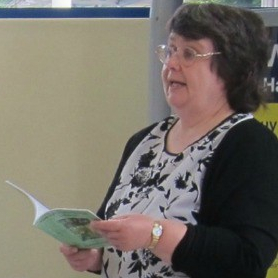
Image Credit:  many thanks to the Hampshire Writers’ Society for taking the photo of me reading as guest speaker and for kind permission to use the photo.  Both much appreciated!

Fairytales with Bite – Signs of a Fairytale World

What are the signs of a fairytale world?  How can you know quite quickly you ARE in one (via fiction I’m presuming for the purposes of this post!  If you do find a portal to another world, however, be sure to report back with plenty of details, pictures if at all possible.  We will all want to know!!).

1.  Magic.  The biggest giveaway of course is the use of magic.  The interesting thing to work out when planning your stories though is whether everyone can use magic or just a select few.  If everyone can use it, what are the rules so anarchy doesn’t break out?  Boundaries increase the drama in your story.  If everyone can zap everyone else, that doesn’t make for much of a story.  If only a few can do that but the price they pay is their own lives are forfeit, now there’s a potential story.

2.  Inanimate Objects – The Use Of.  We all know from Disney (see Beauty and the Beast) a teapot, to name one example, is rarely just a teapot!  Sometimes they’re an enchanted victim.  Sometimes these things are portals (also see Harry Potter).  So what uses are the inanimate objects put to in your setting?  Does a particular object convey a particular meaning or power and, if so, what and why?  What are the limits to the use of objects?

3.  Creatures.  Ranging from domestic animals that can talk (hello, Puss in Boots!  Loved Puss in Shrek.  Thought they had the portrayal spot on) to odd creatures that are the stuff of legends to monsters of course.   Basically what you wouldn’t see here!  And there’s nothing to stop you inventing your own.  This is where some knowledge of natural history is invaluable.  Knowing what animals need to survive and how their bodies are designed to handle that should inspire some ideas for how the creatures in your stories will do this kind of thing.

Happy writing!

This World and Others – Music and Stories

In my latest CFT post, the final part of my mini-series on The Joys and Challenges of Writing Series Novels, I get to have some fun choosing music tracks to go with my fantastic panel’s insights.  Many thanks again to Jennifer C Wilson, Val Penny, Anne Wan, Wendy H Jones, and Richard Hardie for taking part in this three part series.  Hope you enjoy the insights and the music!

Music and stories have long been intertwined of course.  So many wonderful songs are stories set to music effectively.  Music can and does play a part in stories.  It can be used to show character.  Movies, of course, rely on music to help set mood.  Think of the Jaws theme by John Williams.  Every note of that puts pictures and therefore stories in your head (and possibly might put you off swimming in the open sea but that’s another matter!  There are advantages to just swimming in the local public baths!!).

I write with classical music playing.  (I often listen to Classic FM).  Unlike other styles of music, it hasn’t affected my mood (and therefore what I write!).  It does help me relax and I write more (and I hope better) when relaxed.  I’ve also found it helpful to think of the kind of music my characters would be fans of when I’m creating them.  It almost certainly won’t come into the story I write but it fills out my knowledge of the character I’m about to place before a reader.  That has to be a good thing.

And I must admit I loved choosing the music for my book trailer for From Light to Dark and Back Again.   The track used is an adaptation of Camille Saint Saens Danse Macabre (used as the theme tune for the BBC detective series Jonathan Creek).

https://www.facebook.com/plugins/video.php?href=https%3A%2F%2Fwww.facebook.com%2FAllison.Symes.FairytaleLady%2Fvideos%2F954726234630356%2F&show_text=0&width=560

Stand Alones, Flash Fiction and Fairytales

Facebook – General – and Chandler’s Ford Today

Many thanks again to Jennifer C Wilson, Val Penny, #AnneWan, Wendy Jones, and Richard Hardie for their further insights into the joys and challenges of writing series fiction. Amongst tonight’s topics is how to ensure each book in a series works as a stand-alone, given our series writers can never know which book a reader will actually start with. It isn’t necessarily book 1!

This slideshow requires JavaScript.

What five things do I like to see in a character? Ideally they have all of the traits I list below but as long as a character has the majority of them, I’m likely to enjoy spending time in the company of that character as I read their story.

1. Courage.
2. Sense of Humour.
3. Loyalty.
4. They, at the very least, respect books; at best they have their own library!
5. Kindness.

Does that rule out the villains? No! Even villains can be kind to their pet cat, have a decent library etc.

Looking at that list, it’s what I like to see in myself and, before you ask, I’m working on the personal library bit! (It’s nowhere near as grand as the one in the pictures below though!).

This slideshow requires JavaScript.

One of the things I love about going to writing conferences is that I always learn something pertinent to what I write. And it is not always an obvious link.

I’m off to the Association of Christian Writers’ Day on Saturday, the topic is Writing for Children and Young Adults, which is not directly what I do, but I just know I will pick up useful tips that I can apply directly.

And you never know – looking at what other writers do can help you re-examine whether you are working in the best way you can. It may also inspire a new direction of writing too! What I do know is it will be fun finding out if it does or not and what useful tips I’ll bring home with me.

The great thing with writing is you never stop learning how to improve what you do and that is so good for your brain!

(And networking is always fun!).

Facebook – From Light to Dark and Back Again

A = Alliteration. Can be useful for titles in flash fiction (though I don’t use it much) but as with any story, it can grab the attention and help set the mood. Best not overused I think. You want each title to set the tone for what it is to come and a variety of methods for doing that is best. Keeps it fresh for you as the writer too.

B = Backstory. Not a lot of room for that in flash fiction! Best to hint at it through one or two vital details the reader has to know and leave it at that.

C = Character. The kingpin of fiction I think. Get the character right and the plot will come from them. Know your character inside and out – I find it useful to know their chief trait (and I piece together a mental picture of what they are like from there). Find the appropriate starting point for you but it is worth taking the time to know your character well before you start. Your writing will flow better because you write with that knowledge. It does come through in what you write.

As ever, am planning to write flash fiction on the train journey to and from London on Saturday as I head off to a writing day run by the Association of Christian Writers. It’s amazing what you can get done on a smartphone with no interruptions! (Daren’t do this on the Tube though. Always worried I’ll miss my stop! I do think the Tube is a wonderful invention and you never get cold down there either…).

I also sometimes draft non-fiction articles and future blog posts when out and about. I just need a long enough train journey to draft a novel now. 😉😁Hmm….


When planning your story (you do, yes?), I find it useful to work out what the obvious ideas might be from a title I’ve thought of, and then work out what could come from those. I don’t plump for the first ideas that come to me. I try to make myself dig that bit deeper to come up with something that fits the theme, makes sense, but is also different precisely because I haven’t gone for the obvious ideas!

Spider diagrams or flowcharts can be useful here. I find I must have a title to kick start the process with, even if I do end up changing it for something better later. It is always a tad annoying that a better title idea crops up when you are writing the story and NOT before you get started, but that is one of those quirks of writing!

Picture of me reading was taken by the lovely #DawnKentishKnox at last year’s Bridge House event. Am very much looking forward to this year’s one too!


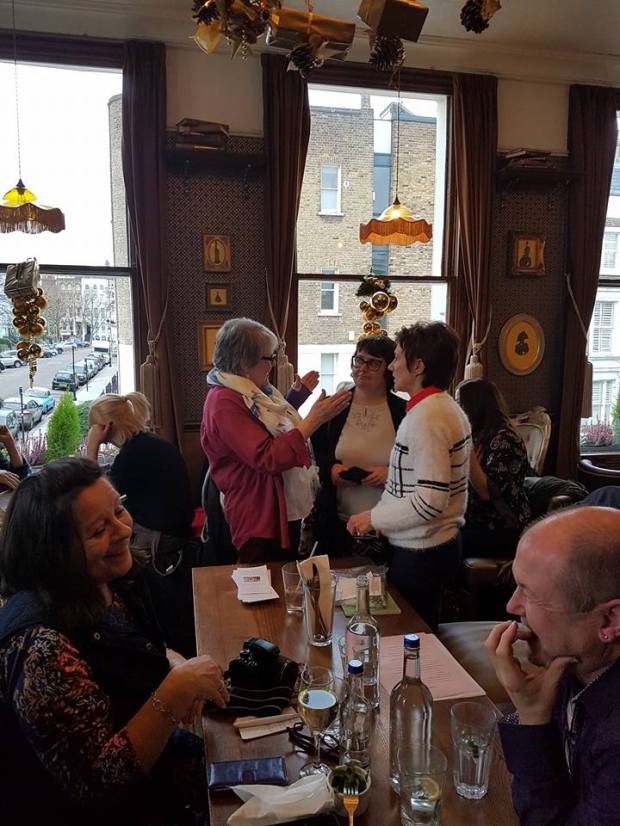
Gill talks with Dawn and I at the BH event, image taken by Paula Readman

Gill James talks with Dawn Knox and I at a networking event held by Bridge House Publishing last December. Am glad to report Dawn will also be in the Waterloo Festival Anthology. Image from Paula Readman and thanks to her for permission to use it.

Paula Readman, Dawn Kentish Knox and Allison Symes and books - with kind permission from Paula Readman - Copy

Paula Readman, Dawn Knox and I at the recent Bridge House celebration event. Many thanks to Paula for the image. Also Paula is another winning entry for the Waterloo Festival.

20171202_160214

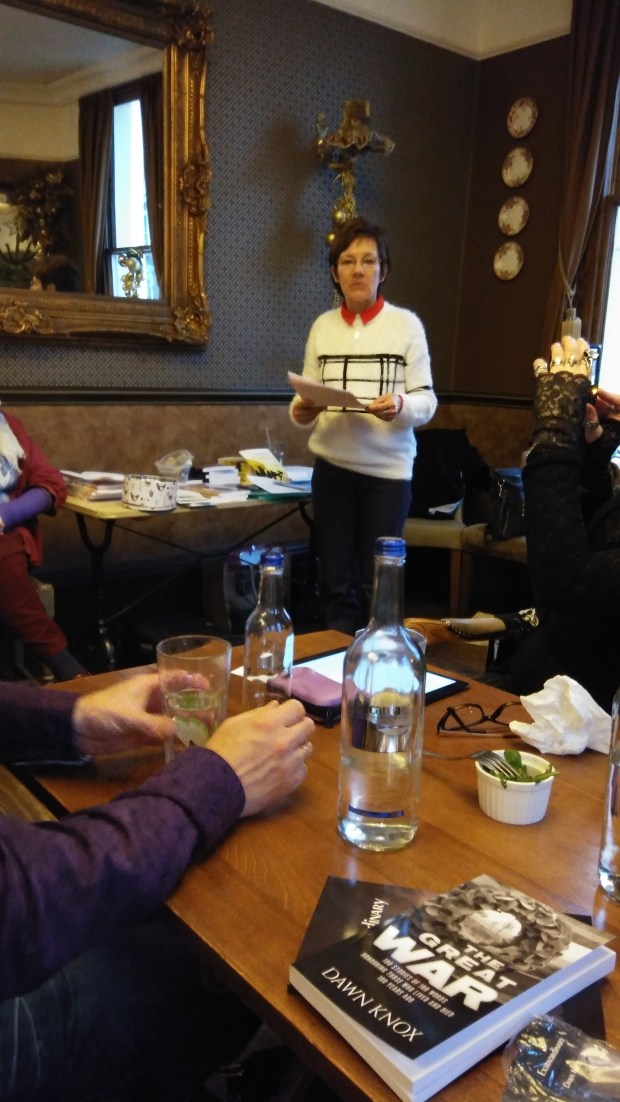
Dawn Kentish Knox, fellow flash fiction writer, reads some work from her excellent book, The Great War. Image by Allison Symes

Lovely having an appreciative audience, pic taken by Dawn Kentish Knox

I read three stories from From Light to Dark and Back Again. Many thanks to Dawn Kentish Knox for the picture!

Book Buying News!

From Light to Dark and Back Again is available from The Book DepositoryDelivery time on the paperback is 1 to 3 business days.  As ever, reviews are always welcome in the usual places.  The great thing is reviews do not need to be long but they all help the writer, even the indifferent ones!

Fairytales with Bite – Flash Fiction and Fairytales

Flash fiction is an ideal vehicle for fairytales.  Why?  Because the best fairytales set up their world quickly, have a definite conclusion, and often pack a powerful punch.  Flash fiction does this too so to my mind flash and fairytales are a match made in writing heaven.

Flash fiction has to be character led due to its limited word count but you can set that character wherever and whenever you wish.  A few telling details can set up a magical world quickly.  For example from my George Changes His Mind (in From Light to Dark and Back Again), I set up a magical world with the opening line “He refused to kill the dragon.”  The telling detail there is in one word – dragon! The story goes on to show what happens and that is the important bit of the story after all.  I don’t need to use thousands of words setting up the magical world in which this is set.  This is not crucial to this story.  What matters is it IS in a magical world and what George goes on to do or not do.

A lot of my stories are either reflections of a fairytale world or set in it and they are great fun to write but I always focus on what the lead character is like.  That is the crucial point of any story I think but in flash where every word must work hard to earn its place to stay there, it is even more so.

This World and Others – Stand Alone

Part 2 of my CFT mini series on The Joys and Challenges of Writing Series Novels looks at, amongst other topics, how to ensure a book stands alone given no series novelist can know at which point a reader will discover their writing.  It is highly unlikely to be book 1.  Indeed I’ve discovered series at the mid point! Many thanks again to my marvellous panellists – Jennifer C Wilson, Val Penny, Anne Wan, Wendy H Jones, and Richard Hardie – for some great insights.  Very happy to recommend their books to you too.  Great reads one and all albeit for different audiences!

It is true that every writer stands alone, even those that collaborate as they have to go off to write “their bits” before coming back and swapping notes with the other one(s) in the project.  We have to judge whether our work is strong enough to submit and, if there is a choice of places to submit to, which is the best one.  We have to judge whether we have edited a piece enough or if it still needs work.  The call is with us and we are going to get it wrong.  The joy, of course, is when we get it right and a piece is published.

This is where meeting other writers, whether at conferences, online, at courses etc., is invaluable.  There is nobody like another writer to know exactly how it feels when you’re struggling to get the words out or who knows the joy of the words pouring out and work going well.  You do have to share this sometimes for the sake of your own sanity!

I learned a long time ago no writer is a competitor to me.  I write as I write.  I cannot write as you would.  We all bring our unique perspectives to what we write – and that is the great thing about it!

This slideshow requires JavaScript.


STORY PROMPTS

Facebook – General

When do you know you are really going to enjoy the story or book that you’ve started? For me it’s by the end of the first page. If I’m not gripped by the story by then, I’m unlikely to go much further with it.

I’m pleased to say though that there have not been many books or stories which I’ve given up on. This is why my To Be Read pile is as big as it is! (It’s not that much smaller on my Kindle either but at least that won’t topple over under the weight!).

By the end of the first page, I want to know who the lead character is going to be (even if they are just referred to at this point) and some idea of what the central conflict is going to be about. Then there has to be the “I’ve GOT to find out what happens next” moment. Without that, I don’t read on.

What kind of story prompts do you prefer? Pictures? An opening line? A finishing line?

I’ve used all in my time (and plan to keep on using them too), but my favourite is the promising opening line. I love finding out where that line can take me. I also believe if the writer is having a whale of a time writing the story, something of that enjoyment will show in the tale itself. I think the writing flows better.

Having said that there have been times when what I thought was a promising line turned out to be a dead end. I see this as a false start scenario and I abandon the tale and start again. I have tried seeing if I can make what I’ve come up with better but the answer is inevitably no as I think it is clear to me that my heart wasn’t really in it. I think that can show through in the writing too.

The great thing with the latter situation is if, later, an idea comes to you that resolves the problem with the story (or you think it will), there’s nothing to stop you digging that tale out and giving it another go. I suppose what I’ve learned here is not to panic if a story doesn’t work out right. Go on to the next one. Come back to the old one if better ideas occur as I’m writing something else (and that happens a LOT. I can be writing my next CFT post when a good story idea crops up. So I pause, jot the idea down, go back to my CFT post and then have a look at the story idea later. The benefit of this is I can take a good hard look at that idea and judge better whether it really is a “goer” or not. As a result, my “abandon a story because it really isn’t working” rate has decreased significantly).

This slideshow requires JavaScript.

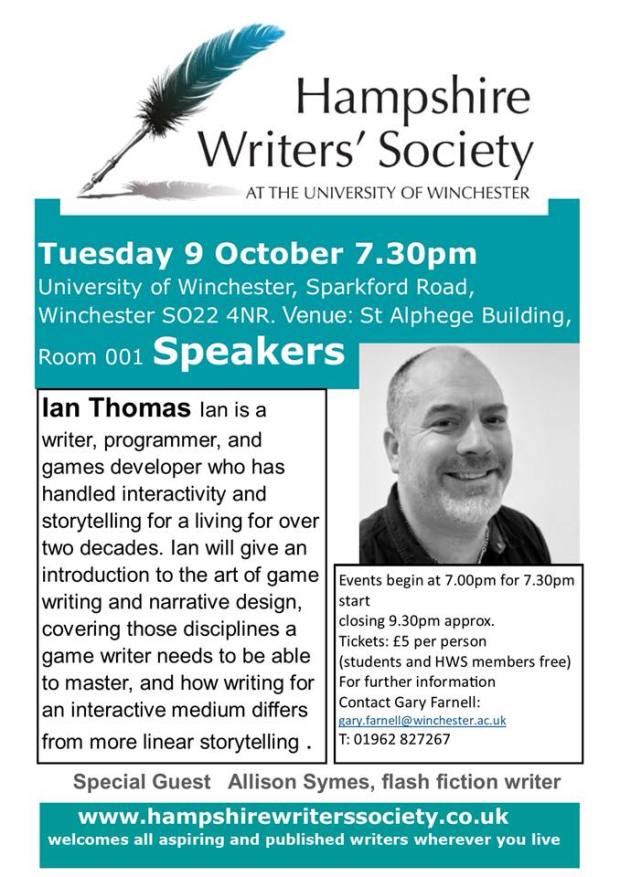
Looking forward to being at the Hampshire Writers’ Society tomorrow night to talk about flash fiction.

Also looking forward to the Bridge House celebration in London in December and the Association of Christian Writers’ Day in London later this month.

What with writing and taking the dog out, it’s a social whirl! (I get to talk to lots of lovely writers and equally lovely dog owners. Some of course encompass both roles!).

POSTER SHOWING ALLISON AS GUEST SPEAKER AT HWS OCTOBER 2018

Many thanks to Maggie Farran for the poster.

LIKES POST - editing - Pixabay image

The joy of editing! Image by Pixabay

cropped-cropped-version-of-my-reading-at-railway-station

The Open Mic for Prose night

Many thanks to Geoff Parkes for kind permission to use this shot of me reading at the Swanwick Prose Open Mic Night.

FLTDBA in the Swanwick Book Room

FLTDBA for sale in the Swanwick Book Room. Image by Allison Symes

FromLightToDark_back_medium

Back cover of FLTDBA. Image by Allison Symes

BEING THANKFUL - On writing or being appreciative - image via Pixabay

Always good advice. Image via Pixabay.

Am writing this early as I don’t expect to have a lot of creative energy left after the Hampshire Writers’ Society meeting tonight! (But in a very good way of course…😀)

Later in the week, I will be sharing on Chandler’s Ford Today Part 1 of a three part series on the joys and challenges of writing series novels. Many thanks to #JenniferCWilson, #ValPenny, #AnneWan, #WendyHJones, and #RichardHardie for taking part in this. Link to go up on Friday but what I can reveal now is their thoughts about this topic are riveting. Very much looking forward to sharing this over the next three Fridays.

The lovely thing is there is a wide range of fiction represented here from children’s and YA to crime to historical fiction with a twist. Much to learn from here.

I think one of the best things about writing is you never do stop learning how to develop and improve what you write. Nor should you want to stop seeking to improve and develop! As well as making you a better writer, this kind of thing is so good for your own well being anyway.

Facebook – From Light to Dark and Back Again

Just because a story is short, it doesn’t mean it lacks insight. Far from it. I love well written flash stories for the intensity of the impact they make and the characterisation in them has to be good.

You are relying, rightly, on the character to “carry the story” so they’ve got to be strong enough to do so. Strong enough in the sense that there is enough about them to interest the reader. Strong enough to make the reader care about them and so on.

The great advantage flash has, of course, is that there is NO padding whatsoever. It really does cut to the chase.

Every story should reveal something about a character and their development (or what the lack of that does to/for them).

Flash fiction does that too but in a greatly compressed word count. This is why flash fiction can have such a big impact on readers. If your story is a grim one say, there is no room to “soften the blows”. What the reader sees is what they get and so on…. very much direct and to the sharp point.

Equally flash fiction can be great for a much needed laugh as ending a story on a punchline can work well. (Has to be a great punchline though!).

One of the most difficult things about flash fiction is working out where to stop. It is very easy to come up with, say, a 250-word story, which you think needs a little addition or two and then you have a 500-word tale. Well, that’s okay, isn’t it? It’s still flash fiction after all.

Well, yes and no.

Yes, the longer version would still be flash fiction.

No, in that the ideal length of your flash story should be when you have said all that is needed to be said and not a word more.

I gauge what the correct word count is for a story by looking at the impact the story has. If at 250 words it doesn’t have enough impact, then yes I will add to it but only until I’ve got the required emotional resonance from the character(s). I will then edit the piece until I still have that resonance without loss of quality of the story.

My worry about expanding a piece is you could easily dilute the impact, which is something you don’t want. Every word in flash fiction has to justify its place in the story, otherwise out it goes. You do learn to be ruthless about cutting when writing flash but that’s no bad thing.

One useful thing about flash fiction is I’ve often found the best way to explain it is to read a couple of examples. The ultimate in showing not telling perhaps! Also, it doesn’t take too long and you get the idea very quickly. It shows there is a proper beginning, middle and end to the story.

What flash fiction must never be is cut-off prose. The story still has to be a complete story in and of itself. That doesn’t stop you taking the basic idea and developing it further.

For example you like the character in your flash fiction so you want to write more stories about them. Absolutely fine.

Likewise, you love your flash fiction story but know it could be developed into a 1500 word or so standard competition entry story where you have the room to put in a sub-plot which you wouldn’t with the short, sharp flash version of it. Again, absolutely fine.

What flash fiction should be is fun to write (and that will mean it should be fun to read too).

This slideshow requires JavaScript.

Goodreads Author Programme – Blog –

Classic -v- Contemporary

Which books do you prefer reading? Classic or contemporary? I love both, naturally. A bookworm isn’t going to worry about when a book came out. They just want the book to be good…

A lot of my contemporary reading is either flash fiction collections or crime novels. (I know: it IS a nice mix! Some of the flash fiction collections, including my own, include crime stories in them).

My classic reading includes Austen, Wodehouse, Dickens, Christie and so on. I like to think of these almost as comfort reading. I know the stories. I know I will love them. It’s what I turn to when life gets particularly stressful. I want a known quantity at that point.

Terry Pratchett deserves a category of his own in that I read or listen to his works when I am in good need of a laugh. He never disappoints!

The flash fiction collections in turn amuse me, scare me, make me think and so on. I’ve got to be ready for the challenge of at least some of the stories in these. And that’s fine. Good stories should make you think (even if they make you laugh or scream as well).

I tend to flit between catching up with lots of book reading, then switching to magazine reading. The important thing? I am reading – and loving it all!