Meeting Up With Other Writers

This slideshow requires JavaScript.

Image Credits:-
All images from Pixabay/Pexels unless otherwise stated with many created in Book Brush. Book cover images from Chapeltown Books and Bridge House Publishing. Screenshots taken by me, Allison Symes, as was one photo for my Chandler’s Ford Today post this week. The photo of me being “mugged” by Lady while on a previous holiday was taken by Adrian Symes. He also took the shot of me holding up a copy of Creativity Matters. Always handy having someone on hand for photos!
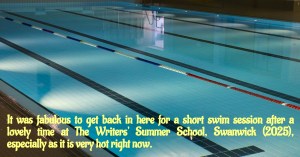
Not long back from another fabulous few days at The Writers’ Summer School, Swanwick. Hope to write more about that for Chandler’s Ford Today next week. Getting back to my usual writing routine – a bit at a time in this heat, mind you! Lady was so excited to see me back, which was lovely. It was fabulous taking her round the park again. What I also relished was a welcome return to the swimming pool. In this heat, I never want to get out of it!
Facebook – General and Chandler’s Ford Today

Lady got to see Daisy, a lovely cocker spaniel we see from time to time. I returned to the swimming pool for a shortish swim but it was so nice!

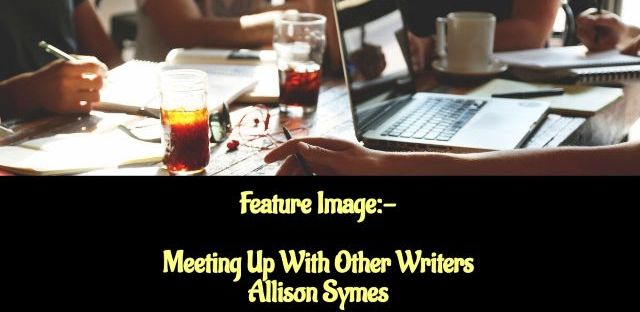
Writing wise, I’m pleased to share Meeting Up With Other Writers for Chandler’s Ford Today this week. It’s an apt post given I’ve just come back from Swanwick though I hope to share specifically more about that next week.

For this post, I look at the many benefits of writing events and getting to know your fellow authors, whether these events are online, in person, or you mix both. I like to do that. Why not get the best of both worlds after all?

Quick reminder for readers in my area – John Puzey will be holding his book event at Chandler’s Ford Library tomorrow, 16th August from 10.00 am, to discuss his new book, Captive Audience (Authors Reach Limited). All are welcome.

Meeting Up With Other Writers

This slideshow requires JavaScript.


Am on my way home as I type this. Have had a fabulous time at The Writers’ Summer School, Swanwick. No surprises there! Am looking forward to catching up with my family which will include being mugged by an excitable collie cross!

While not directly about Swanwick, my Chandler’s Ford Today post this week is called Meeting Up With Other Writers. I explore why this is a good idea. Link up tomorrow and I hope to write specifically about Swanwick for Friday week. See link above.

Hope all at Swanwick had good journeys home. Hope to see you there next year.

Update: I was home by early afternoon, which was great. I was indeed mugged by said excitable collie cross. Even got my laundry done. Now back to my writing life – but it will be a slow return to it. So muggy here (but it was in Derbyshire too). Pic below from a previous holiday but when Lady wants a cuddle, she wants a cuddle!


Well, it’s the final full day of The Writers’ Summer School, Swanwick 2025 and I can hardly believe where the time has gone. My courses today were Effective Listening by Heather Swash and Magic In the Archives by Dr Erica Canela, both of which were fascinating and informative.

The latter also proved to have great acting skills in last night’s Page to Stage, which is our evening entertainment after dinner on the penultimate night of the School.

The performances for that were all wonderful. Scripts are written by Swanwickers and submitted for independent judging ahead of the School taking place. Winners are selected by the independent judges and the mini plays are performed (and directed) by brave volunteer delegates.

The rest of us get to watch some fabulous dramas and comedies. We vote on these at the end. It is always hard to choose the one drama, the one comedy, the one actor in each of these, which stand out for you. They would all be worthy winners. Winners are announced at the farewell event after dinner this evening.

Will I be back next year? Wild horses wouldn’t keep me away.

Facebook – From Light to Dark and Back Again

The competition Friday Flash Fiction runs to tie in with the Edinburgh Festival ends today, 15th August, so again, for this week, there are no names or comments on the stories.

But I am sharing the link to the latest and last batch of drabbles for the competition, which does include another one of mine. You could enter two stories over two weeks.

Hope you enjoy the tales. There is fabulous work here.

It is true what they say – time flies when you’re having fun. It seems like yesterday when I was arriving at Swanwick. Now I’m heading home.

Pleased to see flash fiction had a good shout out at Swanwick. As well as Esther Chilton’s specific course about it, it cropped up in Della Galton’s short story one too.

Well, flash, for me at least, is the ultimate challenge in the short fiction forms precisely because of that 1000 words upper limit. Having said that, one of my favourite short stories comes in at just under 4000 words and couldn’t be any shorter or longer without something vital being lost. This is how you know when your story is at the right length for it to be the story it is meant to be.

What is that short story? It’s Lamb to the Slaughter by Roald Dahl.

Update: Back home, Lady thrilled to bits I’m back, and do read Dahl’s masterpiece. It is a classic story. I first came across it when it was adapted for Tales of the Unexpected.
Sometimes ideas for flash fiction (and indeed other stories) can come from unexpected places. This has proved to be the case for me again today at my final full day of Swanwick 2025. A course on what you can find in archives to inspire your writing (fiction or otherwise) has inspired ideas I hope to write up further once I’ve had chance to come down from the magical creative writing world which is Swanwick. That will take some days I expect!
Fairytales with Bite – Writings in the Magical Worlds

What kind of writings exist in your magical settings? I am thinking outside of things you would expect like spell books. For example, has someone written down the legends which apply to your setting? Did they do this with official blessing or have they written a strictly unauthorised account? Can anyone in your world access these kinds of writings?

What led to someone realising these things had to be written down? Would your world permit books and other writings on things like its geography, its political history and so on? (Could be useful to an enemy though to me it would make sense residents in your setting would understand what their geography is so they can take better care of their world – humans, please note!).

I’ve just come back from a wonderful week at a summer school for writers. Would there be such a thing in your setting to encourage your world’s creative writers? Could your world’s government do something like this to ensure things were written down “in the right way” (and yes there could be sinister implications from that)?

This World and Others – Historical Writings

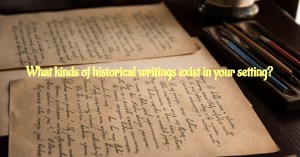
One of the courses I attended at a recent summer school for writers looked at how what you can find in the archives can inspire your writing (and that includes fiction too). I found the course fascinating. Diving back into history can inspire fictional works. So in your setting what kind of historical writings exist? Who wrote them? Are they accurate?

Are writers encouraged in your setting at all? Can they write as they wish, or do they have to stick to strict guidelines, including on how your world’s history is written about?

What kinds of historical writings exist in your setting? How are they stored? Are these things used in schools and other educational establishments? Or are certain tellings banned? Naturally someone would find a way to access anything banned so how could this apply here? What history do they want to expose in your world? What historical writings are considered dangerous?
MailerLite – Allison Symes – Newsletter Sign Up

WRITERS NARRATIVE SUBSCRIBER LINK 

AMAZON AUTHOR CENTRAL – ALLISON SYMES

This slideshow requires JavaScript.

https://platform.twitter.com/widgets.js https://platform.twitter.com/widgets.js

Holiday Writing and Quizzing Characters

Image Credits:-
All images from Pixabay/Pexels unless otherwise stated with many created in Book Brush. Book cover images from Chapeltown Books and Bridge House Publishing. Screenshots taken by me, Allison Symes. Hope you have had a good few days.
Am looking forward to a trip out with family to Windsor Castle later this week. I suspect there will opportunities for people watching. Whenever I go out anywhere, there usually is! Sometimes a snatch of dialogue will inspire a story. Sometimes a striking hat or other clothing item will make me think of a character of mine who might wear something similar and what situation they’re in. As ever, I just need something to get me started and getting out and about can help with that!

BookBrushImage-2023-6-20-20-3539
Facebook – General

Nice, cooler day today – Lady and I appreciated that.

Part 2 of my interview with YA fantasy author, Francesca Tyer, will be up on Chandler’s Ford Today later this week. Cracking interview. Link up on Friday. Be sure not to miss.

Now if you were temporarily allowed to bring one of your characters to life to ask them one question, who would you choose and what would you ask? Could be great material for a story or two here. Hmmm… something I too need to check out I think!

Am looking forward to the Association of Christian Writers’ Flash Fiction Group meeting next week. These are always great fun. I do set exercises here. I find writing exercises a great way to put into practise a tip or two you’ve picked up. The nice thing with writing exercises? There is sure to be at least one or two which really suit the way you write. Practising writing to them helps build up your writing skills so worth a go for that alone.

May be an image of text that says "I love taking part in live writing exercises as part of a Zoơm group ead. I don't miss out ฮท the fun! And spontaneous writing is wonderful thing to do. It can be tidied up much later. Writing should be fun (at least most of the time!)."

Wasn’t sorry for the rain yesterday evening. Has cooled things down though the grass is still like straw over the Recreation Ground. Not that it stopped Lady having a good time with her Rhodesian Ridgeback bestie today.

Writing Tip: Quiz your characters. Find out what makes them tick. What wouldn’t they do in any circumstances? Your job here – put them in those circumstances and then see what they do. They will have to find a way of coping with it. Doesn’t necessarily have to be something “overly” dramatic.

For example, let’s say you have a character who doesn’t like the water. A friend is ill and someone is organising a charity swim to raise funds to help this friend. What would your character do? Sure, they could just donate but where’s the story in that?

What they would do so there is a story is learn to swim, take part in the event (though they probably wouldn’t do many lengths given the lack of experience here) but everyone is thrilled they’ve done this. That would make a nice human interest story. Your character has faced up to something they don’t like here. They are putting themselves out for someone else. It’s that which readers will like.

So think about something which would make your characters do something they wouldn’t ordinarily do. This can be taken in many directions. Have fun!

May be an image of text that says "How well do you know your characters? need to know their major trait(s) before writing their stories."

I’m talking about Holiday Writing for Authors Electric this month. Do you do any and/or do you send your characters on holiday? Take your characters out of their normal environment and what could happen? I discuss this and more in this post. Hope you enjoy it.

This slideshow requires JavaScript.


Bit of an odd day. Have gone from doing the ironing to painting a wood preservative on another fence panel. Oh the joys! So it is with great relief I am now back at the writing desk.

It was great to share Part 1 of the interview with Francesca Tyer on Chandler’s Ford Today yesterday. Am looking forward to sharing Part 2 on Friday.

Many thanks for the great comments coming in on Anniversary, my latest tale on Friday Flash Fiction. This one has a dark twist – if you missed it, check out the link. I very much appreciate the feedback on this great site and if you want to see what flash fiction can be, this is a very good place to start.

Screenshot 2023-06-16 at 18-35-04 Anniversary by Allison Symes

Facebook – From Light to Dark and Back Again

Flash fiction collections are a great way to show off what flash can do and be. Mine have a wide range of characters and situations in them. Equally The Great War by Dawn Kentish Knox is a wonderful book (100 x 100 word stories) all based on World War One. So flash works well for characterisation and themes then. Then there are the flash-in-novella books too.

There is more flexibility in flash than at first might appear to be the case. It is the top word count only you have to watch for but there is much you can do within that

I regularly share tips on flash writing via my author newsletter. Next one is due out on 1st July. If you’d like to sign up, please head over to my landing page at https://allisonsymescollectedworks.com

This slideshow requires JavaScript.


It’s Monday once more. It’s still hot (in my case not helped by having an afternoon in the kitchen batch cooking though it will pay off later in the week!). Time for a story then. Hope you enjoy my latest on YouTube – Editor Edited.


One of the joys of flash (and there are many) is that it is a great format for turning the tables. In my The Terrified Dragon I do exactly that. Firstly, the expectation normally is the dragon would be terrifying. Not in this story from Tripping the Flash Fantastic. Secondly, I then go on to show good reasons why it is terrified instead and have another character come to its aid. Great fun to write. Best kept as a very short story, anything else would be padding, and so flash is perfect for it.

Sometimes you just know when an idea comes to you that it works best in the shorter formats and with flash we have the ideal vehicle for the very short form. A single idea executed in the right amount of words works so well. Gauging whether an idea has “legs” for a longer format is not easy to get right. My gut instinct is to keep an idea tight – stick to the point of it and don’t elaborate further. Turning the table kind of stories tend to focus on one central action so this is why it works brilliantly when kept short.

May be an image of text that says "Flash with a Dash of History, Crime, Fantasy, and Dragons Tripping the Flash Fantastic by Allison Symes carefully crafted collection story worlds"

I’ve sometimes used proverbs as title ideas (and often they end up being the theme as well). One of these is A Stitch In Time from Tripping the Flash Fantastic. I used a humorous slant on this one.

The great thing with using proverbs for fiction is the proverbs have a timeless quality to them. People will always identify with the point they’re making and that is something invaluable to use for your stories. People will always get the point you’re showing in your tales as a result. So don’t throw out that book of proverbs – you can make good use of it here.

May be an image of text that says "Sayings and proverbs used as themes can show us timeless truths and get a point across in an entertaining way. Lie Truth"

Goodreads Author Blog – Book Fairs

Do you go to book fairs? I hope so. I’m taking part in one in my area in July and am looking forward to that. It gives local authors a chance to show what they do and these things are especially useful in areas which have a lost a lot of their bookshops. We had a fantastic local one but that had to close due to the owners’ retirement. Much missed.

All of us as readers appreciate the works of authors. We wouldn’t be on Goodreads otherwise but authors do appreciate support from readers. Going to book fairs is just another way of showing that support. So if you have such an event coming up near you, try and get along. You may well be surprised at the range of works your local authors produce. I know I’m impressed with what is available in my area.

Besides which, these events are fun!

Screenshot 2023-06-17 at 19-54-49 Book Fairs

BookBrushImage-2023-6-20-20-5711

AMAZON AUTHOR CENTRAL – ALLISON SYMES

This slideshow requires JavaScript.

Twitter Corner (2)

https://platform.twitter.com/widgets.js https://platform.twitter.com/widgets.js https://platform.twitter.com/widgets.js https://platform.twitter.com/widgets.js https://platform.twitter.com/widgets.js https://platform.twitter.com/widgets.js

Processing…
Success! You're on the list.

Prep Work

Image Credits:-
All images from Pixabay/Pexels unless otherwise stated. Some images created in Book Brush using Pixabay photos. Screenshots taken by me, Allison Symes.
Book cover images from Chapeltown Books and Bridge House Publishing.
Hope you have had a good week. Busy preparing for Christmas here but at least the cards have been sent! It all counts as writing…!

BookBrushImage-2021-12-17-20-1441

Facebook – General – and Chandler’s Ford Today

Pleased to share my latest post on Chandler’s Ford Today which is about Prep Work. Apt for this time of year of course! But I look at the topic from a writer’s viewpoint.

I share how prep work is an important part of my writing life, look at the benefits of it, and discuss how having a rough outline of what I plan to write when over the course of a week helps me stay on track and get more writing done overall.

Hope you find the post useful, especially if like me you are a planner rather than a pantser though I think some loose structure to a writing week would benefit most people. I know it has done wonders for my productivity.

Prep Work

This slideshow requires JavaScript.

I’ll be discussing the usefulness of Prep Work in my Chandler’s Ford Today post this week. Link up tomorrow.

Also looking forward to sharing the link to Three Minute Santas in due course.

Just to flag up there is an offer on the paperback of Tripping the Flash Fantastic on Amazon at the moment. Looking for a last minute present for someone who likes short stories, especially quirky ones? See the link for more details.

And don’t forget the one thing you can do for authors whose work you love – leave a review! Doesn’t have to be long (indeed keeping it short helps make it more memorable and effective) but a thoughtful review is appreciated by every author.

Screenshot 2021-12-17 at 20-23-22 Tripping the Flash Fantastic eBook Symes, Allison Amazon co uk Kindle Store

I was chatting about ideas yesterday and it is as I develop mine, I often remember books and stories which have influenced me. As I outline my characters, I know from books and stories I love the kind that work the best for me. (Not every book does this for me – I still dislike Miss Price from Mansfield Park and I love Jane Austen’s work as a rule but this case did show me what I don’t want in my characters so still useful!).

And I try to replicate what I like best in my “people”. I say people but then I have written flash pieces from the viewpoint of a mother dragon and responded to a challenge to write a piece about the inside of a ping-pong ball. My characters are definitely not all human but I still need to portray them in a way to either gain reader sympathy or to have readers happily root for them to fail, depending on whether they’re villainous or not.

All great fun and even more reasons to keep reading. I see it as research and that’s my excuse and I’m sticking with it!

BookBrushImage-2021-12-17-20-366

Facebook – From Light to Dark and Back Again

Looking forward to hearing wonderful festive flash fiction on Three Minute Santas hosted by Hannah Kate on North Manchester FM tomorrow. I hope to share the link in due course. I also hope to include it in my Chandler’s Ford Today post for Christmas Eve which will be a festive flash post.

Lighthearted stories take as much care to hone and polish as the more serious kind and I think even more in fact.

Why? Because you know the effect you want to produce in the reader – you are aiming to amuse and/or cheer and everything you write for this story has to serve that purpose. Also what one reader will see as lighthearted others will dismiss as frivolous. You just accept there is no pleasing everybody and you go for what your Ideal Reader would like. That Ideal Reader won’t be just you, honest!

With a sad story, you know what would make you sad, what would make most people sad so you can use that in your storytelling. But humour is notoriously subjective which is why it is not as easy to write as it might appear. It is good fun though and well worth the effort!

BookBrushImage-2021-12-17-19-5235Screenshot 2021-12-08 at 16-07-14 North Manchester FM Hannah's Bookshelf, Saturday 18 December 2-4pm - Hannah Kate


Pleased to share my latest story on Friday Flash Fiction. Hope you enjoy All In The Blend.


Screenshot 2021-12-17 at 19-28-36 All In The Blend, by Allison Symes

The nice thing with flash fiction is it has more scope than you might think. You can set your characters anywhere and everywhere, in the present day or the past or the future, and don’t forget you can vary the genre too. I’ve written historical flash pieces, crime flash, humorous stories and so on. You can also vary the word count as long as you don’t go above the 1000 words limit.

So if a piece works out better at 500 words rather than 100 then that’s fine. You just can’t submit that piece for a 100-word competition or market but there will be others where you can submit it. When I keep a story at 500 words, rather than reduce it down, it is because there are telling details in that story I feel make the tale more powerful and the character more memorable.

If I feel the story would lose something vital if I were to cut further, I don’t! I leave it as it is and find an alternative market for it.

The trick is in working out what is vital. If certain details help a character make more of an impact on the reader then those things stay in. But you do have to ask yourself honestly do I really need this? Does this detail give the reader something useful?

BookBrushImage-2021-12-14-21-748

Looking forward to the Three Minute Santas broadcast on Hannah Kate’s show on North Manchester FM on Saturday 18th December between 2 and 4 pm. My story, The Night Before Christmas, is on there and I am delighted to know other writing friends will also be having their tales on there. A great way to get into the festive mood.

I have a very soft spot for writing festive flash pieces. They’re light-hearted, just what you need I think at this time of the year, great to share on social (and other) media, and a bit of a reading pick-me-up. I will share the link to the show in due course if you can’t tune in on Saturday.

Oh and naturally I am going to love flash stories being shared in this way – it’s another method to get people into flash writing and reading I hope!

This slideshow requires JavaScript.

Fairytales With Bite – Dressing Up

The most obvious example of dressing up is when the fairy godmother turned up to transform Cinder’s rags into a decent ballgown. But are there any opportunities in your stories for your characters to dress up? What events would they dress up for? And what would they actually wear? How is this different from day-to-day clothing?

Does your fictional world have tailors, clothes designers etc or is everything produced magically? If the latter, how does this work? Would your characters need to have some kind of currency to get a magical costume produced? And if they were poor, what would they have to “make do with”?

Occasions dictate costumes as well so what events would mean everyone, regardless of their means, has to dress up? How would the poorest manage this? And what elaborate costumes would the elite wear and why these? What is the history behind them?

Events usually commemorate something and, for everyone to have to join in, these would have to be of national importance. Can you link the history of your fictional world to what people are wearing now? As ever, with this kind of thing, there is always someone who will want to go against tradition – who, why, what are the consequences of them doing so? Does their choosing to dress differently inspire others to look at why they do things traditionally at all?

Clothing can indicate status too and you could use that as a shorthand way of showing how rich or otherwise your characters are.

BookBrushImage-2021-12-17-20-5557

This World and Others – To Map or Not to Map?

Hands up time. I looked at the map in The Lord of the Rings once, maybe twice, on my first read of that wonderful trilogy. I was too engrossed in the story to want to go back to the map at all. So how useful do you find a map to be in fantasy works, especially the longer kind?

I can understand why the writer would need a map. Literally it is a visual aid to them to help them picture things and to thus write about their created world successfully. But do the readers need to see the map? Does film take away the need for such things now? Do feel free to comment!

I do know I couldn’t draw a map if paid to do so. I know I need an idea on setting for my flash and short stories though I find I need to know the characters much, much more. The characters will often dictate to me where they have to be set. I like that as it means I picture them and their location in one go.

And a lot of what I need to know about my characters doesn’t end up in the finished story. It doesn’t need to go in but I needed to know it to write that character up with conviction. Even if I could draw a map. I suspect the same would be true here!

BookBrushImage-2021-12-17-21-33


BookBrushImage-2021-10-1-19-5556

https://platform.twitter.com/widgets.js https://platform.twitter.com/widgets.js https://platform.twitter.com/widgets.js

Processing…
Success! You're on the list.

https://www.youtube.com/channel/UCPCiePD4p_vWp4bz2d80SJA

Ideas, Writing Journeys, and Characters Carrying Their Roles

Image Credits:-
All images from Pixabay/Pexels unless otherwise stated. Some images created in Book Brush using Pixabay images. Screenshots taken by me, Allison Symes.
Book cover images from Chapeltown Books and Bridge House Publishing.
Has been a hectic couple of days. Hope all okay with you. Looking forward to hearing my festive flash piece broadcast on North Manchester FM later this week.

Screenshot 2021-12-08 at 16-07-14 North Manchester FM Hannah's Bookshelf, Saturday 18 December 2-4pm - Hannah Kate

Facebook – General

Looking forward to sharing my Prep Work post on Chandler’s Ford Today on Friday. Hope it proves to be useful. After that I’ll be sharing a festive flash fiction post and I hope to include a link to Hannah Kate’s Three Minute Santas show on North Manchester FM. Will be a nice way to wind down as we heard towards the end of the year. (If you want to listen live, the show will be broadcast this coming Saturday, 18th December between 2 and 4 pm).

Just heard we won’t be having our Carols by Candlelight services this year – will be much missed, as they were last year – but I am enjoying a good sing along to Christmas favourites when Classic FM play them. Favourite carol: In the Bleak Midwinter (the Holst version). (Naturally the dog likes Bach – sorry couldn’t resist).

Am getting a newsletter together for the beginning of 2022. I share tips, writing prompts, and all kinds of things here so please head over to my website landing page at https://allisonsymescollectedworks.com if you would like to sign up.

Ideas are funny things. Some I can get to work on immediately. I can literally see where the idea is taking me. Other ideas I have to “mull over” for a while before seeing possibilities in them. But that is the way of it and the best ways I have found to encourage ideas are (a) to read widely and (b) get on and write.

Writing in itself I’ve found encourages other ideas. There is some truth in the thought the more you write, the more you will have to write about, but the nice thing about this is it includes all forms of writing.

Writing lots of small pieces as I do encourages me to think about what the next small piece could be and I try to get a momentum going. It’s also why it pays to have a notebook to hand. I come back to the ideas I’ve jotted down at a later date. If they still seem good, I then write them up.

This slideshow requires JavaScript.

Hectic day today, Mondays often are for me, though a writing session at the end of my day always makes me feel better. There is something about the creative urge that does just do that for me. If I can’t write (as opposed to choosing not to when I have days off every now and then), well let’s just say I am not a happy bunny. And the nice thing with blogging and flash fiction is when time is tight, as it has been today, I can still write something and feel I’ve achieved something. That matters to me.

Having something already drafted ready for working on later helps me satisfy my creative urge too. If I’m not writing, I am editing and that too is a creative process.

BookBrushImage-2021-12-14-20-409

What has changed along your writing journey compared with how you started out? For me, it is the discovery of the wonderful worlds of flash fiction and blogging, neither of which I knew about when I began writing seriously.

Then there are the technological changes too. The laptop I’m writing this on is far more powerful and smaller than the first computer I used. And then there is the development of things like social media and graphic design programs like Book Brush, which have made it possible to create your own videos and share them on YouTube.

The hardest thing for me to adapt to is getting used to a single space after a full stop. Why? Because I am of the age where it had to be a double space. That harks back to the days when typewriter print wasn’t as clear as it is now so the extra space was needed for clarity. I know! Of all the things to have to get used to! Still Find and Replace is a useful function and Scrivener actually has a Convert Multiple Spaces to Space option. (Found under the Format menu – go to the Convert section and hey presto! This one has helped me a lot!).

I do not miss carbon copies. Cut and paste is so much easier to do in a word processing program too.

Zoom has helped me rediscover the joys of PowerPoint too, very useful for author talks.

Change then can be a good thing and I am grateful I can send in submissions by email rather than have to go and queue in a Post Office to get things weighed (especially at this time of year). There is a lot of time of my life I won’t get back there!

This slideshow requires JavaScript.


Hope you have had a good Saturday. Nice to have a quiet one after a fabulous day at the Bridge House Publishing event last week. Finished the Christmas cards so that’s one writing task completed today!

I’ll be discussing the value of prep work in my Chandler’s Ford Today post next Friday. I’m just not the “pantser” type but I will be looking at how a simple structure to my writing week pays dividends for me. And the principle of planning out what you write over the course of a week can be applied no matter what you write.

Ideas for my CFT posts especially will come out of other articles I’ve written. There is truth in the thought the more you write, the more ideas you will generate. I’ve certainly found that to be true for my blogging.

This slideshow requires JavaScript.

Facebook – From Light to Dark and Back Again

I use different ways to get “into” my flash fiction but the key one has to be knowing my character. I don’t need to know everything. I need to know what their major trait is as that will often determine the types of action they could be reasonably expected to do. Equally it will show up what they would not normally do.

A coward, for example, could become brave if and only if they had no other option to ensure their own survival. That should become apparent in the story. In this case, I would also like to know what made my character become a coward. Have they always been like that or is there a story to be told in showing how they got to be that way?

And yes you could have linked flash tales here. One showing what the coward faced to become that way, another could show them how they overcame it even if that was forced on them.

Motivation is a powerful reason for our own behaviour. Our characters should reflect that too. Asking your character “what is your motivation here” will also help you get a clearer picture of what they are like. Appearances, after all, can be deceptive.

This slideshow requires JavaScript.

It’s Monday, it has been a hectic day, time to unwind with a story. Hope you enjoy my latest YouTube video, Getting the Mix Right. One lady really fancies the changes when it comes to ingredients for her friend’s recipe…


Pleased to say the December 2021 issue of Moms’ Favorite Reads is now up on Amazon for free. As ever, there is a wonderful wealth of features here. I talk about Festivities for my flash fiction column this time and I loved reading the stories that came in on this theme. Time for a cup of something nice and a good read I think!

Screenshot 2021-12-14 at 20-10-34 Mom’s Favorite Reads eMagazine December 2021 eBook Publishing , Goylake , Howe, Hannah , [...]

I sometimes start my flash stories knowing I want to write a funny tale, say. It’s then a question of finding a suitable character who would be able to “carry” a funny role. They themselves need not be funny. Often they’re not. Often they don’t find the situation I’ve put them in funny at all.

It is for the readers to judge whether it is funny or not (though if it makes me smile, I think it will make others smile too. I always write with my Ideal Reader in mind. I ask myself what would they see in this story, this character?). It is all about reaching out to potential readers.

BookBrushImage-2021-12-14-21-748

Goodreads Authors Blog – Reading Acrostic

R= Romance
E = Epic Sagas
A = Adventures
D = Detective stories
I = Intergalatic tales
N = Novels, novellas or new flash/short story collections – the choice is yours.
G = Genre Fiction or literary – again the choice is yours.

Plenty of wonderful books to explore -paperback, hardback, audio, ebook.

Happy reading and I do hope there are plenty of book-shaped presents under your Christmas tree this year!


Twitter Corner


https://platform.twitter.com/widgets.js https://platform.twitter.com/widgets.js

Sayings – Their Uses in Fiction and Non-Fiction

Image Credit:-
All images from Pixabay/Pexels unless otherwise stated. Some images created in Book Brush using Pixabay photos.
Book cover images from Chapeltown Books and Bridge House Publishing. Screenshots taken by me, Allison Symes. Image of Lady and I examining a delivery of Tripping the Flash Fantastic was taken by Adrian Symes. A huge thanks to Fiona Park for taking the wonderful shot of me signing books at the Swanwick Writers’ Summer School in August 2021.
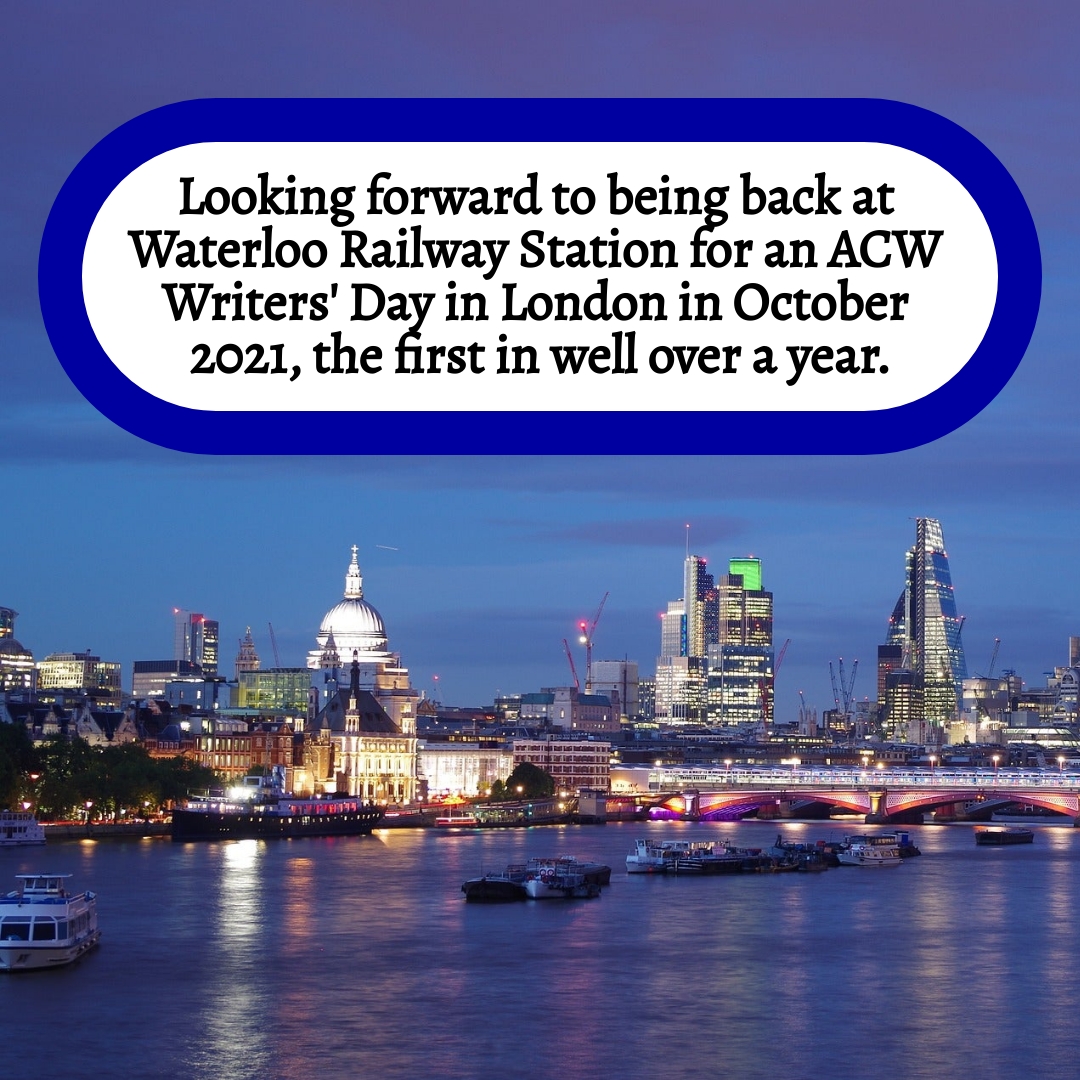
Hope you have had a good week. Looking forward to getting out and about on the train again tomorrow for the Association of Christian Writers’ first Writers’ Day in well over a year in London. Will be so lovely to meet people I haven’t seen in person again for so long.

BookBrushImage-2021-10-8-17-626

Facebook – General – and Chandler’s Ford Today

It’s time for my latest Chandler’s Ford Today post and this is on a topic I really should have written up a while ago. Sayings – Their Uses in Fiction and Non-Fiction is one of those themes with my name on it as I do use sayings a lot in my creative writing. I’ve used a number of well known sayings as story titles and even more as themes.

And many of the old sayings could be used for non-fiction work too. I share a few tips here on how to use sayings but so they don’t become cliches, which I hope proves useful. Sayings are well known for a reason but it pays to put your own spin on them so you can get something unique from them for your story or article. That is by far the best way to avoid falling into cliche territory.

And you can change a word in a saying to put your own spin on it. I did this for my Punish the Innocent in From Light to Dark and Back Again. Subverting a well known saying for your own purposes is not only fun, it intrigues the reader. After all, we usually talk about punishing the guilty so, in the example of my story, I would hope a reader would be curious enough to find out why it is innocent in this case.

Best of all, there are loads of well known sayings so they are useful just as a source of ideas to get you started, even if you don’t use them directly. Course you could do both – as I do!

Sayings – Their Uses in Fiction and Non-Fiction

This slideshow requires JavaScript.


I don’t know where the predicted sunny spells ended up today but I do know they didn’t show up in my part of the world. Today has been a classic murky autumn day.

Looking forward to sharing my Chandler’s Ford Today post with you tomorrow. This week I’m talking about Sayings – Their Uses in Fiction and Non-Fiction. I talk about how I use these in my writing and share tips about avoiding these becoming cliches. I also take a look at character sayings. These can be an effective device – many of our well-loved characters have a pet phrase – though I think the secret is not to overuse them.

What aspect of writing do you find the most fun? For me, it is the editing. Yes, really. I know I’ve got a story down. I know what I’m going to do to it will improve it and help its chances “out there”. And when I do get to submit the piece, I know I’m sending in something far better than what I originally drafted – and that is how it should be.

This slideshow requires JavaScript.


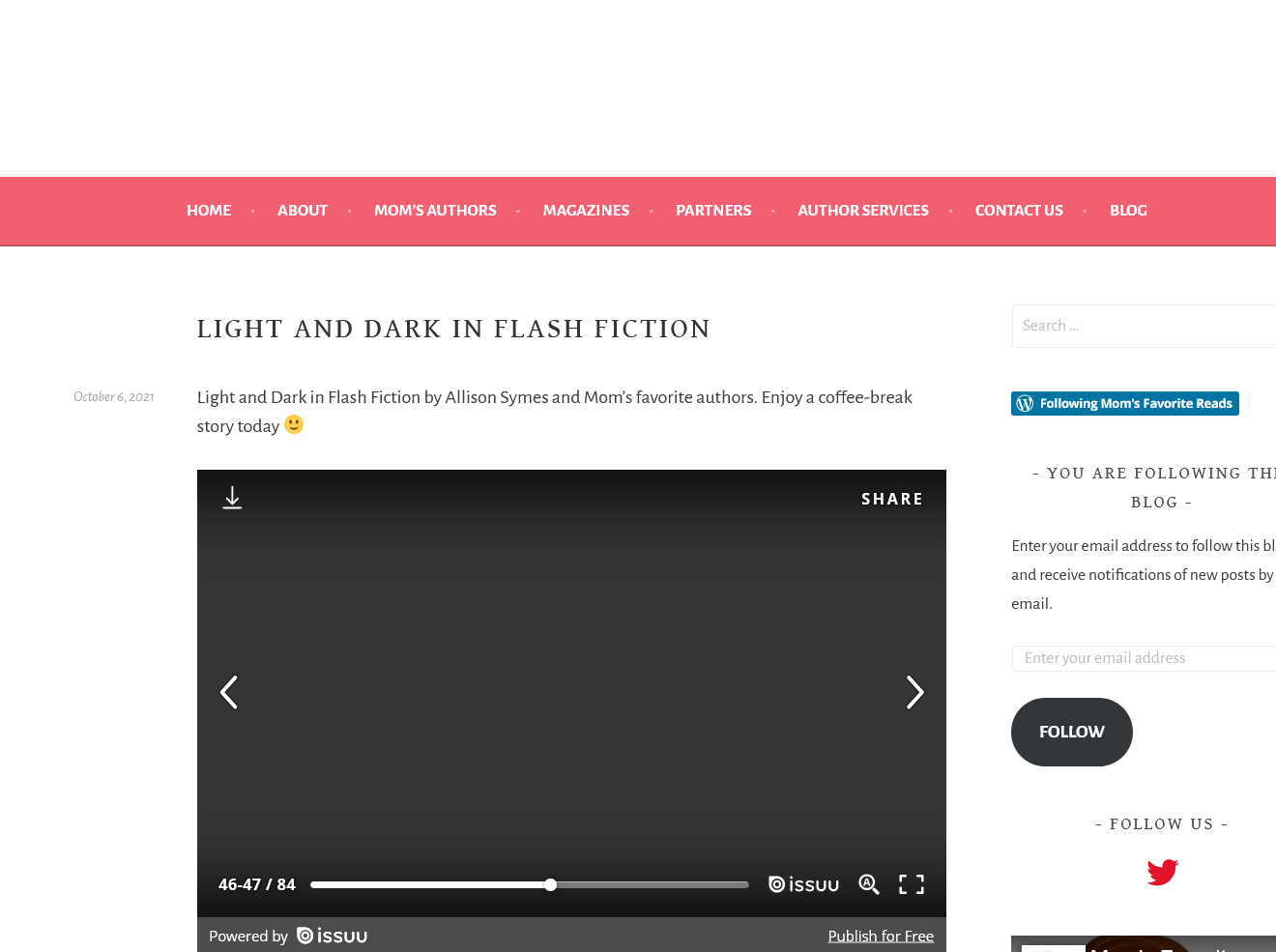
Hope you have had a good day. Writing wise, my post on Light and Dark in Flash Fiction is now out (via Mom’s Favorite Reads) and there are some cracking stories based on that theme too. Well done, everyone! (Link takes you directly to the relevant page – see https://moms-favorite-reads.com/2021/10/06/light-and-dark-in-flash-fiction/).

Screenshot 2021-10-06 at 20-01-30 Light and Dark in Flash FictionScreenshot 2021-10-05 at 16-34-08 Amazon co uk Mom's Favorite Reads October 2021

I tend to work on my next post for Mom’s Favorite Reads directly after I finish the last one. I find this a useful technique for everywhere I blog (Authors Electric, Chandler’s Ford Today, More than Writers etc). When I do get odd pockets of time, I will draft future blog posts and work out where to place them later. It is always a good feeling to know there is “material in the bank” good to go when I need it.

I’m also finding Friday Flash Fiction useful here given it encourages you to prepare a story for the next Friday’s magazine directly after the current one has gone live. It is helping me to produce 100-worders more regularly. For my YouTube videos, I set my own deadline and ensure I stick to it. Over the course of a week, I get a balance of fiction and non-fiction writing done.

BookBrushImage-2021-10-8-19-1831

Facebook – From Light to Dark and Back Again

Delighted to share my latest story on Friday Flash Fiction. Hope you enjoy Leaving It Late. Has my character done exactly that? Read the story and find out!Screenshot 2021-10-08 at 16-41-23 Leaving It Late, by Allison Symes

Just to flag up the paperback of Tripping the Flash Fantastic is currently on offer on Amazon. See http://mybook.to/TrippingFlashFantastic for more details. Have also topped up my supply (which is always a nice thing to do).

Looking forward to seeing both of my collections on a book stall once again when I go to the Association of Christian Writers event on Saturday, 9th October. It will be so lovely seeing book stalls again! I love a good browse…

Every so often I will draft promising opening lines or twist endings for writing up into a story later. The great thing with this is when I come back to them if the ideas still grab me, they’re likely to grab a reader too.

It can be difficult sometimes working out if an idea really is as good as you thought it was when you first came up with it. Time away from it for a while will help you assess it properly. I also find if the idea still grabs me (most of the time this is the case), I am then fired up, keen to get that draft down, and away I go. You don’t lose your enthusiasm for a really good idea. Time away from it, if anything, increases your enthusiasm because you know deep down this will work.

This slideshow requires JavaScript.


I like picking open themes for my blog posts (such as for Mom’s Favorite Reads) and flash fiction tales. I like having “manoeuvre room”. It is also more likely I will be able to come up with a twist that surprises the reader but is compatible with my story and character having an open theme. More interpretations (and therefore more twists) become possible with an open theme.

But I do need time then to work out which would be the best option to use and I use spider diagrams to help me here. I’ve found taking the time to work out the best options saves me so much time later. I find I come up with different ideas and the first couple I can instantly dismiss (too samey, seen it before etc).

I then find I have a couple of promising ideas and I then ask a series of “what if” questions. That usually shows me out of two possible ideas, which is the most likely to engage the reader. If I’m engaged with it, someone else will be.

I also look at why something has engaged me and as long as it is something to do with the character portrayal, I go with it. I say that because any story is depending on strongly portrayed characters who appeal to the reader in different ways. As long as there is the likelihood this character will appeal because… then I’m likely to write them and their story up. (The reason because can vary as different readers take different things from characters but as long as there is at least one good reason a reader would want to read this character’s story, then I go with it).

This slideshow requires JavaScript.

Fairytales with Bite – Light and Dark

Now this is a popular theme for me given the title of my debut flash fiction collection (From Light to Dark and Back Again). The title came about as I realised my two preferences for stories inevitably contrasted with each other. I love humorous/light stories. I like a well crafted darker tale too. And, with few exceptions, most characters are a mixture of light and dark.

Most readers like to read about flawed characters because we know we too are flawed. Most readers are bored by the “goody two shoes” with no spirit to them. Most readers are horrified by those who are just pure evil with no prospect of redemption. (Redemption or the possibility of it is a wonderful theme for stories).

So how will you show light and dark in your characters? What dark aspects do your “good” characters have to show they are well rounded, so a reader can identify with them precisely because they’re not perfect? What lighter aspects do your villains have to show they are nor caricatures?

For your setting, how does light and dark work in a physical sense but also what would be these be politically? Is there such a thing as a good government in your world? What would your characters see as being light and dark and would that agree with what we would consider such things should be? Not every world has the same values after all.


This World and Others – Generation and Regeneration

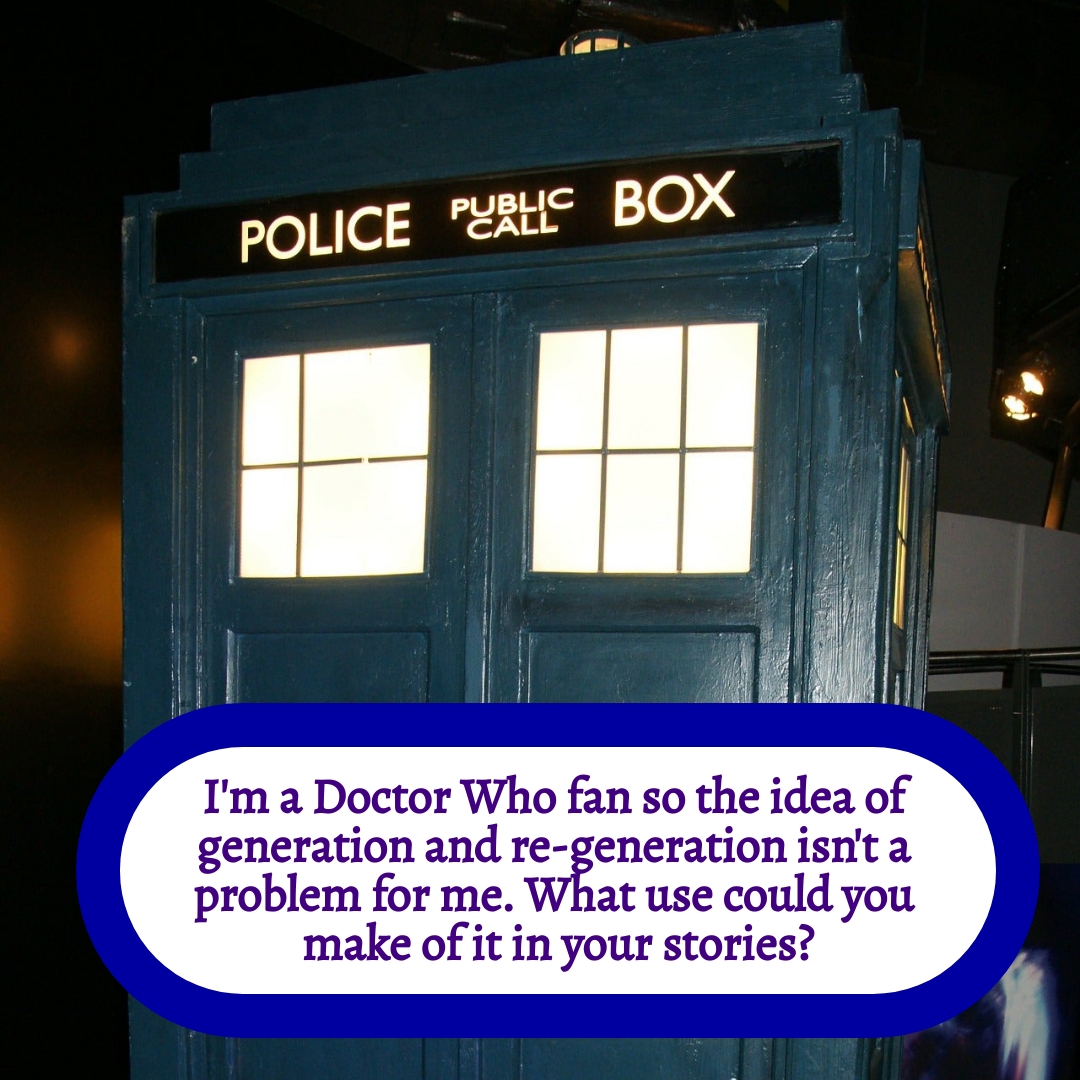
Now I’m a Doctor Who fan of longstanding so the idea of regeneration is not new or one I’m fazed by. In your fictional settings, do you have characters who can regenerate? How does your world generate its food, power supplies, anything it needs for the world to function properly?

Generation and regeneration can be reflected in agriculture. How does your world grow food? How does it generate seeds? How can it ensure crops can keep being grown?

If your setting is an old one, has it had periods where it has to re-generate or re-invent itself or face obliteration? How did it rise to the challenge here?

What are relationships like between the differing generations? Do the great ideas only come from one section of your society? And where there is pollution how can your setting “start again” and build a world where there is onoing regeneration?

BookBrushImage-2021-10-8-19-4855

Twitter icon

https://platform.twitter.com/widgets.js https://platform.twitter.com/widgets.js https://platform.twitter.com/widgets.js

Creosoting, Ideas, and Editing

How has my week gone? See the title of this post! (Oh and do look out for Part 3 of my CFT series The Writing Game – and What to Watch For – link up for Friday. The whole series has sparkled with great ideas and advice so don’t miss the last installment!).

Image Credit:  Pixabay/Pexels unless stated.

Facebook – General

Many thanks, everyone, for the cracking response to Part 2 of The Writing Game – and What to Watch For, my current CFT series. All very encouraging (and most writers, certainly all the ones I know, always welcome encouragement!). Looking forward to sharing the equally cracking finale next Friday.

Have got another fence panel creosoted. (If you needed proof the writing life isn’t necessarily glamorous, I’ve just provided it! Lady was not at all happy I kept her indoors while I was working but I couldn’t risk her going back inside a different colour to when she came out! YOU try telling a dog they can’t “help”!).😆

Am enjoying some wonderful books on Kindle at the moment, though I have a long TBR list on there. Still I shall enjoy working my way through. DON’T send help, I shall be fine, thanks! (Am so grateful electronic book shelves cannot collapse under the weight!).

Some pieces are coming together on one of my longer term projects so am pleased about that. I’ve learned over time that when you’re busy on something else, good ideas for other projects you’ve got in mind pop into your head.

I’ve also learned not to fight this. Grab a notebook, jot said ideas down, work on them when you get chance etc. Rome wasn’t built in a day etc…

I’ve yet to work out a way of having ideas occur to me in a more convenient fashion. I don’t think that will be happening any time soon!

This slideshow requires JavaScript.

Hope the week ahead proves to be a good one for everyone. I’ll be working on an interview for CFT to appear on 14th August after my current series.

All I’ll say now is it about a very special project and my guest author is the ONLY UK writer taking part in it. They will know who they are from that description! I look forward to sharing more about that in due course.

There will be further interviews later in the month too. There has been a lot of change of direction in the air recently, which has been my underlying theme for CFT this summer! And it is a joy and privilege to share some of those change of direction stories via CFT.

One of the great aspects to the writing life is it isn’t in a straight line. You can go off on this track for a while, come back to what you mainly do, then explore other forms of writing and so on. Enjoyment of what you do writing wise is crucial, whatever you write. If you don’t enjoy it, why would anyone else?

Enjoyed re-watching one of my favourite Doctor Who episodes tonight. Vincent and the Doctor (with Matt Smith as our hero) is wonderfully done. There is a lot of depth to this story. Hallmarks of a great story? When it can bear repeated re-readings/re-watchings etc.

Good challenge for me as a writer too!

This slideshow requires JavaScript.

Busy Monday as usual. Still one good thing about that was it meant I had no time to cresote our front fence today. I’ll be back on that tomorrow. I know – the giddy whirl and all that.

I’ve been reading a good old mixture of funny stories and dark fantasy recently. All have made me react. Sometimes in horror at the attitude of the characters – and that is the right reaction too. Other tales have made me laugh out loud. Still others make me wince but I can fathom where the character is coming from. And that is important.

For a reader to enjoy YOUR stories, they’ve got to be able to get behind your characters or at least understand that, in this character’s shoes, they might do the same. So the challenge then is to work out what you want your readers to feel about YOUR creations – and then write it!


This slideshow requires JavaScript.

Another panel creosoted, one to go. And that’ll be my treat for Thursday! Talking of treats, which do you prefer that relate to words or writing in some way?

Mine are:-

1. Playing a Scrabble-like game on my phone (it’s one where the adverts are at the beginning and end of the game and do NOT interrupt the game. Would the makers of the “real” Scrabble please note that? Thank you!).

2. Dipping into a flash fiction or short story collection in between “day jobs” and just luxuriating in escaping the real world for ten minutes or so at a time. (I save my longer reads for my bedtime read and it is a lovely way to finish the day).

3. I used to like the alphabet sweets (not the jelly type, the harder sugar ones. Yes, I do have some teeth left!). Anyone remember them? These days I’d probably make anagrams out of them before scoffing them because I am just like that!😀😀I am partial to a good anagram and a good sweet!

4. I do like the occasional crossword/arrow word/wordsearch but much prefer Scrabble.

I don’t know if any of these sharpen the old brainbox but I do know they help me relax. I write better when feeling relaxed – and that will do!

This slideshow requires JavaScript.

Facebook – From Light to Dark and Back Again

I’ve mentioned before that flash fiction is flexible when it comes to format within it. I’ve written acrostic flash tales, poetic flash stories etc., and recently have written some haiku ones. I also like the flexibility of word count within flash.

Unless I’m writing for #ParagraphPlanet (75 words all in!), or a competition which has set a specific word count, I will write to the story requirements. Sometimes a tale simply works better at 150 words rather than 100. That’s fine. I just find the right market or competition for it.

How do I judge what works best? I look at the impact of the story. If it can make the impact I want it to have at 100 words, fine. If it can’t, it stays at 150 or what have you.

Each piece of flash fiction needs to be a contained story with a proper beginning, middle, and end. Each needs to impact the reader because they’ve been gripped by what you’ve put your character(s) through.

But the single person story works well in flash, as does monologue. I’ve tended to use the first person a lot but have heard some wonderful monologues read out at events such as the Bridge House Publishing ones. So having a go at a flash fiction monologue is going to go on my list of things to do at some point.

This slideshow requires JavaScript.

Sunday already?
The week flies by, as always.
Shame housework doesn’t!

Allison Symes – 2nd August 2020

The only good thing to be said about housework is once it’s done, it’s done. Oh and the thought of getting to my desk to write is a wonderful spur!

I had hoped the drudgery of housework would free up my mind to come up with some wonderful ideas for flash fiction whilst doing the ruddy work! Not a thing!

All I think when doing said housework is something along the lines of “can’t wait for this to be done” interspersed with “what is Lady barking at now?”. (Answer: usually the postman, sometimes the vacuum cleaner).

There is a kind of writing housework too. Now I don’t mind that kind at all. This is mainly things like:-

1. keeping an eye on what stories I send where (to ensure I don’t unwittingly send something to the same place twice);

2. backing up files regularly as I know I WILL regret it if I don’t!

3. Planning what I’m going to write when and marketing work too. Having a plan is the only way I’ve found to ensure I get this done. It helps me keep a proper balance.

So whatever your writing housework is this week, I hope it goes well!😀


This slideshow requires JavaScript.

Triggers for story ideas can come from all over the place which, I know, on the face of it doesn’t seem to be all that helpful, does it? How on earth do you filter these out to find out what would work for you because surely not every trigger would suit?

Correct! It IS a question of having an open mind to those triggers. When I’m brainstorming ideas, I write down several. I never go with the first couple. They will be the obvious ideas that will occur to most writers. But dig deeper and hey, you might find something you can bring your unique take and voice to.

Using competition themes (whether or not you enter them) can be useful. I don’t write love stories so I know any love themed competition isn’t going to be for me. But that’s okay. There are plenty of other stories, including relationship ones, to tell.

It is a question of working out what you like to read, what you would LIKE TO read, and what you like to write. In that happy triangle is your writing ground. Have fun with it (oh and keep the weeds out!).😊

This slideshow requires JavaScript.

When do I know if a story is ready for submission somewhere?

Basically when I cannot think of anything else to change without it taking away something from the character and/or the plot.

On editing, I usually spot several things I could re-phrase in a better way for the added “oomph” factor (and often to reduce the word count too. Less is more is SO true in flash fiction!).


This slideshow requires JavaScript.

Goodreads Author Blog –

Stories You Wish Would Never End

Have you any stories you love so much you wish they would never end?

I remember when I first finished reading The Lord of the Rings being just stunned by the sheer scope of it and wanting to dive back into that world immediately.

On a very different front, the same applied to The Wind in the Willows!

Of course, it is good the stories end. A lot of the time it IS the ending that makes the book stand out. An incomplete story is NOT a story. A story has to have an ending.

So I guess it is the entertainment and enjoyment we have had from these favourite stories that we really wish would not end,

The good news is they don’t have to – you simply pick up your favourite book and re-read it!

This slideshow requires JavaScript.


IDEAS, ROOM 101, AND SPECIAL CHARACTERS

Another mixed bag plus a link to my page on US based site, Scriggler, where a new story of mine is now up.

Facebook – and Chandler’s Ford Today

My CFT post this week is the final installment of my 101 Things to Put into Room 101 series. Good fun to write and therapeutic too! Amongst tonight’s items are debt, fake sincerity and all calories in a 99 icecream. (You can guess where I put that in my list numerically speaking!).

Facebook – General

When is the best time to write? When you can! I write mainly in the evenings but if I can sneak in some writing during the day, I do so. What matters more, I think, here is being consistent with your writing. You know you will always sit down at roughly the same time and you will always write X number of words or accomplish this task or that one.

I keep a list of writing tasks I want to achieve and find it helpful as, whenever I tick off one, there is a sense of achievement. Given rejections happen to everyone, that sense of achievement is very welcome.

This slideshow requires JavaScript.

Facebook – General

Little things reveal a great deal about people. Anyone who always says “please” and “thank you” was brought up to be polite (and not take anything for granted usually too!). Likewise, those who hold doors open for others (regardless of gender), you can reasonably assume at least try to be considerate in other ways.

So little things should give away clues as to what your characters are really like deep down. I think of this as the kind of trait that a character can’t completely hide/suppress.

For example, a character is shown to be a “loudmouth”. Fine but every so often during the story, we also spot the said character lighting a candle as a prayer for someone else. That tells me well hang on, this character has another side to them. A deep, spiritual side they are either not comfortable showing more openly (they’re wary of showing off their piety perhaps) or they somehow feel the need to cover that aspect of themselves up by being “loud”.

So think about what little things will give away what your character is really like. These little things can also back up the main portrayal (and help make it more convincing).

Facebook – From Light to Dark and Back Again

One thing that can be overlooked in flash fiction is, as with any story, the character still has to be at a point of change in their lives and the tale shows the results of that. The difference, of course, is that in flash, you have much less room to complete that “task”.

But a good flash fiction story will show you a character changing (for good or ill), or resolving a problem. It really is a question of cutting to the chase with flash fiction. There has to be a resolution to the conflict your character is facing, whether that is an internal or external one. Everything that is most important to the character and the resolution has to be in the story and not a word more.

This is why I think it is a good idea for most writers to have a go at writing flash fiction, even if you don’t use it as your main fiction form. Why? The skills you learn in writing to a tight word count will spill over into other things you write. As I’ve mentioned before, you soon find out what your wasted words are, you discover you don’t need many adjectives and adverbs, you do learn to say in one word what you might have taken three words to do etc.

This slideshow requires JavaScript.

Facebook – From Light to Dark and Back Again

Flash fiction is great for giving insights into a character which wouldn’t be enough in themselves for a standard length short story (usually 1500 to 2000 words).

With a novel you get to see the whole “tapestry” of the story with all the different threads coming together. With a novella you would see about half of that. With a short story you would see say part of the left or right hand side. With a flash fiction piece, you are picking one spot on the whole “tapestry” to study – and, despite the limited word count, can still produce an “intense” story. Flash fiction can have layers – it just can’t have too many of them!

Facebook – From Light to Dark and Back Again

Ideas, I think, are all over the place waiting to be picked up and used by writers who can recognize them for what they are and, more importantly, which ones are the “goers” and worth running with.

I don’t write character biographies (though I understand the point of them) but I do jot down ideas based on themes and then work out “What if?” scenarios. I think it important to recognize that ideas need development time.

Yes, a brilliant idea can occur and you write away but in my experience at least it has been ideas coming together to form a powerful whole that has inspired my stories. The advantage of this is that the ideas are layered and means I am building in depth to my stories. (Yes, you could and should have depth to flash fiction. There should be nuances the reader ponders on later).

But it is theme, motivation, and character types that interest me the most. Again looking at the news you can pick up thoughts as to what motivated someone to do this or that and then apply that motivation to your characters. For example, we all understand jealousy and how that can arise. So why would your characters be jealous and what would they do as a result?

This slideshow requires JavaScript.

Scriggler – My page

I have put a new story on this called Night Fright but am including the link to the whole of my page here.  Am hoping to add more to this later in the year.

Fairytales with Bite – Five Signs of a Great Character

I do like a list (!) and it has been a little while since my last one on here so time for another!  I would list the following as my five signs of a great character (fairytale or otherwise).

1Being Memorable.  Sounds easy but can be easier said than done.  The advantage is a character can be memorable for good or villainous reasons but there has to be something about them that sticks in your readers’ minds long after they’ve finished reading about them.  Can you say something about your character that would instantly bring them to mind without you having to refer to the story?  (This can be a useful test!)

2.  Having a Life.  Your characters have a life of their own, which may not necessarily be directly relevant to the story you’re telling about them but which feed into it.  For example, a character may be known for usually being a stay at home and then they suddenly go on a quest and they wonder how those who know them will react to this.  The quest is the story but the fact the character has friends and neighbours who will gossip about what they’re up to brings that character to life.  The obvious examples here are Frodo and Bilbo Baggins from Tolkein.

3.  They would be capable of further adventures.  The great characters have traits and skills that would be easily transferrable to other stories about them.  Your readers should be able to picture your characters going off on other adventures.

4.  The characters are willing to be challenged or overcome initial reluctance to face challenges.  I love stories with characters like these, partly because I think about what I (or my characters) would do if facing the same fictional challenges.  This feeds into 3 above, of course.  It is my experience characters like this always do more than their author originally thought them capable of and that is a very good sign.

5.  Their enemies fear them with good cause.  The irony here is that this can apply to the enemies fearing the hero, but also the hero fearing the enemy.  A worthy hero deserves a decent villain to test them.  You can also see why the fear is justified.

person typing on his macbook pro

Creating great characters. Image via Pexels.

person uses pen on book

Outlining your characters, perhaps. Image via Pexel

background black coffee bouquet chocolate

All good aids to writing, though the chocolate is not a great diet aid. Image via Pexels

motivational quotes

Always good advice this. Image via Pexels

This World and Others – What is Special about your Characters?

I think this question is the first thing you must ask yourself before writing your story. What is so special about your characters readers have to keep on reading to find out what happens to them?

The basic answer, of course, is that it has to be a mixture of character traits and personality to make a fully rounded “person” to be the star of your story.  So think about where your characters get their traits from and why they have the personality that they do.  What would happen to this personality if they were put under stress (especially the ongoing for some time kind of stress)?  Would your character still be special or crack under the strain and, if the latter, how can they come back from that?  There are stories to be had there!

Also, what is special to your character?  What do they consider to be the most important things about themselves and why?  Who are their heroes and villains, and why?  What possessions do they have that they value the most (and these don’t have to be priceless antiques.  it could be, say, a battered old teddy bear they’ve had since very young etc)?

Happy writing!

This slideshow requires JavaScript.


READING WIDELY AND WORKING BACKWARD

Facebook – General

Why is reading widely so vital for anyone wanting to write seriously?

Partly because you always learn something from whatever you read. (In the case of bad fiction, this can be as simple as learning what not to do! Sometimes this can also encourage you. If that got published, my work must be in with a chance etc!).

Partly when you read, you are filling your mind with ideas. Ideas encourage other ideas and before you know it, you have an original take on a story idea of your own. The more you read (and especially the more widely), the more ideas you will have for your subconscious to think about. I like to think of this as nurturing the creative spirit. It does need feeding regularly!

Also given all writers love books and stories, doesn’t it make sense to support the industry you hope to be part of?

Reading - says it all really via Pixabay

Says it all really.  Image via Pixabay.

Escape with a good book via Pixabay

Losing yourself in a good book.  Image via Pixabay.

Facebook – From Light to Dark and Back Again

One of my methods of writing flash fiction is to work out the “punch” ending and then work backward from that point. I believe Agatha Christie used a similar technique for many of her novels. I would also be very surprised if she was the only one! I strongly suspect not.

The nice thing about this technique is you have that cracking ending and you have to think of something strong enough to justify it. It means not reaching for the first idea that comes to you but often the second, third, fourth etc.

But in making yourself think more deeply about how the ending could be the way you’ve written it, you come up with something far more original. I like to think of it as mining the imagination – and good mining always goes far beyond the surface!

The world of the imagination should play a role in your stories. I can't imagine any world without some form of the arts. Image via Pixabay.

What is the world of your story? Image via Pixabay.

Whether you write flash fiction or other kinds of story, brainstorming sessions are invaluable. I have, less often, used them to generate ideas for non-fiction work. Image via Pixabay.

Whether you write flash fiction or other kinds of story, brainstorming sessions are invaluable. I have, less often, used them to generate ideas for non-fiction work. Image via Pixabay.


ideas-the-spark-for-writing-competitions-image-via-pixabay

Ideas are only the starting point for stories.  Read widely, encourage your mind to fill up with different ideas and mull over them.  Image via Pixabay


And a recent post… Favourite Moments in Writing

Favourite moments in writing? Some of mine are:

1. That instant when you know your character has come to life and the story takes off.

2. When your characters surprise you with what they come out with (again proof they have come to life). You will broadly know what your characters are going to be capable of but something coming out of “left field” should make you reassess where the character and story is going. I have found to date that the “left field” experience is always worth pursuing. It nearly always ends up being a stronger idea than the one I first had. Sometimes it takes writing the story for a while to dig out the REAL idea behind it.

3. Knowing you’ve left enough room in your outline to allow for “left field” moments so you are ready for these. You can work out where they would best fit and how they impact on your initial thoughts and that they are not going to totally detail your structure, etc. I find being “open” to these things happening means I handle them better and so can make the most of them. I find that very satisfying.

4. Being told your story is going to be published.

5. Seeing your story in print, online or both!

Themes pour out of good books - image via Pixabay

Let those ideas flow!  Image via Pixabay


The wonderful world of stories... Image via Pixabay.

The wonderful world of stories… Image via Pixabay.