A Creative Life Part 2 – Sophie Neville – Author Interview

Image Credits:-
All images from Pixabay/Pexels unless otherwise stated with many created in Book Brush. Book cover images from Chapeltown Books and Bridge House Publishing. Screenshots taken by me, Allison Symes.
Hope you have had a good week. Weather has slowly improved as the week has gone on. Writing wise, am delighted to share Part 2 of a fabulous interview with actress/writer/scriptwriter/artist, Sophie Neville, on Chandler’s Ford Today. Do check it out. (Have had some wonderful comments in on Part 1 too).
Lady has had a good week, getting to see her friends for most of the past few days. She always gets a real buzz from being with her buddies which is lovely to see.

BookBrushImage-2024-4-11-19-5214

Facebook – General and Chandler’s Ford Today

Am thrilled to share Part 2 of a wonderful interview with Sophie Neville on Chandler’s Ford Today. This week, Sophie shares, amongst other things, how she came to write about chronic fatigue, her love of travelling (especially by horseback), and what she’d like to take to a desert island if I let her have the Bible, Shakespeare and, because I’m a fan, Jane Austen. Hope you enjoy the post. Many thanks for the lovely comments which have come in on Part 1 (especially on Facebook).

Author Interview – Sophie Neville – A Creative Life on Water, In Film, and In Writing – Part 2

This slideshow requires JavaScript.

Lovely day. Lady got to see her Hungarian Vizler this morning and I was at the top of the queue to pick up a prescription at the chemists, which for me is about as common a happening as a solar eclipse. I’ll take this as a win!

Part 2 of my interview with Sophie Neville is up on Chandler’s Ford Today tomorrow, don’t miss. See above. Both parts of the interview have been a joy to prepare and there is so much inspiration here for anyone interested in the creative life in whatever way (as Sophie is also a very talented artist and scriptwriter).

Writing Tip: It’s easy to forget your old notebooks from writing conferences, events etc, but every now and again dig them out and have a look through. I’ve found work in these I’ve gone on to polish up and have published on CafeLit etc.

Equally you may come across something you want to explore further and which you’d forgotten about so it is well worth having a flick through your books. It’s also cheering to look back at your earlier works and then see where you are now, writing wise. You will have made progress.

I can look back through my books and spot more easily whether something written back then could be developed or not. Just knowing that means I know now what could work and what absolutely won’t. It saves time! But unless you do look back through your books, you really won’t find that nugget where you could do something.

434052480_10161826408147053_6744102198749073238_nNice day today despite the weather. Lady got to play with her Rhodesian Ridgeback and I’ve had my hair done. (I know. There is a Murphy’s Law for Having Your Hair Cut – that will be when the wind gets up and the rain comes down but never mind).
Looking forward to sharing Part 2 of a great interview with the lovely Sophie Neville on Chandler’s Ford Today on Friday. Again see above. So inspired by this interview – it is a fabulous celebration of creativity I think.

Meantime, if you’re looking for a fabulous read, do check out the latest issue of Writers’ Narrative. Plenty to enjoy here. The theme this time is editing, a subject dear to my heart of course, given I’m an editor (freelance) and copy editor (WN), as well as an author. If you don’t receive the magazine regularly, you can subscribe for free and the link is given in the magazine itself.

Facebook – From Light to Dark and Back Again

It’s lovely to start the working week with a story. It’s just as lovely to end the working week with a story! Am pleased to share my latest on Friday Flash Fiction – Time For A Change. What will Maisy do when her household objects go on strike? Find out here. Hope you enjoy the story.

Screenshot 2024-04-12 at 10-07-07 Time For A Change by Allison Symes

Flash collections are joy to put together. I like to mix up the genres and the moods of my stories in mine. I like to think of this as giving a demonstration of what flash is and can be. I also don’t want to write or read “doom and gloom” tales all of the time, though they do have their place, which is why I like to ensure there is a good mix of humorous flashes, as well as darker ones in my books. Life is made up of humour and darker stuff so I think it apt my stories and books reflect that.

The one thing I have found I haven’t been able to write about at the time or now is the pandemic. I just wanted to escape all of that in my fiction, whether I was reading or writing it. That has remained the case. My publishers did bring out a couple of Covid related anthologies but I just couldn’t write anything on that. I suppose everyone has their blind spots.

If I have got to choose one overall favourite form of fiction, it is humorous writing, whether it is Austen, Pratchett, or Wodehouse (and there’s a trio to conjure with!). Never fails to cheer me up and I will always prefer that kind of fiction rather than the “more worthy” kind. Nothing wrong with humorous writing. Phenomenally difficult to get right.

I do have fun with my titles. I like to keep them as open as possible so readers have to find out which way I’ve taken them and that can only be done by reading the story. But I especially love “innocent” sounding titles like my Time for Tea in From Light to Dark and Back Again. My lead character in this thinks they’re being clever, but are they right to think it? Do check it out via my Amazon Author Central Page.

Give some thought as to what you want your titles to convey to a reader. Proverbs/sayings can make for excellent titles, as well as themes, and I’ve sometimes changed one word in these to “subvert” them for my own purposes. (Punish the Innocent from FLTDBA is an example of this).

Every so often, I do jot down potential title ideas and come back to them later. If they still seem good, I’ll get a draft done. But time away from possible ideas is just as important as time away from the first draft of a stale. You need that break to judge them objectively.

Screenshot 2024-04-11 at 20-09-53 Allison Symes books biography latest update

Fairytales with Bite – Openings Don’t Have to Be All Once Upon A Time

Many of my flash fiction tales are what I call fairytales with bite. They involve a magical character (fairy godmother, witch etc) and I dump them in a situation they have to get out of quickly. Sometimes they call on their powers. Sometimes doing that would make things worse and they have to find another way of resolving their issues. Often there is a humorous twist to my fairytales with bite and I love writing them.

The classic opening for fairytales from childhood stories of course remains as Once upon a time and I remember just hearing those four words meant it was time to settle back and enjoy having another fairytale read to me as a child. Many happy memories there! (And when I could read the books for myself as an older child, I still appreciated that opening. I knew what was to come by then but it didn’t spoil the story, far from it in fact. It was time to eagerly anticipate enjoying a favourite tale).

For my own stories though, I like to show a character in action (and this can include showing their thoughts indicating the attitude of the character immediately) or their setting.

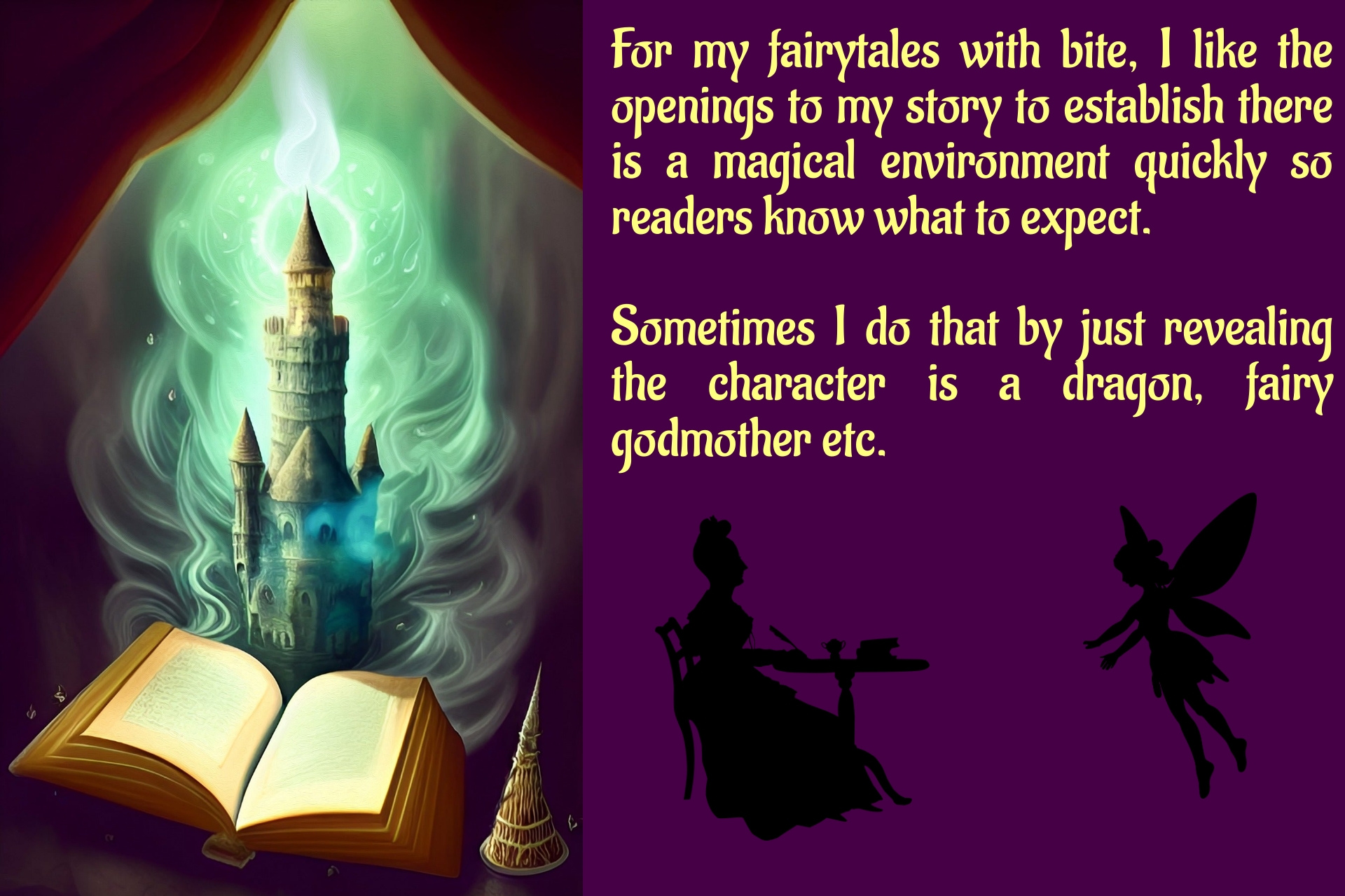
I like to establish it is a magical environment quickly so readers know what to expect. Sometimes I do that by just revealing the character is a dragon, fairy godmother, so if magic is then used to help resolve the problem, readers aren’t surprised by it and it doesn’t seem coincidental. That matters. Coincidences never ring true in any kind of fiction.

So think about what you want your opening to convey to your readers. What do they need to know quickly? How will you show your setting is a magical one?

BookBrushImage-2024-4-11-20-2124

This World and Others – The Stories Your World Treasures or Fears

Every culture has its stories. Some will be stories they treasure. There will also be those that “are buried” and there can be various reasons for that. For example, there are some violent stories in most countries’ histories. Some of those will be remembered (at events like Armistice/Veterans’ Day). Others will be “not talked about”, often because they’re frankly embarrassing and, rightly, the countries concerned have moved on – rightly so too.

So when it comes to your stories and your sci-fi/fantasy/fairytale settings, which stories would be recognised and acknowledged by your characters and those who rule over them? Which stories would be ignored or deliberately suppressed and why? What would happen to anyone uncovering those tales (and it is inevitable someone would! When there is a secret in fiction, someone is bound to reveal it!).

Think about who told those stories. Did they know what the consequences would be? Did they suffer for their art? Or were those stories not approved of at the time of your setting looked on very differently going further back into your setting’s past?

Attitudes can change over time and that can also apply to stories. What would have been approved of years ago may well be condemned now (and vice versa).

Are there stories your world fears because they could so do much damage if these were more widely known? What do the authorities do to keep those stories restricted to limit the risk of that damage ever happening and are they right to take this action?

Stories can convey truth. Not everyone welcomes that. So definite ideas for your own tales could emerge from that thought.

BookBrushImage-2024-4-11-20-2940

WRITERS NARRATIVE SUBSCRIBER LINK

Screenshot 2024-03-22 at 15-23-10 Writers' Narrative April 2024Screenshot 2024-03-22 at 15-24-20 Writers' Narrative April 2024

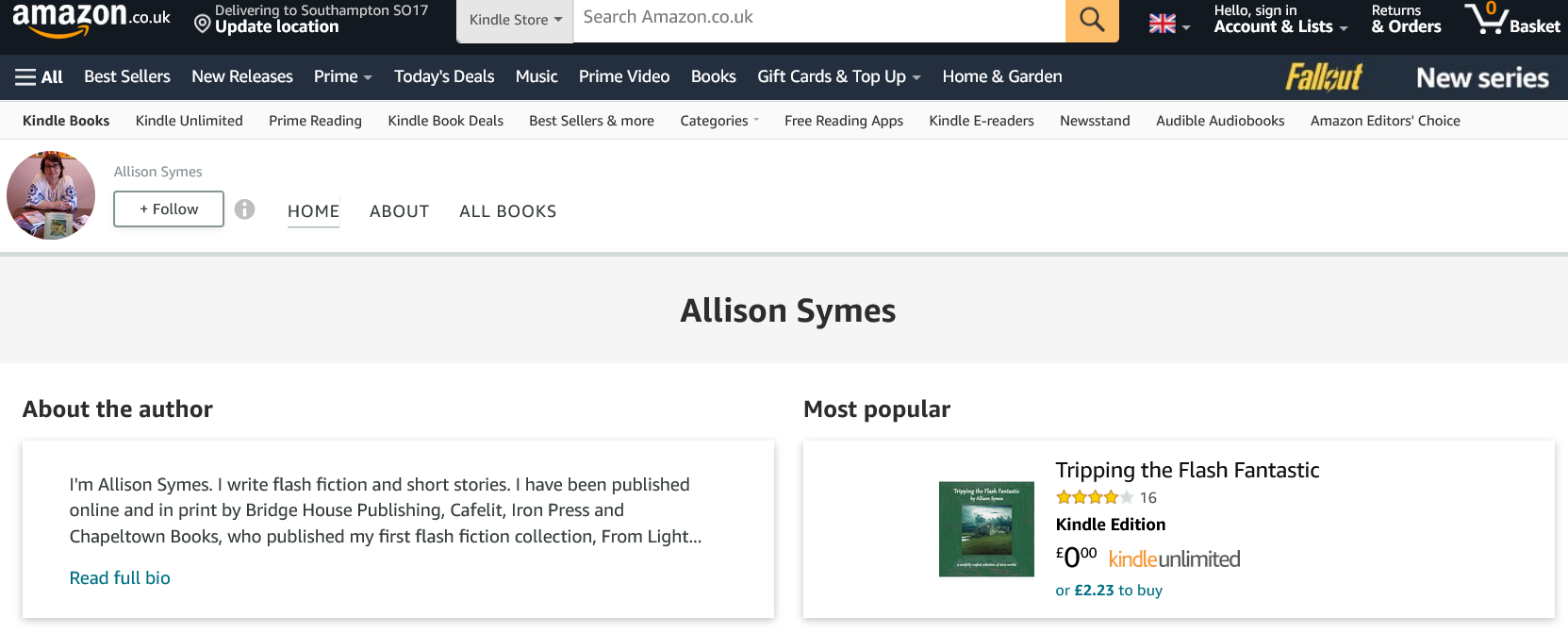
AMAZON AUTHOR CENTRAL – ALLISON SYMES

This slideshow requires JavaScript.

Twitter Corner with hashtag, Scrabble tiles, and the blue bird

https://platform.twitter.com/widgets.js https://platform.twitter.com/widgets.js

Processing…
Success! You're on the list.

Storylines, Dialogue, and Publication News

Image Credit:  Pixabay/Pexels unless otherwise stated.

Facebook – General – and Publication News:  Cafelit

Am pleased to share one of my humorous fairytales with bite, Rotten Day, which is now up on Cafelit.

See http://cafelitcreativecafe.blogspot.com/…/07/rotten-day.html – hope you enjoy!

This kind of story is always great fun to write!

This story came about as a result of an idea suggested in the Prompts book by Gill James. I am slowly working my way through the ideas in here, some of which I contributed.

Is it odd I’m writing a story to my own initial prompt? A bit but still good fun. And I didn’t make my opening lines, my favourite form of prompt, too easy either! There’s no fun in that. You have to rise to the challenge of the prompt but that means it does have to be challenging!

Oh and before you ask I deliberately sent the prompts in without having written the stories for them first. I wanted to come to these prompts “fresh” and tackle them as if they had been written by someone else.

Now that’s not a bad idea for those odd times when you’ve got a few minutes. Jot down ideas. Put them away for a while. Come back to them later and then see what you can do with them. Above all, have fun!

This slideshow requires JavaScript.

Hope you’ve had a good weekend. Blustery here, most unseasonable, but Lady’s had plenty of exercise and is now napping on the sofa. I know… ahhh….

I was watching one of my favourite films earlier – The Ladykillers with Alec Guinness and a very young Peter Sellers in it. (Possibly his first movie too as this came out in 1955). It is a masterclass in tight storywriting and seamless editing. The storyline is excellent and there is a lovely twist at the end. All of my favourite ingredients in a story basically.

Important point: not a word out of place. No scene felt unnecessary either. And that I can apply to whatever writing I do too.

So I’m not going to call it taking time out to watch a film. I’m going to call it visual research into storytelling techniques – and that IS my story and I’m sticking to it!😆😆

(I took the image of Lady, of course, the rest are from Pixabay).


This slideshow requires JavaScript.

Lady played with her best pal, a lovely Rhodesian Ridgeback, this morning so both of them got their Mondays off to a great start! Why is it when dogs play together they feel the absolute need to run into their owners when they’ve got all the space of the park around them? Answers on a postcard…

You do develop quick reflexes to dart out of the way though!

Writing wise, I’m working on material I will need for later on but can’t say any more than that at the moment.

I’m looking forward to sharing a new CFT series later in the month which will, I hope, prove particularly useful to writers, especially those starting out on their writing journey. More details later in the month though I will say a big thank you now to those authors who’ve already sent wonderful contributions for this. I’m looking forward to putting this together in due course.

I try to write a couple of series a year for CFT where I invite guest contributions, alongside author interviews etc. I find there is always something to learn from these.

One of the great aspects of writing that I love is, no matter where you are in your journey, that learning process is ongoing. You don’t want to stop developing as a writer. There is never a point where you can feel “well, that’s it now”. What you aim for is to be the best you can be in what you do and seek to refine and hone your skills in those areas.

What do you like about writing dialogue the most?

I love it when I’ve got two characters talking and it is apparent to me that, other than the odd he said/she said tag every now and then, it is clear who is speaking and what their attitude is!

To me this shows this is a “live” dialogue and, while it will need editing later (everything does!), it will have the benefit of not being clunky or awkward to read out loud.

When you know how your characters would speak, what kind of words they would use, which phrases they would never use and so on, that’s great. It means you know your characters well and I’ve found when I’ve outlined mine properly, when they are in “conversation”, it almost feels as if I’m taking dictation from them.

Moments like that are lovely because it nearly always means I can’t get the words down quickly enough and my characters and I are on a roll!

I occasionally give a character a pet phrase though I prefer to get them to use a particular word and repeat that every so often. It flags up to the reader when there are no tags this must be Character A speaking because they’ve used the word carbuncle again or what have you! Not that I’ve used carbuncle in a story yet…

This slideshow requires JavaScript.

Facebook – From Light to Dark and Back Again

A new flash fiction story, Rotten Day, is now up on Cafelit. See http://cafelitcreativecafe.blogspot.com/…/07/rotten-day.html – hope you pop over and enjoy the tale. Let’s just say I think many of us may identify with the way my lead character feels in the closing line! I know I’ve felt this way especially when particularly busy.

Now the problem with any kind of humorous writing is it has to be subjective. People’s sense of humour varies of course. So I am more than happy if a tale like Rotten Day makes one person laugh and another one smile broadly. Absolutely fine with me, that!

What I do when writing these is ensure that the humour arises naturally out of the situation I’ve dumped my character in. That is far more likely to make people smile. It also won’t come across as forced humour, which I loathe.

If someone tells me I have to laugh at this, well often I don’t. I decide what I find funny, thanks very much!

But a situation where I can see the predicament the character is in and empathise with them, then I am much more likely to cry, laugh, scream, or whatever the appropriate response to the story is and which the author intended to be the reaction.

Nothing forced about that at all and that is exactly how I like it in stories whether I read them or write them.

Stamping on an adverb until it is dead is not the problem it once was for me. Turning to flash fiction writing cured me of any addiction to these. If it can be cut out, I cut it. Just as well I didn’t go into medicine I think!😊

Wanting to achieve the maximum impact on a reader has also helped me with editing my own work. It IS a question of cutting to the chase here. Ironically I was going to put in the word “really” in that last sentence but cut it as it wasn’t going to add any extra to what I was trying to say.

And that’s the whole point. I’ve learned over time to not add words which don’t serve a purpose and/or to cut them when editing. Nobody writes the perfect first draft but adverbs are amongst the first things I look for when I’m brandishing my red pen.

This slideshow requires JavaScript.

Some of the tips I’ve found most useful for writing flash fiction include:-

  1. Keep a dictionary and thesaurus handy. I use the Compact Oxford which covers both nicely. You will want alternative words and to check on meanings, especially if you’re writing humorous tales, which are often dependent on double meanings to work.
  2. Learn what words can be hyphenated. They count as one word for flash fiction! I’m sure you can make good use of that!
  3. Always think about impact on your reader. You want them to respond to your story, whether it is to make them laugh, cry, scream, or what have you. When you read your story through after a break away from it, ask yourself what impact the tale has on you? Is it what you intended?

I love flash fiction collections, not just because I write them (honest!), but I’ve always been a big fan of books where I can dip into stories as and when I want to. I can read those stories individually, as well as read the whole collection reasonably quickly. Just love having that flexibility.

I also like reading short forms in between reading novels. I like to think of this as the equivalent of having an appetiser before enjoying the main course! There is much to be said for appetisers like that. They can make a meal. Sometimes they can be the best bit of it!

So what do I want my flash fiction appetisers to do then?

I’d say whet a reader’s appetite so they look forward to the next collection but then I would say that, wouldn’t I?! But it is a good thing to aim for. Always leave your audience wanting more and then they’ll be pleased to see you again!


This slideshow requires JavaScript.

Goodreads Author Blog – Reactions to Stories

How do you react to stories? I know, I know, what kind of question is that? So much depends on the story you’re reading, right?

Yes, fair comment and all that, but what I am getting at here is do you react to a story in the way the author intended?

Now I must admit if someone tells me “oh, Allison, you’ve got to laugh at this”, a lot of the time I won’t! I want to decide what I find funny, thanks!

But it is true that in whatever story I read, if the situation and the characters come across as natural to me, I am much more likely to react in the way the author wants.

Puppet on a string here? Perhaps. But I want the author to put in the work to set up a situation and character so I will want to react the appropriate way. I see that as part of the “deal”.

The author has set up a funny situation (though it often isn’t to the character, which makes a situation even more funny a lot of the time) and I will react to it. What I don’t want is something coming across as forced.

Even in the most fantastical worlds and situations, there has to be something that I as a reader can empathise with and react to – as the author would want, of course!


Getting Started and Genre Fiction

Image Credit

Unless otherwise stated all images are from the brilliant Pixabay.

Facebook – General

Regardless of what I write where, the hard part is getting started. Once I’m away, I’m away. But I have learned over time to trust the instinct that something will come which I can work up into a story or a blog post. The great thing is it’s going to be a first draft and the only person seeing that is me.

I never worry about getting the writing right first go. I know I won’t. What matters is getting started and putting something down on paper or on screen. You can only work with what you’ve put down to work with after all!

So ways to get started on a piece of writing then?

1. Look through any brainstorming notes and see if ideas jotted down there take your fancy now. If so, away you go.

2. Have another brainstorming session and write anything down that occurs to you. I’d do this for about five minutes. Then look through the ideas. Did one in particular stand out? If so, great, off you go. If not, what was the idea you like the best and why do you think that is? Then still write it up. There will be a reason why you like this particular idea so go with it.

I’ve found that once you start writing, the ideas continue to flow. It is a bit like turning on a creative tap. Stronger and better ideas come as you write too. Jot them down. Come back to them. But just get writing and have fun. Nobody has to see this work but you.

Out of what you jot down, there may come ideas to write up fully. Even if you seem to draw a blank, you are clearing away some creative clutter from your brain in getting these ideas down and out of your system. Just put them away for a bit. Come back to them later. You might see potential in them THEN.

This slideshow requires JavaScript.

Am forging away with my CFT post for this coming Friday – and it will include a quiz too. No prizes – just bask in the glow of getting the questions right! More details later in the week.

Revamping a website always takes longer than you think. I’m adding pages to my work on Cafelit and Bridge House Publishing/Chapeltown Books. I also hope to have a page on writing tips etc. Looking forward to sharing more details when all done. Do explore the rest of the site. There will be more goodies to come in due course. The site is now known as allisonsymescollectedworks.com

Next big event for me will probably be the Bridge House celebration event in December. Looking forward to that a lot. So good to meet up with fellow writers that, for the rest of the year, I meet courtesy of Facebook! Incidentally, I do think that is one of the nicest aspects of social media – writers being able to encourage one another even if they can’t meet in person.

More immediately, I’ve got short stories to draft and non-fiction ideas to work on too. Why is it that it can take ages to get started on a piece of work, you get into your stride with it and THEN the time whizzes by and you have to stop? Oh well. The one comfort there is I know I’m not alone on that one!

Allison Symes and published works

Facebook – General – and Publication News

Glad to say Staying In is my latest story on Cafelit. It ties in with my last story, Humourless. I’ve been working on some linked flash fiction this year and hope to write more of these.

Definitely on the darker side of my particular writing scale but I hope you enjoy them both.


Catching up with reading on the Kindle at the moment. I’m also re-reading my novel on there too (I do love the Send to Kindle function!) and am trying to read it as a reader would.

I tend to save using the Save to Kindle function for my big projects. I think I might try batching my short stories and flash fiction in one document so I can review them like this too.

When I put the Kindle on, I am straight into reader mode which is precisely what I want to achieve here. The inner editor has been told to go away somewhat forcefully and I can relax and read.

Ironically, I’ve found on the novel it has made me spot things I can improve but that is because I’m reading it in a relaxed way. I’m not at this stage trying specifically to do anything to it. I think state of mind as you read is key here.

This slideshow requires JavaScript.

Facebook – From Light to Dark and Back Again

I like to write flash fiction in a variety of moods. My absolute favourite are the humorous kind but that’s because I’ve always had a very soft spot for funny writing. I also think it’s under-estimated. (Anything that looks easy to write, you can bet the writer has worked very hard for years to get to that point).

Humour, I think, is the most difficult to get right in any form because it is so subjective. You have to accept not everyone might “get” your sense of irony.

My dear late mum loved a wide range of books but just didn’t “get” funny writing at all. I suspect that’s one reason I DO love it. Well, I guess it is one way of rebelling… albeit very tamely. (She would have been delighted though about From Light to Dark and Back Again and my other published stories).

This slideshow requires JavaScript.

I’ve mentioned using random word and phrase generators before as good triggers for story ideas. I thought I’d take a look at the random phrase generator and again and came up with:-

Two Down, One To Go
Down for the Count
On the Ropes

All of those would make great titles and/or themes for stories. May well have a crack at some of these myself. The nice thing is you can keep clicking until you come to a phrase you like the sound of and, also, how about combining phrases?

Two Down, One to Go could make a great title while On the Ropes could be the theme of that same story.

Happy writing!

This slideshow requires JavaScript.

Are there themes that really resonate with you whether you’re writing the stories, reading them, or both? I think I’d list mine as:-

1. Seeing the tables turned on superiors by a character who has been underrated or rejected.

2. Injustice put right, especially if someone has been falsely accused. (This is why Azkaban remains my favourite Harry Potter story).

3. A quest carried out by someone who is assumed will never fulfil it but they do. Take a bow, Frodo Baggins!

4. Where someone technically inferior is clearly far superior to their boss (but their boss knows it and acknowledges it) – Jeeves and Wooster are the top men here.

For flash fiction, of course, you would need to show a “brief taste” of these themes but there is nothing to stop you fleshing our a short piece into something much longer if you wanted to do so later.

That is one aspect of flash fiction I love – you CAN have a second bite of the cherry here. It’s just that the second bite is going to go much deeper (and go on for longer) than the first one!

This slideshow requires JavaScript.

Am having great fun revamping my website at the moment. Am planning to put on an All About Flash Fiction page with hints and tips. Will share once it’s ready. Plan is to update it regularly. I’ll also use it to compile some of the advice I’ve shared here and I hope to share thoughts on writing exercises too.

I love flash fiction for the way it shines a sharp light on one moment in a character’s life. There is something about the intensity of flash that really appeals to me. And I love getting to create so many different characters too.

This slideshow requires JavaScript.

Goodreads Author Blog – Genre Fiction

I’ve never understood snobbery around genre fiction. Genre fiction encourages people to read according to their tastes and isn’t the idea to get people into books in the first place?

My favourite genres include:-

1. Fantasy
2. Crime
3. Historical

(And yes you can combine those. Terry Pratchett’s Sam Vimes novels in his Discworld series combines 1 and 2 and I’m sure you can think of others that blend genres).

I suppose the only “properly literary” fiction I’ve read is Hilary Mantel’s Wolf Hall, which I adored, but my go-to-for-a-good-read first is always something which is genre based.

Yes, I know what to expect from, say, a crime novel, but what is fascinating is seeing how different crime writers handle their material. (As a writer, I can pick up tips there myself so win-win!).

I’m always fascinated as well by character creation and different writers take varying approaches to this. So reading widely across genres opens my eyes to different ways that this can be done.

So reading books then is a good idea then? Well of course it is!

Now to decide which genre I’m going to go for next…

Happy reading!

This slideshow requires JavaScript.


Mixing It Up

Facebook – General

Which author do you turn to when the world is grim and you just need to step away from it for a bit? My mother always used to say “stop the world, I want to get off” when the world seemed particularly madder than usual, a feeling I totally understand at the moment.

My go to choices are Pratchett, Austen or Wodehouse. In a grim world, comedic writing is very much my first choice of escapism. (And unlike alcohol and chocolate has no calories in either!).

One of my big bugbears is why humorous writing can be looked down in certain circles. If something looks easy, that writer worked their socks off to get their prose to that point. Easy writing is hard writing and even harder editing.

I’m a big fan of the “what if?” school of developing story ideas. I look at all possibilities when I’ve got an interesting theme/title/character to play with (one of them is the trigger – it isn’t always the character for example. I would say it’s a pretty even split between my three triggers here).

I start by writing down the “obvious” links and dismiss those but in the act of writing those down, the thought “oh I could do this instead” crops up and that’s when the ideas really start flowing. It’s also when the writing really kicks off and that’s a great place to be.

I do use spider diagrams sometimes. Sometimes I draft a series of sentences outlining possibilities and then go with the one I like the best. (You can guarantee if it’s quirky, 95% of the time I’ll go with it!). But I like to play with ideas before I commit to one. The great thing with this approach is if Idea B appeals to me but Idea A is stronger and appeals to me more, than I’ll go with A. But there’s nothing to stop me having another look at B and developing that further for another story another time.

Busy night yesterday submitting flash fiction pieces so pleased with that. Third collection coming along well too.

I often draft fiction and non-fiction pieces with eyes open to potential markets and then submit at a later date. This is to give me time to put work aside for a while and then look at it with fresh eyes before editing and submitting those pieces.

Regarding the non-fiction, which is relatively new to me, I’m putting those pieces aside for a bit as I need to work on pitching to the markets I have in mind (but I wanted to make sure I had written the articles first. There is no such thing, to my mind, as wasted writing. If I find I can’t sell these pieces, I will end up recycling them in other ways. Also, you do write better the more often and regularly you write even if you can only write a small amount each time. It all builds up over time and I am one of those writers who likes to know they have the work to submit before approaching a market!).

This slideshow requires JavaScript.

Am looking forward to seeing a local production of one of my favourite stories, A Christmas Carol, on Thursday night. Review will follow in due course.

Am also pleased to say I’ll have some publication news, from different places, over the next few days and am looking forward to sharing some links to new stories with you.

Am also looking forward to sharing an interview with an author of a very special cookbook via Chandler’s Ford Today in next couple of weeks.

My post this week will be looking at light and darkness. Link to go up on Friday.

Not impressed with the cold weather. Am very much looking forward to dodgy CH boiler pump being sorted out tomorrow. Meanwhile, I am wearing loads of layers! It is just a pity that writing isn’t a warmth generating activity but there you go!

Facebook – From Light to Dark and Back Again

F = Fun stories, told briefly
L = Lights up the characters
A = Animated dialogue and internal thoughts
S = Show, not tell (and what else could this be)
H = Hard impact from few words

F = Fantasy and fairytales feature in what I do
I = Imagination running riot (what fun!)
C = Characters compel you to find out what they’re up to.
T = Truth emerges in fiction, better than straight telling.
I = Inventiveness emerges from using low word counts
O = Omnipresent narrator, first person or third? I use all.
N = Narrator must be intriguing to your readers.

Some thoughts about flash fiction!

Time for some more one line stories.

1. The swirling leaves made a great disguise for a human-hungry shapeshifter as nobody spotted him turning up for his latest snack.

2. When even the bats find the dark too scary, you know there is going to be trouble.

3. The fairy godmother smashed her wand against a pane of glass and watched as the splinters turned into a pair of beautiful shoes – one user only for these.

4. Find the monster, the people cried, though they screamed when it was found.

5. Being befuddled was Molly’s normal state of being, which is why they didn’t let her have her magic wand any more.

Allison Symes – 18th November 2018

I have three main triggers for writing flash fiction: a character who intrigues me, a theme I just have to write about, or a title with interesting possibilities so I just need to find out which is the most fascinating and go with that!

I’ve found it pays to have different writing triggers. It keeps things fresh and I’ve never believed in the “one approach suits all” school of thought. I’ve never seen how that can work! Being open to different methods helps with competitions where the theme is set for you anyway.

I do recommend having brainstorming sessions every so often where you just jot down potential ideas. I must do so again myself soon but it is great to come back to these later and work them up into stories or articles for Chandler’s Ford Today, as the case may be. It also means never being short of anything to write about!

(And photos can make a great trigger too. Another reason to love Pixabay!).

This slideshow requires JavaScript.

Publication news coming later this week with new flash fiction stories from me and in different places too. Looking forward to sharing the links with you as and when. Nice mixture of word counts here too.

What makes me decide when a piece really won’t work as a flash fiction story and that it has to be a standard competition length short tale instead?

When the theme is such a powerful one, I need to give the characters more room to explore it is the basic answer. As you write more, you develop a gut feel for when to stop a story (nearly always turns out to be a piece of flash fiction) or when you need to continue (this is where it can become a 1500 short story instead). Just be open.


Goodreads Author Programme BlogMixing It Up

I like to mix up what I read in terms of genre and word count. I love (and write) flash fiction, likewise short stories, but there are times when nothing but a full length novel will do. There is no way Tolkein could have done justice to The Lord of the Rings in three short stories!!

Having said that, I am still stunned they managed to get three films out of The Hobbit, given it was only one book. Hey ho…

The correct word count for any story, of course, is when no more can be said and when to remove anything would be to the detriment of the tale in some way.

I think as a reader of too many years to count, you do develop an instinctive feeling for when a writer has got the word count right. I want to feel at the end of a story disappointed it has come to an end, but at the same time, know within myself, there really was no more to be said. Naturally that’s a challenge to me for my own writing but this is a good thing. It keeps me on my toes!

One of the things I love about creative writing is one of the best tips any writer has to improve their skills is to read widely and across the genres, including non-fiction. You do learn by absorbing what others have done before you. Absolutely no problem with that, then, and bring it on!

This slideshow requires JavaScript.