A New Year – New Goals?

Facebook – General

I don’t really start thinking in specific terms about what I’d like to achieve writing wise for a New Year until about now. I know what my general goals are and those don’t change much but at about this time I set myself some specifics and then work my way through them as the year goes on.

Some years I achieve them all, some years I don’t, but I feel as if I achieve more for having set some ideas down as to what I’d like to get done.

One specific thing I really do want to do next year is enter more writing competitions (flash, short stories, maybe novel but certainly the first two). I didn’t enter as many as I thought I might this year though I have been working away at other projects, one of which I’d like to also get out in 2019 if I can.

Whatever your projects are, whatever your writing goals are, the most important thing is to enjoy what you write and believe in it. If one market or competition does not work out for you, see if you can figure out why. If there is nothing obviously wrong, try with another market or competition that the piece or story would suit. Above all, don’t give up. Enjoying what you write helps a lot when the rejections come in – and they will.

This slideshow requires JavaScript.

The only problem I have between Christmas and New Year is working out which day of the week it is and I know I’m not the only one to lose track. Back to full writing routine from tonight though and it is great to be back.

Looking forward to using my new writing diary. Full of prompts and loads of places to jot down ideas (including a monthly To Do/Goals page and at the end of the month an Achievements page. The trick here is to try to get both pages equally full I think! A blank achievements page could be depressing! However I plan to use this to help me try and achieve a plan to enter more writing competitions this year).

Under the picture prompts, there is space to jot down notes for story ideas. I’m going to use those to flesh out some flash fiction!

Big plan is to have the novel ready to start submitting again (I hope around Easter time). So lots to do and I start by preparing material for a guest blog and my usual CFT spot. More details on both to come.

Good luck with your writing plans and have fun with them!

Happy New Year, everyone. Good luck with all writing endeavours.

Never be afraid to check out the credentials of publishing services companies/publishers/agents etc as the genuine ones will (a) not mind you doing this as it shows you are taking things seriously and (b) will be able to answer queries well and thoroughly. Also don’t forget you can seek advice from the Society of Authors/Alliance of Independent Authors and their websites are always worth checking out.

Have fun with your writing, try out competitions, write what you would want to read, and read loads! (Magazines, novels, short stories, flash fiction, non-fiction – it all “counts”).

I’ve got a couple of projects planned for the next year including submitting my revamped novel, a third flash fiction volume, and I’d love to do more non-fiction too. Don’t know whether I’ll get this all done but it will be fun finding out – and I guess that’s the point!

Loved the Doctor Who special tonight. Can’t keep a good enemy down, that’s all I’m saying.

The whole point of any story is conflict resolution though that can cover anything and everything from exterminating someone to being reconciled with them. What matters is the conflict is over. The story has concluded.

But while the conflict is going on, it is true that the hero/heroine and villain must be worthy of each other. No hero/heroine gets to win “easily” – there must be huge hurdles to overcome. The villain needs then to be capable of stretching your heroes to their utmost (and beyond ideally, making said heroes stretch too. Drop your characters right in it and see what they can do).

This slideshow requires JavaScript.

Facebook – From Light to Dark and Back Again

Had a great trip on the Watercress Line (steam railway) yesterday with family. Always think of the stories of the navvies who cut out the sidings etc to make our railways. So many stories we won’t know but can only make educated guesses at.

When it comes to our own stories, what is most important to your characters? Who are the characters who you MUST tell stories about and why? Think about what has made you choose these people and play to their strengths and weaknesses. A well portrayed character has plenty of virtues and failings and both will affect the direction of the story.

It’s a good idea to mix up how you source ideas for stories. I like to use proverbs, well known sayings, songs can be an inspiration too and this year I hope to use more picture prompts. (My new writing diary has loads of these in it and I plan to get several flash fiction pieces from these!).

It’s also nice from the writer’s viewpoint to mix up how you gather the ideas/raw material to get you on you way to generating a new story. It keeps things interesting for you and you on your toes, which is never a bad thing. One of the things I adore about flash fiction is it is always a challenge to write small but doing so is very satisfying. (Even more so if the story is published!).

One thing I would like to try and do more of is use more of my own photos to trigger ideas and to take pictures specifically with story generation in mind. The great thing with using your phone for pictures is it is so easy to delete the ones that don’t work out. Sometimes you need to do that with a story too but that is much harder to make yourself do.

I try and avoid getting into that position by outlining first (it really does help). The great thing with outlining is it can be as detailed or not as you like. I’ve sometimes drafted a one-line outline for a piece of flash fiction but it has helped me work out which route to take with the story before I start it. I find I then write more efficiently too.

What are your hopes and plans for your flash fiction writing in 2019?

Mine are to submit pieces online and for competitions more regularly. I also hope to post more on my website – allisonsymescollectedworks.wordpress.com – as well.

I’m working on a third volume of flash stories as well and hope to get this up together and ready for submission.

I really enjoyed taking part in Open Prose Nights for the first time this year and would love to do more of those. I would also like to give more talks on flash fiction as well.

But I should finish the year’s posts with a flash fiction piece I think.

CROSSING TIME
‘I suppose you think that was clever’, the girl said.
‘Of course, why do it otherwise?’ I replied.
‘You can’t hold me back. It doesn’t matter what you do.’
‘There’s not a human born who doesn’t long to, you know. I had the courage to try.’
‘Or the foolishness! Most of you accept you cannot beat me. You even celebrate me once a year.’
‘Yes, it’s all lights and fireworks and parties, but you are a cruel devil and I will beat you.’
The girl laughed. ‘How? You’re not immortal. You can’t win a fight with Time. I should know. I also know how long you have. I can see your sands running through’.
Out of nowhere she produced an hour glass and sure enough the sand was running through but I didn’t care. I didn’t bother looking. I didn’t want to know. It wasn’t the object of the exercise. I wanted to defy Time and I had.
‘I can keep you at bay with this time piece, and keep doing so until it is time for me to go. I like my current age. I will stay this way. That will do.’
I waved the pocket watch in the girl’s face as if daring her to take it but she waved it away from me. The watch’s hands were going backwards. I set them to a week ago last Friday. I wanted to see if I could do it the way the saleman in that strange little shop insisted I could.
And sure enough here I was back where I had been last Friday. Just outside the chip shop, cursing myself for forgetting my coat on what was the coldest night of the year so far. What I hadn’t expected was this wraith like girl turning up to berate me.
‘There is always a price to pay for crossing Time,’ the girl said, sighing. ‘I will catch you in the end. Your time will come. And trust me I will make you know it when it does. I don’t like cheats. I never have.’
‘So be it but my “time’s up” will be at the age I choose.’
‘And how are you going to explain that to people? Tell them you’ve got a funny portrait in your attic?’
I grimaced. I must admit that thought had not occurred to me. But so what? I could always tell people I had found a really good moisturiser!
The girl vanished. I went and got my chips. I was just crossing the road, munching them happily, when a Mini came out of nowhere and sent me crashing across to the other side. The last thing I remember was seeing the girl reappear and she was laughing.
I got one thing right. Time IS a cruel devil.

Allison Symes – 31st December 2018

One nice aspect to flash fiction is if you use a writing exercise to help you start off your creative work for the day, then there is nothing to stop you revisiting what you come up with for that and see if you can turn it into a flash fiction story.

From that writing exercise can come an entry for a competition, a published flash tale etc. Give it a go if you try these writing exercises (which often get you to write a couple of hundred words or so. Perfect length for a lot of the flash fiction categories. You can always edit to get a piece down to 75 words or less or keep the piece as it is and look for the 200, 250, 300 word category competitions and markets).

Good luck!

Goodreads Author Blog – And Happy New Year!

Following on from my Merry Christmas post last week, I could hardly call this one anything else!

So with a New Year in mind, what are your reading and/or writing plans for 2019?

I would like to read more flash and short story collections in the next 12 months plus get my own third anthology of stories finished and ready to submit. (Still very much at first draft stage).

I would like to catch up on my To Be Read pile (but I suspect that is an ambition most of us have!). I would like to submit more non-fiction pieces too.

I don’t tend to take up reading challenges because I think I would feel so disappointed in myself if I don’t manage them. However, I would like to widen my variety of reading (which is reasonably wide as it is but I am conscious there are many genres I haven’t tried and I ought to explore. The world of books is meant to be explored!).

Whatever your plans here, good luck! Happy New (reading) Year!


Christmas and Stories

Facebook – General – and Chandler’s Ford Today

A night early due to having lovely family commitments to look forward to tomorrow and Saturday! I take a look back at my highlights of 2018 which includes everything from a wonderful wildlflower meadow to my writing high points. I hope you had a lovely Christmas and wish you all the best for 2019!

This slideshow requires JavaScript.

Watched The Muppets Christmas Carol. Fab film. I love the “Marley and Marley” sequence (it’s only in the last year or so I got the gag about Jacob and ROBERT Marley – yes?! Reggae fans catered for here!) and Gonzo recommending reading the book itself at the end of the film. Don’t ask why I didn’t get the gag before. Couldn’t believe I hadn’t spotted it before but there you go.

Also watched the film version of Terry Pratchett’s Hogfather a few days ago. Loved that too. Thought Michelle Dockery was a superb Susan. Next thing to watch will be the Patrick Stewart version of Dickens’ classic and at some point over the festivities I will try and rewatch The Ladykillers with Alec Guinness. I catch up with old favourites on film as well as in book form at this time of year!

What makes for a good adaptation? It should stick reasonably faithfully to the book. (I say reasonably as I accept some things would have to be cut). It’s more important to stick to the spirit of the book, I think. Whoever is cast should be utterly believable in the role. Michael Caine is as Scrooge with the Muppets. Reminds me of the classic Eric and Ernie “Andrew Preview” sketch – it had to be played seriously by all parties for the humour to work – and yes I’ll be watching that again too. All time favourite comic sketch for me.

Whatever you watch, listen to, or read this Christmas, have a wonderful time doing it!!

This slideshow requires JavaScript.

Just after Christmas, I do an annual “stock take” of where I am writing wise, what I’ve achieved this year, and what I’d like to achieve during the next 12 months. Naturally, the latter list is always longer than the first one! But I find it helpful to look back and make myself take some time out to think about specific writing hopes and then get on and try and fulfil them, of course.

Just about ready for Christmas now. Had a lovely Carols by Candlelight service tonight. Some lovely poems in amongst the singing fest and Nativity readings.

Another aspect to the season is that having a dog in the house means there is no such thing as leftover turkey ever again! Lady loved her first Christmas with us last year, she has left the trees alone (much to our relief! Our vets have a tree in their surgery which looks lovely but I do wonder about this. It’s a matter of time before the lights on it fuse because every dog that goes in HAS to go over and at best sniff it and… well you get the picture).

Am winding down on writing for the next few days but will relish it the more when I do get back into my usual routine.

This slideshow requires JavaScript.

I’m not surprised the Christmas cracker joke writers prefer to remain anonymous. For example, these were taken from our recent informal carols night.

Why did the scarecrow get a payrise?  Because he was outstanding in his field.

What do you get if you cross a vampire with a snowman?  Frostbite

How many letters are there in the alphabet at Christmas time?
25 – there is No L at this time of year.

Is there such a thing as a bad pun? Of course. Still make me groan and smile in equal measure though. And to finish for a few days break I leave you with:

There was once a cracker joke writer
Whose puns made people curse the blighter
So when his pen was taken
He felt forlorn, forsaken
But the world felt much brighter!

Allison Symes – 24th December 2018

Merry Christmas! Back in a few days…

Hope you had a lovely Christmas and that you received all the books you wanted to have as presents. Well, you did ask for some, yes? Am pleased to report my To Be Read pile has gone up again – no surprises there!

Won’t be back completely to my usual writing routine until Sunday as will have having a lovely time with family tomorrow and Saturday. Glad to grab chance to write now though!

I enjoyed the break away from the PC but must admit am raring to go again properly from Sunday. It is great to be eagerly looking forward to writing again though. It is a good feeling.

Facebook – From Light to Dark and Back Again

Do you like your own characters? I think like many writers, I love some of them, loathe others, and the rest I definitely wouldn’t want to meet in an alley in broad daylight, yet alone at any other time. Good thing? Yes, it means I’ve created characters I believe in and react to – so readers should believe in and react to them too. In many ways, the first person you’ve got to convince about the veracity/worthiness of your story IS YOU!

This is why it pays to put work aside for a while after first writing it because I’ve found there are two reactions to a piece you’ve just finished. You either think it is a work of genius (the Move Over Shakespeare school of thought) or, even more likely, it is total rubbish (the Why Did I Think I Could Write school of thought).

Neither is true! What you will have written is something that has promise but needs a decent edit (and ideally more than one) before the work gets submitted anywhere. I’ve also found coming back to a piece after a break means I will look at it with fresh eyes. You do spot the mistakes better. You also spot the things that work (which cheers you up a lot!). So literally give yourself time here.

AN UNEXPECTED STOP
‘You do know at what speed you were travelling, sir?’
‘Er… no… officer, I’m afraid I was concentrating on getting to my next destination. I have to cover everyone on my list, you see, and I don’t have much time. Was it important?’
‘I’ll say so, sir. You will cause chaos flying at that speed. If everyone did that there’d be accidents galore.’
‘But, officer, it’s Christmas Eve, I’m Santa Claus, there’s nobody up here except us and I’d love to know how YOU got here.’

Allison Symes – 23rd December

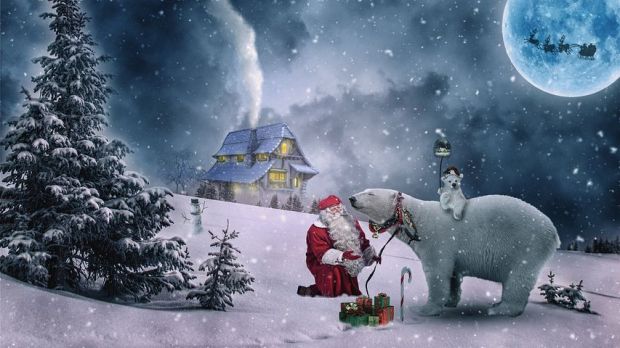
Hope you enjoy. This was inspired by a Pixabay picture I recently used where Santa is on the ground but his sleigh is parked in the sky with reindeer on standby! See below!

There's a story here not least in how Santa got down from his sleigh, see where he has parked it - Pixabay

HOW did Santa get down from his sleigh? Look at where he’s parked it! Pixabay image.

Flash fiction lives up to its name both in its brevity and the way it illuminates one moment in time for a character. It is like shining a spotlight on one particular aspect and there should be a sense of the resulting intensity coming from that. There should also be a sense that the story is the correct length and would be spoiled somehow if a word was taken away or added to. Tough order but writing flash will improve your editing skills.

UP TO SCRATCH
‘Have I passed the MOT then, young man?’ The elderly gent peered at the guy, who could easily have been his grandson. ‘Can I resume my duties now?’
‘Oh yes, Grand…er… sir. And you are getting the correct CPM out of your chosen fuel source too.’
‘CPM?’
‘Carrots Per Mile, sir. You must be feeding your reindeer well.’
The elderly gent smiled. ‘Quality will tell, it always does. I don’t suppose there is anything you can do about the lead one’s red nose is there? I swear it stands out even in the thickest fog and I know Rudolph is embarrassed by it.’
‘Sorry, sir, you will have to go back to the manufacturer on that one.’
The elderly gent sighed. ‘That will have to wait. I’ve got places to go, people to see, and the big boss will want me to get that done first.’
And with that Santa and his reindeer took off as Christmas Eve broke. It would be a busy night.

ENDS

Allison Symes – 24th December 2018

Merry Christmas! Back in a few days…

Hope you had a great Christmas and got to enjoy lots of stories, whether in book, audio, or film formats! I was given 365 Stories which is a wonderful book where for each day of the year there is one story at 365 words exactly. I have already demolished January!! (There is no way I am reading ONE story per day. It’s like trying to stop yourself taking a second Quality Street. You’ve got to have a backbone of steel for that and, frankly, I haven’t!).

And yes flash is great for this time of year. Too busy with all the festivities? Too tired to read much afterwards? Then just dip into a flash fiction collection and enjoy. A brief dip into the world of fiction is particularly refreshing when you know you haven’t time for a “full immersion” (i.e. a novel!).

Goodreads Author Blog – Merry Christmas!

Hope you have a wonderful time at Christmas and all the best for 2019. I hope you have many fantastic book-related presents under the tree this year. One of my favourite times of Christmas Day is that lovely period when I curl up on the sofa and start “tucking into” my festive reading material!

Have recently enjoyed film versions of some of my favourite stories. Don’t think you can beat the Muppets’ Christmas Carol. What’s not to like about Gonzo recommending reading the book itself right at the end of the film?! I’m not surprised A Christmas Carol has never been out of print since it was first published and it must be Dickens’ biggest earner even now.

Have also watched the film version of Terry Pratchett’s Hogfather. These are two must sees in the countdown to Christmas.

Aim for next year is to try to read more (and to review more too). There’s a lot on my Kindle I haven’t updated as finished here! (Bet I’m not the only Goodreads fan guilty of that though).

So whether you take in your stories in book form, audio format, film or what have you, enjoy. And here’s to looking forward to more reading in 2019.

This slideshow requires JavaScript.

Fairytales with Bite – Tis The Season for Fairytales?

I love fairytales no matter what the time of year is, but the Christmas season I think makes those who don’t usually read the genre more open to it.  I think a lot of this is due to the influence of pantomime (at least in the UK it is.  Several of the best known pantomimes are fairytale based – The Babes in the Woods, Aladdin, Cinderella, Puss in Boots etc).

Also it is the perfect time of year in the UK when it is cold and gets dark early to curl up with favourite stories and books and again fairytales play a huge role here.

The one thing I wish I could wish away is the image of fairytales being twee.  They are  NOT.  Just look at what Hans Christen Andersen wrote!  Also I’d like to get rid of the “it’s just a fairytale” statement that people come up with sometimes.  There’s nothing “just” about being a fairytale.

Fairytales contain truths, show up humanity for what it can be like, and can be scathing about greed and unkindness.  Justice can be on the rough side too!  So no unfair dismissal of fairytales then?  I think that’s a good wish for 2019!

Happy New Year!

This World and Others Christmas Stories

Due to (lovely) family commitments, this post is going up a day early.  Christmas Stories ties in with a recent CFT post though naturally this week’s one, as we rapidly approach 2019, is my usual end of year/highlights of year post.

What are your favourite Christmas stories?  Mine are:-

1.  The Nativity
2.  A Christmas Carol
3.  Hogfather by Terry Pratchett
4.  Twas the Night before Christmas – it IS a story, albeit one told in poetic form!

I hope you had lots of lovely books as presents and whether you enjoy stories in book form, audio, or as film, I hope you managed to find time to relish your favourites again here.

Of course the dark and cold (at least in the UK!) encourages you to stay in and curl up with a good book, though I could be living in sunnier climes and still want to curl up with said good book!

The great thing about reading is it encourages your own writing (ideas spark from other ideas) and you learn so much about story by indulging in your love of reading them.  So read on!


Time To Read and Heroes and Villains

Image Credit:  Many thanks to Dawn Kentish Knox for taking the picture of me reading at the recent Bridge House event and for kind permission to use it.

Facebook – General

My To Be Read pile is increasing again! Do you find you have moods where you just want to read books and, at other times, you just want to read magazines? I do. I used to ride an exercise bike and read while on that but frankly it is a very boring form of exercise. I prefer to walk the dog and swim, both of which exclude reading!

Am planning to have Christmas reading time as a treat to me. I do read something each day but I’d like solid periods of reading time. I don’t want it to be a choice between writing time and reading time. I want both! Thoughts on how to get a good balance here would be welcome.

This slideshow requires JavaScript.

I looked at finding time to read in my latest Goodreads blog the other day. It is just as important as finding time to write given we have to feed our own imaginations and by far the best way of doing that is to read widely ourselves. It also supports the industry we want to be part of!

So whether you borrow from the library (always a fab idea, that!), buy books, stick to reading on the Kindle, the important thing is to read, read, and read. A tip often passed on to new writers is to write what you want to read. How can you know what that is unless you read widely and discover what that is? (Sometimes you can discover what you don’t want to write as well!).

Naturally I’m going to put in a plug for the small indie presses such as Bridge House Publishing and Chapeltown Books since this is very much book buying season.

Can I also put a shout out for reviews for books you’ve read? Reviews don’t have to be long – one or two lines is enough. People do read them. (I always read product reviews whether it is on my online shopping or what have you!).

This slideshow requires JavaScript.

Which night of the week, if any, do you find it the hardest to write anything? For me, it is always a Monday. Yes, I write, but I write more on every other day of the week! Maybe I need a “slow day” to make me get a move on for the rest of the week. Maybe it’s just a Monday thing…

The good thing is I’ve learned over time not to worry about this. The important thing is I am writing and loving it. I’ve learned to focus on that. I am also convinced a writer’s love of writing will show through in what they actually produce.

And the “little” bits of writing mount up over time so I’ve learned never to underestimate only having small pockets of time to write in at times (whether it is due to it being a Monday or not!).

It is often said you can tell much about a person by how they treat others who can do nothing for them. This is true but it should also be true for your characters. How do they react to those they would consider weak? (Incidentally, are they right on that or are THEY themselves the weak ones but just don’t know it?).

In the setting of your story, what are the rules? Are older people treated with respect (perhaps even venerated) or are they considered of little worth and belittled? Does your character go along with what is the status quo here or do they rebel against it? If they rebel, what are the consequences? Are they the catalyst for positive change here?

Plenty of food for thought and story ideas there, I hope!

Facebook – From Light to Dark and Back Again

Great article on flash fiction in Writing Magazine. It is good to see the form get more publicity. I still find the question I’m asked most frequently is just what is flash fiction? While technically it is any story under 1000 words, I must admit I prefer flash to be 500 or under, though From Light to Dark and Back Again contains a good mix from across the word count spectrum here.

Also good to see more competitions for flash and having it added as a category to festival competitions. Sure signs flash is in a very healthy state and long may that continue!

This slideshow requires JavaScript.

Whether I read novels, short stories, plays etc, I nearly always find a few stand out moments that stay with me long after I’ve finishing reading. I suppose that looking out for specific moments in fiction that stand out might have subconciously drawn me to flash fiction given you have to make an impact quickly there.

Some of my favourite stand out moments include:-

Frodo offering to take the Ring to Mordor. You know everything changes from that point.

The fairy godmother turning up at Cinderella’s. Again you know everything will change then.

The Little Mermaid realising the Prince is not going to fall for her. Just such powerful stuff, given all she has gone through and you must read the original Hans Christen Andersen story to get the full impact of that.

Inspector Alan Grant in The Daughter of Time discovering the picture he has been given is that of Richard III and wondering what mystery he will find in the king’s story. You just know he’ll find something otherwise there is no story here. Again a major change point.


Sometimes selecting the right “moment in time” to be your flash fiction story can be tricky. My guiding rule is to go for whichever of the choices I have which makes the most impact on an impartial reader.

Incidentally I don’t “tug on the heartstrings” here. Any impact has to arise naturally out of the situation I’ve put my characters in and therefore any reaction is genuine. No matter how fantastical your setting, you have to keep it real!

And there must be something about your character that fascinates your reader in some way. It will be that which makes them read on.

What is the appeal of a well written villain? They’ve got to have good reasons for being as they are (and even elicit some sympathy from the readers for them). They’ve got to challenge the hero/heroine and make them work for their achievements. Hey, nothing worthwhile ever comes easy, does it? The villain should be reasonably likeable (it gives the reader the lovely dilemma of knowing they really shouldn’t want the villain to win BUT secretly they wouldn’t mind THAT much).

What is the appeal of a well written hero/heroine? Funnily enough there are a lot of parallels with the well written villain. Your hero/heroine should also have good reasons for being as they are (and should elicit FAR MORE sympathy from the readers for them). They should challenge, and ultimately defeat, the villain, no matter what is thrown their way. They WILL work for their achievements. They’ve got to be reasonably likeable (though no character is without flaws) for any reader to engage with them. They shouldn’t be “goody two shoes” as that will just annoy most readers.

Goodreads Author Programme Blog –

Finding the Time to Read

Finding the time to read is one of the most important things any would-be writer should do. We need to read widely and well to feed our own imaginations, to work out how we would portray characters and so on.

Like, I suspect, the majority of people, I save my reading time for when I’m in bed, which works fine. It took me a while to figure out that if I do actually want to read, I need to go to bed before my system tells me it wants to get on and sleep, thank you very much! But now I’ve finally figured that out, I relish my quality reading time.

I am planning additional periods of Christmas reading time though. I want to block out times when I do nothing but read. The thought of that is bliss! After all I carve out times for creative writing and stick to those and lo and behold I get creative writing done! The same principle must apply to carving out reading time. I’ll give it a go anyway.

I do find I have moods where I just want to read books. Other times I just want to read magazines. But I think the best gift anyone can give a reader is the time in which to indulge their love of books!


Stories!

Facebook – General – and Chandler’s Ford Today

My latest CFT post is a review of one of my favourite stories, A Christmas Carol, as performed by the MDG Players at the Dovetail Centre recently. Well done to all!

And this is the only production where the audience got to join in! If you want to know how, read the post! Oh and yes I joined in too.

I forgot to mention I’ve had a couple of stories on Cafelit recently. Anne Boleyn fans will like my story, Consistency, published by Cafelit on 24th November.  It’s been a good week on Cafelit given my Moving On was published by them on 27th November.  Hope you enjoy them both.

My Doubting the Obvious was published by Paragraph Planet on 22nd November.  I need more weeks like this!  The link should take you to their archive for November, which is why I’ve listed the date in case you need to scroll through to find this.  Having said that, have a look good at the other stories here (and indeed on Cafelit too).  There is some wonderful writing here – all very entertaining tales!

This slideshow requires JavaScript.

Facebook – General – and Association of Christian Writers’ More than Writers blog spot

I discuss writing goals in my monthly spot on the Association of Christian Writers’ More than Writers blog.

Do you set any? Have you achieved what you hoped to do? Did you take part in NaNo? I didn’t because I know I’d exceed the word count on some days, be under on others, and while it might balance out in the end, I just don’t need the guilt of “not achieving”! And I would feel guilty…

See what I DO do about setting goals in this post.


This slideshow requires JavaScript.

Facebook – General

My CFT post this week will be a review of A Christmas Carol as staged by the MDG Players.

A Christmas Carol is my favourite Dickens story and one of my favourite tales overall. It has everything – a villain (at least to begin with), ghosts who reveal why Scrooge has become the way he has and what it will mean for him if he doesn’t change, and redemption. The story is its own little world and just works so well.

Still love the Muppet version with Michael Caine. Is on my must watch list again this year. It is just really well done. Looking forward to sharing my post on Friday.

Facebook – From Light to Dark and Back Again

Sometimes I write flash fiction with a historical flavour to it. Here’s one for Anne Boleyn fans. Consistency was published by Cafelit on 24th November. Hope you enjoy.  Link given above.

I’ve been talking about achieving goals as my monthly Association of Christian Writers’ blog has been about that. See below. I don’t set a particular number of flash fiction stories to write or submit in a year. What I DO try to do is seek to produce a regular number of stories and then submit them to outlets as often and consistently as I can.
 

Where is the point where a story really comes alive for you?

For me, it is when I realise I have GOT to find out what happens to the character, whether I love them or loathe them. I generally want to see villains get their comeuppance so read on to see if they do! Equally I want the “good guys” to win through so again read on.

So when creating my own characters, I am always trying to ask myself will this one grip a reader? Is the character strong enough? What is there to love and/or loathe about them?

Fairytales With Bite – When Is a Story Ready to be “out there?”

There is no hard and fast answer to the above question, of course, but what I have found to be true is that a story is ready for submitting when:-

1.  You really cannot edit another word of it without spoiling it in some way.

2.  The story haunts you – and you wrote it!  (Good chance readers will be haunted by it too).

3.  Having deadlines to submit (for reputable competitions say) can be really useful as it makes you work to a date and encourages you to let a story “go”.  It can be easy to keep editing and polishing.  At some point you need to pluck up courage and test the market with your stories.

4.  When you can genuinely envisage your piece as suiting Publication X, say, because you have read several of their editions, have a feel for their style and your story or article fits in beautifully.  If you are right go on and send it in but be sure to follow their submission guidelines.

5.  You come across other published stories which you have cause to feel are not as good as yours.  Only one way to find out if you’re right or not:  send your one in!

This slideshow requires JavaScript.

This World and Others – Story Moods

What’s your favourite mood for a story or does it depend on what mood you are in at the time of reading?

I love humorous and poignant stories and am glad to say Cafelit have published one of mine in each of these categories in the last few days.  Consistency is a historical piece and Moving Onis a changing job story, both very different in mood.  I should add the mood varies for my Chandler’s Ford Today pieces too.  My post this week is a review of A Christmas Carol as staged by the MDG Players recently.  In articles like this, as well as the actual review, I like to give some background to either the material or the writer of the material which is being performed so I generally go for an informative. chatty style.  For my scam alert pieces, I obviously adopt a more serious tone.

The key, of course, is having the right “mood” for the right story or article.  Yes, you can have funny crime and I’ve read and listened to some wonderful stories in that genre, but generally, unless it is flagged up, you would expect crime stories to have a fairly sombre tone to them.  This is where the blurb on books is so important.  A reader will pick up on the mood of the book and decide if it suits them thanks to that so it is vital to get this right.

With my From Light to Dark and Back Again the title is the big clue that there is a variety of moods here (as is my strapline – “a story to suit every mood”).

Yes, I think you should play to your strengths when writing so if that is serious writing, go for it, but I would also say don’t be afraid to experiment and play with words.  If you find you can write in more than one mood or tone of story, so much the better.  It will open up more competitions and markets for you to try.  Good luck!

Goodreads Author Programme Blog – Impact of Writing

The impact of writing on the world in general cannot be underestimated.

As well as the Bible, Shakespeare, Dickens etc., all of which have contributed so much to our language and whose stories have been the inspiration for so many others, there are things like the Domesday Book and Magna Carta.

Historical documents which colour so much else in life and law. Nobody could have foreseen at the time of writing just how much impact these would have (though there would have been many hopes about the Magna Carta. Not least that King John was hoping to get rid of it again as soon as he possibly could! An early recognition of dangerous writing perhaps?).

What makes us love our favourite books and stories the way we do? It is also down to impact. The impact of them stays with us. We want to be like the heroic lead characters perhaps. We feel fear for the characters we love as they face dangers. We feel relief, joy etc when our favourites survive.

So do writers’ play with their readers’ emotions then? Yes but it is always best done subtly. The reader has to be willing to go along with the writer here. The writer has to deliver on the promise of his/her opening lines. We have got to be able to identify with those in the story to want to find out whether they make it through to the end or not.

So the impact of writing is everything then. As readers then we need to decide what impact we want to experience.


All About Time

Facebook – General – and Chandler’s Ford Today

My latest CFT post looks at time management (and oh I would love to be better at that!) and at time travel. Naturally a certain Doctor makes an appearance in the post and I also look at if time travel were to become possible, where would you go and why? What would you do while there? Comments as ever welcome on the CFT page.

This slideshow requires JavaScript.

I discuss the art of time management and time travel in this week’s CFT post. (I suppose thinking about it further, you could say one of the earliest forms of time management in the UK was when the railways standardised time for us all).

On the assumption time travel ever becomes possible (and I’m not counting the gags that say something like travelling on XXX railway makes you feel as if you’ve gone back to the 1860s!), where would go and why?

Thinking heads on. Link goes up tomorrow. Comments welcome in the CFT comments box when post goes live. (If you’re really keen it goes live at just after midnight but you may have to wait to get a reply from me! Unlike Cinderella, I know where I’m going to be at midnight and it won’t be at my keyboard… ah the joys of middle age!).

One good thing about the dark nights coming in earlier is it does encourage reading and writing!

I don’t need much of an excuse to curl up with a good book or get on with various writing projects as it is but the lighter evenings during the summer months can make me feel a bit guilty about not getting more gardening done etc. Note the “a bit”. Easy enough to squash so I can get on with reading and writing! I just wish I could stop feeling the slightly guilty feeling at all!

I often prefer lighter reading and writing during the darker months too. Contrast in mood perhaps? Whatever, it’s definitely time to get on with some writing once again!

Facebook – From Light to Dark and Back Again

I often use lightning flashes in my photos for posts like this, given I think they reflect accurately how a flash fiction story illuminates and impacts on the reader. Very briefly and then over, but you don’t forget the impact.

A short story (say 1500 words+) to me is like shining a torch around – more light for a greater period of time but the impact can be diluted.

Sometimes you want that – you want the story as a whole to impact on your reader and you can only know if it‘s done that by reading and re-reading the whole thing.

The novel is like having a great big light on constantly. When you switch it off (stop reading it), that’s when you think about the impact it has made on you. Or that is how it has always seemed to be to me. I didn’t really appreciate the greatness of The Lord of the Rings until I’d finished reading it. You then take a mental step back and realise the huge scale of the trilogy.

Flash fiction makes you focus on the little details but the great thing with that is you can take this and use it to sharpen your longer works of fiction. No dull bits ever, thank you! The sections that are necessary to link the action should still carry the reader with them. The reader should be as keen to read those sections as they are the main scenes. Flash makes you tighten up your writing and this is enormously useful for ensuring your longer stories flow as they should.

This slideshow requires JavaScript.

Time is the theme of my CFT post this week (time management and time travel. If the latter ever becomes possible, you will have to be really good at the former to make said travelling work well for you!). I’ve used time as a theme for a few of my flash fiction pieces – Telling the Time (there’s a clue somewhere here!) and Time Waits for No Man (likewise!).

My main use of time though for flash fiction is deciding on when I’m setting the story. Am I going to tell it as it “happens” to the character or will I get the character to look back on an event? I use both regularly and usually it is clear which would work better. So much depends on the character A reflective type would be best suited to looking back at something that had happened (which I do in They Don’t Understand). An active “go get them” kind would probably be better off telling the story AS it happens, implying the passing of time as we go through the events with them.

What do I look for in an opening line for flash fiction? I don’t necessarily need to know who the lead character is funnily enough, but I DO need to know the setting, the attitude of the narrator (especially if this is a first person piece), and some indication of what the problem is. That problem and how it is overcome IS the story of course.

Something about the narrator/lead character has got to intrigue me enough to make me want to read on. A great piece of flash fiction will make you ponder whether YOU would have acted in the same way as the character you’ve just read about!

Fairytales with Bite – Favourite Times

What are your characters’ favourite times? Curling up with a good book? Lazing in the bath? Going for a good walk with the dog?

Use questions like this to help you establish your character. The answers may not appear in your story but knowing something about the character before you start writing about them will be enormously helpful. You don’t need to know each and every little detail. What you want is enough information that you can write clearly for them, knowing how they would react to a situation and why. The reader will pick up on the fact you really do know your character (even if they do this subconciously, in many ways it is better if they do pick up on this that way) and the writing will flow better as a result.

Of course, working out what your characters’ favourite times will tell you so much about them. Do they curl up with a good book because they can’t face what is their real life? Why can’t they face it? Dig deep. Maybe you will surprise yourself with what your characters show you about themselves. Use that.

This World and Others – Time

My Chandler’s Ford Today post this week talks about time management and time travel.  Guess which one I want to get better at!  Joking aside, this led me to think about how we use time in stories.

A lot of my flash fiction stories are set within a very short time period (appropriately) and are written in the first person, precisely because I want to achieve a sense of “immediacy”.  For other pieces I have the lead character looking back at their lives and being reflective so the time within stories like that is longer, “stretched” if you like, and the pace of the story is slower.  What grabs you with those kinds of tale is the character – something about them intrigues you enough to make you want to find out more.

Time in itself can make a useful theme for stories (too little of it, too much of it etc) but I’ve found it helpful to think about the kind of story I want to tell and then work out what the best time frame for that tale would be.  In my Pressing the Flesh the opening line is “It was 3 am”.  The impact of that is to make you wonder (a) why the time is important and (b) to assume the character concerned is unlikely to be up to any good at that time of night.  (Quite right too – see my From Light to Dark and Back Again for the whole story!).


Fears, Flash Fiction, and Keeping It Simple

Facebook – General

Pleased to say a new flash fiction story of mine is now up on Cafelit. Story below but am sharing the link to Cafelit too.  Do explore the wide range of stories on there. Hope you enjoy Jack of All Trades.

This is influenced by an old Bob Newhart sketch (where a new employee has to report to his boss that King Kong is climbing up the side of the Empire State Building! Newhart is fab – I have a CD of his very best material including The Driving Instructor and highly recommend him).

Jack of All Trades by Allison Symes

chocolate milkshake

Nothing was said about this in the manual. Jack blinked. He hadn’t been mistaken. The purple dinosaur was there and it didn’t look happy. Still, Jack knew he had to report these things so he tapped his supervisor’s number out on his mobile.

It took several minutes for Jack to stop repeating his description of the beast and longer still for the supervisor to stop swearing. The purple dinosaur was munching its way through what had been the supermarket.

At least demolishing the contents of the butcher’s counter was keeping the creature occupied and its attention away from Jack. He felt this was good news. Jack’s supervisor felt differently – his cousin was the butcher at that supermarket. It was made clear Jack was disposable.

Jack hung up. If he didn’t resolve this, he’d be eaten or, if he survived, sacked. If he did resolve it, the supervisor wouldn’t mind having the call cut off.

He saw the dinosaur had finished the meat. The next aisle contained the veg.

It won’t want that, Jack thought. I never do. Still, if a creature comes through from the next world, it can jolly well go back there again and at speed. We don’t want his sort here.

‘Come here, boy,’ Jack did a quick check, ‘sorry, girl. This world is no place for you.’

Jack took a flare out from his tool belt and fired it above the dinosaur. It roared and ran back through the gaping hole in dimensions its body had blocked from Jack’s view.

Jack sighed. He’d have to fix that too.

About the author

Allison Symes is published by Chapeltown Books, Cafe Lit, and Bridge House Publishing amongst others.  She is a member of the Society of Authors and Association of Christian Writers.  Her website is www.allisonsymescollectedworks.wordpress.com and she blogs for Chandler’s Ford Today – http://chandlersfordtoday.co.uk/author/allison-symes/

Am enjoying Doctor Who though admittedly tonight’s episode was not for the arachnophobes amongst us. Scary though, as DW is meant to be. I always did sympathise with Ron Weasley in Harry Potter and the Chamber of Secrets over his reaction to the giant spiders in that.

Character fears can be a good area to explore to:-

a. Find out whether or not they overcome them
b. How the fears developed
c. What happens when forced to face up to them.

Fears can be the making of a character if, to use the modern phrase, “they feel the fear and do it anyway”. There have got to be some great stories there!

This slideshow requires JavaScript.

Facebook – General – and More than Writers, ACW blog

Time for my monthly spot on More Than Writers, the Association of Christian Writers’ blog. This time, I look at KISS and why Keeping It Simple really isn’t a stupid thing to do.

The irony is that effortless reading (which is a joy) has almost certainly been subject to many an edit to get it to that point. Writing directly can be harder than you think. Fighting the urge to embellish what doesn’t need it is an ongoing thing.

Anyway, hope you enjoy.

Keeping It Simple Is Definitely Not Stupid

I’m not fond of the acronym, KISS (Keep It Simple, Stupid), as there’s nothing stupid about “direct” writing. Keeping it simple is much harder to do than whoever invented that acronym supposed. I guess it is meant to imply the other person IS stupid for not keeping it simple but the reality is you have to edit hard to get your prose to the state where it reads as if it has been written effortlessly.

In my honest opinion, keeping your writing simple is never a stupid thing to do.  Pixabay image.

You then repeat the process until you reach the point where you cannot improve the work. Sometimes you reach the point of being heartily sick of it but that’s another story.  It shows it’s time to take a break and come back to it later and look at it again with a fresh perspective.  The distance away from it does help.

Some editing is definitely needed here!  Pixabay image!

I learned a long time ago when someone makes something look easy, whether it is writing or any other creative art, you can bet that same someone has worked their socks off for years, perfecting their craft, to achieve this.  (And, as they say, other hosiery items are available!).

Just how much hard work has gone into getting to this stage?  Pixabay image

I start my editing of a story or a blog post by looking for what I know are my wasted words – “very”, “actually” and “that”.  The first two contribute little to a piece, you do need “that” sometimes but not nearly as often as you might think, and I have found by focusing on removing these words first, I enter straight into “editor mode”.  It is easier when in that mindset to cut what has to be cut.  (I can justify the “that” there!).

I overwrite, which I used to hate, but now I accept it is part of how I write and there is little a good edit or several can’t fix!  Rarely have I written a piece where I’ve needed to “fill” and I hated it when I did.  It felt artificial and was one of those rare instances where I binned the whole idea (and that is needed sometimes if, no matter what you do, it isn’t working).

If an idea isn’t working, despite time away from it, binning it can be the right thing to do. Pixabay image.

The other good thing was this instance made me brainstorm for better ideas, which is what I should have done in the first place.  Lesson learned there.  I don’t mind effort, indeed I expect it as we all should with our work, but I loathe it when it seems to be wasted.  Still, I’m not planning on making that mistake again so I think some good has come out of it.

Also when editing, I look for how the sentences flow.  Do they read easily?  Do they convey the exact meaning I wanted?  Could I express things better?  (The answer to that one is nearly always yes).

No matter how fantastic your fictional world, it still pays to keep the writing simple.  Pixabay image.

Simple writing then is not lazy writing.  It is hard work but well worth the effort.  Simple writing pulls the reader in.  Look at Jesus’s parables.  Straightforward storytelling.  Not a wasted word.  No waffle.  Now there’s a challenge to us all!

Jesus’s stories are the work of the master storyteller.  Pixabay image.

My CFT post this week will be a review of The Chameleon Theatre Company’s latest production, Blackadder Goes Forth. Link up on Friday though I will say now that final scene of the last episode is incredibly moving and the way it was performed on stage was excellent.

Generally I find it is moments in books, TV shows etc that stand out (and in a really good series, say, helps recall the rest of the show. The chandelier scene in Only Fools and Horses is another classic here, as is Del Boy falling “through” the bar).

I suppose the challenge here for any writer is to ensure we put plenty of stand out moments in our stories!

Facebook – From Light to Dark and Back Again

The writer’s way is strewn with words
Chittering away like the birds.
The issue is how to edit
Would the dialogue really be said
Or does it seem not real somehow?
Does your piece make your reader go “wow”?
Is the tale all action, does it flow?
Is the pace fast enough or, eek, slow?
The advantage to writing flash fiction
Is it teaches writing with precision.

Allison Symes – 30th October 2018

To finish my alphabetical look at flash fiction (in particular attributes useful for writing it), I finish with Y and Z. Now there’s a challenge but at least I know it’s been coming!

Y = Young. Can be taken to mean having a mixture of character ages in your stories or what a character will do to defend their young. Interesting tales to be had from both of these. Also if you tend to write from the viewpoint of older characters, why not switch and see if you can write from the viewpoint of someone, say, 20 or 30 years younger? Mixing things up helps to keep your writing fresh and you will enjoy it far more.

Z = Zealous. Firstly, are your characters zealous enough for their cause to see it through no matter what? They should be. If not, is their cause strong enough? If it is, why isn’t the character engaging with it fully? Look again at what your character wants. Do they want this enough? Secondly, are you zealous about editing your work well, as well as enjoying the more obviously fun creative side of writing? You need both to get work out there and it makes sense then to relish both the writing and the editing.

Now at the tail end of the alphabet for my flash fiction listing.

V = Variation. As with any fiction, vary the pace of your flash fiction tales. There is room for reflective, thought provoking pieces, as well as the action story. Vary how you tell the tale – first person, second etc. Vary the settings. Above all have fun. The first person to enjoy your writing should be you.

W = Writing. What else? Write regularly. Write first, edit later. The lovely thing about flash fiction is you can use it as a warm up exercise ahead of major writing (e.g. a novel) but there’s nothing to stop you editing those exercises and getting them out into the flash fiction markets and competitions.

X = Xerox! I was determined not to use X-rated for this one but Xerox does have a serious point to it. The great joy of writing is inventing something you have created (albeit inspired by what you have read over time). Never ever xerox/copy another writer’s work. Create your own work always. That IS the whole point.

Will have a go at Y and Z tomorrow!

Getting nearer to the end of the alphabet with my flash fiction “requisites”.

S = Story. Has to be really. It is all about the story and that is dictated by the characters. Without memorable characters there is no story. A story is about conflict and resolution in most cases and the characters “carry that”.

T = Turning Point. In flash fiction you obviously reach this point quicker than in standard length short stories. Sometimes the turning point can be revealed in the last line (often via the classic twist in the tale ending). Sometimes you can start with it. In my George Changes His Mind, I start with “He refused to kill the dragon”. There’s the turning point immediately. It is clearly expected George SHOULD kill the beast. The story then hinges on finding out why he didn’t and what the outcome was.

U = Universe. Each flash fiction has to be its own complete universe. By the end of it, a reader should have a sense of your setting, been mesmerised by your character(s), and the conclusion to the tale should be appropriate to the story (and satisfactory as a result, even if the ending is not a happy one). The nice thing is your story universe can be set in a fantastic world or this one in amongst the mundane! Your call but we should be wanting to find out what happens in the world you show us.

This slideshow requires JavaScript.

Goodreads Author Programme – Blog – Music and Stories

As I’m typing this, I’m listening to a concert of John Williams’ music being broadcast on Classic FM. (I do love the Listen Again feature!).

Every piece of music conjures up memories of films (often Spielberg ones) and with those memories come stories. Stories of when I discovered the film, the story contained within the movie itself etc. Of course so many movies are based on novels too.

So do you find a certain piece of music always conjures up stories for you? I’ve only to hear the opening notes of the Harry Potter film to be whisked away to recalling the books and movies (loved both).

I sometimes use music as a guide to help me create characters for my own writing. Character X would love this, Y would love that, etc.

I also love stories set to music. Up the Junction by Squeeze is a wonderful example of this – and a great ballad in the old tradition too.

When reading I have to read in silence but music is fab for when I can’t just drop everything to pick up a book. I still have the stories and the memories of stories as I work on other matters and that has to be a good thing.


Objectives

Facebook – General

Looking forward to seeing the Chameleons’ production of Blackadder later this week. Should be a very good night out. The last episode of Blackadder Goes Forth is one of those sublime moments of writing where comedy meets tragedy and both are done superbly. Definitely not an easy thing to do.

Blackadder clearly had one objective in mind in Goes Forth – to get out of the war and go back home. Totally understandable.

What is your character’s overriding objective in your story? What will they do to achieve it? What gets in their way? In those three lines, you have a plot outline!

Pleased to have sent off some flash fiction stories last night. Plan to get more out later this week, there is one particular website I’m keen to try out, and finally want to get around to doing so!

One of the trickiest things to handle is time. (And yes I think Doctor Who showed that brilliantly in the Rosa Parks episode). How much time do you spend working on new stories and ideas? How much time do you spend marketing?

As with so much in life, there has to be a balance. I’ve found it helpful to look at the week as a whole. By the end of it, I want to have written some new material, be editing older work ready for submission, have my next CFT post up and ready to go, and have carried out at least some marketing. Okay life does not always go according to plan but whatever I’ve not quite done enough of writing wise in one week is what gets the focus of my attention during the following one. It does all balance out eventually.

Acronyms featured in this morning’s church service sermon and of course they’re a common feature in writing. KISS – Keep It Simple, Stupid is probably the best known one. Very much the antidote to “purple prose” – the days of the long descriptive passages are behind us!

I suspect that is due to everyone being used to films etc where you get into the action quickly but it is not a bad thing. I like descriptions in stories to be to the point and to feel as if they are a seamless part of the narrative and not a “bolt on”.

All parts of the story must feel to the reader as if they have to be there and the tale would fall down without them. If you’re not sure if something should be cut, ask yourself how your story works without that something in it and that should indicate quickly enough whether it is needed or not.

This slideshow requires JavaScript.

Had a fabulous time at the Writers’ Day run by the Association of Christian Writers today. The topic was on writing for children and YA but there was discussion on crossover fiction and contracts, all very useful stuff. From my viewpoint, it is lovely to meet some of the membership face to face given I usually only meet them via emails!

The importance of networking came out as well during the day and I lost my own fear of this when I realised it meant chatting naturally about books, what I’m writing and so on. I have no problem going on at length about that topic!

(Oh and a quick reminder: if you’re offered a publishing contract, always get it checked out. The Society of Authors and Alliance of Independent Authors are the places to go for that. Both I believe issue guides which are free to members. There’s a small fee charged to non-members. Never be afraid to ask).

This slideshow requires JavaScript.

Facebook – From Light to Dark and Back Again

A = Alliteration. Can be useful for titles in flash fiction (though I don’t use it much) but as with any story, it can grab the attention and help set the mood. Best not overused I think. You want each title to set the tone for what it is to come and a variety of methods for doing that is best. Keeps it fresh for you as the writer too.

B = Backstory. Not a lot of room for that in flash fiction! Best to hint at it through one or two vital details the reader has to know and leave it at that.

C = Character. The kingpin of fiction I think. Get the character right and the plot will come from them. Know your character inside and out – I find it useful to know their chief trait (and I piece together a mental picture of what they are like from there). Find the appropriate starting point for you but it is worth taking the time to know your character well before you start. Your writing will flow better because you write with that knowledge. It does come through in what you write.

There was talk at the ACW Writers’ Day today of how boundaries, far from restricting creativity, help it to flourish. This is SO true for flash fiction as well. The limited word count means you have to dig deeper to come up with those original ideas that make flash fiction stand out and have the most impact on a reader. It is worth the effort!

I usually know what impact I want a story of mine to have on a reader before I write it. This is to help me choose my words with precision. However, sometimes a story (more accurately the lead character) surprises me and the tale ends up being funnier, darker, sadder than I’d originally thought. This is no bad thing. It means the character has life and if they surprise me, they’ll surprise the reader too.

It may also indicate I hadn’t outlined enough but the great thing is ideas that come to you as you write a piece are not wasted. Jot them down, step back and take a look at where they can fit in. Are they better than your original thoughts? Do they add depth to your original thoughts?


Back to working my way through the alphabet again then…

D = Drama. Even the shortest flash fiction has to have some drama in it! But it is also true that serious drama doesn’t necessarily have to have lots of words to make it so! There is drama and anguish in Hemingway’s famous example of For Sale: One pair Baby Shoes. The drama should suit the story though (and be to the right length for that tale).

E = Editing. Every story needs this and I don’t think it should be something a writer dreads. I always feel a sensible amount of relief when I’ve drafted a story as it means I’ve then got something to work with. Editing improves a story and, as a result, increases its chances of success. Take your time over the process though.

F = Fun! Writing should be fun. You are creating something new for others to enjoy. The first person to enjoy said tale should be you!

So marching on then:-

G = Genre. One of my favourite things about flash fiction is because it has to be character led, due to the word count restrictions, you can set those characters anywhere. So, if you’ll pardon the pun here, you do have an open book when it comes to genre in the stories you write. Have fun with that, I do!

H = Humour. Can work well in flash fiction as you can end the story with what is effectively a punchline. Also when you have a very short funny piece, look at turning it into flash fiction. It can be an ideal vehicle for those pieces which would be spoiled if you added anything more (and this often goes for humorous pieces).

I = Imagination. True for any form of fiction, but I find with flash fiction I’m using my imaginative muscles far more. Why? Because I try not to come up with the obvious idea from a theme or title. I dig deep and see what else I can come up with, something that will make a greater impact on the reader.

Goodreads Author Programme – Blog –

After the End, What Next?

If you’ve enjoyed a really good book, what do you do when you finish it? Go on to read more books by the same author, or read more in the same genre, or do you go for something that is completely different in mood and style?

I have done all three of these (though obviously not at the same time!) and it very much depends on my mood at the end of the story. If I’ve loved a gory crime thriller, I may well want something humorous to show the lighter side of life, albeit a fictional one!

With short stories especially, I tend to read a few by the same author before moving on. With novels, if the book has really gripped me, I’ve got to check out what else the author has done, even if I decide I’ll come back to those later.

The important thing though is that whatever you read, you enjoy it so much, you keep on reading, no matter what author, genre, style etc you choose next. Happy reading!

The Appeal of Writing

Facebook – General – and More than Writers blog (Association of Christian Writers)

It’s time for my monthly post on the Association of Christian Writers’ More than Writers blog. Many thanks as ever to SusanSanderson for flagging this up earlier today.

This month I share my thoughts on writing likes and dislikes and one of my favourite writing quotes from Elmore Leonard.

This slideshow requires JavaScript.

What is it about writing that appeals so much? Is it the creating of your own world which you then populate with characters unique to you? Is it the actual story you devise? Is it the feeling of accomplishment when you’ve written a piece, edited it, sent it out to a relevant publication and it has been accepted?

Of course it can be all those things but, for me, it is the challenge of coming up with a story or a post that will appeal to an audience beyond just me and THEN...to keep coming up with more stories and posts!

I’ve found reading widely and, increasingly now, reading non-fiction too, sparks off all sorts of ideas that I explore in more detail later. Reading widely really does feed the mind. When you’re a writer, it does even more than that. It feeds your imagination. Ideas lead to other ideas and you come up with a lovely mix that is unique to you.

Do you work more productively depending on what day of the week it is?

I keep roughly to the same writing time for most days, when life in general isn’t trying to scupper me here (where possible I find ways to scupper it right back again!), but find I write more in the time slot from about Wednesday through to Saturday.

I don’t know what it is about Mondays and Tuesdays. (Sundays are a general wind down day and I tend to get more reading done so that’s okay).

I was sorry to hear of the death of Geoffrey Hayes of Rainbow, another part of my childhood gone.

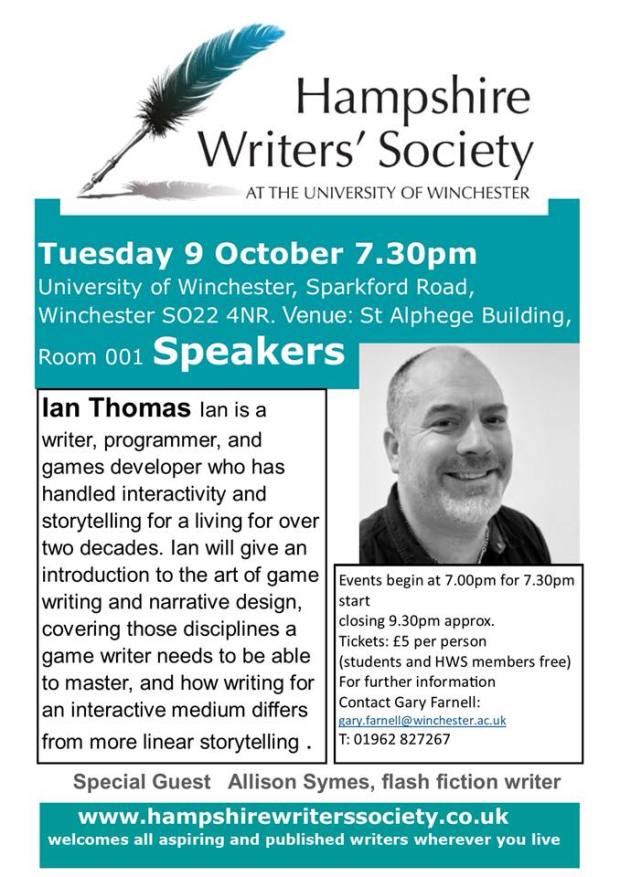
Delighted to say I will be a guest speaker at the Hampshire Writers’ Society meeting at the University of Winchester next Tuesday, 9th October. It will be nice to be back at Winchester again as I’m normally there for the Winchester Writers’ Festival and it is a long time until next June when it is on again!

I’ll be speaking about flash fiction (and why I think every writer should try it).

POSTER SHOWING ALLISON AS GUEST SPEAKER AT HWS OCTOBER 2018

Poster kindly supplied by Maggie Farran from the Hampshire Writers’ Society.

Facebook – From Light to Dark and Back Again

A flash fiction story needs to create its own world whether it is in six words, 25, 100, or 500+. Your character needs to “dominate” that world in the short space of time you have to show the story to the reader.

I think this is one reason why I use a lot of first person for flash as I can get straight into the character’s thoughts and attitudes and get the story off to a cracking start. Well, I hope it proves to be a cracking start anyway!

I usually find if I can get get off to a good beginning, then the rest of the story follows nicely. Again, this is where first person helps as I find I want to explore that character’s thoughts and plans as I write their story. It’s a question of writing it all down and then cutting out what isn’t needed. I find there is always material to be cut out but also feel this is a good thing. I think you’re in real trouble if you find you have to add. Also, if lucky, some of the material you cut you may be able to recycle for other stories.

Flash fiction makes a great writing exercise, even if you don’t want to be published in it.

Firstly, the discipline of sticking to a word count is useful.

Secondly, when free writing to “warm up” why not turn the results of that into a flash fiction story? (I would go on to polish the story and see about submitting it somewhere).

The word count aspect comes in useful again because having a warm up exercise to take you to 500 words, say, means you then have to get on with whatever your main writing work is. The advantage of course is you then have a short piece you could submit somewhere if you wanted to.

This slideshow requires JavaScript.

What is the most difficult challenge when it comes to writing flash fiction? Funnily enough, I find it isn’t the word count.

For me, it is, having chosen what impact I want the story to make on readers, deciding whether that impact is strong enough or do I need to beef it up further? Very difficult to judge that.

This is where things like reading at Prose Open Mic nights can be helpful. You literally hear the feedback as you hear your audience’s response to your story. Nervewracking and exhilarating all at the same time. Given this isn’t always possible, the next best thing is to put the story aside for a while and then come back to it and read it out loud so you can hear how it sounds. (Recording it and playing it back is even better).

Many thanks to Geoff Parkes for the image of me reading at this year’s Swanwick Writers’ Summer School Prose Open Mic night. Good fun!


Word Play

Facebook – General – and Chandler’s Ford Today

One joy of writing is the joy of reading. This is partly because it makes sense to read from (and therefore support) the industry you want to join! Also, you need to read widely to discover the range of writing out there and to find out from that what it is you want to write. There’s also the sheer pleasure of reading well crafted stories that inspire you to work harder on your own!

Playing with Words, as my CFT post this week discusses, is both a fun and invaluable thing for writers to do.  My post this week also pays tribute to Denis Norden and celebrates puns and playing with language.


This slideshow requires JavaScript.

I like to “hit the ground running” when I write flash fiction and do so in a number of ways.

I can take you straight into the lead character’s thoughts, or show you an image of them doing or reacting to something. I also try to show you their general attitude within the first couple of lines. Attitude in itself can tell you so much about what a character is likely to be like (and whether you would like them or not!).

I can also show you a character’s observations such as in my Circle of Life. That opens with “People throw kittens in the river here. I hate that.” Immediately shows a conflict. Immediately shows an attitude at odds with the view held by others around the character. You also know they’re going to do something about it. It is a question of what and will they get away with it?

With all of these different kinds of opening, I am aiming to provoke curiosity in the reader to make them want to find out more.

My CFT post this week looks at Playing With Words. I also pay tribute to the late Denis Norden, who along with Frank Muir, was a wonderful wordsmith. Link up on Friday. I also take a look at puns. (Muir was wonderful on Call My Bluff years ago and Norden – well, I loved his dry wit and manner – and Take It From Here, written by them both, was a forerunner for modern radio comedy).

Two of my favourite ways to end a flash fiction story are a twist in the tale finish or a punchline. Both of course can revolve around puns. I love playing with language but one of the great joys of loving books is coming across others who are masters at this sort of thing. Their work is a joy to read and/or listen to and if you haven’t come across a copy of Muir and Norden’s My Word Ultimate Collection, do yourself a favour and dig out a copy from somewhere. If you like tall tales and puns, as I do, this is a fabulous book.

Facebook – From Light to Dark and Back Again

Flash fiction can be a great vehicle for (a) puns (as part of a punchline to finish with) and (b) short, sharp humorous moments. A good funny flash fiction will not only make you laugh but you should be able to spot other potential for humour had the story been a longer one.

The lovely thing is you can combine humour with other things such as poetic justice to create a great story. Characters being annoyed at the situation they’re in may well make you smile in recognition of their predicament. The situation is rarely funny for the characters themselves. Shouldn’t stop us smiling though!

My late mum always believed in being short and to the point. Think she’d be pleased I take the same approach by writing flash fiction!

You lose any fear of killing adverbs or cutting whatever isn’t necessary for your story when you write flash and, of course, you can carry that over into whatever other writing you do. There’s no chance of getting confused over your characters either given, realistically, you only have the room for 1, maybe 2, main people.

I admit I do miss the fact you can’t have subplots in flash fiction, that really is the privilege of a short story or a novel, but I do love being able to cut to the chase with the very short tale. Definitely a case of you pays your money, you take your choice here.

Time for some autumnal flash fiction one-liners, I think. Hope you enjoy.

1. There were some things brought down by the autumn winds that would have been best left undisturbed.

2. The mouse scoffed the loaf that was meant for the church’s Harvest Festival display, much to the vicar’s chagrin.

(A case of For what we have received, we are truly grateful, I think!).

3. Would the leaves come down deeply enough to cover a body, she wondered?

4. With the nights drawing in, there was more scope for planning and executing the perfect crime.

5. It would be easy enough to do, he thought, given she always has soup at lunchtime on these cold days.

Hmm…. it looks like I’m in a criminal frame of mind this evening!


Is it harder to write longer fiction where you have to keep the readers enchanted enough with your writing to follow the story through to the end or more difficult to write short, sharp stories?

I wouldn’t like to judge on that one as both have their challenges and their joys. Both are vital for ensuring literature has a wide range of styles and lengths of story to suit all tastes.

One problem I face when editing flash fiction is ensuring I keep the important details in as it can be easy to cut far too much out to keep to a set word count and the story is the poorer for it. In those situations, I let the story go what is its natural length whether it’s 50 words or 500 or 1500!

The acid test for me is the editing is done when I cannot add to the story or take away from it. It is a question of not overegging the pudding or cutting back so harshly you have a limited story left. Anything that dilutes the impact of the story on a reader, and that can include harsh editing, is out.

This slideshow requires JavaScript.

Goodreads Author Programme – Blog – Playing with Language

One of the joys of reading across a wide range of genres, including non-fiction, is discovering the different ways authors play with language.

For me the late Denis Norden and Frank Muir were great exponents of this and one of my favourite paperbacks is their My Word The Ultimate Collection. This is full of puns and tall tales galore! Bliss and an addictive read.

I like crisp, punchy styles of writing but every so often you come across a line or two that are just so engrossing, they almost take your breath away. P.G. Wodehouse was a master at creating worlds within what would be considered now very long sentences, but you simply have to read to the end.

I suppose the real test of a good story is does it provoke your curiosity enough so you read it through regardless of the style or genre in which it was written?

Fairytales with Bite – Fairytales A to Z Part 8

Since the alphabet doesn’t divide neatly into three, I will conclude this mini series tonight with the final five letters – V through to Z.  Hmm… going to have fun here I think!

V = Variation
Whatever genre you write in, there should be variation in the types of character you portray.  A story with all heroes is no story at all!  There has to be a villain somewhere (even if the characters concerned don’t think they’re villainous at all).  Also, in a magical setting, there should be variation in how much magical ability characters have.  If they all have unlimited powers, where is the conflict? You’d have a stalemate situation.  The characters know they can’t better each other, at least not with their powers.  So vary things, mix things up, deliberately drop your characters in it, and see what happens!  This is very much the fun side of writing.  You will soon find out who your strong characters are.

W = World
The world you set your stories in can almost be a character in itself.  It needs to be believable, no matter how fantastical its powers or setting.  There must be things about that world we can identify with here.  For example, every world has to be governed somehow so politics has to rear its (at times) very ugly head.

X = Xeno (meaning strange!  Confession time: did have to look it up.  I could have gone for X-rated for this but felt it was too obvious.  I also want to remember this word next time I play Scrabble!).
So word of the week for me is this one then!  Seriously, though, no matter how strange the world you’ve created is, there still has to be something about it that fascinates a reader.  If it is too odd, you risk alienating the reader.  Does that mean your world has to be a sensible one?  Not necessarily.  There has to be a point to what the world does.  If it mines balloons for example, it would make sense to do that if is that world’s chief export to its nearest neighbour.  I did like Monsters Inc for showing why the monsters had to get the children’s screams (they needed it as it was their power source) and I liked it even more when the monster world discovered making the children laugh was a greater source of power.

Y = You
The first fan of your writing should be you.  Your fairytale, whoever it is aimed at, must first convince you.  Is the magic a vital part of the story?  It should be for a fairytale. Do your characters have to get themselves out of trouble without magic?  Even better!  You should enjoy what you write and at the same time be open to where it can be improved.  Not an easy balance to strike which is why it is such a good idea to put work aside for a while and then re-read it.  You will come back to the story with a more open mind, having had the break from it.

Z = Zippy
There will be many in the UK especially who will remember Zippy as a character from children’s TV show, Rainbow!  However for this, I mean zippy in terms of lively.  Your fairytale should be a lively read from start to finish.  Your characters should be lively and engage with your reader.  (This is why if you enjoy your writing, there is every chance others will too.  As for the feeling after reading something you’ve written “this is rubbish”, bear in mind every writer goes through that.  This is another reason for putting work away for a while before coming back to it).

This slideshow requires JavaScript.

This World and Others – Playing with Words

Playing with Words is not just the title of my latest CFT post but the theme for this week for me.  I also take a look at this topic on my latest Goodreads blog.

So how do I like to play with words then?

1.   I like twist endings to a lot of my stories so there is a lot of playing with words to be had there in coming up with a twist that works.

2.    I sometimes end stories with a punchline which often revolves around a pun.  Puns are the very definition of playing with language!

3.     I like to take known phrases and play with them to come up with something that has “echoes” but which is also unique to my story.  For example, we usually talk about punishing the guilty for crime etc but my story in From Light to Dark and Back Again is deliberately called Punish the Innocent.  The idea is to get you wondering (a) why would someone want to punish the innocent, (b) do they do so, (c) were the innocent that guiltless after all?

I sometimes use spider diagrams to help me work out in which directions I could take a story idea and then I pick the one that I like the best.  Playing with words here helps me come up with thoughts deeper than my initial “obvious” ideas and therefore I hope a more original story line.


Music and Characters

Facebook – General

Loved listening to a wonderful hour of Dr Who music on Classic FM tonight. Each piece brought back many happy memories of wonderful editions of the show. I suppose that is one reason why I love music – it can be so evocative – and for films/TV etc, it can really help set the tone for what is to come.

With stories, of course, there is no background music usually! We have to set the mood through what we reveal about our characters in what they say, think, and do. But the great thing about being the writer of the stories is you get to make the characters dance to YOUR tune! The really fun bit is making that tune varied – no monotones here, thank you.

This slideshow requires JavaScript.

It was great fun earlier today taking part in #ValPenny‘s book launch for her second novel in the Edinburgh Crime Series, Hunter’s Revenge. Many thanks, Val!

The great thing about things like this is it makes you think about what you are reading and what you particularly enjoy.

The big thing for me with series novels is discovering how the characters change and develop from one book to another. Great fun. I also see it as getting more than one story for your money.

Not only is there the individual story of each book to follow, you get to see how your favourite (and least favourite) characters move on or not, as the case may be.

My overall favourite for character development is Terry Pratchett’s Sam Vimes. Compare him with how he appears in Guards, Guards to how he is in Raising Steam. Literally a character that comes a long way!

Good luck to Val and I hope everyone has a fabulous time with their reading and writing. It should be fun.


This slideshow requires JavaScript.

How often do you review where you are with your writing? I tend to do this at the end of each year. What I’m looking for here is where I’ve been published during the last 12 months and whether I’ve achieved something I’ve not done before. I also set myself a couple of goals that I’d like to achieve in the next 12 months.

With regard to my CFT posts, I tend to look back at my topics every time I write a new article. This is partly because I’m looking for links to go with the current post. Often one writing related topic will kick off ideas for others. I love that when this happens.

In fiction, what I really love is getting ideas for other characters from the characters in the story I’m currently writing. Say Character A acts in a certain way due to pressure being put on them, I come up with a Character B who faces different pressures but reacts differently.

I love the creative buzz you get. It is always a good sign when you are buzzing with ideas to write up at some point.

Other than people giving plot endings away, what is the one thing you loathe most which is writing connected? (I take loathing the giving the plot endings away thing as read by the way!).

I suppose mine is when someone believes short stories (including flash fiction) must be easier to write than a novel. What is forgotten here is, no matter the length of story, all tales have to be edited and polished well ahead of submitting them anywhere.

Sure, a novel is going to take longer. Of course it is but it doesn’t mean short stories (including flash fiction) are any less worthwhile. Far from it. And, of course, many novelists write shorter pieces too!

This slideshow requires JavaScript.

Facebook – From Light to Dark and Back Again

Managed to write some flash fiction on the way to and from an Association of Christian Writers Committee meeting today. I do love using train journeys for this! I find it liberating to be writing but away from my desk.

I drafted a nice mix too – one story was a very short piece, the other I think is going to come in at about 200 words, but both can be submitted somewhere later once I’ve had the chance to polish them.

Looking forward to giving a brief talk on flash fiction at the Hampshire Writers’ Society in October. Will post more details nearer the time.

I like story collections which offer a variety of moods of story. I see it as dipping into a “selection box” of story treats (and a lot less fattening than dipping into an actual selection box!). This is why I wanted From Light to Dark and Back Again to be like this and that mood selection inspired the title too.

As for flash fiction collections on single themes, I like those too. (Dawn Knox’s The Great War is a fabulous example of this). Don’t know if I’ll go that route myself but it’ll be posted here first if I do! It’s fantastic having so much choice with flash fiction.

I like being able to come up with different settings for my flash fiction stories. Though my rule here is one setting for one story and generally one character too. (Sometimes I’ll use two but if I’m keeping to the 100-word limit especially it is nearly always one character only and often I’m telling the story in the first person for a more immediate impact).

The great thing is the character or the setting can dictate the story genre being used. If I mention a character is a fairy godmother, well you’ve got the fantasy genre there in a nutshell. What images you have of what a fantasy world with fairy godmothers in it looks like will almost certainly differ from the images I conjure up here (pun intended!), but that’s good. We bring our differing experiences and thoughts when we read a story. How much more when we write them too!

I find it hard to say whether I prefer writing the lighter or darker stories in From Light to Dark and Back Again (and indeed the book I’m currently working on).

I love coming up with something humorous but with the darker pieces, I often feel there is more character development in those.

Certainly whenever I read darker flash fiction whether it is written by myself or others, I am always wondering what led to that character being like this and thinking about what their back story could have been. This is a good sign as it shows that character has really come to life in your imagination.

With humorous pieces, I am kind of working to the “punchline” though this must wrap the story up beautifully, make sense, and be funny.

Goodreads Author Blog – Read the Book First or Watch the Film?

When it comes to adaptations, do you read the original book first or watch the film and then decide to go and read the book?

I must admit I’ve done both. I read The Lord of the Rings before seeing the films. I read Oliver Twist after seeing Alec Guinness play Fagin on TV all those years ago. (Mesmerising performance in evil manipulation there!).

I must admit one thing I love about the Muppets’ version of A Christmas Carol is they plug reading the original book right at the end of the film. (And they’re right – you should read it!).

A good adaptation will bring a story to life and help draw people into reading the original book. A bad one will do the exact opposite!

So where DO you turn first – the book or the film? Why do you think you’ve chosen as you have?