Getting The Most Out Of Themes

This slideshow requires JavaScript.

Image Credits:-
All images from Pixabay/Pexels unless otherwise stated with many created in Book Brush. Book cover images from Chapeltown Books and Bridge House Publishing. Screenshots taken by me, Allison Symes, as was the photo of my two flash fiction collections taken at The Writers’ Summer School, Swanwick, taken back in August. That seems ages ago now!
Hope you have had a good week. Weather wet, wintry, and cold. In happier news, I celebrate my wedding anniversary and am glad to share the December issue of Writers’ Narrative, another cracking read for all writers. See below for more.

BookBrushImage-2023-12-8-19-1915

Facebook – General and Chandler’s Ford Today

Pleased to share Getting The Most Out of Themes for Chandler’s Ford Today this week. Themes, to me, are the foundation stones of any piece of writing, fiction or non-fiction. Why? Because they show me what the writer cares about.

Themes also drive character motivations. Love, as a theme, is a classic example here. What would your character be prepared to do for love (or not to paraphrase Meatloaf!)?

Motivations drive actions and reactions. Motivations are driven by the themes. Many a romance and/or crime story has come about due to the character acting and reacting to love.

Hope you enjoy the post.

Getting the Most out of Themes

This slideshow requires JavaScript.

Will be looking at Getting the Most Out of Themes for Chandler’s Ford Today this week. This topic will be of use to all writers as themes are a wonderful hook for non-fiction works too. Link up tomorrow. See above.

Had a fabulous time at a sci-fi/fantasy group run by the Association of Christian Writers last night. The verdict on the Doctor Who specials was overwhelmingly positive. Must admit I did feel a tad emotional on seeing Wilfred Mott as played by the much missed Bernard Cribbins in the last one.

Storylines matter (as the Doctor Who specials are proving). There has to be a solid foundation here. I see those foundations as made up of gripping characters, a situation they have to deal with (and you know they’ve got no choice but to deal with it), and a good outcome. Okay the outcome doesn’t necessarily have to be a happy one but it should be apt for the characters and situation.

A reader (or viewer) should be able to see that yes, this outcome was a logical one, even when the story is set in the most illogical universe you can imagine. For anyone to “buy” the universe you’ve created, they’ve got to see it works.

Think about the old fairytales. There is still an internal logic to them. This happens, that happens as a result, magic is used to help a worthy character who also does something to help themselves, happy ending (usually). The follow through happens, basically. Sets up a reader to want to read more.

Delighted to say the December issue of Writers’ Narrative is now out. I have two pieces in here this time. I talk about Finishing Strong in the Short Fiction Forms (page 28). My second piece on Page 35 is where I talk about the Association of Christian Writers: Flash Fiction Group as part of the regular feature Writing Group of the Month. It is a joy to share what the group has been up to!

For my main article, I look at why there must be a point of change in your story and why I consider it is vital to at least have a rough idea of where your tale is likely to end. This is to ensure your story does end strongly. You really do need to know the stop point.

Hope you enjoy a cracking read. The magazine is packed full of wonderful information and interviews, the perfect read for any writer.

Facebook – From Light to Dark and Back Again

Delighted to share Questions, a Christmas themed story for Friday Flash Fiction. See why Sam ended up with two cookies rather than just the one he’d hoped for.

In other news am thrilled to say my festive flash piece has been accepted by Hannah Kate for her Three Minute Santas show on North Manchester FM. More details to follow in due course but so pleased to achieve this again.
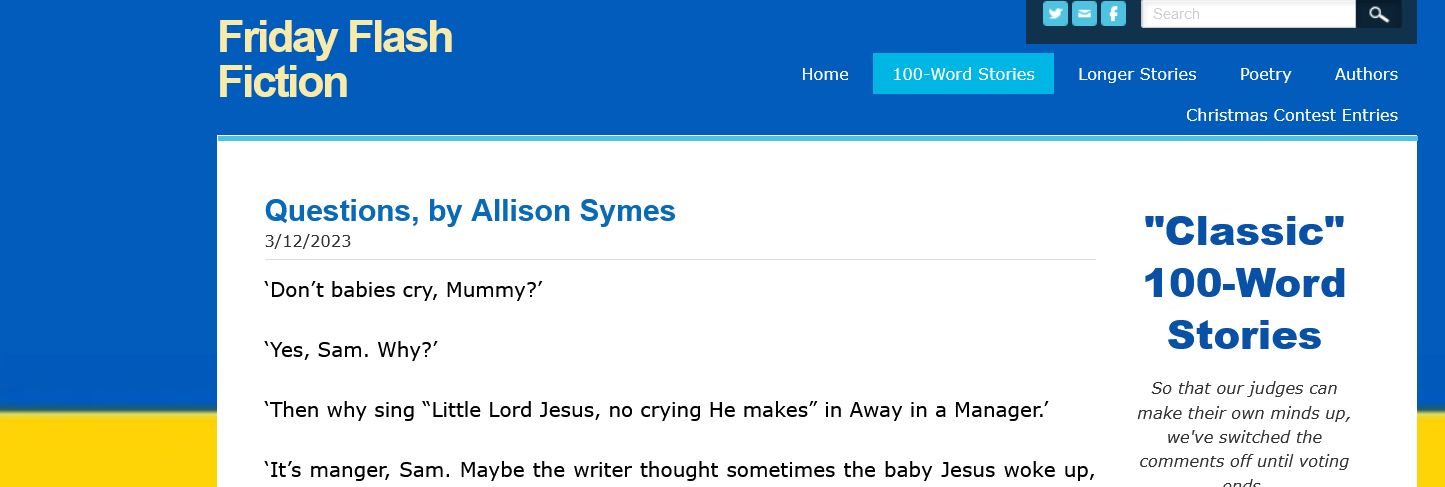
Screenshot 2023-12-08 at 16-57-06 Questions by Allison Symes

Let’s just say I shouldn’t have bothered drying my hair after my swim today. Lady and I got a soaking on our afternoon walk! On the plus side, it isn’t as cold as it has been. You win some… some only, mind you.

Another plus side to writing flash fiction is you can still get something usefully drafted in a small number of words. It will still be a complete story. What it will need later is editing and polishing but that applies whether you write 50, 500, or 50,000 words.

So if you are pushed for time (and who isn’t at this time of year?), consider drafting a flash story. They make great warm up writing exercises and there are competitions and markets out there for these tales. Could well prove useful in building up publication credits. I’ve found that to be the case.

I like to end my writing day knowing I’ve got this done, that done etc. Having a story drafted is satisfying in itself. I know I’ve got something to work with and I can come back to this later when I do have more time at my desk.

408984012_785023513637512_1875158668328506987_n

Hope you have a good day. Brrr… it has turned cold again though Lady didn’t notice as she got to play with her Rhodesian Ridgeback, Hungarian Vizler, and Labradoodle pals this morning. Very much a puppy party! All four dogs went home tired but happy.

If you’re looking for a present for anyone who loves short reads with more than a touch of humour, I will point the way to my debut book, From Light to Dark and Back Again, which is on offer on Amazon at the moment. See link below for more.

If you would like to buy signed books directly from me, please contact me via my website at https://allisonsymescollectedworks.com/contact

Contact

Fairytales with Bite – Baking in the Magical World

There are some renowned ingredients in the fairytale world, of course – suspiciously shiny red apples, the pea (though that got shoved under the Princess’s mattress rather than be used in actual cooking), and gingerbread! Plus there is bread, as dropped on the path by Hansel and Gretel, and the bean as in the giant’s beanstalk, not forgetting the good old pumpkin being readily available too.

The bread and gingerbread confirm baking has to take place to produce these things but what would be baked in your setting? Would the foods be roughly as we know them here or something completely different (to quote Monty Python!). Are Earth-style methods used for baking or is magic used for “mundane” things like cooking?

If you have magical foods, what are the qualities that make them magical? Can all characters in your setting eat them or are there some species for which doing so would have dodgy consequences? Is baking considered an art (it ought to be in my view!) or something those lower down the social scale do (not just for themselves but those above them in rank)?

For celebrations, special events, festivals etc., what special foods would be prepared? Who does the preparing? Can they be trusted? And again is magic used at all? Is food ever used as a weapon and, if so, how? Poisoning is just one way of doing so but if you have a setting where a certain food is not easily available and a neighbouring enemy setting has it in huge quantities, what stories could emerge from that?

BookBrushImage-2023-12-8-19-4650

This World and Others – Gatherings

I write this as the Christmas season rapidly approaches and naturally that is a time for people to get together. In your setting, what kind of events would have the same effect? Is your setting one where gatherings are strictly controlled and who does the controlling and why?

Where gatherings are permitted, are there rules governing this or does anything go? Is magic used at these gatherings? I always have loved Gandalf’s fireworks at the start of The Lord of the Rings though, given I am a dog owner, I would ask him, if I could, to produce for me the silent type. It’s the noise that worries the animals.

Are there gatherings which are state sanctioned/compulsory? What would be the consequences for someone not going? For other gatherings, do all of your characters enjoy these things? If there are some who don’t, why is this? How do they make themselves cope with the gatherings especially if society/family/friends expect them to turn up?

BookBrushImage-2023-12-8-19-525

WRITERS NARRATIVE SUBSCRIBER LINK

Screenshot 2023-12-05 at 21-13-46 The December Magazine isHereScreenshot 2023-12-05 at 21-21-05 Writers' Narrative eMagazine December 2023Screenshot 2023-12-05 at 21-21-20 Writers' Narrative eMagazine December 2023

AMAZON AUTHOR CENTRAL – ALLISON SYMES

This slideshow requires JavaScript.

Twitter Corner with hashtag, Scrabble tiles, and the blue bird

https://platform.twitter.com/widgets.js https://platform.twitter.com/widgets.js https://platform.twitter.com/widgets.js

Processing…
Success! You're on the list.

Creating Characters

Image Credit:  Pixabay/Pexels unless stated. Also a big thank you to Richard Hardie for the images supplied for my second CFT post which appeared over the weekend, more below.

Facebook – General – bonus Chandler’s Ford Today post

A busy week on CFT for me this time. My second post this week shares news from YA author, Richard Hardie, about his link with Doctor Who. All very exciting and a feather in the cap for Richard. Well done! Check out the post for more details.

Facebook – Association of Christian Writers

More Than Writers blog spot – Creating Characters

It’s my turn on More than Writers, the blog spot for the Association of Christian Writers.

I talk about Creating Characters and share hints and tips, including a list of questions that will help you outline your “people”.

Hope you find it useful. (And many thanks to those who have commented on this. Much appreciated).

A good TV or film adaptation of a book only works if the images shown roughly coincide with the images I had from reading the text. The Inspector Morse series did this, as did the Poirot and Miss Marple series (with David Suchet and Joan Hickson). Film wise, I thought Peter Jackson’s The Lord of the Rings had it spot on.

Are there any books you would like to see made into series or films? Which ones and why? Are there adaptations that haven’t worked for you? (I couldn’t get on with the Marple series. For me, Joan HIckson was perfect in the role and that was that).

When it comes to writing my stories, I put myself in my character’s shoes and see the world their way. I don’t always like my characters by the way! (Oh and a big thanks for a tremendous response to my ACW post on More Than Writers yesterday which was all about Creating Characters. Glad it was useful).

What I have found is you DO have to inhabit your character’s space so you can write about them/for them effectively.

This slideshow requires JavaScript.

One very tired Lady on the sofa tonight. Had a great big play with several pals, including her “boyfriend”, a lovely Collie gent, and her best pal, a Rhodesian Ridgeback. I should imagine they’re pretty shattered as well!

Enjolyed listening to the Movie Music Hall of Fame on Classic FM today. I was right about the top two and pleased about them too. Must remember to find out where the Pink Panther theme came in (and there’s an earworm for anyone of a certain age!).

I usually write with classical music on as I find it helps me relax and when I relax, I’m more productive with the writing. Other things I have to have on my desk are my dictionary, my Scrivener for Dummies guide, my publisher guides (Writers and Artists and Mslexia) and plenty of pens (I know! I’m using a laptop, what do I need pens for? I guess I just like to see them around!).

I don’t have any rituals before writing. I just open my laptop and get on with it but I do like to see the accoutrements on my desk. I suppose it’s a case of Allison going into her comfort zone sort of thing.

And now I am IN my comfort zone, time to get on with more writing then!


This slideshow requires JavaScript.

I can’t say a particular writer made me pick up my pen and start writing. I’ve loved books and stories for as long as I can recall. I loved writing stories in English lessons at school (and I’ll be talking a bit more about that in my Chandler’s Ford Today post this week).

But it took me a long time to figure out I really ought to get around and write seriously. It took two major life events to wake me up here! My only serious regret with writing is NOT starting a lot sooner than I did.

But it is wonderful to say that all of the writers whose books are on my shelves (and the electronic one too!) have added to my love of stories and storytelling. For that I will always be grateful. And then there’s the joy of discovering new writers too.

If I could invent things I would invent:-

1. Elastic time so I never run out of time to read or write.
2. Calorie free chocolate.
3. Calorie free prosecco.
4. A stamina “topper-upper” for those times you could really do with it!

This slideshow requires JavaScript.

Facebook – From Light to Dark and Back Again

I don’t know about you but I find it unsettling it is 8.30 pm in August in the UK and it is pitch black out there! (Not due to the weather either). The seasons are definitely shifting. Talk about going from light to dark!

I’ve mentioned before that one of my favourite writing exercises is writing to a set opening line. The ones that work best for me are the ones that can be taken in more than one direction. For example:-

1. The door remained locked despite her efforts.
2. He was on time, as the note insisted, but nobody was about.
3. The fairy godmother was on early shift.

Now all three opening lines here have comic as well as dramatic possibilities. (The door could remain locked because it took her a while to realise she was using the wrong key. He might be on time but what if he turned up at the wrong place and forgot to check? As for the fairy godmother, what could she expect to have to do on early shift that she might not face later on in the day? Definitely scope for humour there and that would almost certainly be the way I’d take these story ideas).

I find it useful to jot down initial ideas from an opening line and then go for the one that is a little way down my list. That is the idea which is not likely to be the obvious one and could well be open to my putting a twist on it, which I always love doing.

This slideshow requires JavaScript.

One of my favourite stories in my new book, Tripping the Flash Fantastic, involves a librarian and a snake. Can’t say more than that at the moment but it was great fun to write! By all means, let your mind boggle at the thought of that!

But then that is the fun of fiction. You can write in any genre, any time period, and the impossible isn’t so much in things like fantasy, magical realism etc.

Whatever you write, it is important to enjoy it. I mentioned to a friend and fellow author (the lovely #ValPenny) that you have to enjoy what you write, especially if it is a book, because you’ll be promoting said book for a long time.

You as the writer have got to be able to live with what you’ve written and enjoy living with it too! That’s an aspect to the writing life which isn’t often considered I think.

But commitment to what you write shows up here and not just in the hard work it needs to get those stories written in the first place.

Writing is good for you as it stretches you and develops your imagination. It is also good fun experimenting with different forms of writing and discovering where your strengths are. But even when you’ve found the style of writing that suits you best, writing should still keep pushing you.

Pushing you to keep on producing good work.

Pushing you to discover new markets/competitions for your work.

Pushing you to get better at editing your work and polishing it as well as you can to give it its best possible chance out there in the big, bad world.

Pushing you to develop new skills including but definitely not limited to reading your work to an audience, making the most of technology to produce items that can help you market your work more effectively, and so on.

What writing doesn’t do is allow you to rest on your laurels and that’s a great thing. Why? Because you want to keep on developing. The writing journey should be as much fun as possible. Different things come up along that journey, things you would not have expected when starting out, and by developing you will be ready to tackle those things and have more strings to add to your bow.

This slideshow requires JavaScript.

Am looking forward to taking part in the Zoom session with #GillJames and #DawnKentishKnox on 26th September. I hope to be reading a story or two, including one from Tripping the Flash Fantastic. You did hear it here first!

I will share the link to the event later in September. You do need to register but the event is free. I’ll also be flagging it up via Chandler’s Ford Today in due course.

Flash is great for reading aloud at events etc. It doesn’t take too long to read. It makes an immediate impact and the “deeper” stories resonate with you and linger long in the memory afterwards. Nothing to dislike there!

And I’ve said before it is a good idea to read your work out loud so you can hear how it flows, whether the dialogue etc comes across as smoothly as you’d like etc. If you trip over your words, a reader almost certainly will. Again with flash, this doesn’t take long. I’ve spotted things I’ve needed to change many a time doing this.

This slideshow requires JavaScript.

Goodreads Author Blog Book Dilemmas

What book dilemmas, I hear you ask?

Well, there is the obvious one of which book you are going to read next from your naturally huge TBR pile.

I refuse to believe that doesn’t give you pause for thought from time to time! (I get a little annoyed with myself for doing this. I realise the half hour I spent deciding what I’ll read next could have been spent on reading!).

Then there is the dilemma of whether you’ll reduce the TBR paperback pile or the one on your Kindle.

Then there is the dilemma of whether you’ll read short stories or another novel or non-fiction.

There is no one right answer to how you answer these.

I find I read a load of things on my Kindle for a while, then switch back to paperbacks for a bit, and that’s fine with me.

I just need to stop wasting half hours every now and again making up my mind and just get on with what matters – the reading!

This slideshow requires JavaScript.


Writing Prompts and Publication News

Image Credit

As ever, images are from the fantastic Pixabay, unless otherwise stated.

Facebook – General – and

Association of Christian Writers  – More Than Writers

My turn on the Association of Christian Writers’ blog spot, More Than Writers.

I’m on the 29th so that means I get every three Februaries off! 😆😆

Hope you enjoy the post and find it useful. Mixing up how you write stories is fun and keeps you on your toes too!

I talked about writing prompts in my monthly slot for the Association of Christian Writers today. As well as sharing some tips, I share a story I produced using one of the tips. Annoyed librarians may well like it… hmm… go on have a look then!😊

What I’ll add here is that I’ve found it useful to mix up how I approach writing a story. It keeps things interesting for me. It keeps me on my literary toes too.

By mixing up the methods, I avoid the dangers of becoming formulaic too. I don’t want any of my stories to sound the same to a reader after all. What I do want is someone to read my stories and spot my voice through them all, but to also enjoy each tale for its uniqueness. My characters are very different people after all. The way I tell their stories should reflect those differences too.


Facebook – General

Loved the finale to Doctor Who but that’s all I’m saying about that. It is nigh on impossible to say anything else without unwittingly revealing a spoiler so best not, I think. Give it a week and then I should be all right on that!

Well portrayed characters, for good or evil, will keep you glued, whether they’re on the page or on the screen. The challenge as a writer is to ensure the characters you create have that quality to keep a reader hooked. How do you make the readers care about what happens to your people?

Firstly, YOU’VE got to care what happens! Thankfully this happens rarely but I have come across instances where I’m bored with a character portrayal and I suspect the author became bored too.

Secondly, your character has got to have a problem that must be resolved somehow. It doesn’t necessarily have to be a life or death problem, though that is obviously a great one for winding up the tension in a tale, but the issue your character HAS to resolve must be something they can’t run away from. Their situation won’t improve until they DO do something etc.

Thirdly, your character mustn’t give up easily. When their initial attempt(s) to get out of their situation fail, how do they react? Do they learn from their failures? What gives them the break through to success?

This slideshow requires JavaScript.

Facebook – General and From Light to Dark and Back Again and Publication News

Story time again. Hope you enjoy. A little humour at the end of a busy Monday is never a bad thing!

Taking Time Out From the Day Job is my latest tale on Cafelit. (I’ve written flash fiction tales with fewer words than the title for this one in my time but there you go!). I have every sympathy for my lead in this one.

It’s lovely having one of my humorous fairytales with bite up on Cafelit.

Taking Time Out From the Day Job shows what happens when a fairy decides to do just that.

Hope you enjoy reading it. I loved writing it but then I do adore characters like this one.

It is a real contrast in mood from my recent linked stories on Cafelit but now you know why my collection is called From Light to Dark and Back Again. It sums up what I write!

Just to say that #ParagraphPlanet archive stories at the end of each month and the February 2020 “lot” are now available. See the link.My Time Is Everything is amongst the collection here. #flashfiction #amwriting #75wordstories

Is it easier to write to a specific word count or write the story first and then work out what the word count would suit it best?

Hmm… I’ve done both. The discipline of working to a specified word count is a great one and keeps you on your toes. It really does force you to check that each and every word has to be included in your tale. If there’s anything that doesn’t carry its weight, out it goes.

When I am working to a theme or title (often generated by random word generators), I write the story first. I see what I have, edit it, and then decide on whether it would work better at 100 words or 200, for example.

However you write, have fun!

This slideshow requires JavaScript.

Facebook – From Light to Dark and Back Again

Conflict in stories can take many forms of course but some of my favourite tales are the ones where a character is in conflict with themselves.

This is why I find Gollum from The Lord of the Rings an interesting character. You know you can’t trust him but I found on reading the tale for the first time, I desperately wanted him to somehow come good at the end. (And I’d say it’s open to interpretation whether he did or not. I am with Gandalf on this one when he says Gollum had his part to play in the history of the Ring and left it there).

In my story, Rewards, which is one of my longer flash tales, I use thoughts to show my lead character’s conflict. The reason this tale needed to be towards the upper end of the flash limit was because I needed some space to show those thoughts and then how my character acted on them.

But then that’s the joy of flash. You can go from the tiny tales in terms of word count to the longer ones but still have a limit you need to stick to. (I do find that a really good writing discipline. It’s why when I prepare my Chandler’s Ford Today posts I set my own word count and stick to it. I have to have parameters!).

The conflict a flash fiction writer has is deciding what word count will work best for their story. Sometimes you do have to go to the upper limit. Sometimes you can say all you need to in 100 words or less. Always think of the impact of the story on a reader. Don’t water it down by padding it out. If the conflict in the story is played out in 250 words, leave it there! But if you need 999, that’s fine too.

This slideshow requires JavaScript.

Symbols have a great deal of meaning of course. Can they be used in flash fiction?

Yes, as long as readers are likely to know the meaning of the symbol or can get to the meaning from context. As with any writing, clarity is the important thing here.

Could you come up with your own symbols for your characters?

Yes but it would be useful to base them on what we already know.

For example, red roses are associated with love but what could black roses be associated with?

This slideshow requires JavaScript.

Reviews are so important for any writer for a variety of reasons but the good news is they don’t have to be lengthy. One or two lines would be absolutely fine. A big thank you, while on topic, to all those who have been kind enough to review From Light to Dark and Back Again.

So if you’re looking for a way to support author friends, do review their books. The one caveat is reviews have to be honest for them to have any meaning. Honest reviews also aren’t usually at risk of being taken down!

https://www.amazon.co.uk/…/B07T…/ref=dp_byline_cont_ebooks_1


This slideshow requires JavaScript.

Goodreads Author Blog – Story Openings

What is it about a story opening that makes you want to read on?

For me, either the character has to be “hitting the ground running” in such a way, I’ve got to find out what happens to them, or the set up is intriguing enough to make me want to read on.

Mind you, I don’t think I’ll ever tire of the classic fairytale opening of “once upon a time”.

There is the wonderful association with happy childhood reading of those great stories. That opening just, for me, sets the tone for what is to follow.

I know to expect fairy godmothers turning up at surprisingly convenient moments. (I’ve always wondered why Cinderella didn’t berate hers for not coming to her aid a lot sooner but that’s another story).

I know to expect talking animals (and I should imagine the Three Bears had quite a bit to say about Goldilocks that was best kept off the page. I know how I’d feel if someone destroyed my chair and bed – though they’d be welcome to the porridge. I’ve never liked the stuff!).

I know to expect the villains to get their comeuppance. It’s just a question of finding out how and when.

And there is something wonderfully poetical about Charles Dickens’s opening to A Tale of Two Cities (which I confess I’ve not read but is on my To Be Read list), but even I love the sound of “It was the best of time, it was the worst of times” and the rest that follows. The rhythm of that opening paragraph is amazing.

So what I’m saying here is I want a story opening to take my breath away so I have to read on. Now there’s a challenge for any writer (including me!).

This slideshow requires JavaScript.


Looking Forward

Image Credit:  Unless stated otherwise, all images are from Pixabay.

Facebook – General

On days when I don’t have much time to write, I focus on drafting blog posts for future use and/or flash fiction stories. Ironically it can often feel like I’ve got far more done because I’ve written 3 or 4 posts and a couple of 100-word stories. But that’s fine. I don’t mind that at all.

What can feel tough is when you’re on a longer project and it feels like you haven’t got much done. Hang on in there. You have. You’ve written a chapter (fiction or non-fiction) for a book. You’ve drafted a longer story (say 2,500 words plus). You’ve edited a lot of work. You are achieving. It just doesn’t show up so well that’s all.


This slideshow requires JavaScript.

Loved Part 1 of the Doctor Who series finale, looking forward to Part 2 next week, and that’s all I’ll say there!

A good story makes you wonder, especially on your first read (or viewing come to that). The characters you’ve become attached to? Well, what WILL happen to them? I find I start trying to anticipate how the story will pan out. Sometimes I’m right but I love it even more when I’m wrong and the writer has wrongfooted me.

Of course flash fiction is a great vehicle for twist in the tale stories. The twist has to make sense – none of the “it was all a dream” nonsense, the last author who used that with any conviction WAS Lewis Carroll. This is why, for twist tales, I often know what the twist is first and then work backwards to get to several reasonable starts. I then pick the one I like best. Good fun that!


This slideshow requires JavaScript.

I can’t recall when books and writing were absent from my life. Nor do I wish to!

I do know they mean a great deal to me, even when the writing is a struggle or I’m not getting as much time as I’d like for them.

Incidentally with the former, it is usually just a question of being dog-tired (sorry, Lady!) and a good night’s sleep restores me and my imagination.

Don’t undervalue the importance of getting enough sleep. People focus on the health benefits of it but it is also true good sleep will help with your creative side. (At least you won’t have tiredness dragging it and you down).

A good writing day is when I head off to the Land of Nod happy with what I’ve written/edited/both and am anticipating another good writing session the next day.

A bad one is when I struggle to get anything down and am fighting to keep my eyes open. Time to give up and just get an early night. I’ve learned that lesson the hard way.

This slideshow requires JavaScript.

Looking forward to going to #TheChameleonTheatreGroup‘s Spring Quartet production in April aka the Chandler’s Ford Today works outing, given my lovely CFT editor will be there too. A good time will be had by all though, unlike with TCTG’s last production, there will be no cries of “It’s behind you!” to contend with – well, not unless something goes horribly wrong… 😆😆

More immediately, am looking forward to sharing this week’s Chandler’s Ford Today post which will be an interview with #PaulaReadman. Link up on Friday. Don’t miss it. Some fab insights as to what books and writing mean to her.

Many thanks to #DawnKentishKnox for the shout-out on her Knox Box of Miscellany. It is also a pleasure to highlight Prompts by #GillJames as well. It is a fab book and I’m looking forward to writing up many more of the story ideas.

So lots of looking forward going on tonight but given Lady and I got caught in a downpour earlier today, I think looking forward, especially to spring, is a very good idea indeed!

Prompts 2020 by [James, Gill] Image by Gill James

Facebook – From Light to Dark and Back Again

I tend to “hit the ground running” with my flash fiction stories. I want to get a reader into the story as quickly as possible (and of course out again at the end of the tale).

I mix up the way I do this as it keeps things interesting for me (and I hope for readers). I sometimes take a reader straight into my character’s thoughts. Sometimes I ask a question I hope will provoke curiosity – the must find out the answer type.

Sometimes I will start with a character action, again the type that will trigger the where will this go reaction (and there is only ever one answer to that – read on!).

I mix up using the first and third person for my stories (though I love the immediacy the first person gives you).

I also mix up my settings. My first love is the humorous fairytale with a sting in the tale but I adore writing crime and historical ones too. That is the thing I love most about flash fiction – its flexibility with setting. It is just the word count I have to watch – and even there I have choice. If something works better at 200 words than 100 so be it. It just go in for a 100-word (aka drabble) competition or market, that’s all.

This slideshow requires JavaScript.

What I like with character creation:-

1. The sheer joy of coming up with a fully rounded person you as writer can have fun telling what to do and dropping right in the mire when it suits you!

2. When the character comes alive and, for me, that moment is when I know how they’d react in ANY circumstance. I usually know things such as what kind of music they’d listen to and so on. When I started out writing, I used to find it a little unnerving to hear a piece of music and think oh yes, Character X would like that. Now, I see that as a good sign.

3. When the character makes you laugh, terrifies you etc., just as you want them to do to a reader. If there’s no reaction from you, their creator, there won’t be from a reader either.

4. The challenge of coming up with different characters. Their voices must be different. I don’t want to write “all the same person” any more than a reader would want to read that. So getting the variety in keeps me on my toes.

5. When someone tells you they really loved or disliked a character but that is the reaction which is meant to happen!

This slideshow requires JavaScript.

What I like about writing dialogue:-

1. When the dialogue flows, I know for certain I’ve got into the head of my character properly. It can feel almost as if I’m taking dictation from my characters but that’s a good sign.

2. I can get my characters to say things I’d love to say but wouldn’t dare! Now that’s got you wondering, hasn’t it? Best left there I think. Well, imagination is not fun if you give EVERYTHING away now, is it?

3. For my longer stories, I love getting two characters to spark off each other via their dialogue. My danger point there is to make sure everything is relevant to the story and I’m not just writing it because I love my characters and what they’re saying (though I do!). This is where the edit comes in and I do cut out anything that does not move the story on. I really do kill my darlings, darlings.

This slideshow requires JavaScript.

Further to my mini-series so far, what I like about writing in general:-

1. Writing is fun and can be amazingly therapeutic. It is not a cure-all, nor is it meant to be, I think, but just escaping into your created world for a bit I’ve found to be very helpful and relaxing. Sometimes just that is all you need, regardless of what happens to the piece of writing itself. Of course, if you submit it and it is published/wins a competition etc., even better!

2. It is a challenge to do but it stretches you and that, I think, is a good thing.

3. You will expand your knowledge. I’ve looked into all manners of topics for my Chandler’s Ford Today posts, but research comes into fiction writing too. (If you are also a quiz fan, this could be really useful for that too!).

4. You can try all sorts of writing to work out which one suits you best. Nor do you have to stick at one either.

5. The challenge to begin with is to see if you can create a story, then, for me at least, it was to try and be published, and since then to see if I can be published more often. That challenge continues. It combines with wanting to make your storytelling better as you learn from what you write as you go along too.

Whatever you write, enjoy!

Goodreads Author Blog – Sneaking In Reading Time

My main reading time is in bed but the snag with that, of course, is if you’re really tired, you’re going to be lucky to get to the end of a page before your head hits the pillow and the book drops to the floor!

Having said that, there is nothing to beat being nicely cosy and comfortable and settling down for a chapter or so before sleeping. (To my mind this is not the time to read Stephen King though, especially if you dislike clowns!).

So I’ve managed to find little pockets of time during the day when I can sneak in some extra reading time. Five minutes here, five minutes there, and it’s lovely.

At the moment I’m using these pockets of time to catch up with my magazine reading but that’s great. Reading is reading when all is said and done, whether you read magazines, books, graphic novels etc.

When I use the train, I tend to focus on writing. I will occasionally read but I do feel the need to be “doing” something so out comes the smartphone, Evernote, and my stylus and I either draft some flash fiction or blog posts like this one.

So how do you sneak in extra reading time? I realised long ago there is never enough time in the world to do all the reading you would like to do so it’s a question of compromise.

What must I read next? What must I read now? How can I break the book I’ve chosen into manageable reading chunks?

I am grateful for the time I have though and it is a question of trying to make the most of what you can do here. (Same applies for creative writing). Any thoughts and comments on how to sneak in even more reading time are welcomed!


This slideshow requires JavaScript.


New Year, New Book

Image Credit:  Unless otherwise stated, all images are from Pixabay.

Happy New Year to you all!

PUBLICATION NEWS

As you can imagine, I am thrilled to bits to start the New Year in such a positive way and look forward to bringing more news about Tripping the Flash Fantastic in due course.

Advance Notice

I am planning to change the name of my book page on Facebook from From Light to Dark and Back Again to something more flash fiction related nearer to when I know Tripping the Flash Fantastic will be out. That way the page can cover both books and I’ve been using this page mainly to discuss flash fiction anyway.

Facebook – General

One goal I have set myself this year is to try to prepare more posts in advance and schedule them to free up writing time for other things. I have done this before, mainly ahead of going on holiday, and it works well but I need to do this more often. (If I can do the same with Twitter as well, even better!).

I’m currently reading 500 Words You Should Know, which was a lovely gift from a friend who thinks I probably know most of them already. Hmm…. we’ll see. Incidentally I did pick up the word “soporific” from Beatrix Potter many, many moons ago. Reading is by far the most enjoyable way of improving your vocabulary.

I’m relishing being back in the writing saddle again properly now having submitted two short stories already and working away on several new flash fiction tales. What I love about writing is that buzz of creativity never loses its attraction! I always feel so much better within myself for having created something with words.

Loved Part 2 of Spyfall from Doctor Who tonight as well and that’s all I’m saying on this for now, given I know people who haven’t seen it yet! Very much looking forward to the rest of the series after such a cracking start.

Hope to be able to share publication news again soon (so I think I’m off to a cracking start for 2020 too, not that I mind this, far from it!). Again will share news as and when I can but really looking forward to being able to do so soon.

One of the writing prompts in my new diary is to write a New Year’s Eve party from the viewpoint of three different characters. Not sure I’ll do this one mainly because I simply don’t do New Year’s Eve parties so feel I wouldn’t write convincingly on same! I would rather stay at home and curl up with a good book (and I would have done so in my younger years too. Yes, I know. Boring it may seem to be but give me a good book and I can assure you the hours whizz by very nicely reading and that suits me just fine!).

This slideshow requires JavaScript.

Am thrilled to announce my second flash fiction collection, Tripping the Flash Fantastic, will be published by Chapeltown Books later this year. Will share more details as and when I have them.

What I love is that the buzz of being published never diminishes whether it is having a story online, or in an anthology, or you have another book out.

I only wish I could bottle the buzzy feeling for those times when writing feels like really hard work and you have to push yourself harder to keep going!


This slideshow requires JavaScript.

Many thanks, everyone, on your wonderful support at my publication news yesterday. It is very much appreciated. I look forward to sharing more news as and when I have it.

I am also delighted for friends who I know will also be published later this year – well done, all. I look forward to seeing your books come out too. I never mind adding to my To Be Read pile!

Now back to the nitty-gritty! The writing life can be compared to a rollercoaster. It really is full of ups and downs. Stamina is useful!

Incidentally, I’ve mentioned elsewhere that you have to play the long game in writing. You can’t know that what you write will be accepted or successful. You can only give it your best shot (and be prepared to edit, rewrite, edit etc). So writing for the joy of writing is vital in my view. It is what helps keep you going when nothing seems to be happening.

Seeds can take a long time to germinate. That’s even more true of the writing seeds you send out there. But it is lovely when the first shoots and then the blooms appear! And it is important to cherish the moment, especially as you can’t know when the next one will be. It is equally important to then move on and keep writing and sending work out.

So I’d better get on then!

This slideshow requires JavaScript.

Facebook – From Light to Dark and Back Again

Do you find when writing stories in batches one mood tends to dominate? In the last couple of days, I’ve written sinster and sadder but moving stories. I am hoping to lighten up a bit in the next few days!

What matters is being true to the characters you create. If their story is a sad one, so be it, but the character has to engage with a reader so they will want to find out what happens to said character.

I am very fond of stories where characters find a way of dealing with issues troubling them. I always thought it realistic that Frodo never did fully recover from all he went through in The Lord of the Rings. A happy ever after ending still has to be appropriate for the character. It wasn’t for Frodo, it was for Sam.


This slideshow requires JavaScript.

I hope to be able to share exciting publication news soon so, as they say, watch this space.

Meanwhile, I’m happily drafting plenty of flash fiction pieces I will submit as and when over the next couple of months or so. I am also currently sorting out my running order for a further flash fiction collection I hope to submit at some point though I know there will be further editing to do on that once I’ve done this. I find sorting out the running order helps clear my thoughts and makes editing easier to do. Note I said easier, not easy!

Running order matters to a collection. It can make a huge difference as to how well the stories flow into each other. Also when you specifically want a contrast in moods (as I did with FLTDBA) you want that contrast to stand out. I grouped my stories in FLTDBA specifically by mood and that worked well. I suspect for what I am currently working on, I will probably organise it by type of flash fiction (e.g. group the historical ones together, group the funny ones together etc).

This slideshow requires JavaScript.

As mentioned on my author page, I am delighted to say Tripping the Flash Fantastic, my second flash fiction collection, will be published by Chapeltown Books later this year. Will share further details as and when possible but naturally am thrilled about this. (I had the great joy of sending the signed contract back today. That’s a good job to have!).

Meanwhile there will be more flash stories from me on Cafelit later this month and in March. Naturally I hope to get some more on there throughout the year too.

You have to accept, I think, that you are playing the long game when you are writing and seeking publication. There are no guaranteed results for anyone. You do have to work hard on your writing and be prepared to edit and edit again etc but the joy of publication is truly a wonderful thing and never diminishes!


This slideshow requires JavaScript.

Many thanks for all the kind messages here and on Twitter re my publication news yesterday. All very much appreciated.

Whatever your writing projects are, I hope they are going well and that you are having the proverbial ball writing them.

Writing should be enjoyable. Yes, it can be a hard slog but there should be the joy of being creative in there too. I love it when I hit that moment when I know my characters have come to life for me. (If they do so for me, they will do for other readers).

There is something fantastic about storytelling, whether you read stories, write them, or do both. It is certainly worth celebrating!

Goodreads Author Blog – Happy New (Reading) Year!

Happy New Year!

I’m looking forward to discovering authors new to me this year and getting plenty of reading done. The TBR pile, unlike my ironing pile, is one where I’m not that sorry if it stays pretty much at its high level!

I’d like to read more non-fiction this year too and expand my range of subjects.

The biggest problem, of course, is time. I always mean to read more over the Christmas break and, yes, I did catch up a bit. However, I’m usually too tired to read for long so I never get as much done as I was hoping for.

Am trying to read more (particularly magazines) at lunch time and am enjoying that.

I’d also like to get back to more humorous reading and suspect it will soon be time to resume the works of P.G. Wodehouse and Terry Pratchett, both of whose books bring me much joy.

Whatever your reading plans are this year, I hope you have a fabulous time with them. I intend to!


Beginnings

Image Credit:  As ever, all images are from Pixabay unless otherwise stated. Think I’ve finally nailed the “have an appropriate title for the start of a New Year for your blog post” game!

Facebook – General – and Chandler’s Ford Today

Well, Beginnings is an appropriate topic for the start of 2020! I look at why beginnings are so important for any creative art (especially storytelling), share some of my favourite story openings, and discuss New Year’s Resolutions. Talking of which, Happy New Year!

As my CFT post on Beginnings mentions, I see the end of the old year as the time to take stock of where I am writing wise, so I am raring to go again as soon as possible writing wise after the festive season.

My initial goals are to continue to try to get more work in more anthologies and to develop professionally in other ways too. I hope to share more of the latter as I go throughout the year.

I am aiming to submit two of my big projects by the spring and see how I go with those. I’d like to finish another project by the end of the summer if possible and see if I can be submitting that by the autumn.

I’m also hoping to pitch more non-fiction articles too.

I don’t set specific dates ever because life can and does get in the way and no writer should feel bad about that. My deadlines are only set for my CFT posts and competitions and I work to those fine but it is lovely having longer projects to work on too. I like a good writing mix and am loving all of the writing I do. I hope that comes through in what I write.

So onwards then. Happy New Year and happy writing and reading!

This slideshow requires JavaScript.

Sent off my two short stories yesterday so that gets 2020 off to a promising beginning! I’m also working on some writing prompt exercises and those are proving to be good fun. Hope to resume my major projects over the weekend.

Appropriately my CFT post this week is on Beginnings. As well as sharing what I think of New Year Resolutions, I discuss why beginnings are so important to get right for any creative piece of work. I also share a couple of my favourite beginnings. Link up tomorrow as normal. I am SO grateful to CFT, especially this week. It means I know tomorrow is Friday!! (On weeks like this one, having a good writing routine helps so much!).

(Oh and the pictures of fireworks below, courtesy of Pixabay, are the only place I like to see such things. Lady agrees with me on that one).

This slideshow requires JavaScript.

Wow! Absolutely adored Doctor Who tonight (shown in the UK on New Year’s Day) and can’t wait to see Part 2. Cracking storyline and am intrigued to see how it pans out.

Getting off to a reasonably good start as I have two stories I’m planning to submit this week. I then have two competitions to prepare material for plus, at the weekend, I hope to get back to my longer projects.

Have been out and about with other half and Lady in the New Forest today. I hope all the exercise will prove to be refreshing to the imagination as well as much needed after the Christmas festivities! (Lady had a great time at the festivities and on the walks!).

This slideshow requires JavaScript.

Facebook – From Light to Dark and Back Again

Plans for 2020 include submitting to even more competitions (flash fiction and short stories). I am pleased I did enter more last year though nothing happened with the tales themselves. Still, that is material I can edit and resubmit elsewhere.

Little is wasted in writing especially if you can take a step back, analyse your story and be prepared to change things to make the tale stronger if it is needed.

Bear in mind sometimes a story not “making it” can be because the competition organisers/publishers have already chosen a story using the same theme you have. Sometimes, even when they want the same theme, someone else’s tale has just got a bit more bite to it which has clinched things for them. I’ve found it helps to see this as a challenge to me to “up my game”. That aspect of writing keeps me on my toes and I think that’s a good thing. Never take anything for granted!

Look at work that hasn’t been accepted in the cold light of day. Still can’t see any changes needed? Try submitting the story elsewhere. If you can get feedback on it, even better. And good luck with your writing plans for 2020.

I’m having fun at the moment coming up with linked stories based on the same character but set at different word lengths. Worth a go! (And a big thanks to #DawnKentishKnox for the tip). Will definitely be trying this again.

One huge advantage to writing prompts (which is where the above idea comes from) is they make you mix up how you approach writing a story. That keeps you on your toes, I’ve found it keeps writing interesting for me (and hopefully that comes through to a reader), and differing approaches can encourage you to try different styles. Well, you never know what you like here until you try it! I DO know you don’t want to get stuck in any kind of rut with your writing,

See Prompts by #GillJames on Amazon. Highly recommend.


Prompts 2020 by [James, Gill] Image by Gill James

Lovely afternoon walking in the New Forest with other half and Lady (New Year’s Day). Was eerie the way the mist suddenly appeared though. Of course the problem with having any kind of imagination at all is being able to visualise what kind of monsters that mist could be hiding!! Fortunately, only the New Forest ponies were company for us (and Lady looks at them curiously. We think she thinks they’re some kind of very big dog!).

Hope to get back to flash fiction writing shortly (though my immediate plans are to submit a couple of standard length short stories). I must admit the break has been great but the lovely thing about writing is I always look forward to getting back to it again.

Onwards and upwards! Or maybe for flash fiction that really should be onwards and downwards (with the word count!😀).

Fairytales With Bite – Starts

So many of the classic fairytale characters have awful starts to their stories but, of course, the real tale is in how they overcome those things (with or without the help of a fairy godmother).

This is why Hans Christen Andersen’s The Little Mermaid is such a revelation. It was the first fairytale/story I’d come across where there isn’t a classic happy ever after ending (well not for her anyway. Do check out the original tale and you’ll soon see why Disney couldn’t film it as true to the original. Well not and keep their All Ages certificate anyway!).

How do you start your stories off? I like to set up an intriguing situation and/or characters quickly (it usually is both together) and then I happily dump my characters in it. I have fun in finding out how my characters sink or swim and I hope if I have fun in writing that, readers will also have fun in discovering the same thing for themselves.

I nearly always have to chop the start of a story when I go back and edit it. It can be tricky to work out where a story should start but what matters is getting that draft down. Then you can see, after time away from the tale to give you some distance to be able to be objective, where the opening should be. But you do need to get  started on a tale and I’ve learned never to worry that an awful lot will be chopped later. That’s okay. It is a case of looking for the nugget of the story and ensuring that shines through. Anything not helping that nugget to shine gets cut.

Happy editing!

This World and Others – Celebrating

I hope you had a wonderful time celebrating Christmas and the New Year. When it comes to our fictional worlds, what kind of celebrations do they have? What is the history behind those celebrations? You almost certainly won’t put all of that into a story.

I’ve found it useful to work details like this out and then select those a reader needs to know. I’ve found working things out gives me the confidence to write the story and I think something of that confidence comes through. (It can also be useful to have this material to hand for use on your website as additional information for readers. I know I love reading material like that on favourite author websites. Little is wasted in writing. It is a question of finding an appropriate use for material at times!).

If your world does not celebrate anything, why is that? Was there a time when it did? What went wrong? There should be some interesting story thoughts there.


A New Year – New Goals?

Facebook – General

I don’t really start thinking in specific terms about what I’d like to achieve writing wise for a New Year until about now. I know what my general goals are and those don’t change much but at about this time I set myself some specifics and then work my way through them as the year goes on.

Some years I achieve them all, some years I don’t, but I feel as if I achieve more for having set some ideas down as to what I’d like to get done.

One specific thing I really do want to do next year is enter more writing competitions (flash, short stories, maybe novel but certainly the first two). I didn’t enter as many as I thought I might this year though I have been working away at other projects, one of which I’d like to also get out in 2019 if I can.

Whatever your projects are, whatever your writing goals are, the most important thing is to enjoy what you write and believe in it. If one market or competition does not work out for you, see if you can figure out why. If there is nothing obviously wrong, try with another market or competition that the piece or story would suit. Above all, don’t give up. Enjoying what you write helps a lot when the rejections come in – and they will.

This slideshow requires JavaScript.

The only problem I have between Christmas and New Year is working out which day of the week it is and I know I’m not the only one to lose track. Back to full writing routine from tonight though and it is great to be back.

Looking forward to using my new writing diary. Full of prompts and loads of places to jot down ideas (including a monthly To Do/Goals page and at the end of the month an Achievements page. The trick here is to try to get both pages equally full I think! A blank achievements page could be depressing! However I plan to use this to help me try and achieve a plan to enter more writing competitions this year).

Under the picture prompts, there is space to jot down notes for story ideas. I’m going to use those to flesh out some flash fiction!

Big plan is to have the novel ready to start submitting again (I hope around Easter time). So lots to do and I start by preparing material for a guest blog and my usual CFT spot. More details on both to come.

Good luck with your writing plans and have fun with them!

Happy New Year, everyone. Good luck with all writing endeavours.

Never be afraid to check out the credentials of publishing services companies/publishers/agents etc as the genuine ones will (a) not mind you doing this as it shows you are taking things seriously and (b) will be able to answer queries well and thoroughly. Also don’t forget you can seek advice from the Society of Authors/Alliance of Independent Authors and their websites are always worth checking out.

Have fun with your writing, try out competitions, write what you would want to read, and read loads! (Magazines, novels, short stories, flash fiction, non-fiction – it all “counts”).

I’ve got a couple of projects planned for the next year including submitting my revamped novel, a third flash fiction volume, and I’d love to do more non-fiction too. Don’t know whether I’ll get this all done but it will be fun finding out – and I guess that’s the point!

Loved the Doctor Who special tonight. Can’t keep a good enemy down, that’s all I’m saying.

The whole point of any story is conflict resolution though that can cover anything and everything from exterminating someone to being reconciled with them. What matters is the conflict is over. The story has concluded.

But while the conflict is going on, it is true that the hero/heroine and villain must be worthy of each other. No hero/heroine gets to win “easily” – there must be huge hurdles to overcome. The villain needs then to be capable of stretching your heroes to their utmost (and beyond ideally, making said heroes stretch too. Drop your characters right in it and see what they can do).

This slideshow requires JavaScript.

Facebook – From Light to Dark and Back Again

Had a great trip on the Watercress Line (steam railway) yesterday with family. Always think of the stories of the navvies who cut out the sidings etc to make our railways. So many stories we won’t know but can only make educated guesses at.

When it comes to our own stories, what is most important to your characters? Who are the characters who you MUST tell stories about and why? Think about what has made you choose these people and play to their strengths and weaknesses. A well portrayed character has plenty of virtues and failings and both will affect the direction of the story.

It’s a good idea to mix up how you source ideas for stories. I like to use proverbs, well known sayings, songs can be an inspiration too and this year I hope to use more picture prompts. (My new writing diary has loads of these in it and I plan to get several flash fiction pieces from these!).

It’s also nice from the writer’s viewpoint to mix up how you gather the ideas/raw material to get you on you way to generating a new story. It keeps things interesting for you and you on your toes, which is never a bad thing. One of the things I adore about flash fiction is it is always a challenge to write small but doing so is very satisfying. (Even more so if the story is published!).

One thing I would like to try and do more of is use more of my own photos to trigger ideas and to take pictures specifically with story generation in mind. The great thing with using your phone for pictures is it is so easy to delete the ones that don’t work out. Sometimes you need to do that with a story too but that is much harder to make yourself do.

I try and avoid getting into that position by outlining first (it really does help). The great thing with outlining is it can be as detailed or not as you like. I’ve sometimes drafted a one-line outline for a piece of flash fiction but it has helped me work out which route to take with the story before I start it. I find I then write more efficiently too.

What are your hopes and plans for your flash fiction writing in 2019?

Mine are to submit pieces online and for competitions more regularly. I also hope to post more on my website – allisonsymescollectedworks.wordpress.com – as well.

I’m working on a third volume of flash stories as well and hope to get this up together and ready for submission.

I really enjoyed taking part in Open Prose Nights for the first time this year and would love to do more of those. I would also like to give more talks on flash fiction as well.

But I should finish the year’s posts with a flash fiction piece I think.

CROSSING TIME
‘I suppose you think that was clever’, the girl said.
‘Of course, why do it otherwise?’ I replied.
‘You can’t hold me back. It doesn’t matter what you do.’
‘There’s not a human born who doesn’t long to, you know. I had the courage to try.’
‘Or the foolishness! Most of you accept you cannot beat me. You even celebrate me once a year.’
‘Yes, it’s all lights and fireworks and parties, but you are a cruel devil and I will beat you.’
The girl laughed. ‘How? You’re not immortal. You can’t win a fight with Time. I should know. I also know how long you have. I can see your sands running through’.
Out of nowhere she produced an hour glass and sure enough the sand was running through but I didn’t care. I didn’t bother looking. I didn’t want to know. It wasn’t the object of the exercise. I wanted to defy Time and I had.
‘I can keep you at bay with this time piece, and keep doing so until it is time for me to go. I like my current age. I will stay this way. That will do.’
I waved the pocket watch in the girl’s face as if daring her to take it but she waved it away from me. The watch’s hands were going backwards. I set them to a week ago last Friday. I wanted to see if I could do it the way the saleman in that strange little shop insisted I could.
And sure enough here I was back where I had been last Friday. Just outside the chip shop, cursing myself for forgetting my coat on what was the coldest night of the year so far. What I hadn’t expected was this wraith like girl turning up to berate me.
‘There is always a price to pay for crossing Time,’ the girl said, sighing. ‘I will catch you in the end. Your time will come. And trust me I will make you know it when it does. I don’t like cheats. I never have.’
‘So be it but my “time’s up” will be at the age I choose.’
‘And how are you going to explain that to people? Tell them you’ve got a funny portrait in your attic?’
I grimaced. I must admit that thought had not occurred to me. But so what? I could always tell people I had found a really good moisturiser!
The girl vanished. I went and got my chips. I was just crossing the road, munching them happily, when a Mini came out of nowhere and sent me crashing across to the other side. The last thing I remember was seeing the girl reappear and she was laughing.
I got one thing right. Time IS a cruel devil.

Allison Symes – 31st December 2018

One nice aspect to flash fiction is if you use a writing exercise to help you start off your creative work for the day, then there is nothing to stop you revisiting what you come up with for that and see if you can turn it into a flash fiction story.

From that writing exercise can come an entry for a competition, a published flash tale etc. Give it a go if you try these writing exercises (which often get you to write a couple of hundred words or so. Perfect length for a lot of the flash fiction categories. You can always edit to get a piece down to 75 words or less or keep the piece as it is and look for the 200, 250, 300 word category competitions and markets).

Good luck!

Goodreads Author Blog – And Happy New Year!

Following on from my Merry Christmas post last week, I could hardly call this one anything else!

So with a New Year in mind, what are your reading and/or writing plans for 2019?

I would like to read more flash and short story collections in the next 12 months plus get my own third anthology of stories finished and ready to submit. (Still very much at first draft stage).

I would like to catch up on my To Be Read pile (but I suspect that is an ambition most of us have!). I would like to submit more non-fiction pieces too.

I don’t tend to take up reading challenges because I think I would feel so disappointed in myself if I don’t manage them. However, I would like to widen my variety of reading (which is reasonably wide as it is but I am conscious there are many genres I haven’t tried and I ought to explore. The world of books is meant to be explored!).

Whatever your plans here, good luck! Happy New (reading) Year!


All About Time

Facebook – General – and Chandler’s Ford Today

My latest CFT post looks at time management (and oh I would love to be better at that!) and at time travel. Naturally a certain Doctor makes an appearance in the post and I also look at if time travel were to become possible, where would you go and why? What would you do while there? Comments as ever welcome on the CFT page.

This slideshow requires JavaScript.

I discuss the art of time management and time travel in this week’s CFT post. (I suppose thinking about it further, you could say one of the earliest forms of time management in the UK was when the railways standardised time for us all).

On the assumption time travel ever becomes possible (and I’m not counting the gags that say something like travelling on XXX railway makes you feel as if you’ve gone back to the 1860s!), where would go and why?

Thinking heads on. Link goes up tomorrow. Comments welcome in the CFT comments box when post goes live. (If you’re really keen it goes live at just after midnight but you may have to wait to get a reply from me! Unlike Cinderella, I know where I’m going to be at midnight and it won’t be at my keyboard… ah the joys of middle age!).

One good thing about the dark nights coming in earlier is it does encourage reading and writing!

I don’t need much of an excuse to curl up with a good book or get on with various writing projects as it is but the lighter evenings during the summer months can make me feel a bit guilty about not getting more gardening done etc. Note the “a bit”. Easy enough to squash so I can get on with reading and writing! I just wish I could stop feeling the slightly guilty feeling at all!

I often prefer lighter reading and writing during the darker months too. Contrast in mood perhaps? Whatever, it’s definitely time to get on with some writing once again!

Facebook – From Light to Dark and Back Again

I often use lightning flashes in my photos for posts like this, given I think they reflect accurately how a flash fiction story illuminates and impacts on the reader. Very briefly and then over, but you don’t forget the impact.

A short story (say 1500 words+) to me is like shining a torch around – more light for a greater period of time but the impact can be diluted.

Sometimes you want that – you want the story as a whole to impact on your reader and you can only know if it‘s done that by reading and re-reading the whole thing.

The novel is like having a great big light on constantly. When you switch it off (stop reading it), that’s when you think about the impact it has made on you. Or that is how it has always seemed to be to me. I didn’t really appreciate the greatness of The Lord of the Rings until I’d finished reading it. You then take a mental step back and realise the huge scale of the trilogy.

Flash fiction makes you focus on the little details but the great thing with that is you can take this and use it to sharpen your longer works of fiction. No dull bits ever, thank you! The sections that are necessary to link the action should still carry the reader with them. The reader should be as keen to read those sections as they are the main scenes. Flash makes you tighten up your writing and this is enormously useful for ensuring your longer stories flow as they should.

This slideshow requires JavaScript.

Time is the theme of my CFT post this week (time management and time travel. If the latter ever becomes possible, you will have to be really good at the former to make said travelling work well for you!). I’ve used time as a theme for a few of my flash fiction pieces – Telling the Time (there’s a clue somewhere here!) and Time Waits for No Man (likewise!).

My main use of time though for flash fiction is deciding on when I’m setting the story. Am I going to tell it as it “happens” to the character or will I get the character to look back on an event? I use both regularly and usually it is clear which would work better. So much depends on the character A reflective type would be best suited to looking back at something that had happened (which I do in They Don’t Understand). An active “go get them” kind would probably be better off telling the story AS it happens, implying the passing of time as we go through the events with them.

What do I look for in an opening line for flash fiction? I don’t necessarily need to know who the lead character is funnily enough, but I DO need to know the setting, the attitude of the narrator (especially if this is a first person piece), and some indication of what the problem is. That problem and how it is overcome IS the story of course.

Something about the narrator/lead character has got to intrigue me enough to make me want to read on. A great piece of flash fiction will make you ponder whether YOU would have acted in the same way as the character you’ve just read about!

Fairytales with Bite – Favourite Times

What are your characters’ favourite times? Curling up with a good book? Lazing in the bath? Going for a good walk with the dog?

Use questions like this to help you establish your character. The answers may not appear in your story but knowing something about the character before you start writing about them will be enormously helpful. You don’t need to know each and every little detail. What you want is enough information that you can write clearly for them, knowing how they would react to a situation and why. The reader will pick up on the fact you really do know your character (even if they do this subconciously, in many ways it is better if they do pick up on this that way) and the writing will flow better as a result.

Of course, working out what your characters’ favourite times will tell you so much about them. Do they curl up with a good book because they can’t face what is their real life? Why can’t they face it? Dig deep. Maybe you will surprise yourself with what your characters show you about themselves. Use that.

This World and Others – Time

My Chandler’s Ford Today post this week talks about time management and time travel.  Guess which one I want to get better at!  Joking aside, this led me to think about how we use time in stories.

A lot of my flash fiction stories are set within a very short time period (appropriately) and are written in the first person, precisely because I want to achieve a sense of “immediacy”.  For other pieces I have the lead character looking back at their lives and being reflective so the time within stories like that is longer, “stretched” if you like, and the pace of the story is slower.  What grabs you with those kinds of tale is the character – something about them intrigues you enough to make you want to find out more.

Time in itself can make a useful theme for stories (too little of it, too much of it etc) but I’ve found it helpful to think about the kind of story I want to tell and then work out what the best time frame for that tale would be.  In my Pressing the Flesh the opening line is “It was 3 am”.  The impact of that is to make you wonder (a) why the time is important and (b) to assume the character concerned is unlikely to be up to any good at that time of night.  (Quite right too – see my From Light to Dark and Back Again for the whole story!).


Fears, Flash Fiction, and Keeping It Simple

Facebook – General

Pleased to say a new flash fiction story of mine is now up on Cafelit. Story below but am sharing the link to Cafelit too.  Do explore the wide range of stories on there. Hope you enjoy Jack of All Trades.

This is influenced by an old Bob Newhart sketch (where a new employee has to report to his boss that King Kong is climbing up the side of the Empire State Building! Newhart is fab – I have a CD of his very best material including The Driving Instructor and highly recommend him).

Jack of All Trades by Allison Symes

chocolate milkshake

Nothing was said about this in the manual. Jack blinked. He hadn’t been mistaken. The purple dinosaur was there and it didn’t look happy. Still, Jack knew he had to report these things so he tapped his supervisor’s number out on his mobile.

It took several minutes for Jack to stop repeating his description of the beast and longer still for the supervisor to stop swearing. The purple dinosaur was munching its way through what had been the supermarket.

At least demolishing the contents of the butcher’s counter was keeping the creature occupied and its attention away from Jack. He felt this was good news. Jack’s supervisor felt differently – his cousin was the butcher at that supermarket. It was made clear Jack was disposable.

Jack hung up. If he didn’t resolve this, he’d be eaten or, if he survived, sacked. If he did resolve it, the supervisor wouldn’t mind having the call cut off.

He saw the dinosaur had finished the meat. The next aisle contained the veg.

It won’t want that, Jack thought. I never do. Still, if a creature comes through from the next world, it can jolly well go back there again and at speed. We don’t want his sort here.

‘Come here, boy,’ Jack did a quick check, ‘sorry, girl. This world is no place for you.’

Jack took a flare out from his tool belt and fired it above the dinosaur. It roared and ran back through the gaping hole in dimensions its body had blocked from Jack’s view.

Jack sighed. He’d have to fix that too.

About the author

Allison Symes is published by Chapeltown Books, Cafe Lit, and Bridge House Publishing amongst others.  She is a member of the Society of Authors and Association of Christian Writers.  Her website is www.allisonsymescollectedworks.wordpress.com and she blogs for Chandler’s Ford Today – http://chandlersfordtoday.co.uk/author/allison-symes/

Am enjoying Doctor Who though admittedly tonight’s episode was not for the arachnophobes amongst us. Scary though, as DW is meant to be. I always did sympathise with Ron Weasley in Harry Potter and the Chamber of Secrets over his reaction to the giant spiders in that.

Character fears can be a good area to explore to:-

a. Find out whether or not they overcome them
b. How the fears developed
c. What happens when forced to face up to them.

Fears can be the making of a character if, to use the modern phrase, “they feel the fear and do it anyway”. There have got to be some great stories there!

This slideshow requires JavaScript.

Facebook – General – and More than Writers, ACW blog

Time for my monthly spot on More Than Writers, the Association of Christian Writers’ blog. This time, I look at KISS and why Keeping It Simple really isn’t a stupid thing to do.

The irony is that effortless reading (which is a joy) has almost certainly been subject to many an edit to get it to that point. Writing directly can be harder than you think. Fighting the urge to embellish what doesn’t need it is an ongoing thing.

Anyway, hope you enjoy.

Keeping It Simple Is Definitely Not Stupid

I’m not fond of the acronym, KISS (Keep It Simple, Stupid), as there’s nothing stupid about “direct” writing. Keeping it simple is much harder to do than whoever invented that acronym supposed. I guess it is meant to imply the other person IS stupid for not keeping it simple but the reality is you have to edit hard to get your prose to the state where it reads as if it has been written effortlessly.

In my honest opinion, keeping your writing simple is never a stupid thing to do.  Pixabay image.

You then repeat the process until you reach the point where you cannot improve the work. Sometimes you reach the point of being heartily sick of it but that’s another story.  It shows it’s time to take a break and come back to it later and look at it again with a fresh perspective.  The distance away from it does help.

Some editing is definitely needed here!  Pixabay image!

I learned a long time ago when someone makes something look easy, whether it is writing or any other creative art, you can bet that same someone has worked their socks off for years, perfecting their craft, to achieve this.  (And, as they say, other hosiery items are available!).

Just how much hard work has gone into getting to this stage?  Pixabay image

I start my editing of a story or a blog post by looking for what I know are my wasted words – “very”, “actually” and “that”.  The first two contribute little to a piece, you do need “that” sometimes but not nearly as often as you might think, and I have found by focusing on removing these words first, I enter straight into “editor mode”.  It is easier when in that mindset to cut what has to be cut.  (I can justify the “that” there!).

I overwrite, which I used to hate, but now I accept it is part of how I write and there is little a good edit or several can’t fix!  Rarely have I written a piece where I’ve needed to “fill” and I hated it when I did.  It felt artificial and was one of those rare instances where I binned the whole idea (and that is needed sometimes if, no matter what you do, it isn’t working).

If an idea isn’t working, despite time away from it, binning it can be the right thing to do. Pixabay image.

The other good thing was this instance made me brainstorm for better ideas, which is what I should have done in the first place.  Lesson learned there.  I don’t mind effort, indeed I expect it as we all should with our work, but I loathe it when it seems to be wasted.  Still, I’m not planning on making that mistake again so I think some good has come out of it.

Also when editing, I look for how the sentences flow.  Do they read easily?  Do they convey the exact meaning I wanted?  Could I express things better?  (The answer to that one is nearly always yes).

No matter how fantastic your fictional world, it still pays to keep the writing simple.  Pixabay image.

Simple writing then is not lazy writing.  It is hard work but well worth the effort.  Simple writing pulls the reader in.  Look at Jesus’s parables.  Straightforward storytelling.  Not a wasted word.  No waffle.  Now there’s a challenge to us all!

Jesus’s stories are the work of the master storyteller.  Pixabay image.

My CFT post this week will be a review of The Chameleon Theatre Company’s latest production, Blackadder Goes Forth. Link up on Friday though I will say now that final scene of the last episode is incredibly moving and the way it was performed on stage was excellent.

Generally I find it is moments in books, TV shows etc that stand out (and in a really good series, say, helps recall the rest of the show. The chandelier scene in Only Fools and Horses is another classic here, as is Del Boy falling “through” the bar).

I suppose the challenge here for any writer is to ensure we put plenty of stand out moments in our stories!

Facebook – From Light to Dark and Back Again

The writer’s way is strewn with words
Chittering away like the birds.
The issue is how to edit
Would the dialogue really be said
Or does it seem not real somehow?
Does your piece make your reader go “wow”?
Is the tale all action, does it flow?
Is the pace fast enough or, eek, slow?
The advantage to writing flash fiction
Is it teaches writing with precision.

Allison Symes – 30th October 2018

To finish my alphabetical look at flash fiction (in particular attributes useful for writing it), I finish with Y and Z. Now there’s a challenge but at least I know it’s been coming!

Y = Young. Can be taken to mean having a mixture of character ages in your stories or what a character will do to defend their young. Interesting tales to be had from both of these. Also if you tend to write from the viewpoint of older characters, why not switch and see if you can write from the viewpoint of someone, say, 20 or 30 years younger? Mixing things up helps to keep your writing fresh and you will enjoy it far more.

Z = Zealous. Firstly, are your characters zealous enough for their cause to see it through no matter what? They should be. If not, is their cause strong enough? If it is, why isn’t the character engaging with it fully? Look again at what your character wants. Do they want this enough? Secondly, are you zealous about editing your work well, as well as enjoying the more obviously fun creative side of writing? You need both to get work out there and it makes sense then to relish both the writing and the editing.

Now at the tail end of the alphabet for my flash fiction listing.

V = Variation. As with any fiction, vary the pace of your flash fiction tales. There is room for reflective, thought provoking pieces, as well as the action story. Vary how you tell the tale – first person, second etc. Vary the settings. Above all have fun. The first person to enjoy your writing should be you.

W = Writing. What else? Write regularly. Write first, edit later. The lovely thing about flash fiction is you can use it as a warm up exercise ahead of major writing (e.g. a novel) but there’s nothing to stop you editing those exercises and getting them out into the flash fiction markets and competitions.

X = Xerox! I was determined not to use X-rated for this one but Xerox does have a serious point to it. The great joy of writing is inventing something you have created (albeit inspired by what you have read over time). Never ever xerox/copy another writer’s work. Create your own work always. That IS the whole point.

Will have a go at Y and Z tomorrow!

Getting nearer to the end of the alphabet with my flash fiction “requisites”.

S = Story. Has to be really. It is all about the story and that is dictated by the characters. Without memorable characters there is no story. A story is about conflict and resolution in most cases and the characters “carry that”.

T = Turning Point. In flash fiction you obviously reach this point quicker than in standard length short stories. Sometimes the turning point can be revealed in the last line (often via the classic twist in the tale ending). Sometimes you can start with it. In my George Changes His Mind, I start with “He refused to kill the dragon”. There’s the turning point immediately. It is clearly expected George SHOULD kill the beast. The story then hinges on finding out why he didn’t and what the outcome was.

U = Universe. Each flash fiction has to be its own complete universe. By the end of it, a reader should have a sense of your setting, been mesmerised by your character(s), and the conclusion to the tale should be appropriate to the story (and satisfactory as a result, even if the ending is not a happy one). The nice thing is your story universe can be set in a fantastic world or this one in amongst the mundane! Your call but we should be wanting to find out what happens in the world you show us.

This slideshow requires JavaScript.

Goodreads Author Programme – Blog – Music and Stories

As I’m typing this, I’m listening to a concert of John Williams’ music being broadcast on Classic FM. (I do love the Listen Again feature!).

Every piece of music conjures up memories of films (often Spielberg ones) and with those memories come stories. Stories of when I discovered the film, the story contained within the movie itself etc. Of course so many movies are based on novels too.

So do you find a certain piece of music always conjures up stories for you? I’ve only to hear the opening notes of the Harry Potter film to be whisked away to recalling the books and movies (loved both).

I sometimes use music as a guide to help me create characters for my own writing. Character X would love this, Y would love that, etc.

I also love stories set to music. Up the Junction by Squeeze is a wonderful example of this – and a great ballad in the old tradition too.

When reading I have to read in silence but music is fab for when I can’t just drop everything to pick up a book. I still have the stories and the memories of stories as I work on other matters and that has to be a good thing.


Objectives

Facebook – General

Looking forward to seeing the Chameleons’ production of Blackadder later this week. Should be a very good night out. The last episode of Blackadder Goes Forth is one of those sublime moments of writing where comedy meets tragedy and both are done superbly. Definitely not an easy thing to do.

Blackadder clearly had one objective in mind in Goes Forth – to get out of the war and go back home. Totally understandable.

What is your character’s overriding objective in your story? What will they do to achieve it? What gets in their way? In those three lines, you have a plot outline!

Pleased to have sent off some flash fiction stories last night. Plan to get more out later this week, there is one particular website I’m keen to try out, and finally want to get around to doing so!

One of the trickiest things to handle is time. (And yes I think Doctor Who showed that brilliantly in the Rosa Parks episode). How much time do you spend working on new stories and ideas? How much time do you spend marketing?

As with so much in life, there has to be a balance. I’ve found it helpful to look at the week as a whole. By the end of it, I want to have written some new material, be editing older work ready for submission, have my next CFT post up and ready to go, and have carried out at least some marketing. Okay life does not always go according to plan but whatever I’ve not quite done enough of writing wise in one week is what gets the focus of my attention during the following one. It does all balance out eventually.

Acronyms featured in this morning’s church service sermon and of course they’re a common feature in writing. KISS – Keep It Simple, Stupid is probably the best known one. Very much the antidote to “purple prose” – the days of the long descriptive passages are behind us!

I suspect that is due to everyone being used to films etc where you get into the action quickly but it is not a bad thing. I like descriptions in stories to be to the point and to feel as if they are a seamless part of the narrative and not a “bolt on”.

All parts of the story must feel to the reader as if they have to be there and the tale would fall down without them. If you’re not sure if something should be cut, ask yourself how your story works without that something in it and that should indicate quickly enough whether it is needed or not.

This slideshow requires JavaScript.

Had a fabulous time at the Writers’ Day run by the Association of Christian Writers today. The topic was on writing for children and YA but there was discussion on crossover fiction and contracts, all very useful stuff. From my viewpoint, it is lovely to meet some of the membership face to face given I usually only meet them via emails!

The importance of networking came out as well during the day and I lost my own fear of this when I realised it meant chatting naturally about books, what I’m writing and so on. I have no problem going on at length about that topic!

(Oh and a quick reminder: if you’re offered a publishing contract, always get it checked out. The Society of Authors and Alliance of Independent Authors are the places to go for that. Both I believe issue guides which are free to members. There’s a small fee charged to non-members. Never be afraid to ask).

This slideshow requires JavaScript.

Facebook – From Light to Dark and Back Again

A = Alliteration. Can be useful for titles in flash fiction (though I don’t use it much) but as with any story, it can grab the attention and help set the mood. Best not overused I think. You want each title to set the tone for what it is to come and a variety of methods for doing that is best. Keeps it fresh for you as the writer too.

B = Backstory. Not a lot of room for that in flash fiction! Best to hint at it through one or two vital details the reader has to know and leave it at that.

C = Character. The kingpin of fiction I think. Get the character right and the plot will come from them. Know your character inside and out – I find it useful to know their chief trait (and I piece together a mental picture of what they are like from there). Find the appropriate starting point for you but it is worth taking the time to know your character well before you start. Your writing will flow better because you write with that knowledge. It does come through in what you write.

There was talk at the ACW Writers’ Day today of how boundaries, far from restricting creativity, help it to flourish. This is SO true for flash fiction as well. The limited word count means you have to dig deeper to come up with those original ideas that make flash fiction stand out and have the most impact on a reader. It is worth the effort!

I usually know what impact I want a story of mine to have on a reader before I write it. This is to help me choose my words with precision. However, sometimes a story (more accurately the lead character) surprises me and the tale ends up being funnier, darker, sadder than I’d originally thought. This is no bad thing. It means the character has life and if they surprise me, they’ll surprise the reader too.

It may also indicate I hadn’t outlined enough but the great thing is ideas that come to you as you write a piece are not wasted. Jot them down, step back and take a look at where they can fit in. Are they better than your original thoughts? Do they add depth to your original thoughts?


Back to working my way through the alphabet again then…

D = Drama. Even the shortest flash fiction has to have some drama in it! But it is also true that serious drama doesn’t necessarily have to have lots of words to make it so! There is drama and anguish in Hemingway’s famous example of For Sale: One pair Baby Shoes. The drama should suit the story though (and be to the right length for that tale).

E = Editing. Every story needs this and I don’t think it should be something a writer dreads. I always feel a sensible amount of relief when I’ve drafted a story as it means I’ve then got something to work with. Editing improves a story and, as a result, increases its chances of success. Take your time over the process though.

F = Fun! Writing should be fun. You are creating something new for others to enjoy. The first person to enjoy said tale should be you!

So marching on then:-

G = Genre. One of my favourite things about flash fiction is because it has to be character led, due to the word count restrictions, you can set those characters anywhere. So, if you’ll pardon the pun here, you do have an open book when it comes to genre in the stories you write. Have fun with that, I do!

H = Humour. Can work well in flash fiction as you can end the story with what is effectively a punchline. Also when you have a very short funny piece, look at turning it into flash fiction. It can be an ideal vehicle for those pieces which would be spoiled if you added anything more (and this often goes for humorous pieces).

I = Imagination. True for any form of fiction, but I find with flash fiction I’m using my imaginative muscles far more. Why? Because I try not to come up with the obvious idea from a theme or title. I dig deep and see what else I can come up with, something that will make a greater impact on the reader.

Goodreads Author Programme – Blog –

After the End, What Next?

If you’ve enjoyed a really good book, what do you do when you finish it? Go on to read more books by the same author, or read more in the same genre, or do you go for something that is completely different in mood and style?

I have done all three of these (though obviously not at the same time!) and it very much depends on my mood at the end of the story. If I’ve loved a gory crime thriller, I may well want something humorous to show the lighter side of life, albeit a fictional one!

With short stories especially, I tend to read a few by the same author before moving on. With novels, if the book has really gripped me, I’ve got to check out what else the author has done, even if I decide I’ll come back to those later.

The important thing though is that whatever you read, you enjoy it so much, you keep on reading, no matter what author, genre, style etc you choose next. Happy reading!