

Image Credits:-
All images from Pixabay/Pexels unless otherwise stated. Book cover images from Chapeltown Books and Bridge House Publishing. Screenshots taken by me, Allison Symes.
With the awful news going on right now, I think it is more important than ever to appreciate all of the creative arts – and avoid those who would scam you as a result of your trying to follow your dreams here.

Facebook – General
Many thanks for the wonderful responses to my anti-scammers post yesterday. See below. And do bear in mind there are plenty of sharks who try to lure in the unwary writer too. Never be afraid to check things out and organisations such as The Society of Authors and Alliance of Independent Authors should be your first ports of call for advice. This is also another advantage to joining in with writing groups, whether these are online or in person, because writers share what they learn from one another and that includes warnings about which so-called “services” to avoid etc.
It’s also a good idea to regularly read the writing magazines too as you learn so much from these too and check out websites like Writer Beware! This is an American site but the principles of what they expose for rogue publishers etc applies the world over and you will at least know what to look out for.
It was only when I had been a writer for a while I realised how much there was I didn’t know and needed to know but recognising that and then doing something about it like joining writing groups etc is a good first step into being more savvy about the do’s and don’ts of the writing life. Don’t be conned!

I’ll be talking about Imagery In Fiction for Chandler’s Ford Today on Friday. I look at writers using words to “paint” images with and the importance of book covers. One way or another, imagery comes into fiction a lot, even if it is not always obvious.
Will be giving a talk soon on historical flash fiction soon – looking forward to that and, of course, next week, I’ll be heading off to Scotland once again. I’m at the Scottish Association of Writers Conference from 18th to 20th March and will be running a flash fiction workshop there. Plenty going on then and I will report back from Scotland for Chandler’s Ford Today in due course.
Oh and a word to the wise – I am getting emails in from those who say they have a proposal for me. I bet they have too – how to check my email address is a genuine one and use it for phishing at best. Stay well clear of these things, folks. I delete immediately and then clear my delete folder immediately too. Never click on the links they send you.
Not sure whether this one is targeted at me because I’m a writer or whether it’s a huge mailshot and they only need a few people to respond to make money (and that is what they’re after – your money). Hmm… maybe there’s a flash fiction story or several in which scammers like that get scammed themselves. Something to think about!


Where do my ideas for stories come from? All over the place which I know is not exactly helpful. The point though is to be open enough to recognise something as a potential idea. My ideas come from things I have read, fiction and non-fiction, and from triggers such as the random generators I often use. Also overheard snippets of conversation can be the starting point for a story.
But what matters is recognising what I call the “aha moment” when I come across something and think yes, I could do something with that. And the more you read, the bigger the pool you have to fish in for ideas of your own. We all build on what has gone before.
What we do is bring our unique take to an idea or a theme and make it our own. Prompt books are always useful too. What I find matters is finding a way in to writing a story. And you have to love reading stories to know that you yourself want to write them.

Fiction has a variety of purposes as I’m currently exploring in my In Fiction series for Chandler’s Ford Today. Escaping from worries via a variety of genres or exploring the human condition or confronting evil head on via what our characters go through is all fine.
What matters is that fiction is truthful. It has to be to have any meaning. And for fiction to be truthful, the characters have to be true to themselves, whether they’re the best hero of all time or the worst villain.
This is why I need to know the major trait for my characters before I write their stories up. I can look at how and why they’ve developed that trait (and this is so often a springboard for further story ideas).
Major traits can tell me so much about the characters in themselves. If my character’s major trait is they like a good laugh, I can look at what has driven that. Is their life sad and they want to escape sadness at any cost so put on a jolly persona to cover that up? Is it their way of being accepted by others and what drives the need for that acceptance?
Also, I can take things another way and show how their good laugh helps another character or causes problems. All sorts of story ideas can come from just knowing my Character A will do almost anything to have a good laugh. And that is just one example of how knowing a major trait can trigger ideas. For me, that’s more important than knowing what the character looks like.

Facebook – From Light to Dark and Back Again
In any story regardless of its length, there has to be conflict, character, and change – the three C’s! Without a character experiencing conflict, even if it is internal only, there is no story. There should be change. Did the character overcome or succumb to the conflict? Either way that is a change though one is obviously more positive than the other!
One of the lovely things about flash is I can have, as a story, a self-contained moment of change for my character which simply isn’t long enough to even be a short story yet is still insightful.
How your characters react to things tells you so much about them. How you react to the character’s reaction may well shed insights about yourself – fiction can be illuminating like that. Flash does it more intensively than any other form though so be warned!
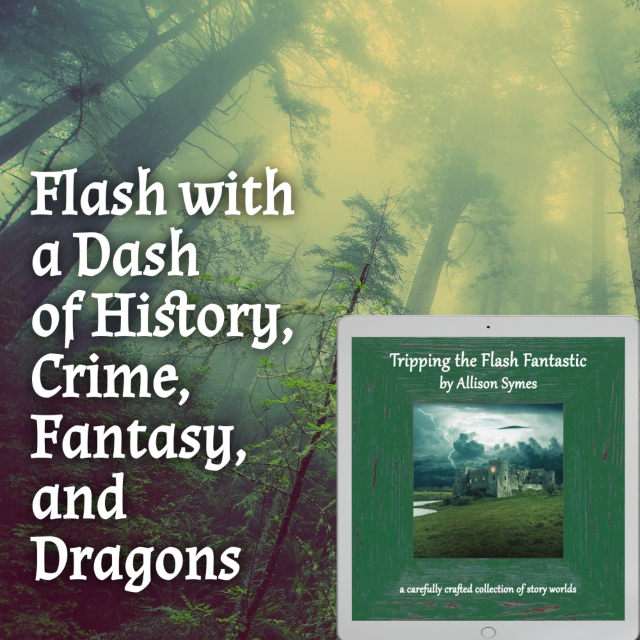
You know I’ve written from the viewpoint of a mother dragon before, yes? (See my book trailer for Tripping the Flash Fantastic). Well, I think I’ve upped my game a bit here. See my latest YouTube video and see what you think. Hope you enjoy it.
Writing a short story, such as flash fiction, is not easier than writing longer work. Nor is longer work easier than writing shorter items. You need the idea. You need to get that first draft down. You need to edit it. And edit it again. You need to rest it for a while. You look at the story again, spot the errors you missed first go around (and we all do that!), correct those, and once happy submit the piece or save it for a collection. And you do this over and over again because you love the challenge of it.
As I’ve mentioned, I find I can get a first draft down quickly. It is the editing and crafting of the story, even my 100-worders, that takes the time. Rightly so too. I want to get every word right. Where I can find a better choice of word that gives more “oomph” to my writing, I will change to that word. And if I am writing to a specific word count, as I so often am, I then have to check I haven’t gone over that and adjust things where I have.
The one thing I have learned over the years is I’ve got to give myself enough time to follow things through thoroughly enough. But that’s fine. I’m drafting more pieces while resting others so I always have something to work on. No chance of getting bored and I love that too.

Just to flag up Amazon have an offer on the paperback of Tripping the Flash Fantastic. See link for more.
I like the variety flash offers me. I can write across a number of genres, write my stories as acrostics, all-dialogue pieces, monologues etc., and I can choose my word count up to 1000 words.
My hopes for flash is that it will encourage the reluctant reader to dip their “toes” into the wonderful world of books and encourage people to write their own stories. Creative writing is good for you. And writers read so book sales go up! There’s nothing to dislike about that scenario!
But I hope flash brings characters to life for people. Those brief glimpses of a character’s life, I hope, will intrigue people to want to read longer stories, novellas, novels etc. Characters are the draw for readers. We need to know what is going on in a character’s life. You don’t necessarily need to write an epic to give that fascination to a reader.

Goodreads Author Blog – Realistic Characters
I’ve never been fond of characters who seem too good to be true. I love the characters with flaws and who change for the better. For any fiction, regardless of genre or length, I’ve got to be able to “get” where the character is coming from and why. I don’t necessarily have to agree with them though!
For my own writing, I like to work out my character’s major trait as all sorts of things can come from that. If a character is brave, are they reckless with it? If they like a laugh, what will they do to get that laugh from others? Plenty of story ideas there – and you can explore the idea of when things go wrong too.
So I like characters to resonate with me in some way. While I will always root for the hero/heroine to win, I want to see that the villain does have reasons to behave the way they are. Their objective has got to make sense. There is never any room for the pointless character. I suppose writing flash fiction with its restricted word count of 1000 words maximum has made me more aware of that.

https://platform.twitter.com/widgets.jsliked Allison Symes's blog post: Realistic Characters https://t.co/rW35r6UfCZ via @goodreads I look at why I like realistic characters and what makes them so for me. I look at why flash fiction writing, my genre, has made me more aware of this. pic.twitter.com/1xgz8KAPjX
— Allison Symes (@AllisonSymes1) March 5, 2022
https://platform.twitter.com/widgets.jsMany thanks, @valeriepenny – my books are below – available in paperback too. If you like a mixed assortment of stories, try these out! https://t.co/ffOf8jcpso pic.twitter.com/3R8JXWR8Jw
— Allison Symes (@AllisonSymes1) March 7, 2022


 Allison Symes: Collected Works