The Writing Community

SOA_Member_rgb

Image Credits:- All images from Pixabay/Pexels unless otherwise stated with many created in Book Brush. Book cover images from Chapeltown Books and Bridge House Publishing. Screenshots taken by me, Allison Symes.
Hope all is well with you. About to head off for a break in gorgeous Northumberland. Will be taking laptop with me. Have laptop, will travel, will write, and I suspect I’ll get some done via good old Evernote on the phone on the journey up there. I’ve taken to the idea of using pockets of time for writing, whether it is to brainstorm or draft a story or blog post. Those pockets mount up. Amazing what you can get done.

BookBrushImage-2023-10-6-19-2637

Facebook – General and Chandler’s Ford Today

Am delighted to be sharing The Writing Community on Chandler’s Ford Today this week. This is something so worth celebrating and something I deeply appreciate. It has added richness to my writing life and I have learned so much useful information too. It’s lovely being able to share some of that information back again. There are always new writers glad of this.

I share some useful website links (Society of Authors, Alliance of Independent Authors, Writer Beware, and Hampshire Writers’ Society). I also look at the usefulness of writing magazines which can help you feel part of a wider writing world and a few thoughts on online communities.

I do follow some on Facebook but deliberately don’t follow them all. (Not enough time basically but being selective about what you would like to give to a group as well as receive from it is a good idea anyway). Hope you enjoy the post and find it useful.

The Writing Community

This slideshow requires JavaScript.


When did I realise I wanted to write? It has been in the background of my life for a long time. I always did love composition lessons at school but it didn’t occur to me for decades I might do something with this. It took a significant birthday and the birth of my son to make me realise if I wanted to see a book out there with my name on the front cover, it would be a great idea if I sat down and got on with it!

In all seriousness, my only regret, writing wise, is not starting sooner than I did because I had no idea how long it would take for me to find my feet, learn my craft, learn to come to terms with rejections, improve my craft more, get better at submitting the right story to the right place to increase my chances of acceptance etc.

And it does take time. I think though there is a good side to this. I appreciate my acceptances more than if they had come to me “easily” I think. I now have a great deal more appreciation of how hard writers work to bring out works for us to enjoy. I also appreciate the editor’s craft more too. Mind you, I ought to, being one myself! I also appreciate more why every writer needs a good editor!
370051565_745095310963666_2820144343510089716_nHope you have had a good day. Definitely feeling the autumn chill now. Am celebrating The Writing Community in my Chandler’s Ford Today post on Friday. That’s something which is always worth celebrating! See above.

Writing Tip: I find three to five word titles ideal for most of my stories. There are always exceptions to any rule (bear in mind my first book, From Light to Dark and Back Again, has seven, count them, seven words in it!) but most of the time the shorter the title, the easier it is to remember and to share on social media, especially where there is a limited character count.

I will use pockets of time to jot down ideas for future potential titles. I come back to these later and any that still grab me, well those are the ones I flesh out characters for and then go on to write my first draft. The time away from my initial ideas is a good test to see if something is likely to work. If I find myself thinking why did I come up with that, it is highly unlikely I’m taking things any further!
385078587_744513057688558_5885311456850627697_n

Facebook – From Light to Dark and Back Again

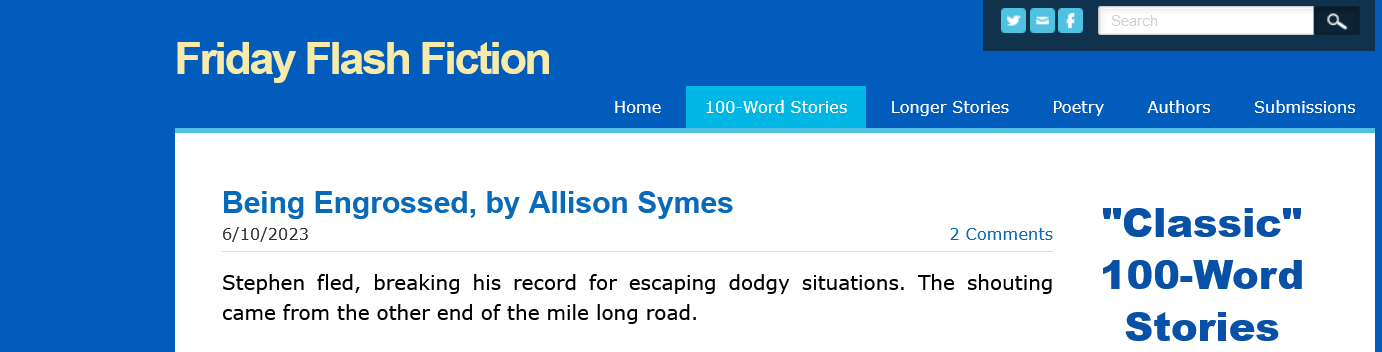
Pleased to be back on Friday Flash Fiction. My latest story here is called Being Engrossed. Find out what kind of trouble that leads my character, Stephen, into! Glad to say there are some smashing comments coming in on this one already. I do appreciate the feedback I get from FFF (and this ties in nicely with my Chandler’s Ford Today post this week which celebrates The Writing Community!).
Screenshot 2023-10-06 at 09-28-46 Being Engrossed by Allison Symes

There are many things I love about flash fiction. I like the way I can put characters anywhere I want in terms of genre, time period etc. I love coming up with lines which I know will make great twist endings or humorous punchlines. I love working out how I could get to those closing lines literally so, yes, it is like putting a puzzle together.

This may well be one of the joys of crime writing for the author as well. They know what’s happening so it is a question of working out how to put it together so it hooks the reader. And that’s the challenge for every writer, regardless of what form we write in – how do we hook the reader?

For me, it’s always about intriguing characters and interesting situations to dump them in. I so enjoy putting my characters through the mill and finding out how they manage.

385773827_745096554296875_202221957929432612_nRemorse and regrets can make for an interesting character study story. I do this with My Girl in Tripping the Flash Fantastic, where my take on Queen Anne Boleyn is sharing her thoughts on the eve of her execution. All I came up with for her in this story is based on plausibility.

It would not be unreasonable, for example, to be thinking of her young daughter and what would happen to her. We also know Queen Anne did pray a lot (and she would’ve done then).

But this kind of story gives you an opportunity to have your character reflect on their life (whether you use a historical character or make one up) and this can have huge resonance with a reader. Also works best when kept short so flash is ideal for this.
BB - Flash with a Dash for TTFF

Fairytales with Bite – Away Trips

In your magical setting, do your characters get sent on “away trips”? If so, are these missions to spy on other worlds and why would this be done? For example, would a magical world send their spies to Earth to keep an eye on what we are doing with what we call science? Would they be looking to steal our best ideas and use them for their own purposes on their own world?

Equally do your magical characters get to have “jollies” where they can just go away and enjoy themselves? What would they have done to serve their world to justify getting something like that? Where would your average fairy godmother go when she wanted a holiday? Can all beings in your world have these trips or are they just for the select few?

What would the benefits be to your characters of having these trips? If they are allowed to visit other worlds, such as ours, does that trip away change their attitudes towards (a) their own lives at home and (b) their previous views on other worlds? What could the consequences be? If you are told that Species X is evil and you discover that they’re not, what would you then do on your return to the place where you have been lied to?

BookBrushImage-2023-10-6-19-5951

This World and Others – To Boldly Go or to Stay Right at Home?

Sorry couldn’t resist the nod to Star Trek here (and is that the most famous split infinitive in history – I think it may well be!). Does your setting encourage its characters to explore and, if so, are there limits as to where they can go and what they can do?

If your world encourages exploring other worlds, do they like what they find out? Do they adapt useful ideas for their own use? Or does finding out about other worlds fuel hostility if they (a) disapprove of what what other world is doing or (b) that other world is doing better than they are.

“Simple” motivations such as jealousy can be put to good use here to set characters on a course of action which will have consequences and increase drama in your story. If you knew your world was going to be resentful, would you give them a watered down account of what you found out when you went exploring? Do you get found out and, if so, what would the consequences be?

I mention consequences a lot. All stories are based on cause and consequence and change. Having characters explore outside of their normal boundaries has great potential for stories as those characters bring new ideas home. Not everyone welcomes new ideas!

BookBrushImage-2023-10-6-20-456

WRITERS NARRATIVE SUBSCRIBER LINK

Screenshot 2023-09-25 at 12-14-31 Writers' Narrative eMagazine October 2023

AMAZON AUTHOR CENTRAL – ALLISON SYMES
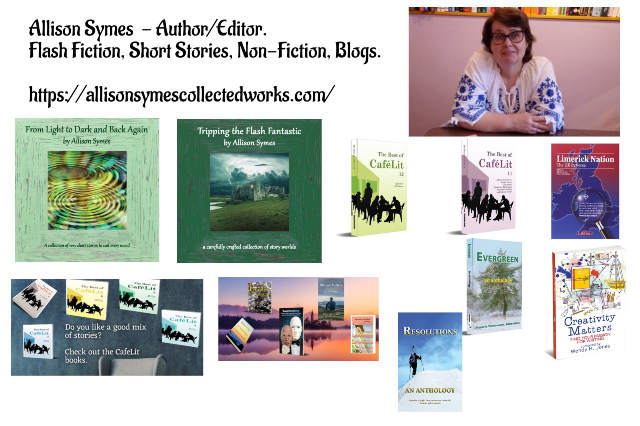
Allison Symes - advertising books and services resized 640Twitter Corner with hashtag, Scrabble tiles, and the blue bird

https://platform.twitter.com/widgets.js https://platform.twitter.com/widgets.js

Processing…
Success! You're on the list.

Character Study

Facebook – General

Do your characters look back at their lives at all? (You should as their creator! Have they developed? If so, positively or negatively? How does this impact on the story?). If the characters do look back at their own lives, why are they doing it? Are they trying to learn from past mistakes and do they actually do so? How does that “look back” change their behaviour (for better or worse) and how does that change the direction in which they go?

Sometimes Character B can look back at Character A’s life and this can be because:-

1. They don’t like the changes in A’s life now (and they may be right to take that view!). By drawing A’s attention to this, B is hoping to get A back to where they used to be.

2. Character B is comparing themselves with A, especially if A has gone on to be really successful. (We all do this for real so why shouldn’t our characters do so?! What is interesting here is how does B respond? Are they jealous? Do they seek to improve themselves or try to “do A down”?).

3. Character B is delighted Character A has changed (and again they may well be right. Equally they may be pleased because A has worsened and it makes B look better! B does not have to have noble motives here!).

All three of these points could generate some fascinating stories.

Facebook – General

One thing to consider when creating your characters is to work out what impact they have on other characters. Naturally, this can be for good or evil. Equally, it can be a happy or sad impact. How would the death of a character affect your story world and its other residents?

There would have to be some impact made, even by a minor character (otherwise why are they in the story at all?). Is a character killed because the assassin(s) know the death will change the political situation in your story world (if so, how?) or it gets a rival out of the way? How did that character become a rival in the first place?

How does personal history impact on the characters themselves? Family background and circumstances usually do impact somewhere. Are they running away from something? Trying to better/prove themselves? Do they succeed?

The history of the story world and the general setting should have an impact on your characters. Someone being brought up in the country will have a different perspective on rural life than someone who has always lived in a town or city and does not know anything about rural life except what they see on the media.

So let your characters have an impact and be impacted upon. Both of these points should generate wonderful tensions within your story and drive the plot along beautifully.

Facebook – General

What do you look for when it comes to the ending of a story?

I don’t necessarily look for a happy ending. What I like to see (and indeed write) is an ending that is appropriate for the characters and the situations they are in. It is so important the ending doesn’t feel forced or “runs out of steam” because you, the writer, were getting to the word count limit!

You also want the ending to wrap up the story with impact. No damp squibs here, thank you!

This slideshow requires JavaScript.

Facebook – General

I’m taking a shortish break from my 101 Things to Put into Room 101 on Chandler’s Ford Today. This week I’ll be looking at some of the frustrations of publishing and then lead into a two-part feature where I interview a fellow Chapeltown author. More details later.

Some great insights to come from the interview and I suspect most of you will have had direct experience of the frustrations of publishing I will be talking about this week. This aspect of the writing life deserves a whole section in Room 101’s vaults! (It was easier to write about them separately though!).

Will return to the Room 101 series later (and look forward to doing so too. Is there any one of us who doesn’t like a good moan every now and again?!

Books invite you into their world - image via Pixabay

Books invite you into their world. Image via Pixabay

Baubles Medium

My story Helping Out is in Baubles, the Bridge House anthology for 2016

Good advice here - all writers need to fail better - image via Pixabay

Good advice. Image via Pixabay.

Humans are immensely creative - image via Pixabay

Let those ideas flow! Image via Pixabay,

Photo2241

I love walking by water – so calming. Can also inspire how you create your own world. Image by Allison Symes

Use review questions to find out more about your characters, image via Pixabay

Use personal reviews to help you generate characters and story outlines. Image via Pixabay.

I'm not arguing with this - image via Pixabay

I’m not arguing with this one! Image via Pixabay.

Facebook – This World and Others

Do you have fun with your characters? There should be the initial fun of creating them, of course, but for me, I think the most fun comes when they develop and mature and truly take on a life of their own. You can look back at the earlier stages of their development and literally see how far they have come.

I also enjoy dropping my characters right in it when appropriate to do so but that probably says more about me than them. I will claim dramatic licence though! So yes you should have fun with your characters, especially for novel writing, you will be living with them for a long time. Even in flash fiction writing, while you will generally go from one character to another for each story, you should still know what makes that character tick and enjoy working out how best to get that across to your readers.

If you become tired of your characters, it does show through in your writing so love them, love to hate them, enjoy writing for them, enjoy putting them through the emotional wringer etc! It will help your writing flow and sparkle. Characters written like this always draw me to a story. I think it is the characters, more than anything, that makes a story unforgettable.

Facebook – From Light to Dark and Back Again

There are certain ways of knowing your created world works. These are:-

You can picture in your head everything from how the world is run politically to who the beings are the world depends on to get anything done.

You can visualise the societies of your world – there are class systems everywhere – and how they interact or, conversely, why they don’t.

You can plan out what the history of the world was, how that affects the current situation you’re writing about in that world, and whether there’s an official version and/or revisionist one.

You can see how towns, villages etc are run and the life that goes on in them regardless of what your story is actually about. (The life of towns/villages etc is bound to affect at least some of your characters – are they rebelling against it? Does it inspire them? Are they acting heroically to defend it?).

You can ask yourself questions about your world and answer them!

And it doesn’t matter if you are “just” writing flash fiction, you still need to know where your characters come from, what drives them etc. How their world operates and how it affects them will have a direct impact on that so you still need to know enough about your setting so you can write about your characters with conviction. That in depth knowledge does show through in what you write.

Facebook – From Light to Dark and Back Again

One good thing about flash fiction is that there is nothing to stop you taking characters you enjoyed writing about in this form and then writing longer stories for them. I have done this occasionally (though I find I am so focused on the next idea, the next story, that I don’t do this as often as perhaps I could and should do, but it is something to bear in mind.). Also, a flash piece can be turned into a longer one (so you have two stories on your hands then!).

Another thing you could do is if you have a character in mind for a longer story but are not sure whether they have the capacity to carry the tale, then try them out in a flash piece first. If the character is strong enough to make a good impact in a form that demands a tight word count, no waffle, and getting the story down quickly, then they should have the strength to star in a longer work.

How do you define “good impact”? For me, the characters have to stay with me long after the story has ended. I have to find myself wondering what else they might get up to and so on.

This slideshow requires JavaScript.

Facebook – From Light to Dark and Back Again

I wear two writing hats (and often at the same time!). One hat is the flash fiction and the other is my non-fiction work – in particular, my writing for Chandler’s FordToday. But the great thing has been that skills I’ve learned for CFT (especially writing to a deadline and a word count) have been really useful for my fictional side.

So does it pay to expand on what kind of writing you do? I think so!


I write fairytales with bite as flash fiction and short stories in particular. Image via Pixabay.

THE POINT OF IT ALL

FAIRYTALES WITH BITE

The Point of It All discusses one aspect where fiction is very clearly shown to be fiction.  This is the fact that the main character (and usually more of your “cast”)  know the point of it all in terms of their story.  They know where they are heading.   Also if they were to forget, there is someone else who will always remind them.  Frodo Baggins and Sam are the best examples of this that I can think of.  Think about how your main characters regroup and refocus (and who helps them to do that) when they lost sight of their goal in the story.

THIS WORLD AND OTHERS

Nothing but the Best discusses the fact that we have to present the very best material if we have any hope at all of being published.  So do our characters come across the way we mean them to do?  The very best characters, whether they are evil or good, will ring true in all they say and do (even if they are being false!).

FACEBOOK – GENERAL

I look at character studies tonight and why flash fiction is a great vehicle for them.

https://www.facebook.com/plugins/post.php?href=https%3A%2F%2Fwww.facebook.com%2FAllison.Symes.FairytaleLady%2Fposts%2F974386565997656&width=500

FACEBOOK – FROM LIGHT TO DARK AND BACK AGAIN

Am making progress with advertising my latest event – the book signing at Chandler’s Ford Railway Station on 8th July!  Will share more news as and when I can but am pleased with how things are going so far.  Also looking forward to the Winchester Writers’ Festival which is next month.  Have not entered any of the writing competitons this year as far too busy on the book (and family circumstances have taken up the rest of my time) but am looking forward to catching up with old friends, hopefully making new ones, as well as enjoying the courses.

https://www.facebook.com/plugins/post.php?href=https%3A%2F%2Fwww.facebook.com%2Ffairytaleladyallisonsymes%2Fposts%2F536424936746319&width=500

castle-2115425_640