Light and Dark

Facebook – and Chandler’s Ford Today

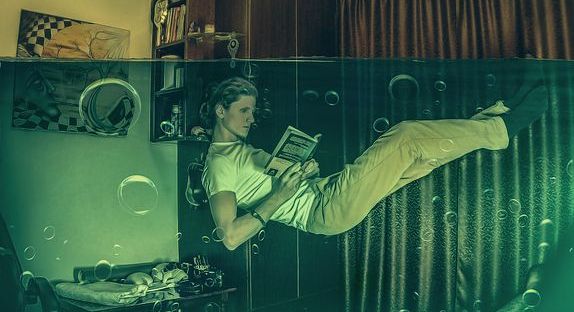
My latest CFT post is called The Light Fantastic and looks at light and dark in terms of fiction, mood, and vision (including photography). I look at how fantastic light is but why we also need darkness – and this is true for fiction writing too. Hope you enjoy.

This slideshow requires JavaScript.

Had a lovely evening at the Dovetail Centre watching A Christmas Carol performed by the MDG Players. Review to follow on CFT on Friday week.

A Christmas Carol is one of my favourite stories and Dickens is one of the few authors to add something to the Christmas tradition. (The others include Christina Rossetti with In the Bleak Midwinter, Mrs Cecil Frances Alexander with Once in Royal David’s City etc, Charles Wesley with Hark the Herald Angels Sing etc and Clement Clark Moore with The Night before Christmas). Favourite version of Dickens’ classic for me is The Muppet one though!

Talking of stories, I am thrilled my Doubting the Obvious is on Paragraph Planet. 75 words including the title is a good challenge! Work to come in next few days on Cafelit too.

DOUBTING THE OBVIOUS Jemma knew monsters existed, the monsters knew they existed, so why did everyone else scoff at the idea and end up eaten by the things? They weren’t getting her that way. Jemma was prepared. She had her dart gun. She had a fire roaring in the forest clearing. Everyone knew monsters were attracted to the warmth. It meant food. An hour later one monster discovered that was true. Jemma was barbecuing him.

Allison Symes – Published on Paragraph Planet 22nd November 2018


This slideshow requires JavaScript.

Really loved seeing the moon rising through the trees tonight, both at home, and on a late walk with better half and Lady. Lady has to have a clip on light to her collar, otherwise you really wouldn’t see her, so she goes around lighting up the world like a little Christmas tree. She’s not impressed by this – but I am! And it means I can see my dog!

I was impressed with the amount of light the moon was giving on the walk tonight. Absolutely beautiful. My theme for CFT this week funnily enough is light and dark in terms of mood, fiction, and vision (in every sense). It’s too easy to take too much for granted and the way the brain processes light is one of them.

As for light writing, I have a 75 word piece coming up online tomorrow. More details then but I will say my heroine isn’t afraid of the monsters in the dark! Mind you, most of my heroes/heroines aren’t but then that’s how I like my characters!

This slideshow requires JavaScript.

Facebook – From Light to Dark and Back Again

Light and dark is the theme for my Chandler’s Ford Today post this week. Very appropriate given my book’s title! Do you enjoy writing and/or reading the lighter stories in a collection for do your prefer your tales on the dark side?

I love both of course. Much depends on my mood as to which I prefer at any one time. What I do know is the 100-word story is ideal for where I want to make an impact and also the simpler the theme the better. More likely to “deliver” on the promise of the theme set.

Contrasts are often used in fiction as they are a great way to generate conflict between characters or between a character and their situation. I’m reminded of magnets here – contrasts can either attract or repel!

Contrasts can also be internal within a character especially on things they would like to do and things they are actually able to achieve. (There can be some great comedy out of that scenario too! Think of all the comedy characters who’ve clearly thought more of themselves than they should have done and how they always fall flat on their face – in the famous Del Boy falling through the bar scene in Only Fools and Horses, that was quite literally too!).

There can be be the obvious contrast between light and dark between two characters or within one character. Dr Jekyll and Mr Hyde resonates as a story precisely because we can all identify with a character’s struggles to be “good”.

Looking forward to sharing latest flash fiction story to be published online tomorrow. I will say it is a 75-word one so that will give fellow flash fiction writers a big clue as to where it is appearing! More tomorrow.

I must admit one of my favourite writing sessions is when I have got “the bit between the teeth” and I draft lots ot flash fiction stories of differing word counts. I edit later and eventually submit them to different places. All good fun.

Another thing I love about flash is when I know I won’t have a lot of time for writing, there is always enough to draft a story or two here, even if they are just of the one line variety. Sometimes I expand those stories out when I DO have more time. Sometimes I leave them as they are (and I must try and submit some of these to the 25-word competitions, they’d be ideal for that).

Fairytales with Bite – Light and Dark

The Light Fantastic is my latest Chandler’s Ford Today post and looks at light and dark from the perspectives of vision (including photography), mood and fiction.  Light and dark are crucial to fiction.  If there is no dark in a story, there is no conflict, there is no drama, nothing happens for better or worse, and any potential tale here collapses.

Fairytales are full of the contrasts between light and dark in the way they portray their characters.  Fairytales are often grim and perhaps the antidote here has been what has become the “happy ever after” ending.  Light and dark have to be in the right proportions.  All darkness is just oppressive.  All light would be blinding.

Look at the light and dark qualities of your characters.  Are they in balance?  What weakness in your character really lets them down?  What virtue really makes them?  How did they develop these things?  Do they actively try to fight the weakness?

It isn’t always appropriate for a story to end happily of course but the finish must be appropriate.  I like to see stories end on a note of hope even if the finish is a sadder one.

This World and Others – Pointers for World Building

Some useful pointers for world building include:-

1.  Ensure there is some sense of how your world is run.  We may not need to know how it is done, we need to know it IS done, and your fictional world isn’t in a state of anarchy.

2.  Ensure your characters know what they need to know at a local level.  For example, if there are rules in the region of XYZ citizens can’t go out after a certain time at night, your characters need to know this.  Breaking such a rule could, of course, be a major part of your plot here.  If so, ensure your characters know the consequences of breaking the rules and what they are facing in doing so.  It all helps increase the tension!

3.  Your characters will, presumably, need to eat, sleep, find shelter etc so again there should be some sense of how your characters do this as they have their adventures.  Things don’t “just happen”!

4.  I like to see a general picture of how the different species interact with each other, including whether there could be any Romeo and Juliet situations where two “people” from rival backgrounds fall for each other.

5.  What is expected OF your characters by the world in which you’ve placed them?
This slideshow requires JavaScript.


All About Time

Facebook – General – and Chandler’s Ford Today

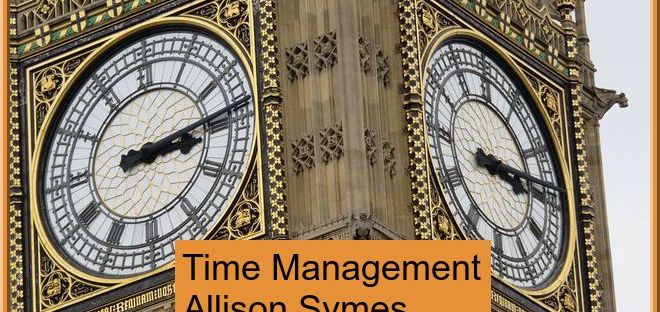
My latest CFT post looks at time management (and oh I would love to be better at that!) and at time travel. Naturally a certain Doctor makes an appearance in the post and I also look at if time travel were to become possible, where would you go and why? What would you do while there? Comments as ever welcome on the CFT page.

This slideshow requires JavaScript.

I discuss the art of time management and time travel in this week’s CFT post. (I suppose thinking about it further, you could say one of the earliest forms of time management in the UK was when the railways standardised time for us all).

On the assumption time travel ever becomes possible (and I’m not counting the gags that say something like travelling on XXX railway makes you feel as if you’ve gone back to the 1860s!), where would go and why?

Thinking heads on. Link goes up tomorrow. Comments welcome in the CFT comments box when post goes live. (If you’re really keen it goes live at just after midnight but you may have to wait to get a reply from me! Unlike Cinderella, I know where I’m going to be at midnight and it won’t be at my keyboard… ah the joys of middle age!).

One good thing about the dark nights coming in earlier is it does encourage reading and writing!

I don’t need much of an excuse to curl up with a good book or get on with various writing projects as it is but the lighter evenings during the summer months can make me feel a bit guilty about not getting more gardening done etc. Note the “a bit”. Easy enough to squash so I can get on with reading and writing! I just wish I could stop feeling the slightly guilty feeling at all!

I often prefer lighter reading and writing during the darker months too. Contrast in mood perhaps? Whatever, it’s definitely time to get on with some writing once again!

Facebook – From Light to Dark and Back Again

I often use lightning flashes in my photos for posts like this, given I think they reflect accurately how a flash fiction story illuminates and impacts on the reader. Very briefly and then over, but you don’t forget the impact.

A short story (say 1500 words+) to me is like shining a torch around – more light for a greater period of time but the impact can be diluted.

Sometimes you want that – you want the story as a whole to impact on your reader and you can only know if it‘s done that by reading and re-reading the whole thing.

The novel is like having a great big light on constantly. When you switch it off (stop reading it), that’s when you think about the impact it has made on you. Or that is how it has always seemed to be to me. I didn’t really appreciate the greatness of The Lord of the Rings until I’d finished reading it. You then take a mental step back and realise the huge scale of the trilogy.

Flash fiction makes you focus on the little details but the great thing with that is you can take this and use it to sharpen your longer works of fiction. No dull bits ever, thank you! The sections that are necessary to link the action should still carry the reader with them. The reader should be as keen to read those sections as they are the main scenes. Flash makes you tighten up your writing and this is enormously useful for ensuring your longer stories flow as they should.

This slideshow requires JavaScript.

Time is the theme of my CFT post this week (time management and time travel. If the latter ever becomes possible, you will have to be really good at the former to make said travelling work well for you!). I’ve used time as a theme for a few of my flash fiction pieces – Telling the Time (there’s a clue somewhere here!) and Time Waits for No Man (likewise!).

My main use of time though for flash fiction is deciding on when I’m setting the story. Am I going to tell it as it “happens” to the character or will I get the character to look back on an event? I use both regularly and usually it is clear which would work better. So much depends on the character A reflective type would be best suited to looking back at something that had happened (which I do in They Don’t Understand). An active “go get them” kind would probably be better off telling the story AS it happens, implying the passing of time as we go through the events with them.

What do I look for in an opening line for flash fiction? I don’t necessarily need to know who the lead character is funnily enough, but I DO need to know the setting, the attitude of the narrator (especially if this is a first person piece), and some indication of what the problem is. That problem and how it is overcome IS the story of course.

Something about the narrator/lead character has got to intrigue me enough to make me want to read on. A great piece of flash fiction will make you ponder whether YOU would have acted in the same way as the character you’ve just read about!

Fairytales with Bite – Favourite Times

What are your characters’ favourite times? Curling up with a good book? Lazing in the bath? Going for a good walk with the dog?

Use questions like this to help you establish your character. The answers may not appear in your story but knowing something about the character before you start writing about them will be enormously helpful. You don’t need to know each and every little detail. What you want is enough information that you can write clearly for them, knowing how they would react to a situation and why. The reader will pick up on the fact you really do know your character (even if they do this subconciously, in many ways it is better if they do pick up on this that way) and the writing will flow better as a result.

Of course, working out what your characters’ favourite times will tell you so much about them. Do they curl up with a good book because they can’t face what is their real life? Why can’t they face it? Dig deep. Maybe you will surprise yourself with what your characters show you about themselves. Use that.

This World and Others – Time

My Chandler’s Ford Today post this week talks about time management and time travel.  Guess which one I want to get better at!  Joking aside, this led me to think about how we use time in stories.

A lot of my flash fiction stories are set within a very short time period (appropriately) and are written in the first person, precisely because I want to achieve a sense of “immediacy”.  For other pieces I have the lead character looking back at their lives and being reflective so the time within stories like that is longer, “stretched” if you like, and the pace of the story is slower.  What grabs you with those kinds of tale is the character – something about them intrigues you enough to make you want to find out more.

Time in itself can make a useful theme for stories (too little of it, too much of it etc) but I’ve found it helpful to think about the kind of story I want to tell and then work out what the best time frame for that tale would be.  In my Pressing the Flesh the opening line is “It was 3 am”.  The impact of that is to make you wonder (a) why the time is important and (b) to assume the character concerned is unlikely to be up to any good at that time of night.  (Quite right too – see my From Light to Dark and Back Again for the whole story!).


REMEMBERING – AND THE POINT OF FICTION

Facebook – General

I had a friend, now sadly gone, who couldn’t understand the point of fiction. He only read non-fiction and thought the world was too wonderful to want to make things up!

I had some sympathy for that view funnily enough, as I could see what he was getting at, but I did point out that fiction can show truths facts can’t always do. Fiction can show elements of human nature in a better way than just relating a list of what we are capable of.

I also think fiction should encourage empathy. We root for characters we like. Why? Because there is something in them we can identify with or aspire to in ourselves. So does it follow then the more we read, the more we encourage empathy in ourselves? I like to think so.


This slideshow requires JavaScript.

Very moved by the Remembrance events over the weekend. So many stories we know about, so many still untold (not everyone wants to “open up” about what they went through). So much history recalled – personal, national and international. I was also pleased to see the animals who served in the war (especially horses and dogs) were also remembered at various times over the weekend.

One common theme running through Doctor Who is how one action, no matter how small, can change the history of the individual and, from that, the history of their country, the planet even. Very much a chain reaction.

So when are we planning our characters and stories, look for the pivotal moments that are going to turn everything upside down. What is behind those moments? What makes your characters act and react the way they do (given there is always an opposite reaction to be considered)? Is the motivation of your character strong enough to justify the stance they’re taking?

Glad to hear one of my favourite radio shows, I’m Sorry I Haven’t A Clue, is back on Radio 4. Some fantastic word play here. Got to see the live show a little while back. Good fun. If you get the chance to go, do so. Laugh a minute is not an exaggeration!

I’m very fond of a good pun. (Am also very fond of a dreadful one!). I like playing with the language like this. (This is also why the late great Frank Muir and Denis Norden are much missed. They were fabulous at this).

I occasionally get to give my characters a humorous one liner, which I enjoy doing, but I think it has more impact because I don’t do this all the time. Also the humour has to arise out of the situation I’ve put the characters in and mustn’t feel forced. A reader will spot that a mile off.

But having fun with the language is one of the great joys of writing.

My CFT post this week will look at the art of time management and takes in a quick look at time travel too. More on Friday.

How does time work in your stories? I don’t tend to think of it much as most of my flash fiction is very much in the “here and now”. I’m not sure though whether my using the first person encourages that or if the here and now encourages the use of the first person! Jury out here…

Even those pieces where a character is looking back at a period of life have a kind of bracketed time zone. It can only be for so long. I suppose you could argue I use time as a kind of a frame for my flash fiction and that does work well. As ever, though, be consistent with your use of time throughout the story.

Facebook – From Light to Dark and Back Again

R = Recalling the debt we owe
E = Engaging with the past so we do not end up re-living it
M = Memories to be treasured and learnt from
E = Elegies and the war poetry of Sassoon and Owen amongst others
M = Men fallen and wounded, numbers too vast to comprehend
B = Bugles and the moving notes of The Last Post
R = Regiments, so many of them “old pals” networks. Reflect an almost forgotten era.
A = Armistice Achieved Eventually.
N = Never again they said. Sadly they were wrong. What can WE do then? Remember, recall, DON’T repeat.
C = Creatures such as the horses that also saw active service, amongst others.
E = Edith Cavell, Nurse, who rightly wanted to help the injured of both sides.

Allison Symes – 10th November 2018

This slideshow requires JavaScript.

How do the seasons affect your characters? The reduced amount of sunlight throughout the autumn and winter months is known to affect many people in terms of moods, being more prone to depressive attacks (in terms of quantity and how long each episode lasts). Should our characters reflect this too? I think so.

As well as the general point of acknowledging depression openly, (pretending it doesn’t exist or happen helps nobody), I think it unrealistic to have characters in a “set” state of mind. Their moods are bound to fluctuate, whether it is due to the lack of sunlight, the earlier and longer nights, or the circumstances they’re facing or a combination of that.

When we portray our characters, we must show them honestly for them to have any resonance with our readers. While there isn’t the word count room in flash fiction to show a lot of change of moods (you’d need the longer short stories and novels for that), you CAN give an indication of a character’s usual mood and where/what has changed it.

For example, in my They Don’t Understand, I start with my lead character showing us he has blamed himself for something. As the story progresses, he recalls his life with his wife, and then the ending, the “punch in the gut” end as I like to think of it, shows why he blamed himself at the start. This was one of my longer flash fiction pieces and I needed all the words available here to convey this sense of mood well enough. But without those changes of mood, and the reasons for them, the story simply wouldn’t have impact.

Flash fiction isn’t a new idea, far from it. The name of it might be but the concept isn’t. Aesop’s Fables would count as flash fiction as would many of Jesus’s parables in the New Testament. (Many come in at under 100 words!). (The longer story of the Good Samaritan is a great example of the Rule of Three in action too!). Truly, there is nothing new under the sun!

Having said that, the challenge for flash fiction writers now, as with any story writer, is to come up with strong characters and engaging ideas which grip your reader so much they HAVE to read your story through. I call it the “do I have to read this and read it NOW?” test. If the answer to that is a resounding “yes”, you are definitely on to something!

This slideshow requires JavaScript.

What are your favourite times for writing? I find late afternoon into the evening works best for me. With most of the day’s cares behind me, I can focus on writing something I love and relish every moment of it.

I’ve found the biggest thing about having a regular writing “slot” is it conditions you to accept this is the time you will write so you settle down and get on with it (never a bad thing that!).

I try to mix up what I write during the week as a whole. I focus on my CFT post first, then get on with the flash fiction and other, longer term, projects I’ve got in mind. Keeps the imagination busy!


Goodreads Author Blog – Remembering

I write this on the eve of Remembrance Sunday/Armistice Day 2018 when all thoughts turn to remembering those who sacrificed so much.

This is where the war poetry of Sassoon and Owen amongst others hits home. This is where historical writing – fiction AND non-fiction, can truly show what life would have been like in the trenches (and make us devoutly thankful we’ll never face anything like that).

The testimonies and local history records should be treasured. Reading others’ experiences and thoughts should encourage empathy in us (and I think is one of the truly great things about fiction generally).

There are so many stories – someone local to me has found out the stories of those on our War Memorial. Imagine that happening up and down the UK. Every single person recalled and their story told.

Fiction is wonderful and should reflect the human condition but the sheer brutal facts of non-fiction around things like the World Wars should never be forgotten. We owe a huge debt to those who wrote things down so we have those written records. We dare not forget (else be destined to re-live) and writers play a crucial role here.


This slideshow requires JavaScript.


Memories and Motivations

Facebook – General – and Chandler’s Ford Today

My latest CFT post, The Importance of Memories, is timely of course as we enter Remembrance Sunday/Armistice Day, but I also look at the topic from the angle of how and why memories are vital to us all as individuals and as countries. I look at the impact of dementia and how singing helps with memory. I also discuss how fiction writers can use memories.

This slideshow requires JavaScript.

One tip I’ve found useful when planning out my stories is making sure my characters’ motivations ARE strong enough.

It doesn’t necessarily have to be a “do or die” approach either (though the dramatic qualities of that are obvious), but if, for example, Character A wants to buy a special present for Character B, then you must show why Character B means the world to A. Motivations have got to be something any reader is going to be able to identify with (but not necessarily agree about!).

What is your favourite form of writing and/or reading – fiction or non-fiction?

I love (and write) both. Non-fiction can and has inspired ideas for my fiction. It also means having different projects to work on, I never get bored, and I am exercising more “writing muscles” than if I did just write one thing. (I just wish I had more time but then don’t we all?).

I also think where you have a fictional world but which has solid basis in fact (i.e. you have thought about how gravity works in your fantasy setting, what form of government there is etc, based on what we know here), your story has got to be more convincing and stronger as a result.

Facebook – From Light to Dark and Back Again

The best flash fiction is where the writer has stuck to ONE simple idea/theme and followed it through. There really isn’t the room to do anything else and the impact of the story is greater for keeping it simple.

This is not the same thing as simplistic though. The best flash fiction will hit you emotionally, can make you think, can frighten you, make you laugh etc, all in a few words.

Simple writing is where the editing has been done (and often several times) and, to quote the late great Eric Morecambe, albeit in different circumstances, “you really can’t see the join”!

Favourite themes of mine for flash fiction include rough justice, alien life being as intelligent as ours (and usually more so!), and crime (often showing the criminal’s justification, if only to themselves, as to their course of action). It is perhaps ironic that the really big themes – love, justice etc – can be summed up in one word but the amount of variety of stories you can get from these is vast.

I believe the simpler the theme, the better. It comes across well too. You don’t need your readers scratching their heads trying to work out what the theme is.

Looking forward to the Bridge House celebration event in early December. Less than a month to go!

One of the nice things about writing is getting to meet other writers. It is lovely knowing you are not the only one who wants to get their imaginary world down on paper and send it out there in book form.

I suppose one of the biggest things I’ve learned is never to underestimate how long it takes to get a book together! It always will take far longer than you think, as will the editing process, but it will be worth it in the long run.

Memory is my theme on Chandler’s Ford Today this week but it plays a vital role in fiction too. For characters to seem real and therefore believable, they must have a past. That past doesn’t need to BE the story you’re telling but it should impact on it in some way (if only because it has made the character turn out to be the way that they are).

Also the setting in which your characters live, that world should have values and rules, which will be formed by its history. There are likely to be ceremonies and special days which your characters will observe or note in the course of your story.

With flash fiction of course this has to be condensed right down. In my Helping Out, my opening line has a witch helping a fairy and acknowledging she is not supposed to do so. Those last few words immediately imply a whole history of feuding between the two magical groups and the witch is remembering it and, in this case, ignoring it! The story goes on to explain why but her memory of usual behaviours impacts on her actions here. Memories = realities = more convincing fiction.

This slideshow requires JavaScript.

Fairytales with Bite Character Memories

I write about The Importance of Memories in my Chandler’s Ford Today post this week.  I touch on the subject of memories and fiction writing here too but below are some specific reasons why memories should come into your stories (even if they are just implied.  They often are just implied in flash fiction due to the limited word count but to my mind that makes the impact more hard hitting).

1.  Characters need to seem real to be believable.  Real people have memories.  So do real characters.

2.  Our behaviour is affected by memory – memory of what we did wrong, memory of what we did right and the difference between the two!  Our characters should reflect this too.  They’re not going to get it right all the time (good thing too – no story there!) but do need to show they’ve learned from their mistakes.  That is where memory comes in of course.

3.  Your world setting will have rules and values it expects its citizens to live by.  Your characters will know what these are, will know what special days and ceremonies there are, and will live their lives i obedience to all of that or be rebelling against it, but again your characters need to know and remember what these are!

4.  We are shaped by our memories in terms of who we are and why we are the way we are.  Our characters should be too.

5.  We can be haunted by memories, especially of those we’ve loved and lost.  Our characters should be too.

This World and Others – Character Traits

What are the most useful character traits for a writer to use?  My thoughts would be:-

1.  Whichever trait you choose, it has to be “open” enough to go in several directions.  For example, if your character has a “brave” trait, does this mean they are brave all the time?  Are there some fears they really cannot face but because they are brave in other areas that hides this?  Are they brave when out and about with friends but cowardly at home?  Lots of directions you could go in there.

2.  Whichever trait you choose, it should be something most people can identify with/aspire to.  Most of us want to be decent, kind, brave etc.  I love reading characters who have those traits and who overcome against all the odds.  Instant reader sympathy.

3.  Whichever good trait you choose for a character, they should also have a fault that goes against it, something they have to manage and control.  (A good example of that is The Incredible Hulk!  Mild mannered most of the time but boy when he becomes angry the sparks fly!).  You have internal conflict here and also what happens when another character has seen the good side and suddenly comes to see the bad side for the first time?  What are the reactions there?


Music and Stories

Facebook – General – and Chandler’s Ford Today

One of the joys of writing my Chandler’s Ford Today posts is when I have a topic where I can go to town on finding music clips! The topic of books is one of them.

Many thanks to my wonderful panel – #JenniferCWilson, #ValPenny, #AnneWan, #WendyHJones, and #RichardHardie – for taking part in my mini-series The Joys and Challenges of Writing Series Novels. Hope you enjoy their fantastic insights AND the music I’ve used to go with these!

This slideshow requires JavaScript.

Had a great night out watching the Chameleon Theatre Group perform three episodes from Blackadder Goes Forth, including Goodbyeee. Review to follow on Chandler’s Ford Today in due course but I will say now it was superbly done and the set, made by the company themselves, was brilliant. Looking forward to sharing more on that.

Adaptations I’m generally happy with if they are faithful to the book/series etc. This is why I loved the Miss Marple series with Joan Hickson – they were faithful to the Christie canon – but the Marple series. No. Didn’t watch it. Just couldn’t bring myself to do so when it emerged they were altering the stories and bringing in characters that didn’t belong in the originals. Really don’t like that.

My CFT post this week will be the final part of my series on the joys and challenges of writing the series novel. As ever, my thanks to to #JenniferCWilson, #ValPenny, #AnneWan, #WendyHJones, and #RichardHardie. Nice range of genres between them too – from children’s to crime (and Wendy writes both!) to fantasy to historical crossed with ghost stories. Link up on Friday.

Glad to report I’ll be having more work on Cafelit later this week and again in November. Will share links as and when.

From what I’ve seen of the set the Chameleons have produced for the stage version of Blackadder Goes Forth, I anticipate a packed house and a wonderful and thoughtful evening of entertainment. Will review for CFT in due course. Do check their FB page out.

No automatic alt text available.

Image may contain: outdoor

thank you text on black and brown board

Pexels image.  There are times when words are inadequate.

Facebook – From Light to Dark and Back Again

So more on my alphabetical list then.

J = Juicy Storylines! Not just for soap operas, honestly, but something every character wants. Now “juicy” can be taken literally of course, but I see it as the storyline being appropriate for the character and taking them and stretching them to see what they are really made of. There’s nothing like a crisis for bringing out the best or worst in someone and that applies just as well to fiction!

K = Kicker. Must admit I needed to look this one up. (It’ll be interesting to find out what I can research for Q!). In journalism it apparently means a sudden unexpected change of events. In fiction we’d usually refer to it as a twist in the tale. I like kicker though. Has bite. And your stories must too, whether they have a twist/kicker in them or not.

L = Lines. Who is getting the best lines in your story? Your hero or your villain? A great story will have this split between the two to prevent either becoming a stereotype or, worse still, boring! Also a villain capable of humour etc means while your reader will not want them to win (possibly SHOULD not!), they will sympathise and identify with the villain to a certain extent. There should be something about each character a reader can identify with. (My inspiration here is Alan Rickman’s masterly portrayal of the Sheriff of Nottingham in Robin Hood: Prince of Thieves!).

About halfway through the alphabetical listing now. So then:-

M = Muse. The best way to feed said muse is to read widely and often (and do include non-fiction and poetry in this too. Different sources of writing are good for you and inspire your own thoughts and ideas in various ways). I’ve also found writing regularly feeds it too. Never worry about what you come out with at first being awful and needing work. That would’ve happened to Shakespeare too! It can and will be put right in the edits!

N = Narrative. Whose story is it? Whose viewpoint is going to dominate? What can that character see and know that the others cannot? Why have you chosen that character to lead the narrative? Answer those questions and your story will be off to a good start!

O = Originality. Reading widely feeds your originality. Partly this is due to what you read, but sometimes it can be because you read something you really don’t like or feel you can do better and that can be the trigger point for your own writing. Also, your voice is unique to you and will come through in your writing, especially if you write often. Regular writing (even if it is short bouts at a time) really does encourage your imaginative “muscle” to start working.

Pressing on with my alphabet topic then, we reach P, Q and R. (Great letters if you can get them out in Scrabble incidentally!).

P = Performance. Do your characters perform well in your stories? Do they live up to what you outlined them to be or have they gone beyond that? Read your stories out loud. Perhaps record them and play them back. Hear how your characters perform. Are they having the impact on you that you want them to have on your reader?

Q = Quizzing. I’ve found quizzing my characters to be a very useful part of my outlining. I don’t need to know the minute details. Nor do I put everything I outline in a story. However, I take my character’s basic traits and quiz them from there. If I decide a character is going to be brave, I will quiz them to find out if there are limits to that courage. I try to find out where that courage comes from. Does their “tribe” prize bravery? Or is it noticeably absent and your character is rebelling against that? What are the outcomes? (There WILL be some and that’s where the drama and your stories are to be found!).

R = Right Word Count for your Flash Fiction. I sometimes write a piece deliberately to a word count and that’s it. Sometimes I think a story will come to 100 words but discover it can be done in 75 or needs to run to 250, say. Be flexible on this. The story is the right length when the lead character has done and said all they have to do/say for the situation you’ve put them in. The great thing with flash fiction is there are so many different categories, that even if your treasured 100 word piece comes in at 500 words, there will be markets and competitions for that out there.

This slideshow requires JavaScript.

Goodreads Author Programme – Blog –

After the End, What’s Next?

If you’ve enjoyed a really good book, what do you do when you finish it? Go on to read more books by the same author, or read more in the same genre, or do you go for something that is completely different in mood and style?

I have done all three of these (though obviously not at the same time!) and it very much depends on my mood at the end of the story. If I’ve loved a gory crime thriller, I may well want something humorous to show the lighter side of life, albeit a fictional one!

With short stories especially, I tend to read a few by the same author before moving on. With novels, if the book has really gripped me, I’ve got to check out what else the author has done, even if I decide I’ll come back to those later.

The important thing though is that whatever you read, you enjoy it so much, you keep on reading, no matter what author, genre, style etc you choose next. Happy reading!

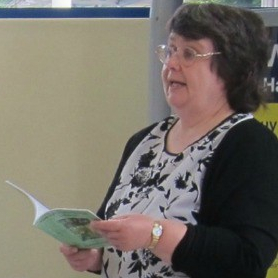
Image Credit:  many thanks to the Hampshire Writers’ Society for taking the photo of me reading as guest speaker and for kind permission to use the photo.  Both much appreciated!

Fairytales with Bite – Signs of a Fairytale World

What are the signs of a fairytale world?  How can you know quite quickly you ARE in one (via fiction I’m presuming for the purposes of this post!  If you do find a portal to another world, however, be sure to report back with plenty of details, pictures if at all possible.  We will all want to know!!).

1.  Magic.  The biggest giveaway of course is the use of magic.  The interesting thing to work out when planning your stories though is whether everyone can use magic or just a select few.  If everyone can use it, what are the rules so anarchy doesn’t break out?  Boundaries increase the drama in your story.  If everyone can zap everyone else, that doesn’t make for much of a story.  If only a few can do that but the price they pay is their own lives are forfeit, now there’s a potential story.

2.  Inanimate Objects – The Use Of.  We all know from Disney (see Beauty and the Beast) a teapot, to name one example, is rarely just a teapot!  Sometimes they’re an enchanted victim.  Sometimes these things are portals (also see Harry Potter).  So what uses are the inanimate objects put to in your setting?  Does a particular object convey a particular meaning or power and, if so, what and why?  What are the limits to the use of objects?

3.  Creatures.  Ranging from domestic animals that can talk (hello, Puss in Boots!  Loved Puss in Shrek.  Thought they had the portrayal spot on) to odd creatures that are the stuff of legends to monsters of course.   Basically what you wouldn’t see here!  And there’s nothing to stop you inventing your own.  This is where some knowledge of natural history is invaluable.  Knowing what animals need to survive and how their bodies are designed to handle that should inspire some ideas for how the creatures in your stories will do this kind of thing.

Happy writing!

This World and Others – Music and Stories

In my latest CFT post, the final part of my mini-series on The Joys and Challenges of Writing Series Novels, I get to have some fun choosing music tracks to go with my fantastic panel’s insights.  Many thanks again to Jennifer C Wilson, Val Penny, Anne Wan, Wendy H Jones, and Richard Hardie for taking part in this three part series.  Hope you enjoy the insights and the music!

Music and stories have long been intertwined of course.  So many wonderful songs are stories set to music effectively.  Music can and does play a part in stories.  It can be used to show character.  Movies, of course, rely on music to help set mood.  Think of the Jaws theme by John Williams.  Every note of that puts pictures and therefore stories in your head (and possibly might put you off swimming in the open sea but that’s another matter!  There are advantages to just swimming in the local public baths!!).

I write with classical music playing.  (I often listen to Classic FM).  Unlike other styles of music, it hasn’t affected my mood (and therefore what I write!).  It does help me relax and I write more (and I hope better) when relaxed.  I’ve also found it helpful to think of the kind of music my characters would be fans of when I’m creating them.  It almost certainly won’t come into the story I write but it fills out my knowledge of the character I’m about to place before a reader.  That has to be a good thing.

And I must admit I loved choosing the music for my book trailer for From Light to Dark and Back Again.   The track used is an adaptation of Camille Saint Saens Danse Macabre (used as the theme tune for the BBC detective series Jonathan Creek).

https://www.facebook.com/plugins/video.php?href=https%3A%2F%2Fwww.facebook.com%2FAllison.Symes.FairytaleLady%2Fvideos%2F954726234630356%2F&show_text=0&width=560

Stand Alones, Flash Fiction and Fairytales

Facebook – General – and Chandler’s Ford Today

Many thanks again to Jennifer C Wilson, Val Penny, #AnneWan, Wendy Jones, and Richard Hardie for their further insights into the joys and challenges of writing series fiction. Amongst tonight’s topics is how to ensure each book in a series works as a stand-alone, given our series writers can never know which book a reader will actually start with. It isn’t necessarily book 1!

This slideshow requires JavaScript.

What five things do I like to see in a character? Ideally they have all of the traits I list below but as long as a character has the majority of them, I’m likely to enjoy spending time in the company of that character as I read their story.

1. Courage.
2. Sense of Humour.
3. Loyalty.
4. They, at the very least, respect books; at best they have their own library!
5. Kindness.

Does that rule out the villains? No! Even villains can be kind to their pet cat, have a decent library etc.

Looking at that list, it’s what I like to see in myself and, before you ask, I’m working on the personal library bit! (It’s nowhere near as grand as the one in the pictures below though!).

This slideshow requires JavaScript.

One of the things I love about going to writing conferences is that I always learn something pertinent to what I write. And it is not always an obvious link.

I’m off to the Association of Christian Writers’ Day on Saturday, the topic is Writing for Children and Young Adults, which is not directly what I do, but I just know I will pick up useful tips that I can apply directly.

And you never know – looking at what other writers do can help you re-examine whether you are working in the best way you can. It may also inspire a new direction of writing too! What I do know is it will be fun finding out if it does or not and what useful tips I’ll bring home with me.

The great thing with writing is you never stop learning how to improve what you do and that is so good for your brain!

(And networking is always fun!).

Facebook – From Light to Dark and Back Again

A = Alliteration. Can be useful for titles in flash fiction (though I don’t use it much) but as with any story, it can grab the attention and help set the mood. Best not overused I think. You want each title to set the tone for what it is to come and a variety of methods for doing that is best. Keeps it fresh for you as the writer too.

B = Backstory. Not a lot of room for that in flash fiction! Best to hint at it through one or two vital details the reader has to know and leave it at that.

C = Character. The kingpin of fiction I think. Get the character right and the plot will come from them. Know your character inside and out – I find it useful to know their chief trait (and I piece together a mental picture of what they are like from there). Find the appropriate starting point for you but it is worth taking the time to know your character well before you start. Your writing will flow better because you write with that knowledge. It does come through in what you write.

As ever, am planning to write flash fiction on the train journey to and from London on Saturday as I head off to a writing day run by the Association of Christian Writers. It’s amazing what you can get done on a smartphone with no interruptions! (Daren’t do this on the Tube though. Always worried I’ll miss my stop! I do think the Tube is a wonderful invention and you never get cold down there either…).

I also sometimes draft non-fiction articles and future blog posts when out and about. I just need a long enough train journey to draft a novel now. 😉😁Hmm….


When planning your story (you do, yes?), I find it useful to work out what the obvious ideas might be from a title I’ve thought of, and then work out what could come from those. I don’t plump for the first ideas that come to me. I try to make myself dig that bit deeper to come up with something that fits the theme, makes sense, but is also different precisely because I haven’t gone for the obvious ideas!

Spider diagrams or flowcharts can be useful here. I find I must have a title to kick start the process with, even if I do end up changing it for something better later. It is always a tad annoying that a better title idea crops up when you are writing the story and NOT before you get started, but that is one of those quirks of writing!

Picture of me reading was taken by the lovely #DawnKentishKnox at last year’s Bridge House event. Am very much looking forward to this year’s one too!


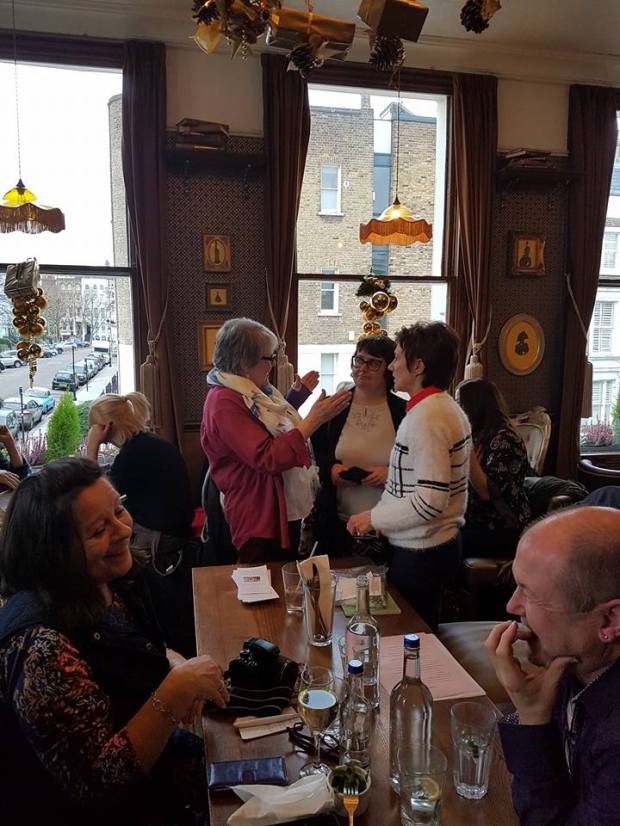
Gill talks with Dawn and I at the BH event, image taken by Paula Readman

Gill James talks with Dawn Knox and I at a networking event held by Bridge House Publishing last December. Am glad to report Dawn will also be in the Waterloo Festival Anthology. Image from Paula Readman and thanks to her for permission to use it.

Paula Readman, Dawn Kentish Knox and Allison Symes and books - with kind permission from Paula Readman - Copy

Paula Readman, Dawn Knox and I at the recent Bridge House celebration event. Many thanks to Paula for the image. Also Paula is another winning entry for the Waterloo Festival.

20171202_160214

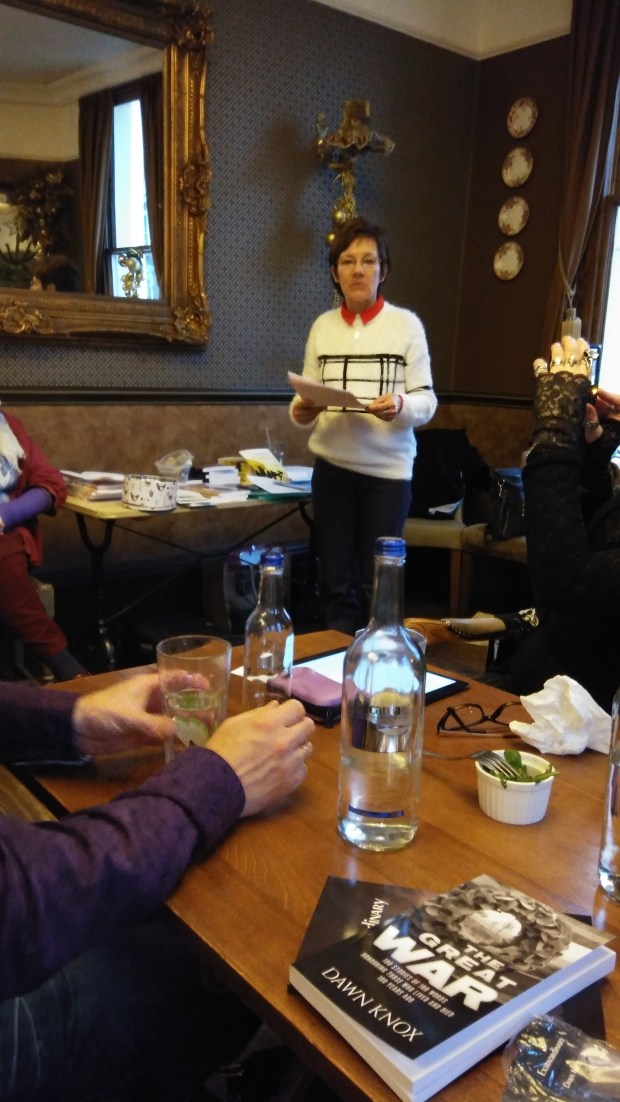
Dawn Kentish Knox, fellow flash fiction writer, reads some work from her excellent book, The Great War. Image by Allison Symes

Lovely having an appreciative audience, pic taken by Dawn Kentish Knox

I read three stories from From Light to Dark and Back Again. Many thanks to Dawn Kentish Knox for the picture!

Book Buying News!

From Light to Dark and Back Again is available from The Book DepositoryDelivery time on the paperback is 1 to 3 business days.  As ever, reviews are always welcome in the usual places.  The great thing is reviews do not need to be long but they all help the writer, even the indifferent ones!

Fairytales with Bite – Flash Fiction and Fairytales

Flash fiction is an ideal vehicle for fairytales.  Why?  Because the best fairytales set up their world quickly, have a definite conclusion, and often pack a powerful punch.  Flash fiction does this too so to my mind flash and fairytales are a match made in writing heaven.

Flash fiction has to be character led due to its limited word count but you can set that character wherever and whenever you wish.  A few telling details can set up a magical world quickly.  For example from my George Changes His Mind (in From Light to Dark and Back Again), I set up a magical world with the opening line “He refused to kill the dragon.”  The telling detail there is in one word – dragon! The story goes on to show what happens and that is the important bit of the story after all.  I don’t need to use thousands of words setting up the magical world in which this is set.  This is not crucial to this story.  What matters is it IS in a magical world and what George goes on to do or not do.

A lot of my stories are either reflections of a fairytale world or set in it and they are great fun to write but I always focus on what the lead character is like.  That is the crucial point of any story I think but in flash where every word must work hard to earn its place to stay there, it is even more so.

This World and Others – Stand Alone

Part 2 of my CFT mini series on The Joys and Challenges of Writing Series Novels looks at, amongst other topics, how to ensure a book stands alone given no series novelist can know at which point a reader will discover their writing.  It is highly unlikely to be book 1.  Indeed I’ve discovered series at the mid point! Many thanks again to my marvellous panellists – Jennifer C Wilson, Val Penny, Anne Wan, Wendy H Jones, and Richard Hardie – for some great insights.  Very happy to recommend their books to you too.  Great reads one and all albeit for different audiences!

It is true that every writer stands alone, even those that collaborate as they have to go off to write “their bits” before coming back and swapping notes with the other one(s) in the project.  We have to judge whether our work is strong enough to submit and, if there is a choice of places to submit to, which is the best one.  We have to judge whether we have edited a piece enough or if it still needs work.  The call is with us and we are going to get it wrong.  The joy, of course, is when we get it right and a piece is published.

This is where meeting other writers, whether at conferences, online, at courses etc., is invaluable.  There is nobody like another writer to know exactly how it feels when you’re struggling to get the words out or who knows the joy of the words pouring out and work going well.  You do have to share this sometimes for the sake of your own sanity!

I learned a long time ago no writer is a competitor to me.  I write as I write.  I cannot write as you would.  We all bring our unique perspectives to what we write – and that is the great thing about it!

This slideshow requires JavaScript.


Time Pockets and Titles

Facebook – General

Managed to draft a little non-fiction whilst out and about today. I love Evernote and my smartphone! Looking forward to the Association of Christian Writers’ Day on 20th October. As well as hearing inspiring speakers and learning so much there, the train journey to and from is also very useful for getting some more work done!

I learned a long time ago it pays to use whatever pockets of time you have to write. Those pockets mount up literally over time and I’ve learned to adapt. If I’ve got 10 minutes, say, I’ll use that period to brainstorm ideas for stories and CFT posts. If I’ve 30 minutes, I’ll draft a couple of flash fiction stories (though I will edit separately later).

Favourite things about titles? I love titles that can carry more than one meaning or take the reader in more than one direction. (It also has the advantage of being a wonderful shortcut when writing flash fiction – think of all those words saved!).

I love titles that can conjure up the mood of the story to come (and usually it ends up conjuring up the genre too). I like those titles where an author has taken a well known saying or proverb and twisted it to suit their purposes. (I do this too). That triggers instant curiosity in me to find out whether the story delivers on the promise of that title. I’m glad to say the vast majority do.

This slideshow requires JavaScript.

I sometimes use spider diagrams to help me work out the best ideas for a story. This technique is most useful when I’ve got a promising title to work with but want to work out all possible options coming from it. (I want to make sure I don’t miss any and also not to go with the most obvious option).

There is something about seeing a diagram that encourages lateral thinking. Also flowcharts could work well too.

Sometimes photos can inspire story ideas. If you have a family portrait, who are they, is there anyone missing from the picture (and if so who and why), and what led up to the portrait being taken. Was everyone happy to take part or is the portrait a picture of a group hiding secrets and resentments? Plenty of food for thought there I think!

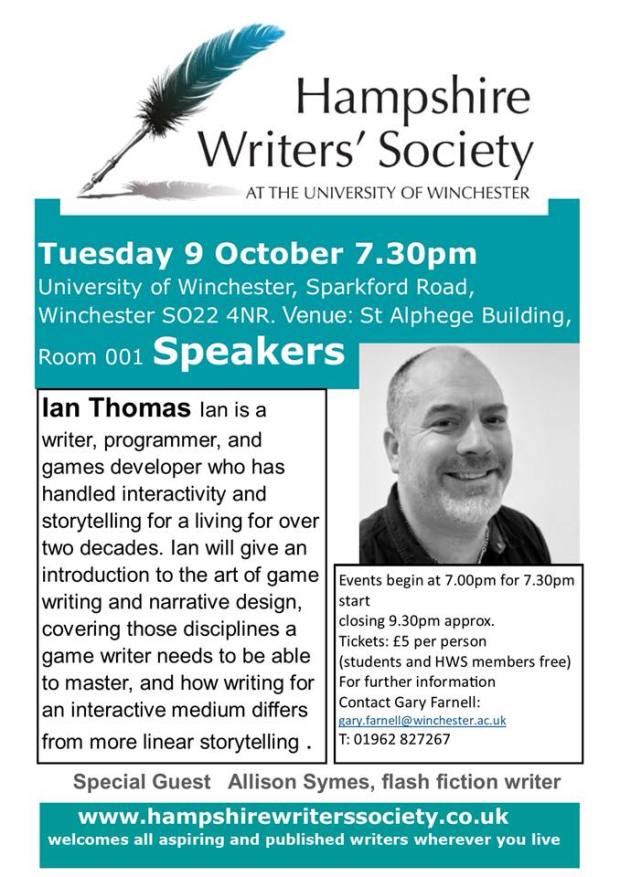
Many thanks to Peter Hitchen and the Hampshire Writers’ Society for an excellent summary of last Tuesday’s event.

What was fascinating from my viewpoint was that with flash fiction, you have to leave gaps for the reader to fill in with rheir imaginations. You give them the telling details, the what they need to know, and they do the rest. You could call it interactive fiction.

This tied in beautifully with Ian’s fascinating talk given ruthless editing and leaving the gaps is crucial to games writing too.

Again, many thanks. It was a great evening.

POSTER SHOWING ALLISON AS GUEST SPEAKER AT HWS OCTOBER 2018

P1100232

Many thanks to the Hampshire Writers’ Society for the image and to Peter Hitchen for the great write-up.

Hampshire Writers’ Society have kindly put up a great summary of last Tuesday’s meeting where Ian Thomas, games writer, and I were speaking. Many thanks to them!

My CFT post this week will be part 2 of The Joys and Challenges of Writing Series Novels. Once again, thanks to my guests, #JenniferCWilson, #ValPenny, #AnneWan, #WendyHJones and #RichardHardie. More great insights here which we all hope will be encouraging to other writers. Link up on Friday.

Making good progress on my third collection of flash fiction, though I think it is the way of things that progress is never as quick as writers would like! Have edited a novel I wrote ages ago and need to put those amendments in, so hope to get on with that soon too. Any chance to get bored? Not a bit of it and that’s just how it should be!


Facebook – From Light to Dark and Back Again

Flash fiction may be short but it should still reveal character and, with that, something about the human condition.

What makes you hiss the villains in stories or cheer on the heroes/heroines? Their characters, as well as their actions, have you reading on and on to find out what happens. One of the things I love about fairytales is generally justice will be done in some way by the end of the story. We all know that so often doesn’t happen in life.

Ultimately, a story should leave you wondering whether YOU would do as the lead(s) did in the tale if you were facing those circumstances or if your actions would be somewhat different. (And what WOULD you do instead? A story to be written there perhaps).

This slideshow requires JavaScript.

I’ve occasionally used alliteration in my story titles (Telling the Time in FLTDBA) but don’t use this method much. Not sure why other than that I absolutely love using well known sayings, proverbs etc as my source of inspiration for titles. (Often make great themes for the stories too of course).

I suspect though that alliteration is probably best treated a bit like chilli powder. Use alliteration to attract attention to your story, it can and SHOULD liven things up, (and ensure your tale delivers on the promise given by the title).

However, too much of it and you will regret it (and this comes from someone who DID put too much chilli in a con carne once. Once done never forgotten, trust me on that!). From a writing viewpoint, I suspect too much alliteration will simply become tiresome and would look gimmicky, definitely things to avoid.

Have fun with flash fiction and experiment with the form. It can be written poetically. It can be all dialogue. It can be all narrrative (though I think all dialogue is easier to do and easier to get a good pace continuing throughout).

Then there are the one line stories, the one paragraph tales and so on. Have fun experimenting with the mood of the story too. As with any story, your characters are going on a journey. It’s just that in flash it’s an abrupt one!

Set your stories in the present day, in the past, in the future. Set them in this world or in something made up. Have characters you love and those you loathe.

Above all, enjoy your writing. There really should not be a dull minute!


When a writer creates a world, you usually think of epic stories (such as sagas, fantasy etc) where that creation runs to several tens of thousands of words! Not the case in flash fiction where you might have tens of words at best and that’s it! Quite a difference…

So what are the telling details then that can conjure up a world in such few worlds? I’ve found that showing something of the lead character’s attitude to their world can be revealing. (Said character usually goes on to reveal why they love or loathe it – there’s rarely any middle ground here).

Getting the character to have a “quick look around” and summarise what they see is another good method to conjure up pictures quickly.

Getting a character to query something odd (to them) is also handy. Why is it odd? Do we know what the item is?

In all of these methods, you are following the old maxim of showing and not telling too.

Goodreads Author Programme Blog –

Images and Stories

Can you think of one image that conjures up a story so much so that when you see these images you can’t stop yourself recalling the tale? Some of mine are:-

1. A wardrobe. (Narnia). (Can make life awkward when walking past a furniture shop. I walk past, see the wardrobes and smile, though really I am a bit disappointed if I see someone open said wardrobe, and there are no pine trees, a lamp post, or lots of snow to be seen anywhere! I accept this may just be me).
2. A phone box (Dr. Who – and do check out the novels. They’re great).
3. A block of marble. (King Arthur). (Sometimes get to see these when visiting historical buildings, cathedrals etc).
4. A bow and arrow (Robin Hood – and I still love the Disney version of that).
5. A bonnet. (I instantly think of Pride and Prejudice, though I usually only see said bonnet if going to some sort of exhibition).
6. A cigar. (Hamlet – yes I know! I AM old enough to remember the advert for Hamlet cigars but these days I see the product and think of the wonderful production of Hamlet I saw with Benedict Cumberbatch in the title role. I have at least gone upmarket a bit!).
7. A typewriter. I think of P.G. Wodehouse and his wonderful Jeeves and Wooster and Blandings stories in particular here.
8. White and red roses. I think of The Daughter of Time by Josephine Tey which is a wonderful read and made me change my view on Richard III.
9. Daffodils. Yes, Wordsworth’s poem comes immediately to mind. A story captures a moment in time for a character but poems can as well even if the “character” is the poet and you are sharing with them one of their life experiences.
10. A picnic. Conjures up images of the Famous Five by Enid Blyton – and yes I’m partial to ginger beer too.


Joys and Challenges

Many thanks to the Hampshire Writers’ Society for making me so welcome on Tuesday night.  Also thanks to those who have liked or given other positive feedback via my Facebook pages on my talk.  Much appreciated.

thank you text on black and brown board

Thank you, HWS! Image via Pexels

HIGHS POST - An inspiring thought

Indeed! Pixabay image.

HAMPSHIRE WRITERS PICTURE OF ALLISON

Many thanks to the Hampshire Writers’ Society for their kind permission to use this photo.

Facebook – General – and Chandler’s Ford Today

My CFT post this week is part 1 (of 3) looking at the joys and challenges of writing series novels. My panel joining me for this are #JenniferCWilson, #ValPenny, #AnneWan, #WendyHJones and #RichardHardie. Between them they cover crime fiction, children’s fiction/YA, historical, ghost and timeslip! Some great insights here with more to come over the next couple of weeks.

This slideshow requires JavaScript.

Many thanks to all who sent in likes, encouraging comments etc following Tuesday night’s talk at the Hampshire Writers’ Society. All very much appreciated.

I know that some would like the links for some of the competitions/markets I mentioned. I list only a few below. I hope you can see these as a useful starting point.

http://www.flash500.com/index_files/flashfiction.htm
You do have to pay to enter this one but the competitions are quarterly and on an open theme so if you miss one date, put a story in for the next one!

http://writersfestival.co.uk/competitions
This is for Winchester Writers’ Festival and lists all their competitions. Great to now see flash fiction listed here.

http://www.paragraphplanet.com/submission.php
Free to enter. Always looking for submissions. Want to get around to trying this one myself!

Cafelit – give website details and submission details
http://cafelit.co.uk/index.php/submission-guidelines-2
I started writing flash fiction thanks to their 100-word challenge but do visit the site for a wealth of stories and styles.

Writing Magazine
For their 750 words and 1000 word competitions but very much fits into flash fiction territory. Keep an eye on their website and, of course, the magazine itself.

Earlyworks Press details
http://www.earlyworkspress.co.uk/Competitions.htm

And don’t forget The Bridport Prize, the Bath Flash Fiction Award etc etc. Definitely worth scanning the net every so often to see what is out there.

Trust this helps – and just to finish, something I didn’t have time to share on Tuesday. Two one line stories which, in different ways, conjure up a whole world of fear! You tell me which is the most frightening…

1. The lion ran straight at you.
2. The dentist will see you now.

Well?

Many thanks to the Hampshire Writers’ Society for making me so welcome as guest speaker at last night’s event. Much appreciated.

I discussed what flash fiction is, what I love about it, why I think all writers should try it, and a few hints as to possible markets and competitions – in about 15 minutes! Mind you, isn’t it appropriate that a flash fiction writer keeps her speech short!!😁

The main speaker was Ian Thomas, games writer, (founder of Talespinners – stories for video games etc) and his talk was illuminating as to what is needed in this field of work. What was interesting was two skills needed in flash fiction writing – the ability to edit ruthlessly and the need to leave gaps for readers to use their imaginations and fill in – are both vital for games writing too.

Facebook – From Light to Dark and Back Again

As part of my talk at HWS yesterday, I discussed what I love most about flash fiction. One aspect is that it is proof you can make a huge impact on your readers but don’t need thousands of words to do so. I’ve read many a thoughtful flash fiction piece which would have LOST impact had it been a longer work.

I find I am always thinking about what impact I want my stories to have on readers (or those I’m reading my work to, come to that!). So even as I am writing the story, I am trying to engage with a potential audience. I think it is a good mind set to be in. It helps make it easier for me to cut out the inevitable waffle that does creep in to any draft writing I do. I have a tendency to overwrite, which is okay. That can be cut after all. But I always DO have to cut and that is just one of those things.

It’s a good thing to look at what your writing weaknesses are (in my case, overwriting) and then work out strategies to deal with them. I accept I overwrite, I get the draft down and then I ruthlessly prune back. Problem solved. The great joy of the first draft is only I get to see it!

If you’re having a brainstorming session for story ideas, how about trying a random word generator?

Weave, say, the first three words you come up with into a story. Having a quick look on the net, I found one of these that lets you choose how many words and the first and last letters of the words. You could even select the number of syllables or word length! I chose the first letter of a and the last letter to be t, and a word length of six letters. The words that came up were:-

appointment
accountant
appoint

So what can be done here? How about:-

A QUESTIONABLE CHOICE

It was a grim day in the magical realm when the Dark Lord decided to appoint an accountant. This was not the way things were done here. The Dark Lord was supposed to rob and plunder and then spend his ill gotten gains in a frenzy. The appointment even made the headline news. People dared to question what the Dark Lord was doing and ask what would happen next.

Allison Symes – 11th October 2018

Naturally you can expand this out to trying the first five words you come up or vary the syllable and/or word length, but there is a lot of fun to be had here playing with words and ideas. When is that ever a bad thing?!

Many thanks to #HampshireWritersSociety for taking this picture of me (see top of tonight’s post!) speaking at their meeting last Tuesday (and for permission to use it). I usually take my own pictures of my book stall etc at events and so on but it’s a bit tricky doing it when you’re the one who’s speaking!

One thing I love when talking about flash fiction is getting to read some of it as part of this. It is by far the best way of showing people exactly what it is and, of course, does not take too long. It also mixes up your talk with some storytelling (and I know I love listening to this sort of thing when I’m at other writers’ talks etc).

Says it all really. Image via Pixabay.

Says it all really. Image via Pixabay. And am glad to say my poorly border collie, Mabel, has very much been showing this spirit.

Never give up, work hard, be disciplined... all valuable traits for success, whether you're a tennis player, a writer or a character in a story! Image via Pixabay.

Never give up, work hard, be disciplined… all valuable traits for success, whether you’re a tennis player, a writer or a character in a story! Image via Pixabay.

Fairytales With Bite – Story Loves

What do you love most in a story?  I look for the following:-

  1. Gripping characters – I’ve got to really root for them to succeed or get their just desserts for me to stay with them during the story.
  2. Good pacing – What pacing is required obviously depends on the type of story but generally I’m looking for a pace that keeps the tension up until the end.
  3. Unforgettable settings – This doesn’t have to be an invented world (though it often is).  Here I’m looking for the setting being appropriate to the story and characters and be a place I’d love to visit or equally be glad I’m nowhere near.  The latter depends on the type of story but whichever way it goes, the setting has to provoke a reaction in me.
  4. Entertaining dialogue – Sure sometimes this will be funny dialogue (when appropriate) but even when not I want to feel as if I’m eavesdropping on a conversation that I have absolutely got to finish listening to!
  5. Strong Resolution – The story definitely has to end.  Not on a cliffhanger – that should be for the chapters leading up to the end in a novel or in the middle section of shorter works before the issue is resolved.

This World and Others – Joys and Challenges

My CFT post this week is the start of a three-parter looking at The Joys and Challenges of Writing Series NovelsMany thanks to my panel of Jennifer C Wilson, Val Penny, Anne Wan, Wendy H Jones, and Richard Hardie for their great contributions.  Am looking forward to sharing the rest of the series over the next couple of weeks.  Between them, these fine writers cover children’s/YA, crime, historical, ghost, and timeslip!  (Some of them cover more than one of these!).

The title of this piece led me to think about the joys and challenges our characters face. How do they handle these?  Which do they cope with better?  (Not everyone handles happiness that well – they literally don’t know how to cope with it or live in such dread that the happiness is going to end any moment, any enjoyment of it is lost!).

Are others pleased for your characters in their joyful times or is there resentment there (openly or hidden)?  In the challenges your characters face, do they have friends and family to support and encourage?  When your characters overcome a challenge, do they go on to learn from the experience or does their success change them (and not necessarily for the better)?

This is where the core central values and attitudes your characters have really matter.  Someone who is generally a decent character is not going to upset others by showing off about their successes.  They will have friends who are genuinely pleased for them.  Someone who aggravates others will only find said other characters will be rooting for their downfall!

This slideshow requires JavaScript.


STORY PROMPTS

Facebook – General

When do you know you are really going to enjoy the story or book that you’ve started? For me it’s by the end of the first page. If I’m not gripped by the story by then, I’m unlikely to go much further with it.

I’m pleased to say though that there have not been many books or stories which I’ve given up on. This is why my To Be Read pile is as big as it is! (It’s not that much smaller on my Kindle either but at least that won’t topple over under the weight!).

By the end of the first page, I want to know who the lead character is going to be (even if they are just referred to at this point) and some idea of what the central conflict is going to be about. Then there has to be the “I’ve GOT to find out what happens next” moment. Without that, I don’t read on.

What kind of story prompts do you prefer? Pictures? An opening line? A finishing line?

I’ve used all in my time (and plan to keep on using them too), but my favourite is the promising opening line. I love finding out where that line can take me. I also believe if the writer is having a whale of a time writing the story, something of that enjoyment will show in the tale itself. I think the writing flows better.

Having said that there have been times when what I thought was a promising line turned out to be a dead end. I see this as a false start scenario and I abandon the tale and start again. I have tried seeing if I can make what I’ve come up with better but the answer is inevitably no as I think it is clear to me that my heart wasn’t really in it. I think that can show through in the writing too.

The great thing with the latter situation is if, later, an idea comes to you that resolves the problem with the story (or you think it will), there’s nothing to stop you digging that tale out and giving it another go. I suppose what I’ve learned here is not to panic if a story doesn’t work out right. Go on to the next one. Come back to the old one if better ideas occur as I’m writing something else (and that happens a LOT. I can be writing my next CFT post when a good story idea crops up. So I pause, jot the idea down, go back to my CFT post and then have a look at the story idea later. The benefit of this is I can take a good hard look at that idea and judge better whether it really is a “goer” or not. As a result, my “abandon a story because it really isn’t working” rate has decreased significantly).

This slideshow requires JavaScript.

Looking forward to being at the Hampshire Writers’ Society tomorrow night to talk about flash fiction.

Also looking forward to the Bridge House celebration in London in December and the Association of Christian Writers’ Day in London later this month.

What with writing and taking the dog out, it’s a social whirl! (I get to talk to lots of lovely writers and equally lovely dog owners. Some of course encompass both roles!).

POSTER SHOWING ALLISON AS GUEST SPEAKER AT HWS OCTOBER 2018

Many thanks to Maggie Farran for the poster.

LIKES POST - editing - Pixabay image

The joy of editing! Image by Pixabay

cropped-cropped-version-of-my-reading-at-railway-station

The Open Mic for Prose night

Many thanks to Geoff Parkes for kind permission to use this shot of me reading at the Swanwick Prose Open Mic Night.

FLTDBA in the Swanwick Book Room

FLTDBA for sale in the Swanwick Book Room. Image by Allison Symes

FromLightToDark_back_medium

Back cover of FLTDBA. Image by Allison Symes

BEING THANKFUL - On writing or being appreciative - image via Pixabay

Always good advice. Image via Pixabay.

Am writing this early as I don’t expect to have a lot of creative energy left after the Hampshire Writers’ Society meeting tonight! (But in a very good way of course…😀)

Later in the week, I will be sharing on Chandler’s Ford Today Part 1 of a three part series on the joys and challenges of writing series novels. Many thanks to #JenniferCWilson, #ValPenny, #AnneWan, #WendyHJones, and #RichardHardie for taking part in this. Link to go up on Friday but what I can reveal now is their thoughts about this topic are riveting. Very much looking forward to sharing this over the next three Fridays.

The lovely thing is there is a wide range of fiction represented here from children’s and YA to crime to historical fiction with a twist. Much to learn from here.

I think one of the best things about writing is you never do stop learning how to develop and improve what you write. Nor should you want to stop seeking to improve and develop! As well as making you a better writer, this kind of thing is so good for your own well being anyway.

Facebook – From Light to Dark and Back Again

Just because a story is short, it doesn’t mean it lacks insight. Far from it. I love well written flash stories for the intensity of the impact they make and the characterisation in them has to be good.

You are relying, rightly, on the character to “carry the story” so they’ve got to be strong enough to do so. Strong enough in the sense that there is enough about them to interest the reader. Strong enough to make the reader care about them and so on.

The great advantage flash has, of course, is that there is NO padding whatsoever. It really does cut to the chase.

Every story should reveal something about a character and their development (or what the lack of that does to/for them).

Flash fiction does that too but in a greatly compressed word count. This is why flash fiction can have such a big impact on readers. If your story is a grim one say, there is no room to “soften the blows”. What the reader sees is what they get and so on…. very much direct and to the sharp point.

Equally flash fiction can be great for a much needed laugh as ending a story on a punchline can work well. (Has to be a great punchline though!).

One of the most difficult things about flash fiction is working out where to stop. It is very easy to come up with, say, a 250-word story, which you think needs a little addition or two and then you have a 500-word tale. Well, that’s okay, isn’t it? It’s still flash fiction after all.

Well, yes and no.

Yes, the longer version would still be flash fiction.

No, in that the ideal length of your flash story should be when you have said all that is needed to be said and not a word more.

I gauge what the correct word count is for a story by looking at the impact the story has. If at 250 words it doesn’t have enough impact, then yes I will add to it but only until I’ve got the required emotional resonance from the character(s). I will then edit the piece until I still have that resonance without loss of quality of the story.

My worry about expanding a piece is you could easily dilute the impact, which is something you don’t want. Every word in flash fiction has to justify its place in the story, otherwise out it goes. You do learn to be ruthless about cutting when writing flash but that’s no bad thing.

One useful thing about flash fiction is I’ve often found the best way to explain it is to read a couple of examples. The ultimate in showing not telling perhaps! Also, it doesn’t take too long and you get the idea very quickly. It shows there is a proper beginning, middle and end to the story.

What flash fiction must never be is cut-off prose. The story still has to be a complete story in and of itself. That doesn’t stop you taking the basic idea and developing it further.

For example you like the character in your flash fiction so you want to write more stories about them. Absolutely fine.

Likewise, you love your flash fiction story but know it could be developed into a 1500 word or so standard competition entry story where you have the room to put in a sub-plot which you wouldn’t with the short, sharp flash version of it. Again, absolutely fine.

What flash fiction should be is fun to write (and that will mean it should be fun to read too).

This slideshow requires JavaScript.

Goodreads Author Programme – Blog –

Classic -v- Contemporary

Which books do you prefer reading? Classic or contemporary? I love both, naturally. A bookworm isn’t going to worry about when a book came out. They just want the book to be good…

A lot of my contemporary reading is either flash fiction collections or crime novels. (I know: it IS a nice mix! Some of the flash fiction collections, including my own, include crime stories in them).

My classic reading includes Austen, Wodehouse, Dickens, Christie and so on. I like to think of these almost as comfort reading. I know the stories. I know I will love them. It’s what I turn to when life gets particularly stressful. I want a known quantity at that point.

Terry Pratchett deserves a category of his own in that I read or listen to his works when I am in good need of a laugh. He never disappoints!

The flash fiction collections in turn amuse me, scare me, make me think and so on. I’ve got to be ready for the challenge of at least some of the stories in these. And that’s fine. Good stories should make you think (even if they make you laugh or scream as well).

I tend to flit between catching up with lots of book reading, then switching to magazine reading. The important thing? I am reading – and loving it all!


FANTASICAL AND REALITY WRITING

Facebook – General – and Chandler’s Ford Today

My CFT post this week looks at how “fantastic” and “reality” writing feed off each other. No matter how fantastic the world setting, there still have to be elements about it and the characters that readers can identify with. So there has to be some system of government, some rulers and some ruled, some system of food gathering etc etc to help make the story itself believable.

In a well written fantasy story, these elements are hardly noticeable. They are what I call the necessary background structure to make the whole story work. Not only that, literature would be much the poorer without fantasy stories. It would also be much the poorer without good quality non-fiction. And that’s the way it should be.

This slideshow requires JavaScript.

What slogan would sum up your writing style? I think mine would be something like “quirky, sometimes twisted, and often humorous”. Before anyone says that sums ME up quite well, I know!!

Questions never to ask a writer (unless you want to run the risk of having something thrown at you) include:-

1. How IS the writing going? (We want to give you chapter and verse, literally. You want a quick one line answer. No winners here).

2. But editing is the easy bit, surely? After all, you’ve got the writing done. Tidying it up a bit can’t take long, can it?

3. Have you given up the day job yet? (Is there any way of answering this politely and still remain friends with whoever dared ask this? Answers on a postcard….).

4. You don’t mind if I borrow your book from the library, do you? (Actually, no. We want to support the libraries. However, we would prefer it if you bought the book – bills to pay and all that).

5. It can’t take you long to write flash fiction/short stories/novellas (delete as appropriate) as they’re all much shorter than a novel. That’s where the hard work is, isn’t it?

(Many thanks to all who sent in wonderful comments on my Facebook page and to those pages where I shared this.  Glad to know I’m not alone on this topic!).


Delighted to say I will be a guest speaker at the Hampshire Writers’ Society meeting at the University of Winchester next Tuesday, 9th October. It will be nice to be back at Winchester again as I’m normally there for the Winchester Writers’ Festival and it is a long time until next June when it is on again!

I’ll be speaking about flash fiction (and why I think every writer should try it).

(I know I put up this post last time but can’t resist doing so again!  Am looking forward to next Tuesday’s event.  Am nervous and excited about it all at the same time!).

POSTER SHOWING ALLISON AS GUEST SPEAKER AT HWS OCTOBER 2018

Many thanks to Maggie Farran for the poster

Facebook – From Light to Dark and Back Again

Flash fiction writing has taught me so much about editing, but it has also shown me the joy of choosing the right word to make maximum impact. I’ve found that spills over into other writing I do (especially my Chandler’s Ford Today posts), which is no bad thing.

We all know we should put work aside for a bit before coming back to re-read it with fresh eyes but I have found that doing so means you also look at a story and think “I could have expressed that better”. I then go on and do so!

It is true your best ideas and expressions sometimes have to be “teased” out of you. But the great thing is that the more writing you do, the more you’ll be ready for the “well actually this works better than what I had done originally” moment and won’t think twice about changing something.

The latter I think can be a confidence thing sometimes. You do have to have confidence in your own writing ability but also to trust the process – that as you work, better thoughts will come, all of which will help you improve your story and increase its chances of being published.

This slideshow requires JavaScript.

It’s important to mix up the moods in a flash fiction collection. I love volumes of stories to dip into as and when I fancy and what I like to find are tales for all occasions. I will always have a very soft spot for the humorous tale but a well written tragic flash story will move me in a way a funny one can’t (and perhaps shouldn’t).

Also given flash fiction has to be character led, and characters all face different challenges, it is not unreasonable to portray said characters in very different moods, which will also affect how you write their stories.

Even in a book which is meant to be sombre, there can be different shades of sombreness in the tales within it. You don’t want to come across in a monotone style. Nor is levity appropriate but I want to see Character A handling a bad situation in this way, Character B reacting differently etc. I will then be intrigued by what makes A and B tick.

As well as mixing the moods of my stories for a flash fiction collection, I like to vary the word counts I use. The majority will be at about the 100 word mark as it is my favourite and the one I seem to gravitate to, but I like to ensure there are some 250, 500 and 750 word stories in there too. For the book I’m currently writing I am also including one line stories.

I love flash fiction collections (not just mine, honestly!), because of their variety. There are wonderful collections out there based on a specific type of flash fiction (usually the 100 or 140 word stories). There are collections with a mixture of length of stories, like mine, but focussed on one theme.

When you’ve not got as much time for reading as you’d like, these books are perfect to dip into. If you like your books electronically, I think flash fiction is wonderful for that. So very easy to read on a screen. And easy to slip into a stocking for that well known festival coming up in December….! (Get the word in early, that’s what I say!!).

Goodreads Author Programme – Blog – The TBR Pile

Confession time. I have a large TBR pile in paperbacks AND on the Kindle. There really isn’t enough time in the day, though it is nice to know I won’t be running out of good reading material any time soon.

Does that mean I won’t want any books bought for me for Christmas or book tokens/cards? Don’t be silly, of course I will!

Okay, I may need to figure out a way of making sure my TBR pile (paperbacks) doesn’t topple over and crush someone (probably me). Or that my Kindle doesn’t explode with the effort of containing all those ebooks for me. But I’ll manage those!

The lovely thing about being a reader and a writer is you’re never stuck for gift ideas, whether you’re dropping hints to your nearest and dearest, or buying for other readers and writers.

As for my TBR pile, back to reducing it a bit at a time (before I inevitably top it up again!).

This slideshow requires JavaScript.

Fairytales with Bite – A Good Fairytale…

A good fairytale should have:-

1.  Believable characters (no matter how magical they are.  There should be something about them that resonates with a reader, which is why magic is NOT the be all and end all situation to your characters’ problems.  There should be things for them to work out without magic.  There should be things about their character which engage the reader so if the old fairy godmother turns up and does work magic for them, your readers are going to be pleased for them rather than see it as a plot device to get your character out of trouble!).

2.  Emotional impact.  Whether this is where your reader ends up screaming at your character to stop being so stupid or laughs with them or cheers when they get their happy ever after, as long as there is some emotional impact, your story is “getting through”.  People will want to read more.

3.  Justice will out somehow.  This is true most of the time.  Stories where the villains win always make me feel uncomfortable.  It just doesn’t seem right.  This is why I love the cliffhanger ending in The Italian Job with Michael Caine.  Even where the villain does seem to get away with it, I like to see some hint that in the future their success may come back to haunt them or they would have done even better had they acted better.  I suppose one reason why I like to see justice of some sort being done is because in life, it so often isn’t like that.  One appeal of stories overall is that they can reflect life as it should be at times – the underdog does win out, wrongs are put right etc etc.  (The other thought here is that perhaps the villain does have cause so are they so much of a villain after all?  Food for thought here I think).

This World and Others – Things You Need to Know about World Building

This is definitely not a comprehensive guide but I list below some useful pointers for you to consider when building your fictional world.

1.  Identifiable Elements
There has to be something about the world you create your readers will identify with, no matter how fantastical the setting.  Worlds have to be governed.  How is that done?  Every living creature needs to eat so how do the characters in your world do this and what is their food?  How are their societies organised?  (There must be some sort of organisation – could anyone survive sustained anarchy?).  These things are what I like to refer to as necessary background structure.  They may not be the main point of your stories but you need to know this information so you can write with confidence about your setting (it is a character in many ways) and that confidence will come through in your writing to your reader.

2.  How things change
A living world adapts and changes due to new technologies, diseases forcing change on society, wars changing the political landscape and so on.  Again these things may not be the main point of your stories but there should be a sense of your world changing and developing as your characters do within it.  It gives the sense that your world really is a live one and therefore infinitely more believable.

3.  Roles
What are the major roles in your world?  How are genders dealt with (and is there any difference in the roles each play?).  What happens to those who won’t accept the roles they’ve been assigned?  (There is always at least one who does this and some fantastic stories emerge from that).

It would pay to outline your thoughts on these three points before committing to major writing (especially if it’s a novel you’ve got in mind).  Work things out early.  It will save you a lot of time later on.  Good luck!