Tried and Tested – and Book Offers!

A very busy night tonight and a special post about book offers too and I will start with those I think!  Also included this week is a link to my guest spot on crime writer Val Penny’s wonderful Book Review blog.  Many thanks to her for hosting me.

BOOK OFFERS!  ONE WEEK ONLY.  ENDS 18TH JANUARY 2019

Book news! I’m Bridge House Publishing/Chapeltown’s author of the week and there are free books up for grabs AND special offers on others. What’s not to like?

I’ve had the great pleasure of being published by BHP/CB in various anthologies as well as with From Light To Dark and Back Again. These form the basis of the package below.

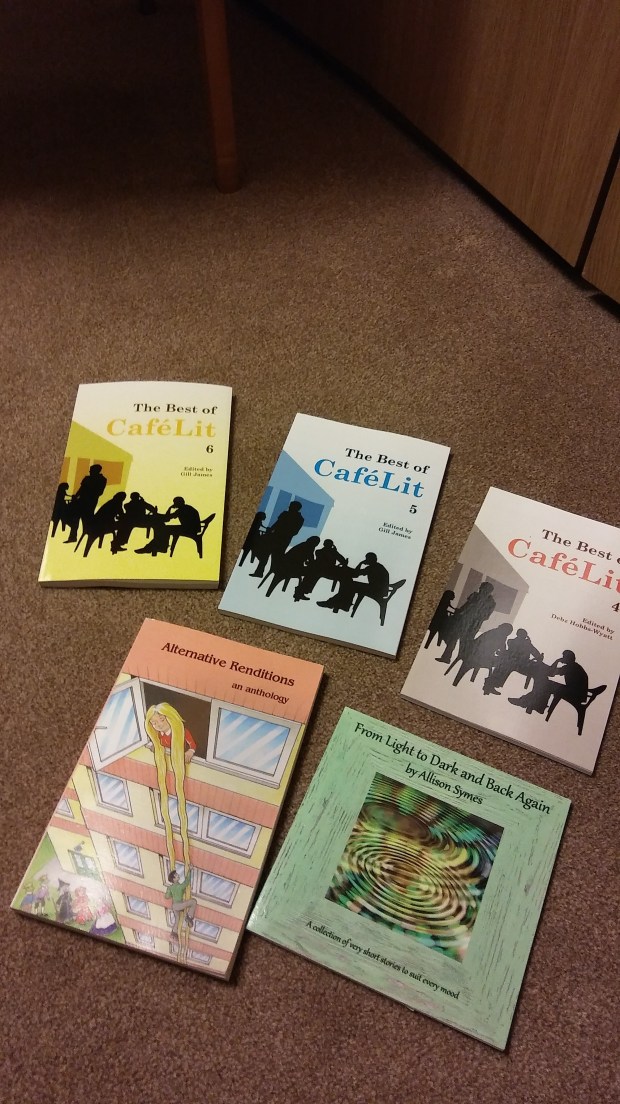
BOOK PACKAGE: There are SIX, count them SIX, publications where I have work on offer for £4.00, all as mobi-files. This includes To Be…To Become (the Waterloo Festival competition, anthology), Baubles (BH anthology), The Best of Cafelit 4, 5 AND 6 and From Light to Dark and Back Again, my first flash fiction collection.

And for those of you who would like print paperbacks there’s an offer for you too.

PAPERBACK OFFER: My first published story was A Helping Hand in Bridge House Publishing’s Alternative Renditions. That isn’t available on Kindle BUT is in paperback and that along with From Light to Dark and Back Again is on offer at a mere £7.00 for the two!

FREE BOOKS! BUT YOU HAVE TO BE QUICK.

I’m giving away one signed copy of:-

From Light to Dark and Back Again AND
Alternative Renditions OR
Baubles OR
One of the Best of Cafelit books I’m in.

First come, first served, naturally. Also one book per customer.

If you’re interested email my lovely editor, Gill James, at editor@bridgehousepublishing.co.uk with your contact details. Also let her know which of the books you would like and Gill and I will take things from there. I’m looking forward to getting some books off in the post next week!

So two lucky people can be in for a free read! What are you waiting for? Gill is waiting to hear from you!

All of the above books are available on Amazon.

And if you would like to try some of my work out first, head over to Cafelit at http://cafelitcreativecafe.blogspot.com/…/l…/Allison%20Symes

Do check out the other wonderful stories here. You’re in for a great read, I promise.

This slideshow requires JavaScript.

Facebook – General – and Chandler’s Ford Today

Busy night tonight but fun! Hope you saw the book offer posts earlier. Meanwhile back to CFT and I’m glad to share my Tried and Tested Writing Tips this week. Hope you find it useful.

This slideshow requires JavaScript.

Will be a busy day tomorrow. As well as my usual CFT post (all about tried and tested writing tips), I’m Bridge House Publishing/Chapeltown Books author of the week and will have news of book offers so stay tuned.

Re my CFT post: I’ve picked those tips I use most often and go into detail as to why they are useful.

Absolutely delighted to have been guest blogger on Val Penny‘s Book Reviews blog. Many thanks to her – it’s been a good week writing wise when it comes to getting the word out there!

And talking of words, the ones I’ve found most helpful are the ones that encourage when all that seem to come in are rejections etc. This is why you need writing friends. We know what it is like – both the joys and the down sides. It is a roller coaster ride but nobody says you have to be alone on the thing!

Am delighted to share the link to the great blog from crime writer Val Penny. The fact that I am her guest on it tonight is not at all coincidental!

Many thanks, Val, for the invite. The questions were great fun to answer. Val and I met at Swanwick Writers’ Summer School (or more accurately just outside Derby Railway Station just ahead of us both going to Swanwick!) and we’ve been great friends ever since.

It is also lovely being on the receiving end of questions too!

Facebook – From Light to Dark and Back Again

I’m due to be Bridge House Publishing/Chapeltown Books author of the week. News of book offers tomorrow.

Getting the balance right between writing new material, revising and improving material that has not yet found a home, and marketing has never been easy to get right. Has there ever been a writer who doesn’t feel there is always something they could be doing better in any of these departments? I don’t think so!

One advantage to flash fiction of course is it can be a great way of getting work done and “out there” while working on longer projects. (And if said work is published, you’re building up your writing CV too).

What questions would you put to your characters to get the best out of them before you write their story?

One of my favourites here is “what drives you?” I use it to dig deep into a character because there will be an answer that is something nobody would mind revealing – the public face, if you like.

However, it is the answer the character (and we as individuals) try to keep to ourselves that is the really interesting one to work with! It can also reveal things about our characters that make us realise we can do so much more with them. It IS worth digging that bit deeper to get to these points.

Your stories will be deeper and have more impact as a result – even the shortest of flash fiction stories will benefit. If I know my character thinks they’re capable of, say, robbery, but I dig deeper and find in certain situations, they could kill, guess which story I’m going with!

You DO want to dump your characters right in the mire and put them under as much stress as possible and really see what they’re made of. Let the drama play out. Have fun with this, I do! (Oh and nobody said writers have to be nice to their characters, often it’s the opposite in fact!).


Many thanks to #ValPenny for hosting me on her Book Reviews blog. It was great fun answering the questions.

Questions like these are really useful for making you evaluate why you write and whether the “how” could be improved. (The answer is almost certainly “yes” to that by the way!).

Fairytales with Bite – Storytelling

Storytelling is one of our oldest traditions of course. You can understand the appeal of fairytales especially when it comes to the oral storytelling tradition. A simple plot, a structure that works, a clear goodie and baddie, and a happy ever after ending. Perfect way to end the day!

Now, of course, we expect our characters to be more nuanced. There is no such thing as the perfect hero. Villains have to have good (and understandable) reasons for acting the way they are (and that can include the fact they simply enjoy being evil. To them, that is reason enough!).

What I love about stories is that there is no one perfect format. I love books in all their forms but totally understand why audiobooks work for some, whereas the print format doesn’t. Our focus as writers is to come up with stories that can work in several formats. Our focus is to entertain. I’ve never understood why some look down on escapism. The world is sad and bad enough to make a wish to escape understandable. After all why did our cavemen ancestors tell stories? To remember what was important. To bring the community closer together. To escape the cares of their day and the ones to come for a while.

So as a writer then I want my characters to appeal to readers. I also want to drop my characters right in it whenever I can. I want my books to engage people. It’s a good thing to aim for: to improve your storytelling as much as possible. You discover better ways of expressing things, learn what works and what doesn’t. Enjoy your storytelling and relish every moment of it.


This slideshow requires JavaScript.

This World and Others – Tried and Tested

My latest CFT post is Tried and Tested Writing Tips, which I hope you find useful.

How are your characters tried and tested?  Do they pass the tests you set them?  In almost any story you can think of, it is only when the characters are put right through the emotional wringer, do you see what they are capable of and where their limits are.  That is also where sidekick characters are useful – to help see your leads through to the bitter end and to get them through that “about to give it all up” moment.

Testing doesn’t need to to be overly dramatic either.  It can be as simple as a character having their patience tested by a relative who is trying to goad them (deliberately or otherwise, it’s not always consciously done).  Your character is very patient to begin with, then they become slightly less patient as time and the goading continues, and so on before they snap or do something they would not ordinarily have done.  Your character may be aware of this process so what do they do to try and fight it?  To not give in to that urge to snap no matter what the provocation?

Think about what would stress your characters out.  Think about their coping mechanisms.  What would happen if they failed or weren’t available when needed?

Have fun finding out!

Writing Wish List, Why Write Flash Fiction, and Special Offers

Facebook – General

If you could make a writing related list for Santa, what would be on it? I’d ask for:-

1. The ability to stretch time so I can get all the writing I’d like to do in and done! Naturally I would not feel any side effects from this.

2. The ability to spot ALL typos etc before submitting work anywhere ALL the time. (If it is any comfort, most writers spot errors in work later on. We just don’t admit to it! We do feel annoyed at ourselves over them though – very much the “why didn’t I spot that one?” school of thought.

3. To never run out of pens, notebooks, ink cartridges, paper etc and also to arrange for the printer toner NOT to run out half way through a print run ever again. (You do get sick of this happening when it occurs more than once. Trust me on this).

4. To never miss a writing competition that might suit you ever again. (It is difficult to keep on top of them all so help from Santa here would be useful).

5. To never run out of inspiration and ideas and to always follow them through thoroughly.

6. Extra stamina would also come in handy. You need it when the umpteenth rejection comes in during the week.

7. More reviews of my book!

8. For the charlatans in the publishing industry to disappear from it for good so nobody is ever taken in by false promises again. Meanwhile, do check out the Society of Authors and/or ALLI, the Alliance of Independent Authors websites for sound advice on what to look for in publishing contracts, self publishing services etc.

9. To never run out of bookmarks. When I don’t need them I seem to have loads. When I do, can I find any? What do you think?

10. For more independent book shops and for them to thrive and do well.

I’m not putting these in any order of importance though 10 should be very high up on any list to Santa, I think.

Am glad to share, via the link, details of some special offers on Chapeltown Books’ flash fiction collections, including From Light to Dark and Back Again by yours truly.

The offers are open until the end of the week. There are currently 8 books in the Chapeltown series and there is an offer on for all of those. Equally you can buy three or four of them and still have a special offer! This offer is on until 21st December.

Some last minute Christmas present ideas, everyone?

Hope that whatever else is amongst your presents this Christmas, some good books are amongst them!

This slideshow requires JavaScript.

The YouTube below shows the books produced by Cafelit/Chapeltown/Bridge House during the year. A lovely selection.

I was in the To Be…To Become ebook produced by Bridge House. This contains the 16 winning entries to the Waterloo Arts Festival’s first writing competition. I hope they go on to have others!

What can be confirmed is there is a lovely variety of books and stories to suit all tastes here.

When do you know a story is really special? When you can’t forget the characters.

For me, story has always been about finding out what happens to the characters. I don’t necessarily need to like them (though most of the time I do) but I do need to be intrigued enough to find out what happens to them. So then there has to be something about the characters I can either identify with or which hits my “curiosity switch” and keeps that pressed down so I have to keep reading!

A good plot can be let down by characters that aren’t strong enough for it (and this means the writer hasn’t got to know his people well enough before writing about them). Great characters will lift any story they’re in. Great characters will generate plot. Imagine the chaos a devious character can cause when they set out to cause mischief deliberately. All sorts of stories can come from that, humorous and otherwise, but the character has to be well portrayed for that to work.

Facebook – From Light to Dark and Back Again

Time for some micro Christmas stories then:-

1. The innkeeper smiled, having seen his guests to the last available room. Nobody else would be disturbing his sleep tonight then.

2. Scrooge grimaced as he walked home, having heard some youngster tell a snippet of a ghost story. Ghosts! Whatever next?

3. In the bleak midwinter, they could have done with a snow plough.4. Rudolph the red-nosed reindeer found that telling everyone he was suffering from a nasty cold stopped the awkward jokes about what he was adding to his water trough to generate said red nose.

5. Frosty the Snowman was the first to admit he really could not appreciate the benefits of central heating.

Allison Symes – 15th December 2018

This slideshow requires JavaScript.

Never worry about overwriting a story. That overwriting can and should be cut later. Usually this is a case of sharpening up phrases etc. I like the creative aspect of that side of editing where you are happy with your characters and story but know you can express things better than you have done with your first draft.

For me, it is far more of a problem when, on odd occasions, my story is too short. Not a problem for my flash fiction but it can be for standard length short stories (usually 1500 words or so). This always means one thing in my book, pun intended (!), and that is my idea simply wasn’t strong enough. I needed to do far more outlining to see where the idea could take me before I committed to writing it and that process would have shown up inherent weaknesses in it.

So do outline. It can save you a lot of grief later.

Reasons to write flash fiction:-

1. You learn how to edit well.

2. You learn to be ruthless when cutting out anything that is not moving the story forward.

3. You really do watch your word count. (This pays off for other forms of writing competitions too).

4. Given flash fiction markets and competitions have different requirements (for example some include the title as part of the word count, others specificially do not), you learn to make sure you ARE following the right rules for the competitions you’re interested in.

5. It is a great way to get work out there while you are working on a longer project.

6. There ARE more competitions and markets out there now so there should be at least one to suit your style of writing.

7. You have to write character driven stories but there’s nothing to stop you setting that character in any time, genre, or setting of your choosing. You are definitely NOT stuck to one genre here.

8. Flash fiction can make a great warm up writing exercise ahead of a longer project. The great thing is you can now do something with what your produce from those writing exercises!

9. You learn to write precisely because you are looking for the maximum impact on your readers for the minimum word count . This is a fantastic discipline which can be transferred across to other forms of writing you enjoy.

10. It’s fun! I’ve loved the challenge of writing to 100 words, to 75, to 50 etc. Flash fiction can be addictive!

This slideshow requires JavaScript.

F = Fantastic Fiction
L = Lines that Hit Home
A = Amazing Characters
S = Stories with Impact
H = Humour and sometimes with a twist too.

F = Fairytales with Bite
I = Imagination is fired up!
C = Can cross genres
T = The word count is the main thing to watch
I = Insist on ruthless editing to cut all that is unnecessary
O = On the look out for markets and competitions
N = Never underestimate the time taken to craft your tales!

Allison Symes – 18th December 2018

Goodreads Author Programme Blog – Christmas Wish List

Naturally I’m assuming books are high up on your Christmas wish list. I would like to add to that though the following:-

1. More time to read!

2. More time to re-read old favourites. Does anyone else feel a pang of guilt sometimes when you really want to go back to a novel you’ve read a few times when you know there are so many other books you really should be getting on with and reading? That you actually want to read but the “clarion call” of the old favourite just can’t be resisted.

3. Being able to read “children’s” books without feeling guilty or embarrassed. Incidentally I understand the point of more grown up covers for certain books to get around this issue but for me this doesn’t really work. I like the original covers far better in the majority of cases and want to stick with those!

4. That all adaptations of stories and books do justice to their source materials. Too many don’t!

5. That I can always find a bookmark when I want one. (I either have LOADS when I don’t need them or none at all. Don’t ask… it is the way it is!).

Hope you have a book and story filled Christmas. The joy of the winter months is WANTING to stay indoors and curl up with a good book!

This slideshow requires JavaScript.


Celebrations, Reading Work Out, and Framing Stories

A nice mixed bag tonight I think!

Facebook – General – and Chandler’s Ford Today

My CFT post this week is the review of the recent Bridge House event, Celebrations, Crackers, Chapeltown, and Cafelit, though I’m quite pleased I managed to come up with an alliterative title! I also look at how reading work out is useful to writers, as is listening to others reading their work out. For one thing, you literally hear a story’s rhythm and can apply that to your own stories.

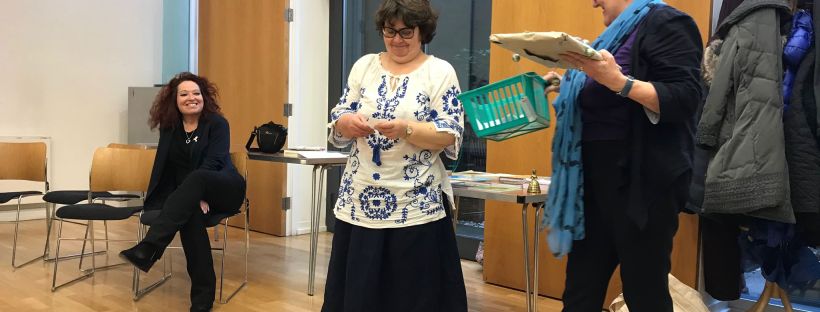
Many thanks to Dawn Kentish Knox for kind permission to use some of the images in this piece. I’ve yet to find a way of reading work out and taking my own pictures of me doing this at the same time! (Oh and before you ask, I am really not keen on selfies!).

This slideshow requires JavaScript.

My CFT post this week will be a look back at the Bridge House celebration event held on 1st December. I’ll also share some thoughts on the benefits of reading work out loud and on being read to, both of which are lovely!

One of the nicest things about this time of year is that it is very much a time for stories, which is a theme I will be looking at for CFT before too long. Naturally, I love the Christian Nativity story but I also love those wonderful tales associated with it. For example, how did the robin get his red breast? By burning himself on a fire he was fanning to keep a fire going to keep the Holy Family warm.

I also like to have a general review of the year (and also a specific writing review. How did things go? Did I achieve all the goals I set myself? What goals would I like to set for 2019 etc?). So that’s my CFT posts sorted until the year end! Just have to finish writing them now…

One of the great joys of stories (both writing and reading them) is their escapism value, especially if the news is particularly grim. That shouldn’t be underrated.

Whether you read or write humour, horror, sci-fi, or what have you, a story, of whatever length, should transport you into its world. You should be happy to stay there for the duration too! That, ultimately, I think is the biggest challenge to a writer. But it’s a great challenge to have a crack at!

Facebook – From Light to Dark and Back Again

I like to choose themes which can be open ended. Love, for example, can obviously provide happy stories. It can also provide tragedies, something Shakespeare took good advantage of in Romeo and Juliet.

I’ve found that picking the theme I would like to use and then deciding on the mood of the story is so helpful in giving me a “frame” for my story. Then the title comes into play and again I try to choose one which is open, unless I specifically want to put a twist into the tale right at the beginning (my Punish the Innocent is a good example of that).

I find it useful to have my “frame” and then write. It helps me focus.

When drafting a story, what is the first thing you are keen to get right?

For me, it’s ensuring I know my character well enough to know how they would react/act regardless of what situation I drop them right in! (Dropping your characters right in it can be a great way of finding out just what they’re made of). I also like to know what would shake my character out of their sang-froid and what their general beliefs are. Naturally, there should then be something to challenge all of that!

I like to use things that inspire me as a source of story ideas. The great thing with this method is what inspires me and how I combine these to create a new tale will help my writer’s voice to come through. Nobody’s tastes and inspirations are exactly the same. The way these are combined will also differ from writer to writer. So list what your inspirations are. Think about how you can use these. At the very least, you should find some great themes emerging. Good luck!

Fairytales With Bite – Why Fairytales with Bite?

It occurs to me I should have written this post long ago but never mind!

I use the phrase “fairytales with bite” as a lot of my flash fiction work, in particular, is set in a fantasy world and I use a lot of irony. There really is a bite to a lot of what I write. I like quirky writing – my own and that of others! I also use twist endings a lot and there can be a great deal of bite behind those. I am, after all, looking to make an impact with my stories.

My catchphrase is also a reaction against those who think fairytales are twee. I know I’ve touched on this topic before, here and on other blogs I’m involved in, but fairytales can show up human nature for what it is and are anything but twee as a result. Think of all the tales where kindness is rewarded and/or greed is punished. What happens to the villains in lot of fairytales is anything but twee!

Of course, with the Big Bad Wolf, you could argue the fairytale with bite is literal here!

This slideshow requires JavaScript.

This World and Others – Reading Work Out Loud

This theme ties in with some thoughts I share on this as part of my Chandler’s Ford Today post this week called Celebrations, Crackers, Chapeltown, and Cafelit.  The latter is a look back at my publisher’s annual celebration event but one part of this is where some of the writers, including me, read some of our stories out to our audience.  Good fun whether you’re taking part or not, but for a writer it’s incredibly useful and here are some reasons why.

1.  You quickly realise if you stumble over words, so will your readers, so out comes the editing pen again.  Always better though that this happens before you submit the story anywhere.  By reading the work out to yourself before submission, this acts as another editing layer and can save your blushes!

2.  You literally hear the rhythm of the story.  There should be a natural ebb and flow to it.

3.  Especially if you write in a genre where you’re inventing names/place names etc, you can literally hear if what you’ve come up with is pronounceable!!  So no more Xxxrbtrzog (try saying that sober yet alone if you have had alcohol!) but something like Xerstone is “do-able” and still conveys to a reader they are in a setting NOT of this world.

4.  As you listen to someone else’s work, take note of what makes a real impact on you.  Is it the power of the dialogue?  Is the sentence structure hitting home well?  I usually find short, simple, and to the point works best.

5.  As you listen, watch out for where you are anticipating what comes next.  What MAKES you wonder what comes next?  Can you apply those thoughts to your own writing?

6.  We all love a story, it’s why we’re writers, and the oral tradition of storytelling is fantastic.  Without it we would have no stories at all so it is a joy to take part in and kind of “support it” ourselves.

Love your reading!


Celebrations and Acronyms

Facebook – General

Had a fabulous time at the Bridge House celebration event in London today. Great to meet up with friends and fellow writers once again.

In no particular order, I’d like to give a shout out to Paula Readman, Ana and Russell, Dawn Kentish Knox and her lovely mum, Pat, Gail Aldwin, and Amanda Huggins. Meeting for lunch in a pub before the event was a fantastic idea! It was nice that the venue was so easy to find from Southwark Tube Station too.

Lovely to hear some great stories read out. Lots of twists and surprise endings, several of the characters I would be very wary of were I meet them in life (!), and it is SO nice being read to!

I read Circle of Life from From Light to Dark and Back Again, Moving On and Time for a Change which were published on Cafelit fairly recently. Laughs and applause were much appreciated by me so thank you all.

Above all, thanks to Gill James and Debz Hobbs-Wyatt for all their hard work behind the scenes at Bridge House, Cafelit and Chapeltown. (I plan to write a Chandler’s Ford Today post on this event in the not too distance future and will share more photos there and then).

Below are just some of the authors who read works out during the celebrations.  All of the stories read were excellent and had the audience spell bound.  Many thanks to Dawn Kentish Knox for taking the photo of me and for kind permission to use it.  Also thanks to her for other images used further down in this post and for the one I’m using as the feature image for this post.

This slideshow requires JavaScript.

Some signs of really good stories include:-

1. Promising opening line that MAKES you want to read on immediately.

2. You loved the story so much you feel disappointed when it ends.

3. You remember it (or in the case of novels, for example, you recall your favourite extracts).

4. You’ve read that opening line but CAN’T read on immediately and rush through everything else you’ve got to do so you CAN! OR If you can’t rush through, part of you is inwardly gnashing your metaphorical teeth, until you can sit down with a cuppa and get on and read the story!

5. The real classics become a tradition. The best example of this, of course, is Dickens’ A Christmas Carol.

6. In the case of twist stories, you really didn’t see the surprise coming. It is only when you re-read the tale, you spot the clues. Roald Dahl was the past master of this in his Tales of the Unexpected.

This slideshow requires JavaScript.

Time for some more writing acronyms. I expect some of these will ring a bell or several.

OFD – On First Draft
SOFD – STILL on First Draft
DAASD – Don’t ask about Second Draft
EWE – Editing, What Editing?
PDHRN – Printer Died Halfway (through) Running (out) Novel
WCINFAP – Why Can I Never Find A Pen (when I call myself a writer)?
RFOMN – Room For One More Notebook
DWD – Deadline, What Deadline? (Theme emerging here I fear!).
PWP – Procrastination, What Procrastination?
WSWPS – Will Start Writing Properly Shortly – linked to PWP inevitably.

If there is one thing I don’t miss from the “good old days”, it is having to cut and paste literally! I also don’t miss carbon paper.

Has the PC spoiled us all? Perhaps but it is a boon knowing I can correct material easily and can move passages of writing around as I want to and without having to then photocopy the new sheet with the amended bit on (as the copy wouldn’t look as if it HAD had anything added to it!).

I suppose the one thing I really DO miss from said good old days is that reading lots of stories and books was something, if you will pardon the pun, that WAS taken as read. Now we have to encourage reading as much as possible. That isn’t a bad thing obviously but it strikes me we are detecting a “reluctance” that has to be overcome somehow. Why is reading seen as a poor relation to other forms of entertainment?

Facebook – From Light to Dark and Back Again

There were some great flash fiction pieces read out at the Bridge House/Chapeltown/Cafelit celebration event in London today. Many congratulations to all.

I’ve found the biggest benefit from writing flash fiction is it teaches you quickly how to REALLY edit! You learn to write with precision and that skill can be transferred to whatever other writing you do.

Must confess I am feeling somewhat tired and I swear I was only on tea and orange juice today!! (More pics to come in a future Chandler’s Ford Today post in a couple of weeks time).

(I don’t know when they got the Christmas tree up at Waterloo but it looked nice, as always).

This slideshow requires JavaScript.

Questions to ask yourself when writing flash fiction:-

1. What do I want the impact to be on the reader?

2. What mood is the story? (Some titles could take you in several directions so I find it helpful to work out whether it is going to a sad tale, a funny piece, or what have you and then think about a title).

3. Would this story work best as a short, sharp piece (say 25 to 75 words) or expanded a little so there is more depth (say 100 to 500)?

4. Which market/competition am I aiming at? Always have your audience in mind! It directly affects how you write the piece.

5. If writing to a familiar theme, think about the unique take you can bring to it. For example, if you’re writing a love story, what will make that stand out? Dig deep for ideas. The first ones you come up with will inevitably be the “obvious” ones. So search a bit more and a bit more…

It is ironic cliches are usually avoided in fiction (and is that in itself a cliche I wonder?!). However, they can have their uses in flash fiction. Why? Because they can be a useful short cut to conjuring up images you want your readers to conjure up. Because they can tell you a lot about your characters. Because they can save a lot of words!

However, the trick here is to not use the cliche directly. I sometimes use a cliche as a title but in the story itself I twist it. One example was a story I drafted a year or so ago at Swanwick where instead of using “take the biscuit” I came up with “take the Garibaldi”. That made people smile when I read my piece out but it should put a picture in your mind as to what kind of character would think automatically of a Garibaldi as THE biscuit to go to! Equally had I said “take the cheap Rich Tea”, that would, I think, create in a reader’s mind an image of a very different character.

The idea here then is to use the cliche but don’t let it use you. Do something different with it. I know I get tired of reading cliches when I come across a lot of them in a story (and it does happen) but the odd one or two, ideally with a twist to them, is fine.

Advantages to writing flash fiction include learning how to REALLY edit, keeping to word counts, and writing precisely. (That is the only way to keep the word count to where it should be). You have to think of the strongest word to convey the greatest image and to again save on word count. No weak images here, thank you!

You are also thinking about the impact of your story on a reader as giving this some thought early on will dictate the way the story goes and save you some time and work in editing later. Putting yourself into the mind of a potential reader will ensure you are writing with an audience in mind from the outset (which will help when it comes to finding a suitable publication to submit the story to as well).

Goodreads Author Programme Blog Being Read To

When was the last time you were read to as an adult?

For me, that was this afternoon – 1st December 2018 – but more on that in a moment.

I have, as I hope you have, many fond memories of being read to as a child. It instilled a life long love of books in me at a very early age. Thanks to Beatrix Potter, I learned the meaning of the word “soporific” early on too! Good books can do wonders for your vocabulary.

This afternoon I was at the Bridge House/Cafelit/Chapeltown Books celebration event. My favourite time was listening to published works being read out by fellow authors (and I read some too). Let’s just say there are some characters I heard about today I am so glad I can never meet in life. One in particular had a penchant for getting away with… well to say more would give the plot away! Oh and I wouldn’t want to meet all of MY characters either!

But it was such a joy just sitting back and listening. I love audio books but there is nothing to beat hearing an author read out their own work. Dickens was definitely on to something there! I don’t know quite what it is but, even in a tale that has you gripped to the edge of your seat, there is something soothing in being read to.


Getting Started and Moving On

Facebook – General

I often think the hardest part of writing is getting started! Once I’m away on a piece, whether it is a FB post like this, a flash fiction or longer short story, I get the “bit between the teeth” and get on with it until I’ve got that first draft down.

I’m not deliberately procrastinating incidentally. I set myself down to write at pretty much the same time every night and get on with it. It’s just finding those first few words to get the ball rolling…

Ah well, time to get on with the next piece!

Does music help you with your creativity?

I write usually with classical music on in the background (courtesy of #ClassicFM most of the time). It doesn’t matter whether it’s Beethoven’s 5th or his Moonlight Sonata, I find that just having the music on relaxes me and I just get on and write more effectively.

I am very fond of the Saturday Night at the Movies show on Classic and it is amazing how the right music can make a film. I bet you can name at least four John Williams’ themes for a start. Think of the films you’ve thought of WITHOUT that music. Almost impossible, isn’t it?

Sometimes when I create characters, I think of what music would best suit them. It never makes it into the story itself but it does help me to picture them better so I write about/for them with more depth and that DOES show in a story.

This slideshow requires JavaScript.

Enjoying the new series of I’m Sorry I Haven’t A Clue on Radio 4. Always love the word play on here. You can’t keep a bad pun down, no matter how much you might want to!

Playing with the language, inventing puns etc, is something I occasionally do as a writing exercise. Always good fun. Makes you think in a different way. (Just how excruciating can I get with a pun?!). Sometimes that has triggered story ideas precisely because I’ve allowed my brain to go off on a tangent for a bit. Try it and see what you come up with. If nothing else, you should have fun with some mental word games here!

This slideshow requires JavaScript.

Delighted to share more publication news. My flash fiction piece, Moving On, is now live on Cafelit. Hope you enjoy, especially if you’re considering a career change!

Facebook – From Light to Dark and Back Again

When do you know if a flash fiction piece has had impact?

If you’re really lucky, a reader will tell you so but for me generally it has been when I can recall most, if not all, of the story days later and it still makes me feel the way I did on first reading it. And that applies whether I’ve written the piece or not. There is a kind of “hits you between the eyes” feeling to stories like this.


Looking forward to sharing more publication news next week. Also looking forward to the Bridge House event in London next Saturday and seeing old friends and meeting new ones there!

Plus, as ever, am planning to do plenty of writing on the train journeys. All hail, Evernote, I get so much done!! I find I either write several flash fiction stories or draft one or two CFT posts in an average train journey. So at some point I ought to go on a long train journey – hmm… what could I get drafted on the sleeper train to Scotland I wonder? If I ever find out, I will report back.😀😉

Will be reading some flash fiction pieces at the Bridge House event on Saturday. Looking forward to that. Looking forward to hearing all the other wonderful stories from my fellow authors there as well. I love sitting back entranced. And how often, as adults, do we get to be read TO? Not often enough I suspect.

To love writing you have GOT to love reading (though taking in stories via other forms such as audio is fine but nothing for me will beat a book). I owe a huge debt to my late mum for instilling a love of stories and reading in me at a very young age. She got to see my first published story – A Helping Hand in the Bridge House Alternative Renditions anthology – and my dad got to see my first book, From Light to Dark and Back Again, published. There’s a pleasing symmetry to that.

This slideshow requires JavaScript.

My latest flash story, Moving On, which is now on Cafelit, was one of those tales where I started with the opening line and based the story around it. I wanted something different to the normal meaning associated with “learning to let go”. I like taking phrases like that and putting my own take on them. Give it a go, it is good fun!

http://cafelitcreativecafe.blogspot.com/20…/…/moving-on.html


Goodreads Author Programme BlogImpact of Writing

The impact of writing on the world in general cannot be underestimated.

As well as the Bible, Shakespeare, Dickens etc., all of which have contributed so much to our language and whose stories have been the inspiration for so many others, there are things like the Domesday Book and Magna Carta.

Historical documents which colour so much else in life and law. Nobody could have foreseen at the time of writing just how much impact these would have (though there would have been many hopes about the Magna Carta. Not least that King John was hoping to get rid of it again as soon as he possibly could! An early recognition of dangerous writing perhaps?).

What makes us love our favourite books and stories the way we do? It is also down to impact. The impact of them stays with us. We want to be like the heroic lead characters perhaps. We feel fear for the characters we love as they face dangers. We feel relief, joy etc when our favourites survive.

So do writers’ play with their readers’ emotions then? Yes but it is always best done subtly. The reader has to be willing to go along with the writer here. The writer has to deliver on the promise of his/her opening lines. We have got to be able to identify with those in the story to want to find out whether they make it through to the end or not.

So the impact of writing is everything then. As readers then we need to decide what impact we want to experience.

This slideshow requires JavaScript.


Memories and Motivations

Facebook – General – and Chandler’s Ford Today

My latest CFT post, The Importance of Memories, is timely of course as we enter Remembrance Sunday/Armistice Day, but I also look at the topic from the angle of how and why memories are vital to us all as individuals and as countries. I look at the impact of dementia and how singing helps with memory. I also discuss how fiction writers can use memories.

This slideshow requires JavaScript.

One tip I’ve found useful when planning out my stories is making sure my characters’ motivations ARE strong enough.

It doesn’t necessarily have to be a “do or die” approach either (though the dramatic qualities of that are obvious), but if, for example, Character A wants to buy a special present for Character B, then you must show why Character B means the world to A. Motivations have got to be something any reader is going to be able to identify with (but not necessarily agree about!).

What is your favourite form of writing and/or reading – fiction or non-fiction?

I love (and write) both. Non-fiction can and has inspired ideas for my fiction. It also means having different projects to work on, I never get bored, and I am exercising more “writing muscles” than if I did just write one thing. (I just wish I had more time but then don’t we all?).

I also think where you have a fictional world but which has solid basis in fact (i.e. you have thought about how gravity works in your fantasy setting, what form of government there is etc, based on what we know here), your story has got to be more convincing and stronger as a result.

Facebook – From Light to Dark and Back Again

The best flash fiction is where the writer has stuck to ONE simple idea/theme and followed it through. There really isn’t the room to do anything else and the impact of the story is greater for keeping it simple.

This is not the same thing as simplistic though. The best flash fiction will hit you emotionally, can make you think, can frighten you, make you laugh etc, all in a few words.

Simple writing is where the editing has been done (and often several times) and, to quote the late great Eric Morecambe, albeit in different circumstances, “you really can’t see the join”!

Favourite themes of mine for flash fiction include rough justice, alien life being as intelligent as ours (and usually more so!), and crime (often showing the criminal’s justification, if only to themselves, as to their course of action). It is perhaps ironic that the really big themes – love, justice etc – can be summed up in one word but the amount of variety of stories you can get from these is vast.

I believe the simpler the theme, the better. It comes across well too. You don’t need your readers scratching their heads trying to work out what the theme is.

Looking forward to the Bridge House celebration event in early December. Less than a month to go!

One of the nice things about writing is getting to meet other writers. It is lovely knowing you are not the only one who wants to get their imaginary world down on paper and send it out there in book form.

I suppose one of the biggest things I’ve learned is never to underestimate how long it takes to get a book together! It always will take far longer than you think, as will the editing process, but it will be worth it in the long run.

Memory is my theme on Chandler’s Ford Today this week but it plays a vital role in fiction too. For characters to seem real and therefore believable, they must have a past. That past doesn’t need to BE the story you’re telling but it should impact on it in some way (if only because it has made the character turn out to be the way that they are).

Also the setting in which your characters live, that world should have values and rules, which will be formed by its history. There are likely to be ceremonies and special days which your characters will observe or note in the course of your story.

With flash fiction of course this has to be condensed right down. In my Helping Out, my opening line has a witch helping a fairy and acknowledging she is not supposed to do so. Those last few words immediately imply a whole history of feuding between the two magical groups and the witch is remembering it and, in this case, ignoring it! The story goes on to explain why but her memory of usual behaviours impacts on her actions here. Memories = realities = more convincing fiction.

This slideshow requires JavaScript.

Fairytales with Bite Character Memories

I write about The Importance of Memories in my Chandler’s Ford Today post this week.  I touch on the subject of memories and fiction writing here too but below are some specific reasons why memories should come into your stories (even if they are just implied.  They often are just implied in flash fiction due to the limited word count but to my mind that makes the impact more hard hitting).

1.  Characters need to seem real to be believable.  Real people have memories.  So do real characters.

2.  Our behaviour is affected by memory – memory of what we did wrong, memory of what we did right and the difference between the two!  Our characters should reflect this too.  They’re not going to get it right all the time (good thing too – no story there!) but do need to show they’ve learned from their mistakes.  That is where memory comes in of course.

3.  Your world setting will have rules and values it expects its citizens to live by.  Your characters will know what these are, will know what special days and ceremonies there are, and will live their lives i obedience to all of that or be rebelling against it, but again your characters need to know and remember what these are!

4.  We are shaped by our memories in terms of who we are and why we are the way we are.  Our characters should be too.

5.  We can be haunted by memories, especially of those we’ve loved and lost.  Our characters should be too.

This World and Others – Character Traits

What are the most useful character traits for a writer to use?  My thoughts would be:-

1.  Whichever trait you choose, it has to be “open” enough to go in several directions.  For example, if your character has a “brave” trait, does this mean they are brave all the time?  Are there some fears they really cannot face but because they are brave in other areas that hides this?  Are they brave when out and about with friends but cowardly at home?  Lots of directions you could go in there.

2.  Whichever trait you choose, it should be something most people can identify with/aspire to.  Most of us want to be decent, kind, brave etc.  I love reading characters who have those traits and who overcome against all the odds.  Instant reader sympathy.

3.  Whichever good trait you choose for a character, they should also have a fault that goes against it, something they have to manage and control.  (A good example of that is The Incredible Hulk!  Mild mannered most of the time but boy when he becomes angry the sparks fly!).  You have internal conflict here and also what happens when another character has seen the good side and suddenly comes to see the bad side for the first time?  What are the reactions there?


STORY PROMPTS

Facebook – General

When do you know you are really going to enjoy the story or book that you’ve started? For me it’s by the end of the first page. If I’m not gripped by the story by then, I’m unlikely to go much further with it.

I’m pleased to say though that there have not been many books or stories which I’ve given up on. This is why my To Be Read pile is as big as it is! (It’s not that much smaller on my Kindle either but at least that won’t topple over under the weight!).

By the end of the first page, I want to know who the lead character is going to be (even if they are just referred to at this point) and some idea of what the central conflict is going to be about. Then there has to be the “I’ve GOT to find out what happens next” moment. Without that, I don’t read on.

What kind of story prompts do you prefer? Pictures? An opening line? A finishing line?

I’ve used all in my time (and plan to keep on using them too), but my favourite is the promising opening line. I love finding out where that line can take me. I also believe if the writer is having a whale of a time writing the story, something of that enjoyment will show in the tale itself. I think the writing flows better.

Having said that there have been times when what I thought was a promising line turned out to be a dead end. I see this as a false start scenario and I abandon the tale and start again. I have tried seeing if I can make what I’ve come up with better but the answer is inevitably no as I think it is clear to me that my heart wasn’t really in it. I think that can show through in the writing too.

The great thing with the latter situation is if, later, an idea comes to you that resolves the problem with the story (or you think it will), there’s nothing to stop you digging that tale out and giving it another go. I suppose what I’ve learned here is not to panic if a story doesn’t work out right. Go on to the next one. Come back to the old one if better ideas occur as I’m writing something else (and that happens a LOT. I can be writing my next CFT post when a good story idea crops up. So I pause, jot the idea down, go back to my CFT post and then have a look at the story idea later. The benefit of this is I can take a good hard look at that idea and judge better whether it really is a “goer” or not. As a result, my “abandon a story because it really isn’t working” rate has decreased significantly).

This slideshow requires JavaScript.

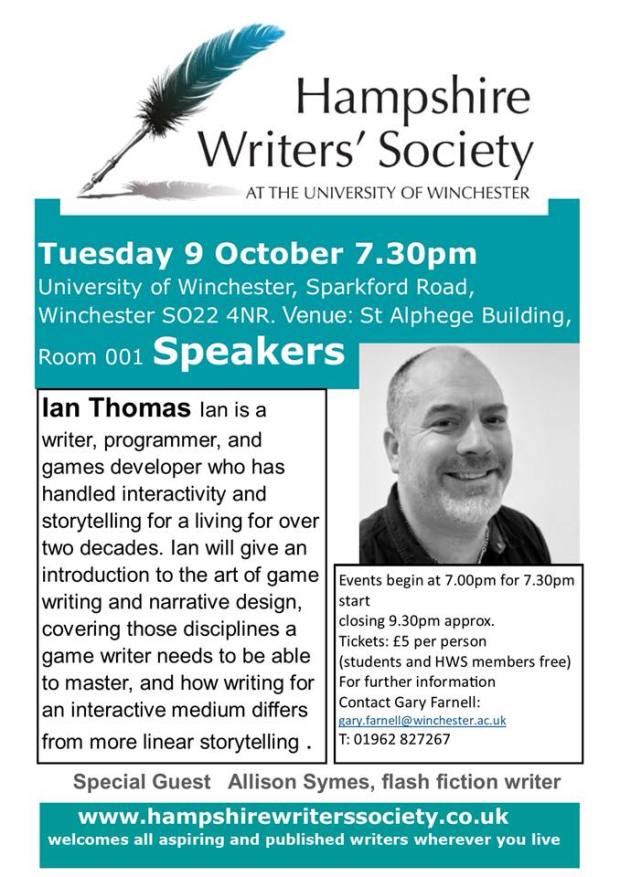
Looking forward to being at the Hampshire Writers’ Society tomorrow night to talk about flash fiction.

Also looking forward to the Bridge House celebration in London in December and the Association of Christian Writers’ Day in London later this month.

What with writing and taking the dog out, it’s a social whirl! (I get to talk to lots of lovely writers and equally lovely dog owners. Some of course encompass both roles!).

POSTER SHOWING ALLISON AS GUEST SPEAKER AT HWS OCTOBER 2018

Many thanks to Maggie Farran for the poster.

LIKES POST - editing - Pixabay image

The joy of editing! Image by Pixabay

cropped-cropped-version-of-my-reading-at-railway-station

The Open Mic for Prose night

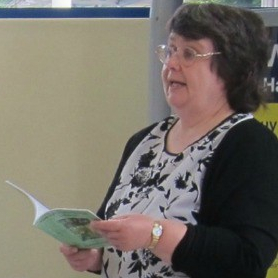
Many thanks to Geoff Parkes for kind permission to use this shot of me reading at the Swanwick Prose Open Mic Night.

FLTDBA in the Swanwick Book Room

FLTDBA for sale in the Swanwick Book Room. Image by Allison Symes

FromLightToDark_back_medium

Back cover of FLTDBA. Image by Allison Symes

BEING THANKFUL - On writing or being appreciative - image via Pixabay

Always good advice. Image via Pixabay.

Am writing this early as I don’t expect to have a lot of creative energy left after the Hampshire Writers’ Society meeting tonight! (But in a very good way of course…😀)

Later in the week, I will be sharing on Chandler’s Ford Today Part 1 of a three part series on the joys and challenges of writing series novels. Many thanks to #JenniferCWilson, #ValPenny, #AnneWan, #WendyHJones, and #RichardHardie for taking part in this. Link to go up on Friday but what I can reveal now is their thoughts about this topic are riveting. Very much looking forward to sharing this over the next three Fridays.

The lovely thing is there is a wide range of fiction represented here from children’s and YA to crime to historical fiction with a twist. Much to learn from here.

I think one of the best things about writing is you never do stop learning how to develop and improve what you write. Nor should you want to stop seeking to improve and develop! As well as making you a better writer, this kind of thing is so good for your own well being anyway.

Facebook – From Light to Dark and Back Again

Just because a story is short, it doesn’t mean it lacks insight. Far from it. I love well written flash stories for the intensity of the impact they make and the characterisation in them has to be good.

You are relying, rightly, on the character to “carry the story” so they’ve got to be strong enough to do so. Strong enough in the sense that there is enough about them to interest the reader. Strong enough to make the reader care about them and so on.

The great advantage flash has, of course, is that there is NO padding whatsoever. It really does cut to the chase.

Every story should reveal something about a character and their development (or what the lack of that does to/for them).

Flash fiction does that too but in a greatly compressed word count. This is why flash fiction can have such a big impact on readers. If your story is a grim one say, there is no room to “soften the blows”. What the reader sees is what they get and so on…. very much direct and to the sharp point.

Equally flash fiction can be great for a much needed laugh as ending a story on a punchline can work well. (Has to be a great punchline though!).

One of the most difficult things about flash fiction is working out where to stop. It is very easy to come up with, say, a 250-word story, which you think needs a little addition or two and then you have a 500-word tale. Well, that’s okay, isn’t it? It’s still flash fiction after all.

Well, yes and no.

Yes, the longer version would still be flash fiction.

No, in that the ideal length of your flash story should be when you have said all that is needed to be said and not a word more.

I gauge what the correct word count is for a story by looking at the impact the story has. If at 250 words it doesn’t have enough impact, then yes I will add to it but only until I’ve got the required emotional resonance from the character(s). I will then edit the piece until I still have that resonance without loss of quality of the story.

My worry about expanding a piece is you could easily dilute the impact, which is something you don’t want. Every word in flash fiction has to justify its place in the story, otherwise out it goes. You do learn to be ruthless about cutting when writing flash but that’s no bad thing.

One useful thing about flash fiction is I’ve often found the best way to explain it is to read a couple of examples. The ultimate in showing not telling perhaps! Also, it doesn’t take too long and you get the idea very quickly. It shows there is a proper beginning, middle and end to the story.

What flash fiction must never be is cut-off prose. The story still has to be a complete story in and of itself. That doesn’t stop you taking the basic idea and developing it further.

For example you like the character in your flash fiction so you want to write more stories about them. Absolutely fine.

Likewise, you love your flash fiction story but know it could be developed into a 1500 word or so standard competition entry story where you have the room to put in a sub-plot which you wouldn’t with the short, sharp flash version of it. Again, absolutely fine.

What flash fiction should be is fun to write (and that will mean it should be fun to read too).

This slideshow requires JavaScript.

Goodreads Author Programme – Blog –

Classic -v- Contemporary

Which books do you prefer reading? Classic or contemporary? I love both, naturally. A bookworm isn’t going to worry about when a book came out. They just want the book to be good…

A lot of my contemporary reading is either flash fiction collections or crime novels. (I know: it IS a nice mix! Some of the flash fiction collections, including my own, include crime stories in them).

My classic reading includes Austen, Wodehouse, Dickens, Christie and so on. I like to think of these almost as comfort reading. I know the stories. I know I will love them. It’s what I turn to when life gets particularly stressful. I want a known quantity at that point.

Terry Pratchett deserves a category of his own in that I read or listen to his works when I am in good need of a laugh. He never disappoints!

The flash fiction collections in turn amuse me, scare me, make me think and so on. I’ve got to be ready for the challenge of at least some of the stories in these. And that’s fine. Good stories should make you think (even if they make you laugh or scream as well).

I tend to flit between catching up with lots of book reading, then switching to magazine reading. The important thing? I am reading – and loving it all!


Crime Fiction and Writing Triggers

Facebook – and Chandler’s Ford Today

My latest Chandler’s Ford Today post is Part 1 of a great interview with crime writer, Val Penny. Her new book, Hunter’s Chase, is now out in paperback and ebook and is the first of her Edinburgh Crime Series. We discuss what drove Val to crime (!) and why she thinks crime fiction is so popular. She also shares some top tips for writers. Part 2 next week.

Facebook – From Light to Dark and Back Again

I have a very soft spot for stories told from alternative viewpoints, especially fairy tales. My first published story was A Helping Hand in Bridge House Publishing’s Alternative Renditions anthology (many moons ago now) and tells the Cinderella tale from the viewpoint of the youngest stepsister.

In From Light to Dark and Back Again, I take Goldilocks’ viewpoint as my angle in the tale, Health and Safety, (though between you and me, I still think she comes across as the kind of character you wouldn’t want to take into a posh giftware shop given the chaos she caused with one chair and one bed in the Three Bears’ house!).

One great thing about using alternative viewpoints like this is you can explore why that character has behaved the way they have. You can explore their justifications for their actions. The great thing is they don’t have to be right! (It can be even more fun when they’re not but they really think they are. You really get to know what they are made of exploring this kind of avenue).

Fairytales with Bite – Writing Triggers

I mention this topic as part of my interview with crime writer, Val Penny, on Chandler’s Ford Today this week looked at what triggered her wish to write.  It is one of those questions I often ask writers I interview and the results are always fascinating.

Also, it is interesting to note that, while there can be similarities, I believe most writers have triggers to begin writing that are unique to them.  Mine were turning 30 and having given birth to my son, two major life changes that made me face up to the fact if I wanted to be a writer, I had better get on and write then!

I also love writing triggers in the form of opening lines, photos, closing lines etc that encourage you to write something around them.  They can make you really work your imagination.  The theme for competitions can also act as good triggers (and can be useful for writing practice even if you don’t enter the contest.  If you do and win it or are shortlisted, even better though!).

I find the ideal opening line writing trigger is one that can give you all kinds of possibilities to work with.  For example, I would find the line “He refused to cry again” a lot more interesting to work with than “The starship crashed into a crater”.  I could write stories on both and have fun doing so but the first one you could set in any time, any world come to that.  The second is an immediate sci-fi or fantasy story, which is fine, but you are getting your genre and setting in one go here.  (That can be useful when I want triggers for my flash fiction though and that is when I will want a line that does a lot of work for me!).

Let creativity spill out - image via Pixabay

Let the creative process flow! Image via Pixabay

The fantastic world of books must include non-fiction too - image via Pixabay

The wonderful world of writing should include non-fiction, which benefits from creative techniques too. Image via Pixabay.

Feature Image - Facts and Fiction - image via Pixabay

What writing triggers will help you create your new worlds? Image via Pixabay

The old fashioned notebook and pen still have major roles to play in interviewing - image via Pixabay

Can’t beat the notebook and pen for quick notes. Image via Pixabay,

20171015_233807.jpg

Some of the books I’ve appeared in and FLTDBA of course. Image by Allison Symes

This World and Others – Popular Fiction – Do You Just Write What You Know Will Sell?

The short answer is “no”!  This topic came about thanks to this week’s Chandler’s Ford Today post.  This is Part 1 of my interview with crime writer, Val Penny, and one thing we discussed was why crime fiction is so popular and what drove her to crime (!).

I think crime and horror are probably the two most popular genres in fiction.  There can be crossover and within each genre there is a wide range of sub-categories.  But does this mean you should just write to these two genres, say, because you know there is a proven market for them?  Absolutely not!

You have got to believe in what you write.  You have got to love what you write (at least most of the time!  I appreciate when you’ve been through the sixth rewrite, you may feel a tad tired about the whole thing!  We all do!).

You have got to love your characters, and love those you love to hate. I also believe that if you don’t write what is your “driving fictional instinct”, what you do come out with will be just a poor imitation of the markets you are trying go get into and that will show.  Whereas if you love what you write, that will also show.  It is where your writing voice will come through loud and clear.  Good luck!

This slideshow requires JavaScript.


My Goodreads blog post this time is an expanded version of my Facebook post for From Light to Dark and Back Again.

Goodreads Author Programme – Blog

I have a very soft spot for stories told from alternative viewpoints, especially fairy tales. My first published story was A Helping Hand in Bridge House Publishing’s Alternative Renditions anthology (many moons ago now) and tells the Cinderella tale from the viewpoint of the youngest stepsister. It was great fun to write and, due it being the first thing I’d written that was accepted for publication (thank you, Bridge House!), it will always have a special place in my heart.

In my flash fiction collection, From Light to Dark and Back Again, I take Goldilocks’ viewpoint as my angle in the tale, Health and Safety, (though between you and me, I still think she comes across as the kind of character you wouldn’t want to take into a posh giftware shop given the chaos she caused with one chair and one bed in the Three Bears’ house!).

One great thing about using alternative viewpoints like this is you can explore why that character has behaved the way they have. You can explore their justifications for their actions.

The great thing is they don’t have to be right! (It can be even more fun when they’re not but they really think they are. You really get to know what they are made of exploring this kind of avenue).

You can also prove the truth of the old saying “there are two sides to every story” by exploring what the other characters think! They just have to be strong enough to carry their own story.


BRIDGE HOUSE/CHAPELTOWN/CAFELIT/RED TELEPHONE EVENT

Had a wonderful time at the Bridge House/Chapeltown/Cafelit/Red Telephone celebration in London on 2nd December.  It was fabulous to meet up with fellow writers again and to share news of what we were up to and to share some of our stories with each other too.

Facebook – General AND From Light to Dark and Back Again

It has been a busy but lovely weekend, especially with the Bridge House event yesterday. One great thing about talking with fellow writers about what you are working on is it DOES encourage you to get on and do it! Am now editing what I hope will be my second flash fiction collection (finally!).

I talk a little about this on my Goodreads blog as well tonight, but I really enjoyed hearing the stories being read out yesterday. There is something special about being read to, especially when many of us only get to do the reading, whether it is to children, or to help us with our own editing. The standard of stories was very high and I enjoyed reading from From Light to Dark and Back Again too.

Already looking forward to next year’s event! (Many thanks to Dawn Kentish Knox for taking the picture of me reading yesterday. All other pictures were taken by me and show some of the many readers/writers at yesterday’s event. Check us out at Cafelit, Bridge House, Chapeltown and Red Telephone Books. You know it makes sense… last minute stocking fillers anyone?).

This slideshow requires JavaScript.

Facebook – General

Had a wonderful time in London at the Bridge House/Cafelit/Chapeltown/Red Telephone celebration event. (It was for the launch of the Best of Cafelit 6 and Bridge House’s Glit-er-ary anthologies. I have a story in Cafelit 6 this year). Fabulous to catch up with friends, especially Gill James, Dawn Kentish Knox and Paula Readman.

Loved the story readings (one image below is of Gill James reading from her Chapeltown collection, January Stones) and I read three of mine from From Light to Dark and Back Again. I will be writing more about this for a later Chandler’s Ford Today post but for those of you at the event who claimed to be “just readers” (and you know who you are!)… ahem! No such thing as “just”. Writers love readers! Indeed without being readers ourselves, we wouldn’t have become writers.

The image below is of Dawn Kentish Knox with The Great War and Extraordinary, Paula Readman with Glit-er-ary and The Best of Cafelit 6, and yours truly with From Light to Dark and Back Again. Thanks, Paula, for sending the fab photo. All other images by yours truly.

Oh, and I got to fulfil a vague ambition by accident on the way into town. I should’ve taken the Edgware tube to get to Chalk Farm, but managed to get the High Barnet one which stops at Camden Town and goes down another route. So I got off at another stop and caught the right tube which was behind the one I was on. I am a huge fan of Radio 4’s I’m Sorry I Haven’t a Clue and I really did have to take a picture of this particular tube station image! Fellow fans of the show will understand why I’m sure. Mornington Crescent! Nice to see the Christmas decorations up at Waterloo too. The chandelier was in the Ladies! They obviously believe in posh loos for pubs in Camden!

20171202_163756

The chandelier in the Ladies at the Princess of Wales pub! Image by Allison Symes

This slideshow requires JavaScript.

Balancing Time and Reading Work Out Loud

Lots happening.  Have included links to Cafelit to two of my new stories now up on their website.  Hope you like them!

Facebook – General and Chandler’s Ford Today

My Chandler’s Ford Today post this week looks back at last weekend’s 10th-anniversary celebrations at the Winchester Discovery Centre. Regional authors took part (including me!) but there were other events happening such as the Winchester Fusion Choir singing from the top floor of the Centre. They were wonderful.

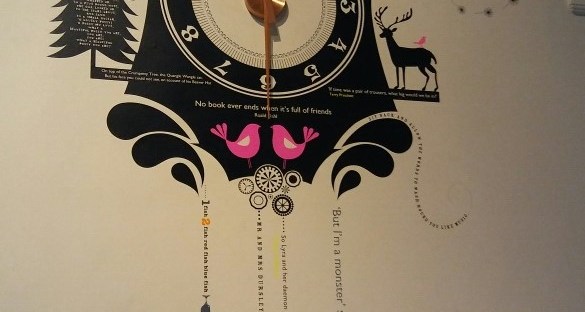
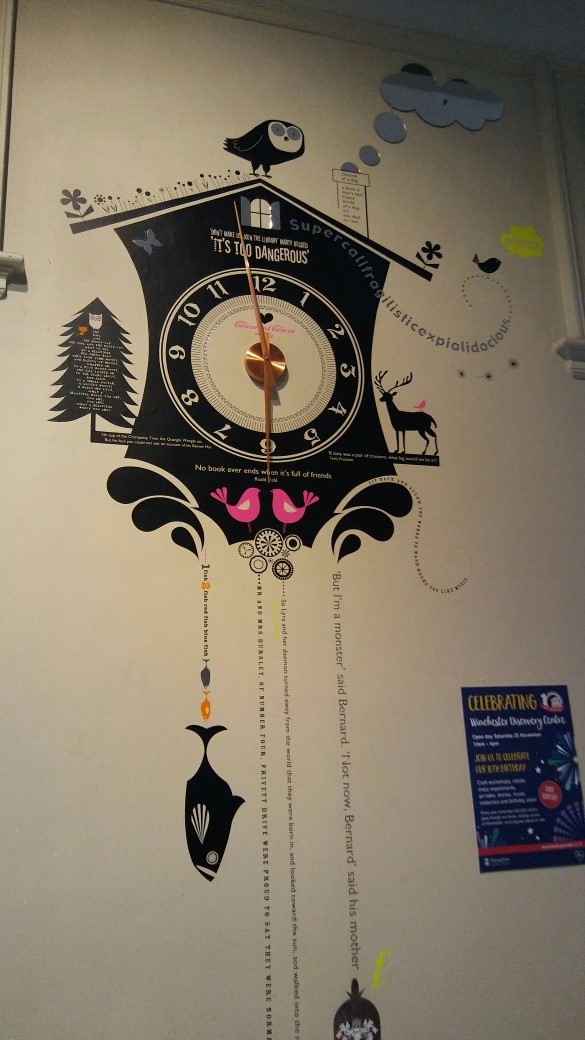
More details in the post but I should add that, despite working in Winchester for years, I had never been in the Centre before. It is a lovely building, I loved the clock decoration in the children’s section with quotes from children’s literature coming from it, and, as well as getting to talk to people and sell some books, I even managed to take in an art exhibition while there!

This slideshow requires JavaScript.

Facebook – General

My Chandler’s Ford Today post this week takes a look back at last weekend’s celebrations at Winchester Discovery Centre, as they commemorated their 10th anniversary. A number of regional authors took part, including yours truly. More tomorrow. Nice to get to go to the Centre. I’ve passed it countless times but had not visited before. Very nice building.

Also had my first swim at the new Fleming Park. Sorry everyone locally WILL call it that, not Places Leisure, Eastleigh. What kind of name is that? (Clue: unimaginative!). Must say though the pool and changing facilities are lovely though I’ll be glad when the car park is sorted out properly. Hopefully, this will happen soon.

Off to London (not to visit the Queen) but to go the Bridge House/Cafelit/Chapeltown Books/Red Telephone celebration.

And talking of Cafelit, another new story from me is now up on their website. (There’ll be another in December).

Yesterday’s story and today’s are two examples of where I’ve played with the flash format a bit by telling my tales in rhyme. This came about as a result of a question put at the flash fiction talk at Swanwick this year as to whether flash fiction counted as prose or poetry, given the person who asked had come across poems that could count as flash. They tell a story after all and briefly after all… Anyway, thought I’d give it a go. See what you think!

Image below is part of my book stand at the Winchester Discovery Centre but given it shows several of the anthologies my stories are in for Cafelit and Bridge House, I thought it would be appropriate to use it here!

Facebook – From Light to Dark and Back Again

Hope everyone coming to the Bridge House/Cafelit/Chapeltown/Red Telephone event in London tomorrow have good journeys and a great time at the said event! Look forward to seeing you there.

I’m hoping to read from From Light to Dark and Back Again and I’ve selected a couple of pieces I hope will “hit the spot”. Glad to say am now on to editing my second book. Do second books always take longer than first ones or is that just me?!

Good to have more work up again on Cafelit too. Hope to do better on that front in the New Year. This year has been a strange one in that I’ve not submitted nearly as much work as in previous ones, but have had the book published, been involved in marketing it (and still am obviously), and taken part in events etc. All good fun. Think I’ve learned a lot from it all. I’ll know for sure if I have if, next year, I manage to balance writing time with marketing time better!

Fairytales with Bite – Reading Out Loud

One thing that came out of the Winchester Discovery Centre celebratory event last weekend was a lovely comment from a lady who really enjoyed my reading some of my flash fiction from From Light to Dark and Back Again to her.  She said how lovely it was to be read to.

It occurred to me after this to wonder how often are we read to?  Regular listeners of audiobooks do have this joy but isn’t there something nice about being read to specifically (and live by an author too)?  So this is another very good reason to support a writing event.  You can hear what the author has written, pick up the tone directly and that will be a good indication for whether you are going to like the style or not.

I find reading work out loud a really useful part of the editing process.  I tend to save doing this until I’m almost ready to submit the work.  If all has gone well with the editing to date, I will be able to read the work smoothly (and almost as if someone else had written it).  If not, I will stumble over the words and it’s back for another rewrite!  But it is best I pick that up rather than a potential publisher!

This World and Others – Balancing Time

To quote the old phrase, “It’s a good trick if you can do it!”.

I don’t know about you but I find it difficult to get the right balance between marketing current work and getting on with the next book.  I’m sure this is something I will get better at with succeeding books to From Light to Dark and Back Again.

I’ve loved taking part in the various events and signings I’ve been involved with this year (including last weekend’s celebrations at the Winchester Discovery Centre), and obviously hope to do more in 2018, but I would’ve liked to have finished the draft of my second book a lot earlier than I have done.  (I’m now editing that second book.  I love editing.  The work is going to get better!).

I am hoping to increase the number of hours writing I do as from early next year, which will help, but the one consolation I think is knowing every writer has this dilemma.  We all find our own ways of getting the balance right so I’ll get there.  Goodness knows when but I will get there!  (Famous last words I know…)

In the meantime, I’m off to another event in London tomorrow – the Bridge House/Cafelit/Chapeltown/Red Telephone celebratory “do”, it will be fantastic to meet up with my fellow authors again and the writing?  I might get some done thanks to the marvels of the smartphone on the train.  I am getting better at using “dead” time.  When I had to take my car in for a service recently, I was almost annoyed they finished quicker than I expected as I really wanted to finish the story I was working on!!  I balanced time there well enough!

The literary clock in the children's section

The children’s clock decoration in Winchester’s Discovery Centre

fireworks

Celebrations at Winchester Discovery Centre today for its tenth anniversary. Okay no fireworks but there WERE balloons and cake! Image via Pixabay

castle-2115425_640

Fantasy may look at other worlds but often reflects on our own. Time is different too. Image via Pixabay.

fantasy-1578656_640

Books can make you lose time but what a way to lose it! Image via Pixabay

Social Media Tree. Image via Pixabay.

Social Media Tree. Image via Pixabay.

Association of Christian Writers – More than Writers blog spot

My monthly blog spot this time looks at the joys in the Christian life and how others’ joys can strengthen you and yours can do the same for them.