When a Story Has “Got You”

Facebook – General

Thinking about picture books with regard to my most recent CFT post, Picture Books and Other Hooks, made me also think about what my reading journey has been.

Every reader of fiction owes a huge debt to children’s writers as the vast majority of readers have grown up loving and reading books, moving from stage to stage and genre to genre as they grow. You get to experiment with the genres you love most (and ideally end up loving loads!).

Writing for children then underpins books overall, I think.

We almost all start with rhymes and fairytales (the latter is somewhat ironic given so many fairytales can be grim!). Picture books play a vital role bridging the gap between “baby” books and the first books we read for ourselves.

So let’s hear it for children’s fiction, especially as it is notoriously difficult to get right.


I’ve listed below books that have either made me change my opinion about something or I’ve had to re-read several times. (Usually the book concerned falls into both categories). They’re not in any particular order of importance.

1. The Daughter of Time by Josephine Tey
2. Pride and Prejudice by Jane Austen
3. The Lord of the Rings by J.R.R. Tolkein
4. The Lion, the Witch, and the Wardrobe by C.S. Lewis
5. Men at Arms by Terry Pratchett.
6. A Christmas Carol by Charles Dickens
7. Murder on the Orient Express by Agatha Christie.
8. Code of the Woosters by P.G. Wodehouse
9. Harry Potter & the Prisoner of Azkaban by J.K. Rowling
10. The Wind in the Willows by Kenneth Grahame

For many of the authors, I could’ve listed more than one of their books. The lovely thing with books is discovering the joys of new ones and, when re-reading, catching up with “old friends”.

This slideshow requires JavaScript.

Book Offer News

Quick heads up! Amazon have currently got From Light to Dark and Back Again on offer at:-

£2.99 – Kindle edition
£4.04 – for the paperback.

Link takes you to the Kindle edition.


Facebook – General

When do you know a story has “got you”? When you are so gripped by the characters, you have to keep reading no matter what, and you get distinctly irritable when anything minor, like life, gets in the way of you reading! Confession time: have been distinctly irritable many a time due to this.

Of course the challenge for writers is to come up with a story that will make readers feel like that! Whoever said writing was easy has never actually done any. The great thing is nobody has to see your first draft, your sixth or what have you, until you are ready to let them see it! Nobody but nobody creates a perfect story first go. I do take a lot of comfort from that thought.

The great thing with writing is you have two interests in one here, the other being reading of course.

To feed your own writing “muscle”, you need to read widely in and out of your genre. I recommend reading widely in non-fiction too. Your creative spark will come from ideas that occur to you as you read other stories and non-fiction.

This author did this in this way. How would I do it? I’d have written this character this way because… etc etc. All sorts of great story ideas can come from asking yourself questions like that and then seeing what you do come up with.

Re non-fiction: I’ve found the creative spark ignites when I discover something interesting I hadn’t known and realise I can use it in a story setting.

It always pays to cast your imaginative net wide!

This slideshow requires JavaScript.

Far Flung Book News!

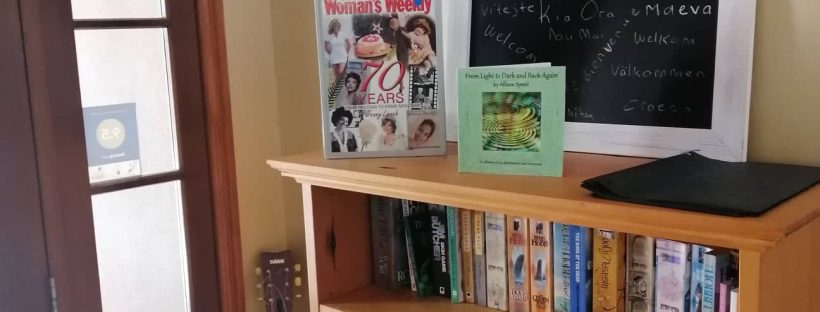
Many thanks to Raewyn Berry for supplying these pictures of From Light to Dark and Back Again in New Zealand!

My book in NZ 1

FLTDBA in NZ. Image kindly supplied by Raewyn Berry

My Book in NZ 2

Always good to see books about and it’s very special if one of them is yours! Many thanks to Raewyn Berry for the picture.

Facebook – From Light to Dark and Back Again

Have drafted a piece from the viewpoint of a groundhog which is this week’s prompt in my writing diary. Good fun to do but needs work but then the great thing with a first draft is only you need ever see it. Also I never envisaged starting a FB post with that opening line!

I often use sayings as titles for my flash fiction and generally that sets the theme and mood too. But a good title is always capable of having a twist put to it, so work out what would suit your character best. They’ll be “carrying” the story so if they are of a quirky nature, the story should reflect that.


This slideshow requires JavaScript.

I do love poetic justice stories and flash fiction is a great vehicle for them. You have to set things up immediately and deliver on the pay-off quickly too! My A Kind of Hell and The Circle of Life are examples of this.

Poetic justice stories work well within a short time frame, which is why they suit flash fiction. I don’t like to spin poetic justice stories out for too long a time span. My worry is a reader could get bored waiting to find out if there is ever going to be a pay-off. No danger of that in 100 words or so!

You haven’t got a lot of room in flash fiction to go into characterisation deeply. So what I do is pick the major trait/flaw/virtue of the character I’ve got in mind for a story and weave the tale around that.

The good thing with this approach is you can imply a lot (and flash fiction is brilliant for implying things!).

For example, if you decide your main character is going to be cowardly, all sorts of things are going to come out of that. How does the cowardice manifest itself? Do they know they’re cowardly? (Often a character will not think they’ve got the faults others think they have!).

Equally, are they prepared to lie to defend their position? Almost certainly yes to that one, I would have thought. Okay then, if they’re prepared to lie, what else would they do? You can already see how things could escalate (as will the tension in the story which is exactly what you want).

So pick a good place to start and away you go!

Time for some one-liners then.

1. Nobody saw the aliens leave with as many minerals as their spaceships would carry.

2. “I’m an endangered species, I’m allowed”, cried the dragon, after flaming the farmer’s field to get barbecued sheep for a mid-morning snack.

3. When even the rats run away, you know you’ve got problems.

4. I usually have no problems with pest extermination but you humans are beyond a joke.

5. It was funny how the beef always vanished whenever Joey the border collie was in the room.

Hope you enjoy.

Allison Symes – 12th February 2019

Goodreads Author Blog – Picture Books and Other Hooks

I don’t believe in wasting a good title! I used this for my Chandler’s Ford Today post recently when I interviewed a local author and her illustrator about a children’s picture book they had brought out. This in turn made me think about my own reading journey and what a debt we all owe to children’s writers.

Most readers have grown up loving books. Someone encouraged that love of story, bought them books, and in time they had the great joy of buying their own stories. I always remember one of my great wishes was to have a library of my own with books I’d chosen to be on the shelves.

Wish fulfilled there I’m glad to say! I’m also glad that there’s a special space on my shelves for books written by friends of mine. And of course my From Light to Dark and Back Again is on display too!

I was trying to think back to what was the first book I could read all by myself. Got stumped there but the Reader’s Digest Collection of Fairytales is a well read and taped up book (the spine needs support!) that would have been amongst the first of my “proper” reads. Has gorgeous pictures too. Never underestimate the power of good pictures to encourage reading and the development of imagination.

Someone “sees” the story and they “get” it. They can go on at a later date to read stories without pictures but there is still something of that hankering for images for most of us I think. Why else do we really love a great book cover?

And I’ve still got a good spot for books with good maps in them – The Lord of the Rings is superb here.

My favourite reads when growing up was Enid Blyton’s Famous Five and Little Women (I always have loved Jo March as a character). I liked Heidi and Black Beauty too. I went on to discover Agatha Christie, Jane Austen, P.G. Wodehouse, and Terry Pratchett. I do believe in a good mix!

So what were your favourite childhood books? What did you “graduate” to?

And let’s hear it for the children’s fiction writers too!


PROGRESS, PLANS AND MOODS

Facebook – General

Does the mood you are in affect what and how you write? My own answer to that is it depends!

If I’m in a flat state of mind but the writing I’m working on has a character in a similar state, then I can use my own mood to help write that piece! (I get something useful out of being in a flat mood! Ironically that knowledge cheers me up so win-win!).

Sometimes I deliberately write opposite to my mood so, again if I feel flat, I try to put myself in the head of a character in a lighter mood and find myself writing light. Again that can be a mood booster for me. Writing can be amazingly therapeutic at times.

What I do know is writing anything is a good “outlet” and later, once in a better frame of mind, I can evaluate any writing done in a flat state and see what I can do with it. But the great thing is I have still written, I still have work to do something with, so my advice would be, if you feel flat and don’t feel like writing, try to write something, even if it is a very short piece. I’ve found many times once I get started, I keep going, and writing takes me to a different, better place. Again, win-win there, I think.

Drafted first flash fiction story that I’ve created using a picture prompt in my new writing diary. 51 challenges remaining then given there’s one such prompt a week! Also enjoying working on my novel again. I want to try to enter more short story competitions (1500 word type) this year too. I like mixing the writing up. Challenges the old brain and that’s never a bad thing.

Third flash fiction volume coming along nicely though I need to group my stories at some point. Am hoping to get along to Winchester Writers’ Festival and, of course, Swanwick Writers’ Summer School later in the year, also the ACW Writers’ Days. I think one of the best things about writing is you never stop learning whether it is how to improve what you do, new places to try to submit work or what have you. That is also a very good thing.

Feed that brain!

Image Credit:  Many thanks to the Hampshire Writers’ Society for the image of me reading an example of what flash fiction is at their meeting last year.

Having completed a picture prompt generated story yesterday, I see this week’s prompt in my diary has no picture whatsoever! Still will tackle that prompt later in the week I hope.

I’m planning to share a few of my favourite writing tips and why they’re useful on Chandler’s Ford Today this week. You pick up lots of useful tips from conferences, chatting to writer friends etc., but as is the way with these things, some advice will always be more useful to you than anything else. It can be a question of working out what is going to help you most. Anyway, will share the link on Friday.

Made good progress on the novel and short story ideas over the weekend so will resume work on those shortly. A writing session for me is most useful when I know I’ve made progress on work, whether that progress is editing something, adding a line or two to something already down, or writing a whole new flash fiction piece/draft CFT post.

It’s when I feel I haven’t got anywhere that is most discouraging and that’s when encouragement from writer friends is enormously helpful. I still wish my fairy godmother would turn up though and grant me “elastic time” which I could stretch as and when I needed to without any side effects/damage to history etc. You know I’d use it to stretch my writing time!

Image Credit:  Many thanks to Dawn Kentish Knox for the picture of me reading at the 2018 Bridge House celebration event.

This slideshow requires JavaScript.

Am looking forward to sharing book offer related news later this week. Will share info and links soon!

Meanwhile, am making progress on a longer term project (non-fiction) I’d been wondering about doing for a while and have finally got around to tackling. I don’t know yet whether I’ll submit this to publishers or self publish but it is good to have both options on the table.

Am also making good progress on my novel too. My writing times are fairly consistent (which helps a LOT) and I’ve learned how to use which sessions for which projects in a way that suits me best.

I suppose the biggest lessons I’ve learned are to make the most of the time you do have AND accept you are in writing for the long haul. Stamina and persistence are key. (Good luck is a useful extra though!). How like life!

Facebook – From Light to Dark and Back Again

Once I’ve finished a few posts tonight, I’m going to use the picture prompt in my writing diary to draft a new flash fiction piece. The diary has one for every week in the year so that’s potentially 52 new stories to be written!

I do use picture prompts sometimes to trigger stories but tend to use phrases, proverbs, and things like that to get me started on stories. I’ve posted before about mixing up sources for ideas so I will be practising what I preach tonight at least!

This slideshow requires JavaScript.

We talk about “moments of illumination” – well, flash fiction could be the written version of those! Such moments are always brief and reveal something not known before. Your flash stories should do that too and be to the point.

From the writer’s viewpoint, this is the fun bit as you get to decide what that moment is in your story. For me, it has to be a turning point, whether you “turn” the character or the direction your story is going in to surprise the reader. It is where twist endings come in because you can save the moment of illumination until then.

I often, when reading stories like this, then go back through the tale to look for any clues I may have missed that hinted at the story ending up the way it has. I usually spot something on that look again read and of course I can learn from that and develop the techinique for my own writing.

When I work out ideas for a story, I focus on the lead character and then plan all sorts of havoc either for them to experience or to be the cause of – all good fun! But I do need to know the lead character’s main trait/attitude first – I use this as a “driver” for working out who they are, what they know they are capable of, and so on.

For me, character is everything. The right characters for the right stories make them spark and come to life for the reader. A good character in a weak plot – both end up being disappointing. You get the feeling the character has been “wasted”.

I’ve found it pays to take my time in outlining a character (and this is a feature of Scrivener I adore. On their fiction setting, you have a template you can fill in to help you plot out a character and I’ve used this several times. Scrivener also have one for working out what the setting of the story is and I have used this but the character development one is really useful. I don’t tend to use it for flash fiction but for longer stories where I’ve got 2 or more characters to flesh out).

Once I’ve got my character, I’m generally well away into writing the story. While editing is always necessary, outlining at the start does stop you going off at an irrelevant tangent and has saved me considerable time.

Will have book offer related news later this week so stay tuned! Links and info up when I have them.

What are the difficulties of writing flash fiction?

1. It is so easy to overwrite and be well over the word count limit. Okay a very good edit will take care of that but the story still has to flow, make sense, and impact on readers, once that editing is done. There’s the real challenge, I think.

2. Knowing where and when to stop! (Having said that, if the idea is a strong one and you can continue it so you end up with a standard length short story, do so. You just enter that piece for standard length short story competitions and markets instead!).

3. Getting people to take the form seriously, though this situation is improving!

Goodreads Author Blog – Story Idea Spotting

Do you ever indulge in story idea spotting when reading a favourite novel? I do!

I love looking for what I think are the influences for a writer. To me this adds extra enjoyment to the story and gives me the perfect excuse for re-reading a book. Not that I really need one but never mind.

It’s my experience you never find all the influences/links in one read through! Sometimes not in two reads either!

Sometimes I know what the writer’s influences are in advance because I’ve read interviews etc and can then have fun seeing how these play out in what they have produced. Other times I don’t know and I get to play detective here.

What I like best is when spotting an influence in a book and it is clear the writer is a fan of another writer I also love. Double whammy!

Reading is fun anyway of course but for me this is extra and I love that.

This slideshow requires JavaScript.