What Writing Means To Me

Image Credit:  Unless otherwise stated, the images come from Pixabay.

Facebook – General

What does writing mean to you? For me it’s:-

1. Escapism. (Always welcome that!).

2. Writing stretches and challenges me. I came up with blog posts or stories yesterday, can I do the same today? (The discipline of daily writing is very good for developing your imagination and stamina and is also brilliant for keeping the brain active).

3. Writing has given me a creative art form I can take part in and love. I’m useless at art (my kid sister was much better there – and still is) but I can use words. I believe most of us have a creative streak somewhere and it’s a question of finding the one that suits us best. Being creative does something positive for my soul/mental well being/self-esteem etc and that is a good thing for my sake obviously but also for those around me.

4. Writing has led me to doing things I would never have dreamt of doing (such as reading publicly from my own work).

5. Writing has given me wonderful friends who understand the joys and frustrations of writing and that wonderful buzz when your books arrive with your stories in them!

This slideshow requires JavaScript.

So what does the coming writing week hold in store for you?

I’m currently preparing a review of the play My Husband’s Nuts performed by The Chameleon Theatre Group for Chandler’s Ford Today. Yes, it really is called that. Reviews can sometimes be tricky. How much do you reveal about the plot? My approach is to give enough of the “flavour” of the play without giving away spoilers. And yes, this one is a farce. Well with a title like that, it kind of had to be really.

I’ve just submitted work to a competition and I plan to work on my big projects throughout the week. Am making good progress on one in particular. I also want to get another flash fiction collection together at some point.

Delighted that the Best of Cafelit 8 with its lovely green cover goes beautifully with the cover of my From Light to Dark and Back Again. They’ll look good together on a book stall! The Cafelit series always has the same cover image, just the colour of the cover changes, and the Chapeltown flash fiction collections always have a frame around a differing central image. Branding, folks, branding – it does matter but it doesn’t have to be complicated. Simple ideas here can work wonders.

Publication News

Delighted to share my latest story on Cafelit called Humourless. Hope you enjoy. Definitely not something that could be applied to me, I’m glad to say.

Facebook – General

When something unexpected happens, how do you react? Okay, okay, I know. It depends on whether the unexpected happening is nice or not. (I was nominated for Miss Slinky in my Slimming World group tonight – very nice surprise and it brightened up my Tuesday considerably!).

Okay, next question. How would your characters react? Same response from you? Yes, and rightly so too. But it pays you to know how your characters are likely to react, no matter what turns up in their lives.

Also think about why they would react the way you think they will. If someone reacts badly to a balloon bursting, is that because their link that sound to a bad memory? There should be a reason for their reaction, especially if other characters seems to consider it an over-reaction. You can ask yourself if it IS your character over reacting and then think about why your character might do that. Trying to get sympathy perhaps?

This slideshow requires JavaScript.

Facebook – From Light to Dark and Back Again

I occasionally write a piece of flash fiction where the first letter of each line spells out a word. Let’s give that a go again now and appropriately I think I’ll go for Autumn. (Now this is where I could cheat and go for the American word of Fall here to make my life easier but I won’t!).

AUTUMN

A = Allison finished digging in the garden not a moment too soon as the rain started pelting down.
U = Urgent requirement for a hot cup of a tea and a Hi-fi bar made her put her spade away in record time.
T = Turning away from the garden shed, she ran indoors, put the kettle on, and grabbed her bar from the larder.
U = Unaware her actions had been witnessed.
M = Missy, next door’s dog, got through the gap in the fence and went to where Allison had been digging.
N = Never had a body been uncovered again so quickly; never had Allison shooed a dog off so quickly before as she rushed to cover up her work.

Allison Symes – 26th October 2019

Not based on a true story, honestly!


This slideshow requires JavaScript.

Reasons to engage with other writers positively:-

1. It’s fun – best reason of all.

2. You will learn useful information – I’ve found out about competitions etc thanks to chatting with other writers. Some of it I’ve used, some of it I may use in the future, some I may never get to use at all.

3. When you can share useful information, see it as paying your dues. I know I’m grateful for the good advice from other writers that has helped me so pass it on.

4. Ultimately, we all want to write good material, whether it’s flash fiction, or an epic saga. There are things on our writing journeys that we will share in common. You don’t have to cope with these things on your own!

5. You can be warned about scams. No industry is exempt from these so why should publishing be?

6. Linking with 5, other writers can tell you where to go for good advice and what has helped them.

7. I was told about Cafelit and from there found out about flash fiction and I’ve been very grateful for finding out about those!!😀

This slideshow requires JavaScript.

Pleased to have another story up on Cafelit – Humourless. More to come too.

http://cafelitcreativecafe.blogspot.com/…/10/humourless.html

For Cafelit, you need to assign a drink to your story and I try to match the mood of the tale with an appropriate beverage. I sometimes find that harder to do than write the story and I’ve often searched cafe menus for inspiration!

It is a great way to discreetly flag up the mood of the tale though. This, and finding pictures for my CFT posts, are probably the main ways where I’m “forced” to think laterally sometimes. But it is worth persisting with doing that. Other story ideas have come to me that way.

This slideshow requires JavaScript.

I always feel a certain amount of relief when I’ve got the first draft of a story written. I never worry about making each line or paragraph “perfect” before moving on because I know if I took that approach, I would get very little written. Also, there’s no such thing as “perfect” writing anyway.

I like to get a first draft written, move on to another piece I’m editing or submitting somewhere, then come back to that draft to give myself enough distance from it to be able to judge it as objectively as I can.

There are two reactions made by a writer to something they’ve written.

1. This is genius. Not true, sadly.

2. This is awful. Whatever made me think I could write. Not true either and that’s better news!

It is inevitable as you read through a piece, ideas for better ways of phrasing things occur to you so go with that and don’t worry about it.

This slideshow requires JavaScript.

Association of Christian Writers – More Than Writers – A Season For Everything

Do you find the seasons affect your writing? I can’t say they do with me. One good thing about the evenings drawing in earlier is the lure of a cosy room, my desk, hot drinks on the go, and an evening’s writing is even more appealing than it normally is!

I don’t write much about the seasons. Flash fiction with its word count limits means I have little room for description. If I want to show it’s cold, I’ll get my character to put on their big coat, having established they usually wear shorts or something daft like that.

Sorry to all shorts fans out there but I’ve never liked them. I’d also consign flip-flops to history’s dustbin. If I ever come up with a character I really can’t stand, I could make them wear shorts and flip-flops in freezing weather and make them suffer! I guess that could be fun…

Is there any writer who doesn’t get some enjoyment out of putting their characters through the mill, especially when those characters have it coming? I refuse to believe that is just me.

If I have seasons to writing, it is not in the quantity of what I do but in the tasks themselves. I will have weeks where I’m submitting work all over the place. (I finished drafting this after sending three stories off to Cafelit).

There will be other weeks where I’m editing work I’d deliberately put aside to look at again with fresh eyes prior to submission. It does pay to give yourself that time so you return to your story afresh. It’s the only way I know that works where you do come back and read your work as a reader would.

Without a time break, I’ve found you can be too close to your own work to be objective about it. This is why when there’s a competition deadline, I take off at least a week from the official end date and that will be the date I aim to submit the piece by. If life gets in the way as it does sometimes, I still have a few days in hand to still submit that piece.

I am so grateful for email submissions! I did start writing seriously when everything went in by snail mail (it was just after the last T Rex left this world). Some things have definitely got better. (I don’t miss typewriters, carbon paper or Tippex either. I did use to cut and paste literally).

I’ve found it pays to have periods when I’m creating new work. While I’m working on the second story, the first one is having its “time break” for me to edit effectively later.

There is always something on the go  writing wise and that’s how I like it. I have a very low boredom threshold and the lovely thing with creative writing is that threshold is never tested. There is always something to do.

Happy writing, editing etc etc!

Goodreads Author Blog –

What Do I Want Books To Do For Me?

This slideshow requires JavaScript.


The Writing Life and Publication News

Image Credit:  Unless otherwise stated, the images are from Pixabay.

Facebook – General

I drafted this post on my way to a Writers’ Day (19th October 2019) run by the Association of Christian Writers. (I’m their Membership Secretary). I do love a good train journey and Evernote! I adjusted to using a stylus quicker than I thought I would too.

The event itself will be good fun and it will be nice catching up with friends too. Am enjoying seeing the sun rise over the Hampshire countryside as I draft this. Will be seeing the sun set on my way home. (And I did. It was lovely).

Writing wise, I’ll have a story up on Cafelit tomorrow so look forward to sharing the link for that.

I’m also looking forward to seeing the next production by The Chameleon Theatre Group called My Husband’s Nuts next week. Should be fun. Review to follow in due course.

Am making progress on projects I’m working on but why is progress never as quick as.I’d like it to be?! Oh well says she, pressing onwards!

This slideshow requires JavaScript.

Publication News

Delighted to say The Best of Cafelit 8 is now available in paperback as well as in ebook form. Reviews welcome, as always!

I have two flash stories in here – The Art Critic and Dignity and Injustice. Very different moods for those two as well! Great collection of stories so if you’re not sure what you fancy reading next, try this assortment! You’ll find something to suit…! Lovely eclectic mix of authors, styles, and moods. (Pleased to say Cafelit 8 is now up on my Amazon Author Page too!). Thanks to my recent CFT series on What Books Mean to Me I can share some of the images of the authors in Cafelit 8 but do check the book out and catch up on all the authors included here. There is a great mix of styles but you don’t just have to take my word for it!

Also thrilled to share my latest story on Cafelit called Takeover. The thrill of being published in print, online or both never dims!


Facebook – General

Favourite moment in editing? When you know the changes you’ve made have strengthened your story/book and your only regret is not having spotted the necessary changes when you were drafting the tale in the first place.

The one thought that has always cheered me up here is that nobody writes a perfect first draft. Shakespeare didn’t. Dickens didn’t. I’m not going to – so that’s okay then. What matters is the edit. And it does pay to take your time over it, leave the work for a while, before then re-reading the piece as a reader would.

Least favourite moment in editing? Checking for typos and then spotting one after you’ve gone through the document several times. The one comfort here is that this happens to us all at some point so you’re definitely not alone!


This slideshow requires JavaScript.

S = Spellbinding characters make you have to find out what happens to them so you keep reading.
T = Tall tales, flash fiction stories – there’s something for every word count!
O = Originality. I find it fascinating how writers create unique characters and keep doing so and, of course that is a challenge to me too.
R = Reading – the other side of writing. Two wonderful creative arts in one in many ways. You have to read well to be able to write. Name a better way of working out how a book works, how characters come across on the page etc.
I = Inventiveness. I love inventing new people and situations to put them in. Exercising the imagination regularly like this has to be good for the brain – and your writing muscles.
E = Entertainment – stories cover the whole range. Some are entertained via tragedy, others via humour, crime, historical fiction. There are plenty of wonderful books out there. And don’t forget the anthologies – flash fiction and short stories. Perfect for quick reads.
S = Setting. Via a book, I can visit fantasy worlds, places on this planet I may or may not get to see for myself, places I’ve never heard of – does this give another meaning to losing yourself in a good book? You can lose yourself in an enthralling setting. The world of The Lord of the Rings is a good example (though I admit I’d never visit Mordor out of choice if that option was available).

This slideshow requires JavaScript.

Facebook – From Light to Dark and Back Again

I was listening to the gloriously peaceful music of Sailing By on Classic FM as my train left Basingstoke when I drafted this earlier today (on my way to the ACW Writers’ Day mentioned earlier). Quite a contrast in images there! Flowing water, sunny days, and a big town!

Contrasting images can work well in flash fiction but, due to the word count limits, contrasts are best shown sharply. You are flashing a brief light on the lives of your characters to your readers when all is said and done. So what is the contrast they must pick up on? Focus on that.

For the longer flash stories, there may be room for subtle contrasts to come in but again focus only on what your reader needs to pick up. You still won’t have room for more than that. Flash is all about focus (which is why it is a great discipline for any writer).


This slideshow requires JavaScript.

Places I have drafted flash fiction stories:-

1. At home on laptop (very conventional!).
2. On the train on Evernote.
3. In a notebook using good old pen and paper while waiting for my phone to recharge! (There is much to still be said for pen and paper).
4. On a car journey.
5. Just the once – at the end of a church service, I had a very strong idea for a story which I knew I just had to write down a few notes about so I could write it up properly later. I usually hear my characters speaking, then visualise them. For this story, it was the other way round. Yes, it does have a faith based theme but I just had a very strong compulsion to get this story idea down quickly – so I did, using Evernote.
6. When I’ve got ten minutes before I have to go out anywhere… well it’s useful writing time and I flesh up the stories properly later on.
7. At writing conferences when I’ve been set a writing exercise. Nearly all of mine turn into a first draft af flash fiction.

I have NEVER followed the advice to keep a notebook by the bed to jot down thoughts that occur over night. This, I know, simply wouldn’t work for me. I sleep very heavily as a rule and don’t often dream so this is a no-go. I am never at my best first thing anyway so any notes jotted down would make no sense to me yet alone anyone else!

This slideshow requires JavaScript.

Why do I like using the first person in flash fiction so much?

1. It’s immediate. I can take you right into the thoughts (and attitudes) of my characters.

2. It reads like a first-hand account (which from the character’s viewpoint is, of course, the case!).

3. I can get my character to refer to other characters and give a sense of a life being lead without actually bringing those other characters into the story itself. It saves on word count, obviously, but if I just need to show Character X hates Character Y, I can show you that by revealing X’s thoughts about them. I don’t need to bring in Y at all. It is more direct and, to me, comes across as more natural.

4. I find first person works really well in the sub-500 words stories so it does tend to be my “go to” when I specifically want to write to that limit or under.

5. There isn’t a lot of room for dialogue and character development in flash fiction. Flash is, as I mentioned the other day, all about focus and I’ve found it best to focus on one to two characters at most in a sub-500 words story. In sub-250 words, one character works very well (and therefore the means of showing their story is often best done via the mouth of the character concerned).

This slideshow requires JavaScript.

Goodreads Author Blog – Travel Reading

I tend not to read much while travelling. I’m usually drafting blog posts and stories on my phone for one thing! But I like to take a good mix of good reads for when I get to my destination.

I prefer light reads when away. I am escaping from the usual routine so want to escape through books too. I’m currently enjoying Ben Macintyre’s The Last Word on Kindle which takes a light look at the use of language and is good fun. Highly recommend.

I also loved his Operation Mincemeat. Not a light read so to speak but a cracking and true story told at a great pace.

What do you look for in a good read?

I like to be entertained, escape my cares for a bit, and ideally learn something too.

When reading fiction, I learn something from how the characters are portrayed, how the dialogue is put together etc. I get so much from books and hope you do too.

This slideshow requires JavaScript.


Flash In The Pan, Meeting Targets, and Book Tokens

Image Credit:  Unless otherwise stated, all images are from Pixabay.

Facebook – General

Lovely day (over the weekend) having a family get-together. Weather held for just long enough too. Lots of laughter, happy memories of those we’ve lost, and mutual support. Gatherings like this are so precious.

What do your characters cherish most? What would their get-togethers be like? Is there anyone they absolutely would NOT invite under any circumstances? How did that come about?

Is there a character who would love to have get-togethers but has nobody to invite? Do they make efforts to break through loneliness, shyness etc? Are they successful? (I must admit for a story like that I would always prefer an upbeat ending).

Happy writing!


This slideshow requires JavaScript.

Facebook – General – 

and Association of Christian Writers –

More Than Writers – Flash In The Pan

It was a real labour of love to write about flash fiction for the Association of Christian Writers’ More than Writers blog today. I looked at the benefits of writing it and what it has taught me. I’m afraid I couldn’t resist the pun of Flash in the Pan though!

Having said that, puns can work well as titles in flash fiction. You are looking for the title to do a lot of the work for you in setting mood and what is likely to come, especially for those competitions and markets where the title is part of the word count.

I like to mix up how I come up with titles to keep me on my toes. You can’t use puns all the time, it would be tiresome, but every now and again, they can add spice to a mix of stories.

This slideshow requires JavaScript.

I used to love writing letters to friends when I was much younger. I like email and couldn’t imagine life without it. (It makes submitting work SO much easier and cheaper for one thing!).

But there was something nice about receiving a hand-written letter with your name all over it and you knew it was from Friend X. Guaranteed to brighten my day as I not only had the joy of the letter to read, I always anticipated the joy of replying!

I occasionally still receive a hand-written letter as part of my volunteer role for the Association of Christian Writers and those are a joy too. I suppose it’s the personal touch that really rings home here. Someone has taken time and gone that extra mile for me. (Thank you!).

How can we as writers go the “extra mile” to benefit our readers? My approach here is to try to make my characters as engaging as possible (even if they are the type a reader loves to hate! I like (silently) booing a “good” villain myself so want to make sure there is something a reader can really get behind here!).

I like dialogue to ring true (I rarely use any kind of accent in a story. Nor do I use old English for historical flash fiction. I always aim for clarity – and frankly old English isn’t always that clear. You just want touches to conjure up the old worlds for readers. So I may use the odd old word, I try to get my characters to speak in such a way it makes sense for them to speak that way – they are always true to their class – and above all I will show something of the setting. Those are generally enough details for the reader to pick up the right images. Then I get on with the story!

Whatever you write, thinking about what the reader needs from your characters I believe is very important. I’m looking to entertain others with my stories (I hope) so I need to figure out how to reach out to those I’d like to read them. After all they don’t have to read my work so I see it that I must go the extra mile so they might want to!

This slideshow requires JavaScript.

Pleased to say I reached my target at Slimming World tonight. I don’t know yet if I’ll be aiming to lose more but this particular journey has been a long one. That’s okay. The writing journey is also a long one and that’s not the only similarity between the two kinds of journey.

1. You know the journey will take a long time and that you have to be in it for the long haul to make progress. That’s okay. Go into it with your eyes wide open.

2. There WILL be blips along the way (rejections, that block of cheese which somehow managed to vanish by itself!). What matters is accepting that and learning how to handle them. (Can you learn from the rejections? Can you try your story out somewhere else? Can you learn NOT to have blocks of cheese in except for special occasions and relish them more because it’s for a special treat?).

3. When success does comes (whether it’s a publication credit or a bigger weight loss than expected comes, sometimes ANY weight loss!), you will cherish it the more because you know the hard work that has gone into either of these. You really will have earned it. That is a good feeling.

4. There will always be someone who will, deliberately or otherwise, try to undermine what you are doing. (You don’t need to lose weight. You don’t want to submit a story THERE. Said unhelpful folk either feel threatened by what you are trying to achieve or really don’t realise what they’re coming out with is undermining you. Best advice? Ignore. Focus on what you are trying to achieve and Go For It. You have nothing to lose here after all. If you achieve what you would like or close to it, that’s fab. If not do you need to revisit your goal? Perhaps go for it in baby steps rather than try to do it in giant strides.). What you really need are people are constructive and can share helpful thoughts and comments. When you find such people, cherish them and naturally always try to be that way yourself.

Good luck with the writing. If any of you are also on a losing weight journey, good luck with that too. Neither are easy but both can be rewarding! (Naturally any food or drink in the Pixabay pictures are completely calorie and syn free!).

This slideshow requires JavaScript.

Facebook – From Light to Dark and Back Again

What things stop you writing? For me the biggest one is fatigue. So if I know I’ve got a particularly busy week coming up, I will draft a few posts and then upload them later. It takes any pressure off me, I still feel like I’m writing (which means the world to me), and I get things done.

It’s never lack of ideas or time, funnily enough, which is a relief. Fighting fatigue is best done for me by ensuring I get enough sleep, eat and drink well etc. I pay for it if I don’t do those things. It pays for writers to look after themselves here. It does help the creative spirit, especially since we are all in this for the long haul.

Happy writing and look after yourself!

This slideshow requires JavaScript.

One of the frustrations of flash fiction I used to find was having a fabulous character that I wanted to do much more with, but I’ve said all that is needed to be said in their story!

One way round that? Linked flash fiction stories! The only thing to ensure is, however many other stories you do with this Fabulous Character in it, that each and every story is strong, stands in its own right, and builds that character over the series. It’s great fun when you get it right. Yes, you do need to know how many stories would be appropriate. Better to have only two linked but strong stories than six, out of which four are weak. You never want to come across as stretching an idea or character too thinly.

The nice thing with linked stories is I still get to enjoy the challenge of coming up with new characters for each story as the Fabulous Character won’t meet the same characters in each and every story. They’ve literally moved on to the next adventure and so will come across new people and challenges to overcome (or not as the case may be!).

This slideshow requires JavaScript.

I love writing flash fiction using a closing line and working backwards to the beginning. It means I can come up with a humdinger of a closing line and then work out logically how my character(s) would get to that point. Agatha Christie often worked backwards like this.

But I think I have the most fun when I have a humdinger of an opening line. I like to work out different possibilities and then I go with the one I like best. It is never the first idea I’ve come up with either. This is where I find spider diagrams useful as I work out varying possibilities.

The important point though is to have fun writing. I think that fun does somehow permeate through to a reader. Certainly when I read, I pick up on the liveliness of a character portrayal, for example, and my first thought is inevitably something on the lines of the writer had fun writing that! Naturally I would like readers to think the same about what I come up with!

This slideshow requires JavaScript.

The things I look for in a good flash fiction story (whether written by me or not) include:-

1. Impact. (Did the story have any?! Also was the impact what I think the writer meant me to feel? Was it the impact I wanted it to have on my readers?).

2. Imagery. (What images does the story/characters conjure up in my mind? What images do I think my story will give readers?).

3. For twist in the tale endings, did I see the ending coming or was the author able to keep me guessing? (Both are fine, funnily enough. The former shows the author delivered on what their story promises. The latter keeps me on my toes).

4. Appropriate use of words.A really well written story will make me gasp in admiration at the way the writer has used the language. They won’t go for the “obvious” either. I can learn from that (and do!).

5. I finish the story, having relished reading it. I then re-read it and can find something new in it that I missed on first read through.

This slideshow requires JavaScript.

Goodreads Author Blog – Book Tokens and Gift Vouchers

Do you remember the book token? I was given a few of these when I was growing up in the 1970s and loved them. The thought of going to a bookshop and choosing something was so exciting.

Of course back then there were more bookshops to choose from. I definitely don’t see the reduction in bookshops (and indeed libraries) as something to be proud of, just the opposite in fact.

A £5.00 book token back then would certainly mean I could get two paperbacks (£1.99 each – those WERE the days!).

One of the earliest series I collected was Enid Blyton’s Famous Five as my local TV company (now sadly defunct) was bringing these to life on the small screen. Naturally the books were rushed out again with new covers linking in to the TV series.

These days it tends to be gift vouchers but I love those you can spend almost anywhere, including W.H. Smiths and Waterstones. I needn’t tell you where I spend mine after that, need I?!

The nice thing is I still have that sense of excitement about the prospect of choosing a new book. I don’t think I’ll ever lose that. Neither do I want to!

Do you remember where you spent your book tokens and what were some of your cherished purchases?

This slideshow requires JavaScript.


As One Season Ends…

Facebook – General – and Chandler’s Ford Today

As part of my CFT post this week, As One Season Ends, I look at how getting older has helped me as a writer. I prefer to use the term mature, though I appreciate that may put you in mind of a fine wine or a good cheese! I am proud to say though my “wine/cheese” still has plenty of life in it and I’m well ahead of my Best Before Date.

One thing I love about writing is it is not the privilege of one age bracket only. Debut writers have had successes when young or old and I find that tremendously encouraging. I hope you do too.

Image Credit: As ever, the marvellous Pixabay. Captions on CFT post.

This slideshow requires JavaScript.

What I love about character creation:-

1. You literally get to invent people. People with traits you’d like to have. People with traits you’re glad you DON’T have. It’s huge fun inventing a new person (I suspect Baron Frankenstein may have had similar thoughts but with much more questionable results in his case!).

2. You have great fun inventing dialogue for your characters and I love it when “they” come up with something that surprises me. I then look at this again and think, yes, that suits the traits I’ve given them. It’s proof to me this character is live, working, “their own” person and likely to be distinctive to the reader.

3. You have even more fun dropping said characters right in the mire and finding out how they get out of it (or not as the case may be. In the latter case, does someone else help them out? Why? What do they hope to gain? All sorts of story possibilities there).

This slideshow requires JavaScript.

Well, the weather was cooler today, much to the relief of both Lady and me. (The same can’t be said for the political atmosphere in the UK at the moment and that’s all I’m saying about that).

Writing wise, while I believe there is a lot of truth in there only being so many plots in the world, I also believe there are infinite possibilities with said plots. Why?

It’s all down to the characters. Character creation fascinates me as a tweak here or there can make a huge difference to how your character is going to respond to situations and therefore what conflicts ensure. If they’ve got any kind of spirit they will be the cause of problems AND be the type that resolves them (or those caused by others who are worse than they are!).

A meek and mild character is not generally going to be the hero/heroine (I never did like Miss Price in Austen’s Mansfield Park, far too wishy-washy for me) but they can be an irritant (however unintentionally) to your main character and be the cause of further problems for your lead to sort out. So even this kind of character can be useful.

Have fun with your people, people!

This slideshow requires JavaScript.

Facebook – From Light to Dark and Back Again

When I was putting From Light to Dark and Back Again together, I didn’t have an overall theme in mind. The stories were a nice mixture of humorous and dark tales and that directly inspired the book’s title.

When writing individual flash fiction stories, I focus on who the character is going to be, what their major trait is, and whether the story is going to be a funny or dark one.

If I’m writing for a competition with a set theme, then I work out different ways of how that theme could be taken and then go with the one I like best. It is very rarely the first idea I came up with either.

It is true for me when brainstorming ideas I do have to get the dross out of my system before coming up with something that has real possibilities. The important bit is not to worry about the dross, after all you’ll be discarding that, but get to those deeper ideas and that’s where you will find promising story ideas and characters to work with.

Open theme competitions can sometimes be more difficult precisely because they’re open. I set my own theme for these and then work to that. I have to have some parameters and then away I go. All I can say is that it works for me.

Whatever you’re writing this weekend, have a fab time doing so!

This slideshow requires JavaScript.

My favourite kind of ending for flash fiction stories is the twist one. I like trying to guess at it and feel pleased when I’m right. I’m more pleased when I’m not as the author has kept me guessing and wrongfooted me (and I really don’t mind that at all!).

It’s a tough thing to get right though.This is where I think knowing what your twist ending will be and then working backwards to get to the start point would pay off. I’ve found this to be a technique that works for me and I’m in illustrous company too. Agatha Christie was known to do this and I can see why.

This slideshow requires JavaScript.

I hope you had writing fun with the random word, phrase, and number generators. The great thing with these is if you’re ever stuck for something to write about, use any of these and just go with what comes up. It doesn’t matter if what comes up is ridiculous. Have fun with it!

Just free write, say for a set period of time, and have a look at your work later. Don’t expect it to be perfect. It won’t be. (I doubt if there is any such thing as a perfect piece of writing anyway).

What I hope you will find is in having something to work with, it will free up your imagination for other writing projects you have on the go.

I find it to be a fun thing to do and I often do use the generators for flash fiction in particular. (Oh and another great prompt can be pictures of course. See what you can do with the great images from Pixabay below!).

Association of Christian Writers – More than Writers –

– Appreciating Writing

How often do you take time out to appreciate writing – your own, as well as the work of others? Not often enough, I suspect, but this begs the question should we appreciate writing more? Wouldn’t we be better off just writing? I’d argue appreciating writing will help you improve your own.

Inspiring, Entertaining, Informing – all good things to aim for with our writing. Pixabay

Every now and again, I recall what writing has done for me. I look at what the work of others has done for me too. One novel changed my attitude to a king. (The Daughter of Time by Josephine Tey if you were wondering. The way it is written is good too).

Appreciating our writing, and that of others, should help us, and them, develop as writers. Pixabay

I believe in realising why you must write and its effects on you (in developing a creative streak, if nothing else), you will end up inspired to write better.

It is in writing my stories and blogs I discovered the hard work needed to (a) keep these going, (b) to continue to be entertaining and, hopefully, share useful information, and (c) how hard other writers must work on their material.

I’m also grateful for technology. I don’t miss carbon paper and typewriter erasers.  Pixabay

I appreciate a great turn of phrase so much more now and often wonder how long it took the writer to come up with the final selection of words that made it into print.

In appreciating the writing of others, you can also analyse what it is you love about it. What can you learn here to apply to your work? There will be something.

In going to conferences and Writers’ Days, you appreciate the breadth of the writing world and find encouragement within your own sphere. Writing has taken me to places I’d never dreamed of reaching. (If someone had told me a couple of years ago, I’d happily take part in Open Prose Mic Nights, I’d have told them not to be so silly).

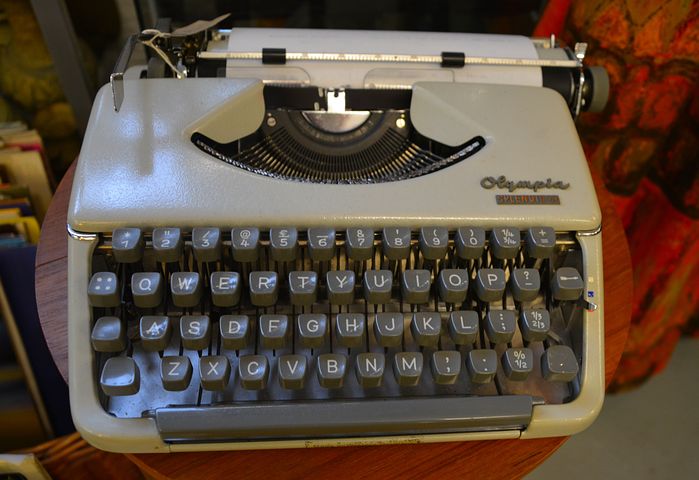
I used a bigger Olympia. It weighed a ton! I really appreciate not having to lug that around any more! Pixabay

Writing should stretch you and that is good. There is no such thing as the perfect piece of writing but what we can do is the best we can at the time and go on to do better as we learn more about our craft and pick up tips from other writers.

It is also lovely when you can share tips with others. Writing is a lonely enough profession so support and encouragement go a long way. Well, they do for me.

Writing is something not to be taken for granted then. I don’t write to give a message. I write to entertain. I hope my stories and blog posts can lift people when they need that. I see it as giving back to the writing world which has given me so much.

This is always a good idea. Pixabay

There is every point for “message” writing. There is every point just to entertain. We cannot know what hard times readers are going through but to give them opportunities to take time out for a while  is worthwhile. So never be ashamed of just writing to entertain. I do sometimes wonder if entertainment is looked down on as a reason to write. I don’t think it should be.

Fairytales with Bite – As One Season Ends

My CFT post, As One Season Ends, looks at the topic from a personal and writing viewpoint, but here I want to look at how your characters handle the changes in the seasons in their lives.

We all have such seasons and our characters should be no different. After all, there have been times in life when we have been students and other times, say, when we’ve been employees. So what seasons in life do your characters go through?

If your setting is in fantasy or sci-fi, do your characters have education as we know it? What do their young people have to go through to be considered mature? How do your characters cope with expected changes in life (their society expects them to do this and then do that etc)? How do they handle the unexpected ones (the sudden loss of someone special etc)?

Does your created world have physical seasons as we understand them here? If so, what function does each season serve? I would expect there to be some sort of growing season (which logically must be followed by some kind of harvest).

How do your characters mature? Are there rituals they must follow and what happens to anyone who defies that?

Plenty of food for thought there I think.

Image Credit:  As ever, the photos are from the fantastic Pixabay. The ones I originally used on this on FWB are up above under my CFT link. Here are some other beautiful seasonal pictures. I always love an opportunity to use photos like these.

This World and Others –

What Every Good Story or Non-Fiction Piece Needs

While every genre has specific requirements, what every good story needs can be summarised as follows. (A lot of this can apply to non-fiction too).

  1. Memorable characters with distinctive voices. For non-fiction, this equates to a memorable narrative style and voice. Think of documentaries you have loved. What made them stand out? A lot of that will be down to the narrative voice.
  2. A plot that keeps the reader enthralled and has plenty of ups and downs. For non-fiction, it is a case of setting out what you want to share with the reader in an entertaining and informative way. No dull list of facts etc. You want to engage with your reader and draw them into the world you’re trying to show them.
  3. To meet the needs of the reader whether it is to entertain them with a story or show them something they hadn’t known with non-fiction. You really do need to know your audience.
  4. A powerful ending that delivers on a promising start.
  5. No sagging middles!
  6. A good, memorable title which hooks the reader.
  7. To be a good advert for the other writing you do!

Image Credit:  The fantasic Pixabay.

This slideshow requires JavaScript.


PERSPECTIVE AND PUBLICATION NEWS

Facebook – General

Hope it has cooled down where you are. I prefer a temperate climate, as does the dog. I also find it easier to focus.

Does the time of year affect what you write? I can’t say it does for me as I write a mixture of light and darker pieces throughout the year.

If the seasons do affect what you write, how can you play to the strengths of this? I would’ve thought it is probably better to work with it rather than to try to fight it, if only because you’ll feel less frustrated that way.

Analysing how you work is a good idea, whether you’re affected by the seasons or not. For me, the amount of time I have per writing session is more important and I aim to make the most of each slot. My goal is to be able to look back and feel it was a good writing session, regardless of whether I had ten minutes or three hours.

Happy writing!😊


Image Credit:  Generally Pixabay as usual but the Scottish beach and loch pictures were taken by me earlier this year.

Glad to be home from a very busy day in London yesterday. Loved visiting the Sky Gardens. They were great and the views incredible. I’d never seen the Tower of London look like it was a Lego sized kit before! I guess it just goes to show perspective is everything.

Perspective is everything for your characters too and indeed for you as you write the story. Just who is your lead and why have you chosen them? Why does it matter to show their perspective and not another character‘s view of the world instead?

What is fun is to write from the perspective of a character you know you wouldn’t sympathise with in any kind of life yet alone the real one. The challenge here is to write about them convincingly despite your own antipathy to them.

Working out how to get into their head to show their reasons for being the way they are will push you into exploring how they got to be at this point in the first place. That will make for interesting characterisation for one thing. It will almost certainly increase the drama in your story too.

Images below taken by me as at 27th July 2019. It isn’t often I get to take a shot with the caption already on it! Also have fun spotting the landmarks.

Publication News

A busy day on the writing front. Glad to share the links for my ACW More Than Writers’ blog which discusses whether or not it is easier to write during the summer.

Also glad to share the link to Stolen, my latest story on Cafelit. This is the nearest I’ve got to an autobiographical story (and probably the nearest I will get I think. I identify with Sarah in this one).

The nature of this story meant I knew it wasn’t going to be a flash piece but that’s fine. The story has to be what it is. If it’s over 1000 words then so be it.


Am sharing an extract from both More than Writers and Stolen here as a taster. Hope you enjoy.

Summertime and the Writing Is Easy…

Or not maybe… Apologies to George Gershwin for misquoting his classic (though I still prefer Rhapsody in Blue).

Do you find writing in summer easier than during the winter? The jury’s out for me here. I try to keep a consistent writing level up for most of the year because, regardless of season, there are always distractions. But there are times when I write less and I’ve learned to come to terms with that…..

Stolen

by Allison Symes

cranberry juice


I’m not going to the bloody doctors.  I couldn’t tell you how often Sarah goes on about it.  When will she take the hint?  I do know my own mind.  I swear she thinks I’m going loopy.  She says not but why else would she want me to go to the doctors when there’s nothing wrong with me?

It’s perfectly normal for older people to forget things sometimes.  Hell, she’s done so herself.  She forgot my birthday last week.  I was really hurt by that.  I was bloody annoyed when she told me my birthday is next month.  I should know my own birthday.

Oh my cup of tea has gone cold.  Did I forget to drink it?  Did I forget to put the kettle on at all and just poured cold water into my mug?  I did do that last Wednesday but I’d had a stressful time of it arguing with Sarah again and well that kind of thing is bound to make you forget odd things, isn’t it?  I didn’t tell Sarah I did this.  She’d have seen it as proof I do need to go and see Dr. Page.

Sarah keeps telling me I shouldn’t be afraid to go to the doctors.  Dr. Page is sympathetic, is bound to have treated patients with memory loss before and there is more awareness now of “mind” issues.  Sarah says this covers everything from depression to dementia.  Sarah is right on all of this but how it applies to me I couldn’t tell you.  I am perfectly healthy.  Sarah says I’m in denial.  There is something wrong when your own daughter tries to tell you what to do.

And I’m simply not having that.  Sarah ought to be pleased.  If ever there was proof I do know my own mind, this is it, surely……

Facebook – General

The challenge of writing stories like Stolen, when they pack an emotional punch, is keeping your own emotions out of it while you’re writing it. You have to put some distance between yourself and the voice of your lead character(s) so it is THEIR story coming through and not yours as the author. You also want the emotion to be authentic and not spill over into melodrama.

This is why it is crucial to put a story aside for a while before revisiting it to edit it. I’ve found it is the only way to get the necessary distance so I can judge what I’ve still got to do on the story objectively (and there is always something!).

This slideshow requires JavaScript.

Facebook – From Light to Dark and Back Again

What is your favourite form of flash fiction? The 100-worder? The 500-worder? Funny? Darker? I love them all of course but if there is one kind that sneaks its way to the top of my list, it is the 100-worder with a humorous twist. So here goes…

Late Running

The ghost train ran straight through the station. It must make up time.

If you thought fines issued to late running train companies on earth were inadequate, you wouldn’t be disappointed here.

Miscreants were treated according to species. Ghosts were obliterated. Vampires were drained down. The rumours tonight were not good.The controllers were more foul than usual. The Boss was due to visit to check all was well…or as bad as this service was meant to be. He wouldn’t be let down by sloppy staff.

Bonemeal was mentioned.

After all, the train was run by a skeleton crew.

Ends.

Allison Symes – 27th July 2019

This slideshow requires JavaScript.

Image may contain: night

If there’s anything odd going on tonight, the cat will not spill the beans.  Pixabay

Image may contain: outdoor

Speeding restrictions apply to all but there are always some who ignore the rules. Pixabay

Must ‘fess up and say I’ve got a few writing prompts to catch up with in my diary but all have the potential to make promising flash fiction stories. Will probably have a go at some of these later in the week. (I tend to get my CFT post sorted first, then resume work on fiction).

Was pleased with my Late Running story I wrote on the train yesterday. Hope you enjoyed it. I am partial to puns and they can be used in flash fiction effectively. You can’t go on at length in flash as you’d defeat the whole object of it so a short pun as a twist ending or as part of a character’s thoughts can work well.

I love writing as well as reading these but, as with most things I guess, puns etc work best when not overdone.

This slideshow requires JavaScript.

My latest story on Cafelit, Stolen, isn’t a flash fiction piece, far from it. The nature of the story meant it had to go well over 1000 words but that’s fine. Not only do I keep my hand in writing a mixture of fiction, it kind of proves the point the story has to be what it has to be.

It never pays to try to cut a story so you can get it to count as flash somewhere.

The stories that work best as flash fiction are those where you want to focus on one intense moment in a character’s life and nothing else. Where there is more than one, you are better off writing a longer story to begin with, otherwise you will sell it short (and reduce your publication chances too).

Time can be an awkward thing to write into flash fiction stories. Most will consist of one vital moment to a character and so the span of time where the action takes place is very short. I’ve found I’ve needed stories towards the upper limit of flash (1000 words) to be able to show action taking place across a longer time span.

For example my Rewards has a time span of one evening and the next morning while my Expecting refers to time as a character realises they haven’t heard from someone for a while.

Flash I think does work best when it is for the moment. Even when I write historical flash, I’m looking at one incident in one character’s life. Time comes into the setting I’ve chosen to use and acts as a backdrop.

This slideshow requires JavaScript.

Goodreads Author Blog –

What a Good Book Can Lead To

Have you known a good book to change you?

For me, The Daughter of Time by Josephine Tey has led to a huge interest in Richard III and conviction he is not guilty of the murder of The Princes in the Tower, assuming they were killed.

There is no evidence they were killed and my own view is at least one was smuggled out of the country. Richard himself was smuggled out as a boy so it would’ve been known it could be done and Henry Tudor was never able to prove where the boys were, else he would’ve done. That really would have damned Richard.

That aside, good books have expanded my view of how irony works thanks to Austen, Wodehouse, and Pratchett. Now there’s a trio for you!

Good books have expanded my ideas of what can be done in fiction, especially in fantasy. There’s a reason The Lord of the Rings is considered an epic. It is! The sheer scale and scope of the trilogy will always amaze me.

Good books open your mind and imagination.

Happy reading!


A Good Writing Week

Facebook – General

Do you read or write (or both) outdoors? I don’t write outside. I much prefer being at a desk for that (and right now it is beautifully cool in the study so added reason to stay in! It also means I can turn up the volume when Beethoven’s 5th comes on and I avoid annoying the neighbours so win-win).

I read outdoors sometimes, there’s nothing to beat relaxing in a nice recliner with a book in hand unless it’s doing that, knowing you’ve got a long cold drink besides you too!

I cope with colder weather better than hot (as does Lady naturally). How do your characters react to their environment and weather conditions? Do they cope with anything that can be thrown at them weather wise or do they curl up at the sight of anything more than a fine drizzle?! If you’re writing fantasy or anything other worldly, what would be standard weather conditions in your setting? How does it impact on your characters?

Hopefully you’ll find some ways to deepen your characterisation answering questions like that.

A good writing week is when I can look back and see:-

1. CFT post written, images sourced, and appears on the Friday. (Only times it hasn’t appeared have been either because I’ve been away or ill and once there was a technical issue, which meant I had to post a day late).

2. Progress made on my projects, especially the novel.

3. I have either submitted work to competitions/markets or am drafting work to be sent in the near future.

4. My WordPress website round-ups have appeared on the Tuesday and Friday. I enjoy preparing these as they look like a mini magazine. I hope you enjoy them too!

It has been a good week! Do I get bored? No! Do I wish I had more writing time? Always.

This slideshow requires JavaScript.

Asking questions is a great way to generate story ideas. The classic one is “What If?” of course, but Kipling’s honest serving men of What and Why and When and How and Where and Who are invaluable for outlining a story of any length.

For example:-

What are the stakes for your lead character?

Why have they got to go for the goal you’ve set?

When do they have to achieve their goal by? (The shorter the time frame the better as it means more pressure for your character).

How will they achieve their objective?

Where does your character live and what bearing does the setting have on their trying to achieve their goal?

Who opposes them and who helps?

You can adjust the above questions to suit your needs, of course, but answering these will give you an outline you can add to or change as you require.


This slideshow requires JavaScript.

Thrilled to announce my humorous fairytale, What Goes Around, will be in the Bridge House anthology, Nativity, later this year. You can rely on me to share the link as and when I can!

Many congratulations to all of the 24 authors in the latest Bridge House book and a particular shout out to #AlysonRhodes, #PaulaRCReadman, #DawnKnox, #LindaFlynn, and #JamesBates.

I can’t wait to read all of your stories. They will be a wonderful ecletic mix!

Image below taken at a previous Bridge House event (and supplied by Paula Readman, who is on the right. Dawn Knox is in the middle).

It has been a busy few weeks with news of stories in The Best of Cafelit 8 and Transforming Being. I like weeks like this!

Paula Readman, Dawn Kentish Knox and Allison Symes and books - with kind permission from Paula Readman

Paula Readman, Dawn Kentish Knox and I celebrate where our stories have appeared! Many thanks to Paula Readman for the picture.!

Facebook – From Light to Dark and Back Again

Am currently listening to the theme from The Incredibles on Classic FM (well I was at the time I wrote this on Facebook!). Loved the film and the music is so appropriate for it. A really good film score always stands out and hooks the watcher into the movie.

Favourite film theme? Hmm… Love The Lord of the Rings soundtrack, no surprises there. Favourite John Williams’ piece is Raiders March (though Schindler’s List is so moving). Very hard to pick out an outright favourite.

For flash fiction writing, it is the title that has to be our big hook in for readers. The title has to be appropriate and to serve the story well, just as film music must serve its movie well. So it is worth taking extra time to get it right but it’s absolutely fine to start off with something and replace it later. I often do that when a better idea occurs as I’m writing the story.


This slideshow requires JavaScript.

Flash fiction, due to its word count restriction, works best with one character, possibly two (and there I would say that would work better with the longer forms of flash). You are looking for your character to have the strongest impact possible on the reader and having too many characters in such a short space dilutes the effect.

It’s another reason why I use first person a lot. I can get into the head of that character and they can reveal other characters for me/the reader. A good example of this is my Calling the Doctor where my character knows she is dying but it is not until the end she reveals who her doctor is. I don’t need to bring the doctor into the story at all. Do have a look at the book trailer as this is the story I chose to use on this and you’ll see why!


Flash fiction may be short, sorry it IS short, but it still takes time to edit and ensure the words you’ve chosen are exactly the right ones to make the maximum impact on a reader.

I usually get a first draft down pretty quickly. What takes the time is re-reading (often several times) and realising this phrase here could be sharpened up if I change one word here. Equally I need to look for those phrases where if I were to cut, something of the flow of the story would be lost. I always judge whether something should stay in on its impact on me (and therefore hopefully readers) and never just on the word count alone.

I see the word count as a guide. If something works better at 200 words rather than 100, then fine, the tale stays at 200! I’ll submit it for a different competition or market. You CAN over-edit. Mixing up what you write in terms of word count is not a bad thing to do anyway and gives you plenty of practice at writing across the range flash fiction offers. Nothing to lose there then!

Good news on the story front as my humorous fairytale What Goes Around is due to be published in the Bridge House Nativity anthology later this year.

It is wonderful when acceptances come in but behind them is a lot of hard work, even more rejections to get stories up to standards where they are in real contention for publication etc.

Even when that is the case, you cannot know whether your Story A or someone else’s Story B will fit the theme of the chosen anthology better.

So if a story is turned down somewhere, look at it again. Is there another market/anthology it could fit? All story writing is useful experience. What you learn as you write a tale (even if it is never published) is what you build on for the next story etc. You do learn, over time, to judge that a story of yours would suit Market X over Market Y. You learn to tailor your submissions too. That increases your chances of acceptance. Note I said increases!

There are no guarantees in writing and I guess that IS guaranteed!


Association of Christian Writers – More than Writers –

Legacies in Writing

Do you ever think about what your writing legacy is and, as importantly, should you?

I was recently at the Winchester Writers’ Festival and at the end of the Saturday courses, there was a lovely celebration held in the University of Winchester’s chapel for the late Barbara Large, MBE, who founded the event.

Not only was that a direct support to writers across all genres, she always found time to speak to writers of all levels, when she must have had a million and one things to do. She is remembered with much love, as you can imagine.

Easier said than done but encouraging others in their writing journey benefits them and you. Pixabay

None of us can ever know where our writing journey is going to take us when we first start. As with any road, there will be cul-de-sacs, the literary equivalent of potholes tripping us up, what we thought was a helpful road sign taking us in the wrong direction with our work and so on. (I’m not aware of any literary traffic wardens though!).

The writing journey is not always straightforward.  Pixabay

So we go into the writing life with our eyes wide open and seek to encourage other writers along the way as we ourselves receive encouragement from them.  We all know the heartaches of rejections after all, but we also know publication is possible. We also know writing for your own pleasure is as valid a thing to do but I also believe we can all leave a positive legacy behind. I think it is part of our calling as writers.

None of this can come all at once but are so worth striving for. Pixabay

The writing legacy we should leave then can be summed up as follows.

1.  Aim to write to the highest standard you can manage.

Improvement is always possible. It is always desirable too. Accept your first draft will not be great. My favourite quote on this comes from Terry Pratchett who saw first drafts as “you telling yourself the story”.

It’s then a question of extracting the gold from the dross – and there will be dross and more than you’d like. Shakespeare and Dickens faced the same. We will not be exempt!

Equally true for your writing but looking for continued improvement IS good to aim for.  Pixabay

2.  Be proud of your work. Ensure you enjoy it.

You are your first audience. Once published, you will want to keep on producing work to be “out there”. You must be able to enjoy what you write over and over again. Do mix up what you write.

I love writing short stories and blog posts as well as flash fiction, but whether you write one type of material or loads, you must enjoy it all.  That enjoyment comes through in what you write. Prose the writer has loved writing has an energy all of its own. I believe readers pick up on that instinctively.

It’s a pity we can’t award ourselves these every so often for our writing but look back and see how far you’ve come. Hopefully you will find encouragement there.  Pixabay.

3.  For you to be able to look back and see how your work has improved.

Working at the craft takes time. There are no shortcuts.

Determination to keep going is important too. Stamina is needed.  Pixabay


This has always struck me as sensible advice but the writing journey will have its ups and downs. The ride is rarely a straightforward and smooth one but it does help to know that!  Pixabay.

Writing challenges and stretches me and is so much fun.  It is also hard work. The two go together. Wherever your writing journey takes you, enjoy the ride!

Goodreads Author Blog – Changing Books

Which books stay with you as firm favourites throughout and which only last for a specific period in your life?

I wouldn’t give you a thank you for the old Peter and Jane books again (!) but would probably still enjoy the Famous Five.

The Lord of the Rings and the Chronicles of Narnia, along with the classic fairytales, will always be favourites.

But the joy of reading is discovering new genres and authors. It has only been comparatively recently I’ve discovered the joys of non-fiction reading. It wasn’t as if I was particularly against it, I just hadn’t tried any.

Now it’s a regular part of my reading routine. (I like the Ben Macintyre books especially. Loved Agent Zigzag in particular). The best non-fiction uses great fictional storytelling techniques and should keep you as gripped as an epic novel.

Which books from your reading past would you change now? Which would you change them for?


Good Books and Steps and Contrasts

Facebook – General – and Chandler’s Ford Today

So what DO you look for in a good book? I share what I think and name three of my favourite tomes in this week’s CFT post.

I do love a self-explanatory blog post title!

The three books I name are Lord of the Rings, Pride and Prejudice, and Men at Arms (by the much missed Terry Pratchett). What elements do these books share? They do have some.

Do share your own three favourite books. Comments are always welcome on the CFT page.

Image Credit:  Images on the slideshow are all via Pixabay (wonderful site!).  Captions up on the CFT post itself.  I can confirm this is the first (and likely to be last) time I put up a picture of ants reading…

This slideshow requires JavaScript.

One of the things I enjoyed doing for my CFT post this week was naming three of my favourite books and looking at what they have in common, despite being in different genres. My problem was limiting my selection to three but it was a nice problem to have! (I’ll put the link up tomorrow. The topic overall discusses what good books should be).

There are certain books I re-read periodically or at certain times of year (Hogfather by Terry Pratchett is always read or listened to in the run up to Christmas for example). I’m glad to say it is a very rare event for me not to be able to finish a book but when that happens it is because the book is awful and I’m at that stage where life is far too short to waste time on books like that. Mind, reading excellent works by other authors is a wonderful challenge to me to ensure I always “up my game” when it comes to writing my stories and that’s no bad thing.


Facebook – General – and More than Writers – Association of Christian Writers

I talk about Steps and Contrasts in my monthly spot on the More than Writers blog (Association of Christian Writers).

I look at how difficult it can be to have faith in the writing process when things are NOT going well and share some tips as to how I’ve got around this.

It is a case of getting around it. I see things not going well, writing wise, as a temporary obstacle. You go through it, bypass it, or what have you but you find ways of NOT letting it get in your way forever, including ignoring it, working on something else for a bit and then coming back to it.

I can’t count how many times I’ve come up with an idea to solve a problem I’ve had on one piece of work while working on something else! Distraction therapy works.

And I suspect most writers will identify with the second image in the picture below!

STEPS - Ideas have to be worked out, I have yet to have light bulb moments like this - Pixabay

I’ve yet to see an idea flash above my head like this! Pixabay

STEPS - Is there a writer who doesn't know how this feels = Pixabay

Most writers will know how this feels… Pixabay

STEPS - It will take time to work out where your writing journey will take you - Pixabay

The writing journey has to be taken a step at a time. Pixabay

STEPS - We all need to recharge at times - Pixabay

Recharge yourself when you need to. Your writing will be better for it. Pixabay

STEPS - Writing is made up of steps - Pixabay

The writing journey – upwards and onwards. Pixabay

STEPS - Writing is not black and white but it can be useful to contrast what your writing is with what you thought it would be - Pixabay

Contrasting can be a useful technique when trying to solve problems with your fiction. Pixabay

Facebook – From Light to Dark and Back Again

One of the things I love most about flash fiction is it is open to genres within it. I’ve written historical fiction tales, crime stories, fairytales, character studies etc all within the flash fiction limit of up to 1000 words.

Character is everything for me both in reading and writing stories. I don’t necessarily need to like the character I’m reading about or writing but there has to be something I can identify with so I can see why they are the way they are. I then want to find out how things work out for them. It’s that initial hook which is so important (and it is a lot of fun working out what that should be too!).

One technique I’ve found useful for writing flash fiction is to work out what I’ve loved in other very short stories and ask myself can I learn from this to help my writing.

The answer to that is inevitably “yes” as reading widely and absorbing, almost unconsciously, how other writers handle dialogue, changes of scene etc, is the best way to learn. The difference with flash fiction is there’s not so much material to get through!

What I’m looking for is the impact the flash tale has had on me and why it impacted that way. You can then look for clues in the story itself as to how the writer achieved that.

Almost inevitably, what I love most when reading other authors’ works is the strength of their characterisation. I’ve long believed getting the characters right is the key to good fiction. A weak character will let down even the strongest of plots.

This slideshow requires JavaScript.

There are days when you have particularly nice writing things to do. Today, I proofread my story, The Professional, which will be in the Waterloo Arts Festival ebook in due course. Love doing things like that.

And other days you are wrestling with a knotty story problem but you will get through it. I’ve found jotting down possible solutions, going to work on something else, and then coming back to look at those possibilities with fresh eyes is a good way forward.

Two advantages here: working on something else frees up your creative juices to mull over your problem. I can’t tell you how often an idea to solve something has occurred while writing something else. The other advantage is you’ve started drafting a new piece of work too!

This slideshow requires JavaScript.

Fairytales with Bite –

What Do You Look For in a Good Book?

What Do You Look For in a Good Book is my theme for this week’s CFT post. Hope you enjoy.

The challenge for any writer, whether they’re writing novels or story collections, is to ensure their book could be classed as “good”.  Allowing for differences in taste I think what writers need to achieve with their writing can be summarised as:-

  1. Believable characters.

  2. Characters we can identify with.

  3. A plot with twists and turns to keep a reader guessing.

  4. The story has to have a “got to find out what happens next” element to it. Without that, the whole thing falls down. This element, for me, works best when the characters are so gripping, I’ve got to find out what happens to them. I don’t need to like them. I just need to want to find out what happens to them. Sometimes it can be to follow a horrible character and experience great glee as they get their comeuppance at the end of the story!

  5. An easy to read style. I’ve got to enjoy the way the prose flows. Easy to read takes time to get right and I learned a long time ago that whenever someone makes writing look easy, that same someone has worked for years to get to that point.

Good luck with your own writing! And whoever said writing is easy has never done any…!

This World and Others Changing Direction

I’ve changed direction at different stages of my writing and anticipate doing so again (and probably a few times at that).

Why is this okay?  Sometimes you discover a new form of writing you just love doing (in my case this was flash fiction). At other times, a certain format is just not working for you no matter how hard you try so you focus your skills where you know you can achieve success.  (Incidentally you can define what success here is too.  It doesn’t necessarily have to be publication. It can be getting to a point where you know you could be published, it could be achieving writing X number of stories in a month etc etc).

Naturally, your characters can change direction too. Sometimes this is literally so (see any quest story for that – a map will come into the story somewhere too!). At other times, it can be a change of opinion (with repercussions. There should always be repercussions, that’s where the drama is).

Whatever the reason for the change of direction, and no matter what form it takes, there should be good reasons for it, reasons your readers will understand and accept. They don’t necessarily have to agree with your characters and neither do you (!), but the reasons for the changes should be well thought out, logical etc etc.

This slideshow requires JavaScript.


Phases, Plays, Prioritising

I do love a good alliterative title!

Facebook – General

I tend to go through phases with my reading when all I will want to read are magazines or short stories, or crime novels, or funny fiction etc. I then come out of that phase and move on to something else entirely.

Writing wise, I like to get a good fix of non-fiction done early on in the week (usually my CFT blog). Later in the week I move on to my fiction and have sessions for my flash fiction and then sessions for working on the novel. By the end of a week I’ve made progress on all the projects I’ve got on the go.

Don’t know if this is ideal. All I do know is it works for me. Planning out your writing time – when it will be, what will you do with each slot etc IS a good idea though, no matter what you write.


This slideshow requires JavaScript.

Enjoyed writing up a couple of the writing prompts in my diary earlier. One was to think of five words you think of when it comes to Easter and then put them in a piece about an Easter egg hunt.

Another was to complete a piece of writing based on “Cross not the dragon and his wrath” which seems to combine Shakespearean language with a nod to St. George.

I like these sorts of exercises. They make me think and push myself harder. Mind you, the quote does seem to be plain common sense to me! I suppose you could get some interesting tales out of beings who DO cross a dragon. I expect that would end up as flash fiction as I can see the outcome being a greatly reduced life span = end of story in every sense!😃


Facebook – General – and

Association of Christian Writers – More Than Writers

My monthly spot on the Association of Christian Writers’ blog, More Than Writers, focuses on prioritising writing work. Easier said than done? Of course but it is worth doing. Planning out how you are going to use your writing slots enables you to get more written funnily enough.

Oh and no my desk isn’t as neat as this one, far from it! I do know where everything is though…

Facebook – General

Looking forward to sharing my review of the recent Chameleon Theatre Groups’ latest production, Spring Trio of Plays, later in the week.

I see going to watch plays like this as another way of taking in stories and they can be a great way of trying genres out you might not necessarily read. There is also a nice link to the oral tradition of storytelling here too given the audience has to focus on the words. Now what storyteller, in whatever format, doesn’t want that?!

This slideshow requires JavaScript.

Facebook – From Light to Dark and Back Again

One thing about writing flash fiction is it does encourage you to keep your titles short and punchy. You want the maximum impact for the least amount of words and if your title can be “open” as to how the story which goes with it can go, so much the better.

My Serving Up A Treat could have been a humorous cooking story. All I’ll say is it isn’t! I took a very different take but the title is still highly appropriate. Take your time working out what the best title is and don’t be afraid to change it if you have to. I have to have a title to work to but will change it if a better one crops up as I’m writing the story, which does happen sometimes. Usually the title I originally came up with is fine and I stick with it.

This slideshow requires JavaScript.

Is there any writer out there who doesn’t wish they had more time for reading? (Yes, I do make sure I read something daily whether it is fiction or non-fiction – and when I can I try to make sure I read both. It can vary from a short piece to chapters of novels etc but I do read something. I switch between paperback and the Kindle too).

One of the great joys of flash fiction is that they make the perfect form to dip into when time is short for reading. I also think that technology (especially smartphones) have helped boost the growth of the form given flash fiction is so easy to read on a screen, no matter how small that screen is.

So read and write on. Pockets of time mount up and you will get stories written/you will finish books you’re reading but keep going and keep going and don’t give up on either!

This slideshow requires JavaScript.

Can you create a sense of mystery in flash fiction given its limited word count?

Yes but it is best done through implication. In my So Close the title should make you wonder WHAT could be so described! The opening line “It has taken centuries to reach this point but you overcome anything to get what you crave” should imply quite a bit on its own.

Firstly, whoever the narrator is must be old (at least by our standards) or you could imply the possibility of time travel here (it would be centuries for us but not for the narrator).

Secondly, you wonder what on earth (or elsewhere) the narrator has overcome. Thirdly you wonder what the narrator is craving. The story does go on to reveal that.

It is a question of putting in the right telling details so a reader then goes on to put two and two together and reads the story to find out if they’re right or not.

I talked about Fads and Fancies in my most recent Goodreads blog where I ‘fessed up to having reading fads. I can sometimes be at the point where all I want to read is crime fiction or humorous prose or what have you, and where all I want to write is flash fiction or longer short stories and so on. There’s nothing wrong with that.

But the great joy of a flash fiction collection is you can write across the board of genres and moods and even vary the word counts of each story in said collection. As long as you don’t go above 1000 words, it still counts as flash!

This slideshow requires JavaScript.

And talking of my Goodreads post…

Goodreads Author Blog – Fads and Fancies

Do you find you have reading “fixes” you just have to indulge in for a while?

I find I read in cycles. There will be periods when all I will want to read are magazine articles. Other times I will want to read short stories. Then again I will have periods when it is nothing but crime I read and so on.

Equally there are times when nothing but “proper” books will do. Other times you can’t prise me away from my Kindle!

Mood of story varies too. There are times I really have to read anything funny. This is particularly true when the news in unremittingly grim. The value of books and stories for escapism should not be under-appreciated or looked down on. Being able to escape for a while I think is good for you.

When I come out from that kind of reading, I tend to go for “nothing but the facts Ma’am” and I catch up with my non-fiction TBR pile.

There is ALWAYS a TBR pile. (I’ve got one on the Kindle too. The advantage with that one is it can’t topple over!).

So what do I fancy reading later tonight then? Hmm… decisions, decisions (but such nice ones to make!).

This slideshow requires JavaScript.


Character Types and Story Essentials

Facebook – General – and Chandler’s Ford Today – and More Than Writers (ACW blog page)

Busy day on the blogging front. Firstly, my CFT post is about Signs of Spring– the ones I love and some I loathe. Comments as ever welcome on the CFT comments box.

Image Credit:  All the images are from Pixabay as usual, do see the CFT and More than Writers’ links for the captions I put to these originally.  Hopefully the pictures will intrigue you.  I love the one showing clocks going off into space!


This slideshow requires JavaScript.

Secondly my spot on the Association of Christian Writers’ More than Writers blog is about When Writing is Difficult. I share some hints and tips. Hope you find them helpful.

This slideshow requires JavaScript.

Had a lovely mini-Swanwick meet up with the fab JuneWebber in Winchester today. Lovely weather, great company, and lots of talk about writing and stories. Now that is what I call a good day. Looking forward to Swanwick itself in August of course.

My CFT post this week will be a seasonal one, all about the signs of spring I love (and a couple that I loathe). Link up tomorrow.

Have almost got my 750-word story ready for submitting. I always find the first edit to reduce word count is the easy one. I take out my known wasted words, find ways of rephrasing things etc and that brings the word count down significantly. The hardest edit is when I’ve done all this and I still need to reduce the word count yet without “losing” the story itself. Almost there though.

This slideshow requires JavaScript.

Righty-ho, on to the final section of my What I Like From a Good Book A to Z.

U = Uniqueness. There must be something about the book that makes it stand out (and most of the time this will be down to how good the characters are. I’m on the characters’ side in the character -v- plot debate because a weak character will drag down a strong plot. I think it is the “cast” people remember from a good book, rather than the plot. How often have you said, when asked if you’ve read a certain book, something like “oh is that the one with so-and-so in it?” I know I have, too many times to count!).

V = Variety (of pace). I want plenty of fast paced action/dialogue etc but I also want the “in between” bits which move the story on, tell me what I need to know, and give me chance to get my breath back before the next action scene.

W = Writing that is a sheer pleasure to read because it flows. Yes, clever lines are wonderful, but it is the overall effect I’m after here. You want to feel at the end of the book that the writing couldn’t have been better (whoever said writing is easy hasn’t done any!).

X = Xeno. Okay, confession time. I looked this one up. It means strange. I wasn’t going to cheat by using eXtraordinary for this one or anything like that and X-rated seems too easy! So then, strange (oh and trust me I’ll be remembering xeno the next time I play Scrabble!) – well I love quirky fiction so this ties in beautifully with that. I love stories of strange creatures and worlds BUT they have got to make sense within that setting and still have something we can identify with to make us want to read on to find out more. So xeno or being strange has its place in a good book but it has got to be integral to it and not an add-on.

Y = Yield. An odd one to choose? I don’t think so. A good book at the end of it should have yielded to you the reader an enjoyable read when all is said and done. For me it is always the characters that make a book work or not. Also it is interesting to follow characters working out when they should yield on a point to develop the story or to get themselves out of a big hole. Whatever the reason for a character yielding or changing their mind, there should be a justified reason for it.

And finally…

Z = Zero. This is in terms of feeling that absolutely no words have been wasted. There is nothing that could be changed without spoiling the story in some way.

Happy reading!

This slideshow requires JavaScript.

Facebook – From Light to Dark and Back Again

I find I have to know the voice of my character before I can really get into the story and do it justice. This is where outlining is so useful.

For flash fiction, I often find a line or two about what the character’s attitude to life is and why is a good place to start. I soon know whether a character is bossy but kindhearted with it, a pain in the neck to all and sundry etc. I see this kind of prep work as essential. It’s just that novel writers have to do more of it!!

Themes for any story are best kept simple to (a) avoid overegging the pudding and (b) avoid you managing to tie yourself up in knots as you write the thing.

The strongest themes can often be condensed to one word only – love, revenge, justice, adventure etc.

The best plot lines are exactly that – a line. For example:-

Mother vows to avenge child killed by drunk driver. (My Punish the Innocent).

Villager vows to stop the animal cruelty going on at home. (My The Circle of Life)

Now the nice thing here is the take you put on these themes is up to you. Punish the Innocent is a serious crime story. Couldn’t really be anything else I feel.

For The Circle of Life, I turned this into a humorous story (my character finds a very neat way of thwarting his fellow villagers who don’t share his views).

The great thing is to have fun with what you write. I’m convinced it does show through in what you produce.

Fantastic day out today as a post-birthday treat with better half and Lady at West Bay in Dorset. Lovely weather. Good time had by all. All shattered.

But time to do something different every now and then is useful both in terms of health but also for your writing. You do come back to it refreshed and that’s important. I see writing as very much a long haul thing and stamina is needed (to cope with the rejections and other disappointments along the way for one thing). So breaks away can help with that enormously.

Another way of giving yourself a break, when going to the beach is not immediately available as an option (!), is to give yourself time to free write, brain storm, jot down notes for future ideas etc. I find this great fun, put said thoughts aside for a while and come back to them later. If the ideas still appeal (and they don’t always), I then write them up!

Goodreads Author Blog – Books to Dip Into

I love books you read straight through from cover to cover but I also adore those where you dip into them as and when.

Things like the Guinness Book of Records come into that category. I’m currently reading a “big book of facts” produced by Classic FM but will almost certainly have regular dips into this, rather than read it straight though. (To be fair it is a HUGE book).

I also like the way this mixes up my reading a bit as I read flash fiction (as well as write it), short stories, and novels. I also dip read. Dip reading is also useful when I’ve finished a book and am not quite sure what I’m going to read next.

I often fancy a change of mood after completing a novel and until I know what is next on my reading “menu”, I will dip into books like this until such time as I do know.

This slideshow requires JavaScript.

Fairytales With Bite – Favourite Character Types

This is by no means a definitive list and I suspect you could add many of your own but my favourite character types include:-

1.  The underdog. (Most of the fairytales have good examples of these.  Cinderella is not expected to do well by her stepmother and stepsisters!).

2.  The character who is not expected to be a hero but becomes one.  (Frodo Baggins is a great example).

3.  The rebel (especially one who can see through the faults of their own side and has tried to rectify them but to no avail.  My fairy godmother character, Eileen, is of this ilk.  Characters like that are great fun to write for).

4.  A well rounded animal character.  I have a soft spot for anthropomorphism. Where would The Wind in the Willows be without it?! I also adore Gaspode in Terry Pratchett’s Discworld.

5.  Those who deal out justice to those worthy of receiving it!  This is usually where some character thinks they’ve got away with something and our hero/heroine turns up to prove them wrong. Or it can be someone like Terry Pratchett’s Lord Vetinari who deals out what he feels is appropriate justice (and is usually right.  Look at how he deals with Moist Von Lipvig in Going Postal).

This slideshow requires JavaScript.

This World and Others –

The A to Z of Story Essentials Part 3

Moving on from last week then…

K = Killer Lines.  The ones that make you gasp, laugh out loud, or simply make you wish you could’ve written something that good!  Use them as inspiration to do exactly that!

L = Logic.  A strange thing to put for this perhaps?  I think not.  A story must make sense, even if it set in the most fantastical place imaginable.  The characters must make sense.  Your story needs a structure that follows through from start to finish.  So the story then must have its own internal logic.  Anything that doesn’t “feel” like a story when claiming to be one will, I think, put readers off.  We have expectations that stories will work and it is because the logic of them works.

M = Murder.  I do love a good crime story and most of those are based on murder.  But this can be applied to other genres here if you take murder to mean “killing your darlings” if they’re in the way of your story. When you read of the death of a character in a story, there should be a point to it and move the story onwards.  A character that doesn’t do anything for the story should not be in it and good writers will ensure their characters do earn their place.  Sometimes that will mean literally killing them off as part of the story.  Sometimes it will mean realising this character isn’t strong enough so back to the drawing board for one that is!

N = Narrative. Should be compelling, drive the story on, tell the reader things they need to know in a way said reader is going to find entertaining (no lecturing!) etc.

O = Overwhelming Odds.  I do love a character that has to face up to these and overcome them.  It is fascinating to find out how they do it. It should also show depth to that character and it’s even better when the character is surprised as they look back at how far they’ve come on, what they’ve been able to achieve etc. Incidentally the overwhelming odds can be something as dramatic as Frodo Baggins’ quest in The Lord of the Rings but it can be something which, to us, might seem mundane, but to your character is everything.  As long as reader knows it really is everything to that character and why, they should want to find out whether the character overcomes or not.

More next time…


Books, Acrostics, and Writing Regrets

Facebook – General

Hope you enjoy If It’s Too Good To Be True, my latest story on Cafelit. Loved writing it. (Oh and spot the typo! Made me laugh – and I hope the story does too…)

IMPACT - What impact does your story have - Pixabay

Do you have any writing regrets?

My main one is not starting to write seriously earlier than I did. Of course, on starting out, you have no idea how long it can take to get to publication standard. Knowing what I do now, I would’ve started at least five years earlier than I did!

My other regret is not discovering the joys of flash fiction sooner but the point is I have discovered them now!

Whatever writing regrets you might have, the important thing is to enjoy what you write. Go for writing opportunities that suit you. (The worst that can happen is your work is turned down. Then you can revise said work and submit it elsewhere).

B = Brilliant covers draw your attention
O = Original storylines
O = Opening lines entice you into the stories.
K = Kindle – so easy to carry – one device to hold them all!
S = Stunning plots keep you enthralled.

A = Action should keep you riveted to the tale.
R = Read, read, read. It’s what they’re there for!
E = Education? Yes, sometimes, but entertainment too.

F = Fiction or non-fiction? A world of choice!
A = Allegories and fantasies take you into other worlds.
B = Borrow from your library and support them too.
U = Underestimate the importance of characters? Never!
L = Live the lives of the characters through the narrative.
O = Oh my moments should keep you hooked.
U = Underneath the surface: how deep are the characters?
S = Story, story, story.

Well, I think that sums up what I love about books.

This slideshow requires JavaScript.

When did you decide you had to write?

I can’t say there was one particular moment for me. It was just something I’d been building up to doing for a long time (and my only regret is not plucking up the courage to start sooner. Yes, courage, as there is the tendency to think “who am I to think that I can write?”).

What I would recommend for anyone starting out is give it a go. You’ve nothing to lose. Try flash fiction. Try articles. Try longer stories. Play with words and have fun. It’s really important to have fun!

Later, on finding yes this form is my niche, then develop with practice and time the skills to be as good as you can get in that niche.

And there’s absolutely nothing wrong in wanting to just write for your own sake. It’s a great way to start and it was years after I started writing before I decided yes, I would see if I could be published. (Oh and success can take many forms whether it is getting a first publication credit or having a book out).

Facebook – From Light to Dark and Back Again

I’ve mentioned before I use well known phrases as a theme for a story. I also use them as titles. My latest example is If It’s Too Good to Be True on Cafelit. (I laughed at the typo. Conjures up some odd images but fun nonetheless!).  NB:  See link further up this page.

The great thing with this title is I will use it as a theme for another story at some point. It has a wide range of possibilities!

Playing with words - Pixabay image

Playing with words. Pixabay image.

Many thanks to #AlyRhodes for her six-word challenge earlier. Good fun. I do like these. Good for focusing the mind. And, of course, you can take that initial idea and expand it out to longer flash fiction or a standard short story.  My entry by the way was Tiny Dragon flees murderous girl.  A nice twist on how things usually go in tales involving dragons and young women!

I am very fond of flash fiction collections (not just mine, honestly!) because of the wide mixture of stories you can have in them. You have those collections which focus on theme, those like mine which have stories of differing moods in them, others which stick to a set word count etc. I am currently reading 365 Stories, which was given to me by a friend, and is a flash collection of stories of exactly 365 words with one for every day of the year. Good range of stories in there too.

I sometimes write acrostics (which I guess can be a kind of flash fiction as long as there is a story unfolding line by line). I’ve just written one for Books are Fabulous (and aren’t they just!) on my author page. So how would an acrostic flash fiction piece work then?

I’d keep it simple, short and sweet to maximise its impact. (I think a one word acrostic would be best. More than that I think would seem gimmicky but you can let your imagination run free with a one word acrostic well enough!). For example, what could be done for the word “stories”? Let’s see.

STORIES

S = Sarah knew today would be different.
T = Today she would deal with Bob for good.
O = Organising a hitman proved easier than she thought.
R = Risking everything on a stranger’s act was not something Sarah anticipated she’d ever do.
I = Involuntary shudders ran through Sarah as she recalled Bob’s abuse and violence.
E = Enough was enough.
S = Sentence of death was pronounced and would be carried out at 12.30 precisely.

Allison Symes – 18th March 2019

This slideshow requires JavaScript.

Am glad to share here a 100 word flash piece that appeared on the Association of Christian Writers’ Facebook page earlier today. The theme was worship.

Discovery
‘Where the hell is that singing from, Sarge? The only thing for miles is rubble.’
‘It’s not from hell, lad. It’s that hymn my gran sang, How Great Thou Art.’
The sergeant cleared bricks, revealing tiles. ‘We’re on an old church. They were destroyed when religion was banned. Remember?’
‘Yes. What a fuss. The fuddy-duddies had nowhere to go on Sundays.’
‘Rumours say some meet in underground churches.’
The men looked down.The singing was coming up.
‘Nothing to report.’
‘Sarge?’
‘Nothing here, lad. If we’re wrong, so what? Let them worship. They’re harmless. Shame our bosses aren’t.’

Ends.

Allison Symes – 19th March 2019


This slideshow requires JavaScript.

Goodreads Author Programme Blog –

The Role of Books/Stories

What is the role of books/stories?

For me, the primary role is to entertain and provide some escapism, especially when life is being particularly grim.

A good book will take you into its world and for a while that gives you a breathing space. Somewhere to just be for a bit before facing reality again. The benefits of that can’t be overstated.

I can understand real life stories and misery memoirs. I hope the writers found the writing of these to be enormously beneficial but this material is not something I can read.

I either want to escape into another world completely (via fairytales, The Lord of the Rings, Narnia, Discworld etc) OR, when I want to get my teeth into non-fiction, I want some good solid history. I love history when it is told as a story (which is why I adore Simon Schama’s History of Britain series).

A good story, and this includes non-fiction told as a tale, should have a point to it but I’d like to bang the drum for stories “just” being entertaining. To me there’s no “just” about it. A story doesn’t have to be “worthy” to be of benefit.

A story does just have to live up to the promise of its opening lines. And that’s challenging enough!


This slideshow requires JavaScript.