

Facebook – General
I’ve been to the Tewkesbury War of the Roses Re-enactment today for the first time. In previous years I’ve either been on holiday or otherwise engaged, so it has been lovely to finally tick this one off my To Do list. It has also been great catching up with family in this part of the world.
Lady stayed at home with my better half as, not only is it hot, I thought all the sights and sounds would over-excite her and I was right! The sights and sounds were incredible.
I sometimes think of the Wars of the Roses as an earlier English Civil War. There are so many stories here – not just of the victors and defeated but those of people who simply had to do what their lord did here. If the lord backed the wrong side, the consequences would be heavy and would go all the way down to whoever followed him. How many families were torn apart this way?
Historical fiction, when well done, can show you something of that and boost your history knowledge. Flash fiction can show you brief moments but a quick light burst can be enough at times.
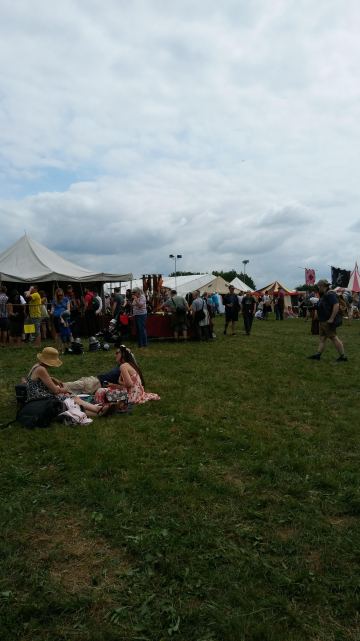
This is only a small section of the Tewkesbury Medieval Festival. Image by Allison Symes

A beautiful place to pray in Tewkesbury Abbey. Image by Allison Symes
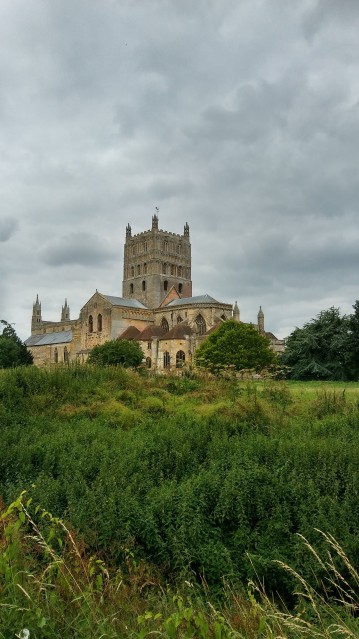
Tewkesbury Abbey. Image by Allison Symes

Incredible basket and weaving work was part of the Festival. Image by Allison Symes
I was amazed at the range of stalls at the Tewkesbury Medieval Fair yesterday. I didn’t get to cover them all either! There really was everything from longbows (including a pink one which I presume is meant for the ladies – hmmm… I’ve never been a pink type of girl anyway. I preferred the dark red ones. Before you ask, no I didn’t get one. Lugging that home on the Great Western Railway would not have been fun!).
What was lovely though was:-
a. Seeing the Richard III Society stand and having a lovely chat with the lady running it.
b. Meeting Alex Marchant of Grant Me the Carving of His Name, an anthology of stories with Richard III at the heart of them. This anthology has a story by #JenWilson in it and the book is raising funds for the Scilosis Society (and apologies if I spelt that wrong!). Alex’s YA book Order of the White Boar was on sale too.
I’m always going to love having a good nose around author stalls at events like this and yesterday was no exception! (It is also lovely to meet face to face people you “meet” on Facebook the rest of the year).
There was also a storytelling tent (aimed at children) but that ties in beautifully with the theme of oral storytelling traditions, which I’ve written about before.
Today has been spent recovering from a lot of walking (it is amazing how much you do walk around for events like this) and anticipating next year’s event!
Does going to events like this inspire story/article ideas? Yes, they can do and have done for me. It’ll be fun to find out what comes from this visit in that department.

Richard III. Pixabay.

Old documents can shed light on so much (lots of stories to be found here). Pixabay
Currently in power cut mode. Thank goodness for a smartphone and mobile data! Apparently someone went through the electric cables so SSE engineers now out working to fix things.
Much as I loved my Tewkesbury visit at the weekend, I am so glad I live now and not in mediaeval times. I appreciate literacy. The likelihood of my having any back then would be extremely remote. My best chance of any would be to be of high birth but I just know I’d be of peasant stock.
How many stories have there been of those rebelling against their “allotted” pace and role in life? How many lives have been changed due to being literate in a way their ancestors would envy?
Pictures are all from the magnificent Tewkesbury Abbey and taken by me.
What are the key ingredients to a story, regardless of its length?
1. Strong characters (strong in that they are memorable to readers. Readers don’t necessarily need to like them though).
2. A crisis (or series of them) that must be resolved (not necessarily well or happily) and usually involving great personal cost to the lead character.
3. A good pace as the crisis develops. Readers need to have the “must find out what happens next” reaction to what you have written.
4. A satisfactory conclusion, but again it doesn’t necessarily have to be a happy one.
Strong characters don’t have to be strong in the conventional sense. A character who is weak, backstabbing, treacherous etc can still be a strong one in that their actions will be crucial to your story and readers will remember them. (And if any fellow fans of Richard III are NOT instantly thinking of Lord Stanley here, I would be most surprised!).


Facebook – From Light to Dark and Back Again
The A to Z of Flash Fiction Writing Tips by Allison Symes
How about an A to Z of flash fiction writing tips? I’ll be holding my breath seeing what I come up with for Q as well but here goes…
A – Alliteration in your titles can make them memorable. (Examples from me are Telling the Time and The Truth, though I haven’t consciously singled out the letter T for alliteration usage, honest!).
B – Backstory. Not a lot of room for this in flash fiction but what you can do is hint at it and leave readers to fill in the rest.
C – Characters. Couldn’t really be anything else. Characters drive the story, regardless of its length. It will be the characters readers remember and either love or love to loathe.
D – Dialogue. Again not a lot of room in flash fiction so keep it to the point. For any story dialogue has to earn its place by moving the story on or revealing information the reader needs to know (and it can be both). This is even more important in flash fiction.
E – Episodes. Yes, you can write linked flash fiction where either one character features in more than one story or they are referred to in another tale. I didn’t do this in From Light to Dark and Back Again but have played with this in my third flash fiction collection (currently in draft form) and it is good fun.
So on to the next section of my A to Z of Flash Fiction Writing Tips.
F – Flexibility – I do see this as one of the great strengths of flash fiction. As it has to be character led for impact in as short a space as possible, you can have fun setting that character wherever and whenever you wish. Talking of which…
G – Genre – Have fun mixing up the genres for your flash stories. I’ve written in fantasy, historical, crime, and horror to name a few. See what you can do here. Mixing things up keeps you on your toes too, which is great for honing your writing to a particular genre’s requirements.
H – Humour – Flash fiction can be a great place for witty one-liners. I’ve sometimes ended stories this way as they can double up as a twist ending. You can also start stories this way andxsee where a promising witty character takes you. Enjoy!
I – Imagination – Being restricted to a specific word count shouldn’t restrict your imagination. It should fire it up! Why? Because you have to use your imaginative powers to select words which carry as much weight and have as much impact as possible. You choose what a reader has to know and what they can work out. Just what are the telling details that matter?
J – Justice – Poetic justice stories work well in flash fiction as the best of these go for maximum impact and that is best “concentrated”. You don’t want that kind of story dragging as it will lose its effectiveness.
More tomorrow but meantime a flash story tying in with my visit to the Battle of Tewkesbury Re-enactment.
Cut Down
I saw the standard bearer fall. I really thought my master had done it. Victory had to be ours…
But no… Master was cut down, betrayed.
My regret? Not taking the chance to cut down Lord Stanley. Without his command to switch sides, my master would still be here and not slung naked over the back of a horse.
Ends
Allison Symes – 13th July 2019
So more on the A to Z of Flash Fiction Writing Tips then and we start with K.
K – Knaves. Unless you write to the top end of flash fiction, there isn’t often the room for an out and out battle between good and evil in your stories. But what can be fun is writing a story from the knave’s viewpoint and working out why they are committing the acts they are (or are about to do) and how they justify doing so to themselves. Yes, you can do that in 100 words! (My Getting It Right is an example of this kind of story).
L – Lively Lines. I love writing dialogue but unless it moves a story on in some way, it has no purpose. In flash especially, dialogue between two characters will take up a lot of your word count. Now you might not worry about that, especially if you’re writing an all-dialogue type tale, but I’ve found instead of using dialogue, showing up a character’s attitudes via internal thoughts saves on the word count. I can still give them good lines too. They’re just not spoken out loud, that’s all, but the reader still picks up what the character is like etc and, I think, more directly too.
M – Monologue. I’ve always thought these work best when they are kept short. And so can they work in flash fiction? Oh yes. I write a lot of flash tales from within the viewpoint of one character only so it is as if they are monologuing to a reader. My Telling the Time is just one example of this.
N – Narrative Voice. Has got to be strong. Has got to make an impact. This is another reason why I like to get into the head of one character and write directly from that viewpoint. I can only use one narrative voice doing this and the impact is strong as a result of that. This is why it is a good idea not to have too many characters in flash fiction. It’s not just about the word count.
O – Originality. Is it possible when it has been said there are only a few basic plots? Yes. It is how you treat your characters and the voice you give them that makes your stories unique to you. Use the flexibility of flash fiction to help you here. You might prefer to write just funny flashes or crime ones or what have you (or mix them up, as I do) but play to your strengths and originality will come from that. You will develop your niche.
Moving on with the next section of my A to Z of Flash Fiction Writing Tips.
P – Pace. Despite the reduced word count, pace is still vital in terms of getting it right for the story. I’ve read and written fast and thoughtful pieces. The important thing is you need to know what pace will be best before you start and hit the ground running with it. Using character thoughts is a great way in here.
Q – Quirky. Flash fiction is a good vehicle for work that defies categories. It has to be character led and you can make your characters as quirky as you like. Have fun here, I do!
R – Reading. Crucial for a writer isthe willingness to read widely in and out of genre. Flash fiction comes in novella form, as well as collections, so explore the form. See what you like to read and it may well be it is what you like to write too.
S – Story. It’s all about the story and that is down to the strength or otherwise of your characters. Look for the impact your story has on you. Is it memorable to you after time away from it?
T – Tension. This will be more intense in flash tales as you have less set up and calm down again time. I think of this as that moment in the spotlight where everything is focussed on one point. Helps with pace a lot! So work out where the tension should be and play up to it. Don’t let your characters off the hook.
U – Universe. Your flash tale is its own universe. Is it somewhere you yourself would want to be? Why? If not, why? Whatever your answer is you need to convey that to your reader.
More tomorrow..


And finally to the last section on my A to Z of Flash Fiction Writing Tips. I start with a tricky letter (to place in Scrabble at times anyway!).
V – Variety. One of the joys of flash fiction is it is so easy to mix up your genres here so do so and have fun with it! It has to be character led so set your character where and when you want. I’ve written historical flash fiction pieces, crime ones, horror stories etc so mix up what you do here. It’ll be fun for you and some of that fun at least will come through in what you write to a reader.
W – Word Count. Had to be really. Don’t forget flash is quite flexible here. It has so many sub-divisions there is bound to be at least one which suits you. Play around with your writing and see where you tend to favour most. I tend to write up to about 500 words mostly, with the occasional longer piece.
X – Xerox! Am I cheating here? Well, maybe. What I mean here is it is good to read what has gone before but don’t copy it directly. Use the flexibility of flash fiction to create marvellous, inventive characters of your own. Read widely to see what characters you love reading about. Can you write a character who would bring out the same reaction in another reader? Look at how and why the character who appeals to you achieves that. You want to “xerox” the technique, not the actual writing or characters.
Y – Yardstick. Think about how you judge what a successful story is. Is it one that has been published? Yes, it can be, but you will have come across published stories that simply don’t work for you. The trick here of course is to make sure none of YOUR stories do that! (Again look at why a story didn’t grip you and look at how you can avoid doing that in your own writing). For me the yardstick is am I proud of the story? Could I make it better? The answers should be yes and no!
Z – Zips. This is what your story should be doing – zipping along with great characters and pace and keeping your readers gripped. Easier said than done? Frankly, yes, but it is worth striving for. A story that zips along and entertains is always going to be of interest to an editor somewhere.
Goodreads Author Blog – Storytelling
I love taking in stories via reading, of course, but also have a very soft spot for the oral storytelling tradition. We owe our oldest tales to that tradition, but there is something wonderful about being told a story.
Whether it brings back happy memories of being read to as a child, or of great jokes told as a story, if you get the chance to go to Open Prose and/or Poetry Nights, do go. As well as supporting those taking part, you are helping to keep this fantastic heritage going.
I always loved the Ronnie Corbett monologues in The Two Ronnies. The ultimate in shaggy dog tales, I think, though I also love the My Word collection by the equally much missed Frank Muir and Denis Norden. I didn’t hear the radio series on which these are based, but if you love puns, do look them up.
Stories on radio and audio books are the modern oral storytelling methods, I guess. What would Chaucer or Shakespeare made of those?!


 Allison Symes: Collected Works